XHLUX
Buyers often order a suspended linear light fitting and only later ask whether the bar should send light downward only—or both upward and downward. That choice changes ceiling appearance, ambient feel and how much useful light reaches desks, not just the shape of the housing.
This guide focuses on when to choose direct-only versus direct-indirect linear lighting: ceiling color and reflectance, suspension geometry, beams and services, glare checks, applications and output ratios. For basic definitions of the two families, see our companion overview of direct vs indirect linear lighting.
We routinely help project teams compare LED linear light layouts against real ceiling photos and photometric files before they lock a distribution—because a brochure ratio rarely tells the whole story on site.
TL;DR
- Direct-only prioritizes downward light for workplanes; it is enough when ambient and ceiling brightness are already acceptable.
- Direct-indirect adds uplight so the ceiling can contribute reflected ambient light—when surfaces and clearance allow it.
- Ceiling color is a clue, not a reflectance measurement; dark or obstructed ceilings can weaken uplight.
- Direct-indirect is not automatically glare-free, and 50/50 is not a universal best ratio.
- Confirm photometry, independent control (if needed) and documents for the exact configuration.
Table of Contents
- When Is Direct-Only Linear Lighting the Better Choice?
- When Should You Choose Direct-Indirect Linear Lighting?
- Does Ceiling Color Affect Indirect Lighting?
- Does Ceiling Height Affect Direct-Indirect Linear Lighting?
- How Do Ceiling Beams and Other Obstructions Affect Uplight?
- How Does Direct-Indirect Lighting Affect the Overall Room Appearance?
- Does Direct-Indirect Lighting Help Reduce Glare?
- Which Commercial Spaces Benefit from Direct-Indirect Linear Lighting?
- How Do You Choose the Uplight-to-Downlight Output Ratio?
- What Should You Check Before Choosing a Direct-Indirect Linear Light?
When Is Direct-Only Linear Lighting the Better Choice?
Choose a direct-only suspended linear light fitting when the project mainly needs reliable downward light on workplanes and does not need the fixture to brighten the ceiling.
What Is Direct-Only Linear Lighting?
Direct-only linear lighting primarily directs light downward. The luminous flux is aimed at desks, counters or floors rather than at the ceiling cavity. A suspended bar can still hang in the room; “direct-only” describes the light path, not whether the housing is recessed or pendant-mounted.
When Does a Space Mainly Need Downward Lighting?
Desks, workstations, display counters and workbenches often need predictable light on the horizontal plane. If the room already has enough ambient light from windows, wall wash or other fixtures—or if the ceiling does not need to look brighter—downward lighting may be the main job. Keep task lighting (illuminating work) separate from general ambient lighting (overall room brightness).
What Are the Benefits of Choosing Direct-Only Linear Lights?
Direct-only keeps the optical story simple: deliver useful light to the workplane without an uplight channel. You do not need to design or commission a separate upward distribution. That can suit projects where workplane illuminance is the priority. It does not automatically mean lower energy use or better comfort in every room—those results depend on layout, output and optics.
🎯 Does direct-only lighting always provide enough light for a room?
Not necessarily. Direct-only lighting can provide sufficient illumination when the fixture layout and output meet the room’s requirements. However, the overall lighting result also depends on the space, mounting height and other lighting sources.
When Should You Choose Direct-Indirect Linear Lighting?
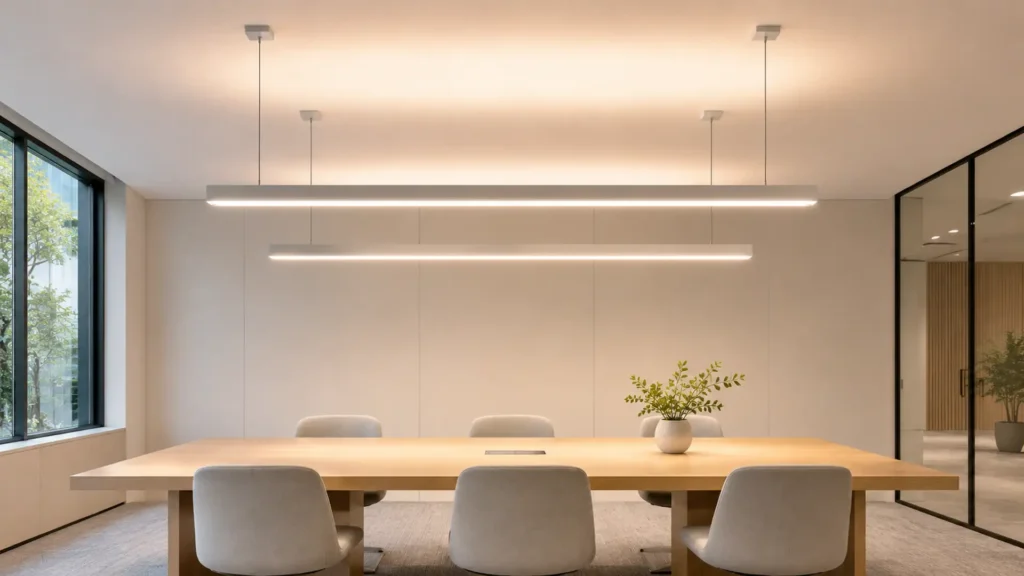
Choose direct-indirect when you need both useful downward light and a meaningful upward contribution to ceiling and ambient brightness.
What Does Direct-Indirect Lighting Add to a Space?
The downlight component illuminates working areas. The uplight component illuminates the ceiling so reflected light can return into the room. Together they influence both task lighting and how bright and even the space looks.
When Does a Room Benefit from Both Uplight and Downlight?
Rooms that need desk-level light and a brighter ambient feel often benefit—especially when a dark ceiling would otherwise sit above a bright bar. Projects that balance workstation lighting with overall appearance are typical candidates, provided the ceiling can reflect light usefully.
Can Direct-Indirect Lighting Replace Separate Ambient Lighting?
Sometimes the combined distribution can cover basic ambient needs as well as task light. In other rooms—large open plans, dark finishes, or spaces with demanding visual tasks—you may still need additional ambient or accent layers. Do not assume one direct-indirect row replaces every other fixture.
🎯 Does every room need both uplight and downlight?
No. The choice depends on the room’s lighting requirements, ceiling conditions and intended visual effect. Direct-only lighting may be sufficient for some projects, while others benefit from combining uplight and downlight.
Does Ceiling Color Affect Indirect Lighting?
Ceiling color is a practical clue, but reflectance, material and finish decide how much uplight returns to the room.
Does a White Ceiling Make Uplight More Effective?
Light-colored ceilings generally reflect more light than dark ones, so white finishes often help uplight contribute to ambient brightness. Color alone is not a full reflectance value—gloss, texture and dirt also matter.
Can Dark Ceilings Reduce the Effect of Indirect Lighting?
Dark surfaces may absorb more of the upward flux, so less light returns as useful ambient. That can weaken the “indirect” benefit. A dark ceiling does not automatically forbid direct-indirect products—you may still want a small uplight for appearance—but expectations for ambient contribution should stay realistic.
How Can You Check the Ceiling’s Reflectance?
Identify materials and finishes with the building or interior team. Ask for reflectance data when it exists. Do not estimate exact reflectance from photographs alone. Use physical samples or lighting simulations when the decision is sensitive.
🎯 Is a white ceiling always better for indirect lighting?
Not always. Light-colored ceilings generally reflect more light, but actual performance depends on surface reflectance, material and finish. Check the ceiling properties rather than relying on color alone.
Does Ceiling Height Affect Direct-Indirect Linear Lighting?
Separate room height, fixture suspension height and the gap between the bar and the ceiling—each changes the uplight path differently.
Does a High Ceiling Change the Need for Uplight?
In tall rooms, light travels farther before it reaches people or surfaces. The distance from the fixture to the ceiling also changes how the uplight spreads. A high ceiling does not automatically mean “more uplight is required.”
How Does Suspension Height Affect Uplight Distribution?
Moving the bar closer to or farther from the ceiling changes uplight coverage and how evenly the ceiling brightens. Measure the actual fixture-to-ceiling distance on the drawing or on site, then check whether the upward wash looks even or shows bright bands and dark gaps. Different models specify different preferred suspension ranges—follow the product’s installation guidance rather than a single rule of thumb.
What Should You Consider in a Low-Ceiling Space?
Check clear headroom under the fixture, the remaining space above the bar, and the risk of bright spots or uneven wash on a nearby ceiling. Always follow the manufacturer’s installation instructions for minimum distances.
🎯 Does a higher ceiling always require more uplight?
No. The appropriate uplight output depends on the ceiling surface, fixture position, room layout and lighting requirements. Ceiling height alone is not enough to determine the required uplight.
How Do Ceiling Beams and Other Obstructions Affect Uplight?
Exposed structure can block or redirect upward light—check beams and services before you commit to a layout.
Can Ceiling Beams Block the Uplight?
Yes. Beams can cast shadows on the ceiling or interrupt the upward beam. The effect depends on beam depth, spacing and where the linear runs sit relative to the structure.
How Do Ducts, Pipes and Other Services Affect Indirect Lighting?
HVAC ducts, pipes, cable trays and other suspended services can interrupt reflected light paths the same way beams do. Dense service zones may reduce how evenly uplight brightens the upper volume.
How Should You Check an Open Ceiling Before Choosing a Linear Light?
Walk the ceiling (or review photos), record major obstructions above the planned runs, and confirm suspension points. Use architectural drawings or lighting simulations when the geometry is complex.
🎯 Can ceiling beams prevent direct-indirect lighting from working properly?
They can affect the uplight distribution by blocking or redirecting light. Check the position of beams and other obstructions before finalizing the fixture layout.
How Does Direct-Indirect Lighting Affect the Overall Room Appearance?
Uplight changes how the ceiling looks; together with downlight it shapes overall room brightness—without turning total fixture lumens into a lux guarantee.
How Does Uplight Change the Appearance of a Ceiling?
Uplight can raise ceiling brightness and soften the contrast between a dark soffit and a bright housing. Distribution across the ceiling plane still depends on optics, suspension distance and surface reflectance.
How Does Combined Lighting Affect the Brightness of a Room?
Downlight drives workplane illumination. Uplight and reflections from surrounding surfaces add ambient brightness. Both components matter for how bright the room feels. Do not equate total fixture lumens with measured illuminance on desks.
🎯 Does adding uplight always improve the overall lighting in a room?
No. Uplight can improve the overall lighting appearance when the ceiling and surrounding surfaces reflect light effectively. However, its contribution depends on room conditions and the balance between direct and indirect illumination.
Does Direct-Indirect Lighting Help Reduce Glare?
Uplight may soften contrast, but direct-indirect fixtures are not automatically glare-free—the downward optic still matters.
Can Uplight Reduce the Contrast Between a Bright Fixture and the Ceiling?
Raising nearby ceiling brightness can reduce harsh contrast around a luminous bar. That may improve comfort in some views. It does not guarantee lower glare in every seat or screen position.
Can Downlight Still Cause Glare in a Direct-Indirect Fixture?
Yes. People can still see a bright downward source, luminous surfaces or insufficient shielding. Combined uplight and downlight does not cancel glare from the downward component.
How Can You Check Glare Before Choosing a Linear Light?
Review the optical design and ask for photometric data, then assess the fixture from normal seated viewing positions and near computer screens—not only from a standing aisle view. Validate with samples or simulations for critical screen or hospitality views. Formal glare methods such as UGR also depend on observer position and viewing direction; see the CIE discomfort-glare framework for interior lighting when a calculated assessment is required.
🎯 Is direct-indirect lighting automatically glare-free?
No. Glare depends on the fixture’s optical design, source visibility, brightness and viewing conditions. The presence of uplight alone does not guarantee glare control.
Which Commercial Spaces Benefit from Direct-Indirect Linear Lighting?
Match the distribution to the task: offices and meeting rooms often value ambient balance; retail decisions depend on display versus ambient needs.
Is Direct-Indirect Lighting Suitable for Offices?
Many offices need desk illuminance and a comfortable ambient field for screen work. Direct-indirect bars can support both when ceiling reflectance and layout cooperate. Final selection still follows the office plan and lighting criteria—not a blanket rule.
How Can Direct-Indirect Lighting Be Used in Meeting Rooms?
Meeting tables need clear downward light; walls and ceilings benefit from enough ambient brightness for faces and screens. Choose based on table layout, room finishes and how the space is used. Hospitality lounges or hotel meeting suites can follow the same logic when product examples fit the brief.
Should Retail Spaces Use Direct or Direct-Indirect Linear Lighting?
When merchandise needs strong downward light, direct-only (or separate accents) may lead. When the floor also needs softer ambient fill, direct-indirect can help. For a simple contrast: a fashion rail or jewelry counter often prioritizes downward or accent light on the product, while a wide sales floor with a dark ceiling may need combined uplight and downlight so the room does not feel cave-like between displays. Accent lighting and general lighting remain different jobs—do not assume every shop should be direct-only.
| Space | Often lean toward | Why |
|---|---|---|
| Open office | Direct-indirect when ceilings reflect well | Desk + ambient balance |
| Meeting room | Direct-indirect or mixed layers | Table light + face/ambient comfort |
| Retail | Direct-only or mixed | Display priority vs ambient fill |
🎯 Is direct-indirect lighting suitable for retail stores?
It can be suitable when a retail space needs both downward illumination and additional ambient lighting. The final choice depends on product display requirements, ceiling conditions and the overall lighting design.
How Do You Choose the Uplight-to-Downlight Output Ratio?
Treat the ratio as a luminous-flux split for a configuration—not a universal recipe and not a desk-lux calculator.
What Does the Uplight-to-Downlight Ratio Mean?
The ratio describes how luminous flux is shared between upward and downward directions for a given product setting. It is about light output distribution, not how electrical watts are split, and not the lux measured on a desk.
How Does the Output Ratio Affect Light on the Workplane?
More downlight flux usually supports stronger direct illumination on the workplane. Uplight mainly feeds ceiling reflections that add ambient light. You cannot read workplane lux directly from the ratio alone—geometry and reflectance intervene.
If two linear lights have the same total lumen output but different uplight-to-downlight ratios, compare how much light each sends downward and how much reaches the workplane. Then check whether the upward component provides useful ceiling illumination under the actual room conditions. Equal total lumens do not mean equal desk lighting.
What Should You Compare When Choosing an Output Ratio?
Compare actual uplight and downlight lumens, ceiling reflectance, workplane requirements and IES/LDT files for each configuration under the real room conditions. A brochure percentage without photometry is incomplete.
🎯 Is a 50/50 uplight-to-downlight ratio always the best choice?
No. A 50/50 ratio is only one possible configuration. The appropriate distribution depends on the workplane lighting requirements, ceiling reflectance, room layout and the fixture’s actual photometric performance.
What Should You Check Before Choosing a Direct-Indirect Linear Light?
Before you approve a suspended linear light fitting with uplight and downlight, turn the earlier decisions into a short purchase checklist—confirm the exact configuration, not the marketing name.
Does the Photometric Distribution Match Your Lighting Needs?
Confirm that the photometric package belongs to the exact luminaire model and configuration you intend to buy. Check the separate uplight and downlight lumen figures, and make sure the IES/LDT file matches the selected optics—not a sibling SKU or a different diffuser. For projects that specify targets, also verify calculated workplane illuminance, uniformity and glare with the planned layout. Do not compare fixtures by total lumens alone.
Can the Uplight and Downlight Be Controlled Separately?
Some products use a fixed split. Others drive uplight and downlight on separate channels (for example under DALI or 0–10V architectures when designed that way). Confirm that the fixture, drivers and control system truly support independent control before you promise it to the client.
What Product Documents Should You Request Before Ordering?
Request product specifications, installation drawings, certifications, driver and dimming details, plus samples and relevant test results. Keep photometric file review with the distribution check above—do not re-explain IES/LDT here.
| Check | Confirm |
|---|---|
| Photometry | Up/down config + IES/LDT |
| Control | Fixed split vs independent channels |
| Documents | Specs, install drawing, driver/dimming |
| Samples | Appearance + on-site look |
🎯 Can all direct-indirect linear lights dim their uplight and downlight separately?
No. Independent dimming depends on the fixture’s driver configuration and control system. Confirm that both light channels are separately supported before ordering.
Conclusion: When should you choose direct or direct-indirect?
Choose direct-only when a suspended linear light fitting mainly needs to light desks or displays and the ceiling does not need an uplight contribution. Choose direct-indirect when ceiling reflectance, clearance and layout let uplight improve ambient appearance as well. Then confirm photometry, control, glare views and documents against the approved model—not against a single “best” ratio.
If you need help comparing linear distributions, suspension layouts or sample programmes, see our custom lighting solutions or contact the XHLUX team.
Explore our related blog posts:
- How Does Suspension Height Affect Suspended Linear LED Performance?
- How to Connect LED Linear Lights in a Continuous Row: Best Guide for 2026
- Why a Linear LED Uplight Can Leave the Ceiling Uneven