XHLUX
XHLUX

The catalogue lists a cable length. The drawing copies it. Then someone shortens the drop on site and still treats the old lux plot as valid.
We often see that happen on a suspended linear led row: power, optic, suspended linear light spacing and the room stay the same, but the hang moves. The fixture did not become a different product. The light on the target plane did.
This page is about that isolated change. Same suspended linear LED fixture, same output, same optic. Only the fixture-to-plane distance moves. What usually changes is illuminance, coverage, overlap, uniformity, viewing geometry and, on direct-indirect bars, the ceiling path.
For the wider suspend, surface or recess map, start with How to Choose Linear LED Lighting: Suspended, Surface, or Recessed?.
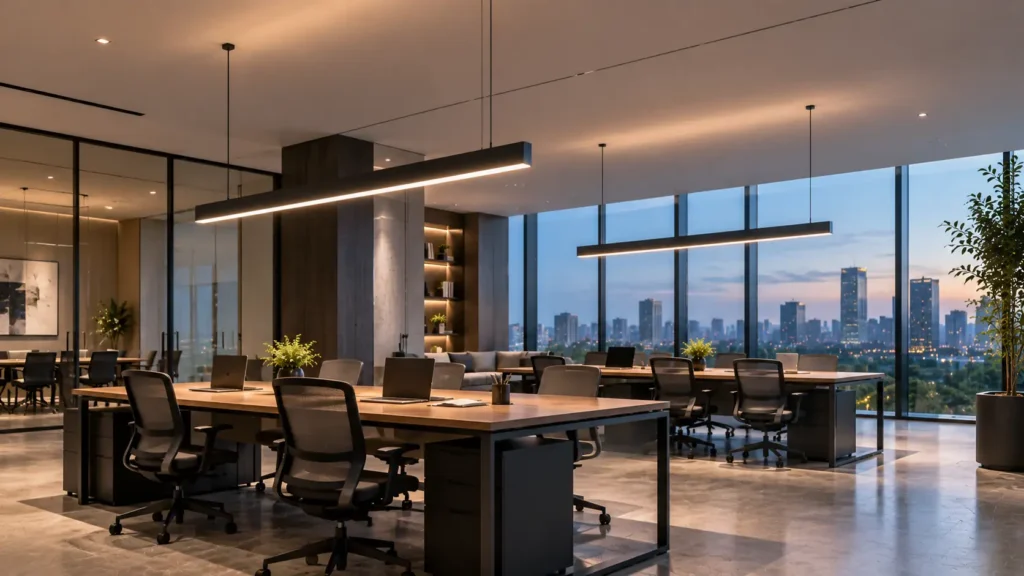
TL;DR: Hang height is part of the photometric setup, not an isolated dimension. Catalogue lm/W does not fall because you hung the bar higher. Workplane illuminance, overlap, uniformity, glare geometry and uplight can all move together. Change the height, then recheck the photometry.
Table of contents
- 📏 1. Why does workplane illuminance change when height changes?
- ↔️ 2. How does the same spacing produce different overlap at different heights?
- 📊 3. Does hanging higher automatically make light more uniform?
- 👁 4. How does height change glare and viewing geometry?
- ⬆️ 5. How does height change indirect uplight on the ceiling?
- ✅ 6. What should you recheck after a height change?
- What to do next
- 🏁 Conclusion
- FAQ
📏 1. Why does workplane illuminance change when height changes?
The luminaire still emits the same lumens. The target plane is simply farther from, or closer to, that source.
Raising the bar usually spreads the same downward flux over a larger patch. Peak illuminance on the workplane often falls. Lowering it usually does the reverse: a tighter patch and a higher local peak.
That is a geometry result, not an efficacy result. IES LM-79 measures luminaire luminous flux and input power on the complete product. Luminaire efficacy (lm/W) is that ratio. Changing linear pendant drop height on site does not rewrite the LM-79 figure.
Do not turn the change into a point-source formula for every linear bar. The IES inverse-square law is stated for a point source: illuminance varies with intensity and the square of distance. The same IES note says the 1% approximation holds when distance is at least five times the largest source dimension as seen from the point.
Worked distance check: a 2.4 m linear run would need about 12 m of distance before that 1% band applies (5 × 2.4 m). Typical fixture-to-desk distances are much shorter than that, so the bar is an extended source. Expect illuminance to change with height, but not as a clean 1/d² rule.
When the fixture itself is the constant, shortlist suspended linear lighting families that publish a stable optic and IES file you can re-run at the new height.
🎯 Does hang height change luminaire lm/W?
No. Catalogue lm/W is a fixture measurement. Height still changes how that output lands on the target plane.
↔️ 2. How does the same spacing produce different overlap at different heights?
This is the main result on most projects.
Keep centres fixed. Move only the hang. Each bar’s coverage footprint on the target plane still changes. Overlap between neighbours therefore changes, even though the spacing drawing did not.
Lower the fixtures and leave spacing alone, and each footprint often shrinks. The gap between peaks can read as a darker band.
Raise them with the same centres, and footprints often grow. Overlap can increase while each peak is lower.
Neither move is a spacing redesign. Height and spacing have to be read together. A linear LED suspension design that looked even at one hang can look striped at another.
| Height move (spacing held) | Coverage on the target plane | Overlap between neighbours |
|---|---|---|
| Fixture raised / farther from the plane | Each footprint usually widens | Overlap often increases |
| Fixture lowered / closer to the plane | Each footprint usually shrinks | Overlap often decreases; gaps can show |
The table is a tendency, not a law. A narrow optic can still leave gaps when raised. A wide optic can still flood when lowered. Read the IES distribution with the new mounting height.
🎯 Can spacing stay fixed if height changes?
Not automatically. The same fixture spacing can overlap more or leave gaps when only the hang height moves.
📊 3. Does hanging higher automatically make light more uniform?
No.
Higher hang can improve overlap. That sometimes smooths the ratio between peaks and valleys. It can also leave the whole target plane underlit if output and layout stay unchanged.
Uniformity is not a property of height alone. It is the joint result of optic, spacing, run arrangement, mounting height and the plane you actually care about.
A layout that was already sparse does not become even because the cables got longer. A layout that was already tight does not automatically become “too bright in the middle” because the cables got shorter. Recheck both average illuminance and the min/avg or min/max ratio you are using.
If the brief only says “hang it higher so it looks more even,” ask which plane, which optic and which centres are being held. Those three decide whether uniformity actually improves.
🎯 Does hanging higher always improve uniformity?
No. Extra overlap can help, but the whole plane can still sit underlit if output and layout stay unchanged.
👁 4. How does height change glare and viewing geometry?
Height moves the luminaire in the observer’s field of view. That is a geometry change, not a glare setting on the driver.
Raising a bar can take the luminous surface out of a seated sightline. It can also bring more of the glowing diffuser into view from a standing circulation path. Lowering it can hide the optic behind a baffle—or put a bright line at eye height.
What to read with the new height:
- Direct view of the luminous surface
- Optic shielding and cut-off
- Observer positions (seated, standing, approaching)
- Fixture luminance, not only delivered lux
- Line of sight along the run
Higher does not always reduce glare. Lower does not always create it. A well-shielded optic can sit lower without a glare complaint. An open diffuser can still discomfort people when the bar is high but directly in the approach view.
Judge the new viewing relationship. Do not copy a glare conclusion from a different hang.
🎯 Does hanging higher always reduce glare?
No. Height changes viewing geometry. Shielding, luminance and observer position still decide discomfort.
⬆️ 5. How does height change indirect uplight on the ceiling?
On a direct-indirect suspended linear LED fixture, one hang change moves two distances at once.
The downward gap to the workplane changes. The upward gap to the ceiling also changes. Uplight is not a side note you can ignore because the desk plot still “looks close.”
Move the bar closer to the ceiling and the upward component travels a shorter distance. Local ceiling luminance can become more concentrated. Move it farther from the ceiling and the upward light has more room to spread—subject to the uplight optic, ceiling geometry and reflectance.
Farther from the ceiling is not automatically better uplight. A darker or visually broken ceiling may return less uplight or distribute it less evenly. A strong uplight optic close to a high-reflectance plane can still wash the soffit. Recheck both hemispheres in the calculation, not only the downward isolux.
If the product is direct-only, this section collapses: height still changes the workplane, but there is no second ceiling distance to re-run.
🎯 Does more ceiling gap always improve uplight?
No. Raising or lowering a direct-indirect bar changes both workplane distance and ceiling distance together.
✅ 6. What should you recheck after a height change?
Treat the new hang as a new photometric setup.
If only height changed (power, optic, spacing, room held): expect coverage, peak illuminance, overlap, viewing geometry and—when relevant—uplight path to move. Re-run the model at the new mounting height.
If height and spacing both changed: do not blame the drop alone. Read the two together.
If the bar is direct-indirect: recheck the ceiling as well as the workplane.
| What you see after a height change | Likely cause | What to do |
|---|---|---|
| Dark bands between rows after a lower hang | Coverage shrank; centres unchanged | Recheck overlap before adding wattage |
| Whole plane dimmer after a higher hang | Peaks fell even if overlap rose | Recheck average illuminance, not uniformity slogans |
| New glare from a familiar optic | Viewing geometry changed | Recheck shielding and actual sightlines |
| Brighter or more concentrated ceiling patch after raising toward the slab | Uplight travel shortened | Recheck indirect distribution and ceiling reflectance |
Mid-check before you keep the old plot:
- New fixture-to-target-plane distance (and ceiling distance if uplight exists)
- Same optic and IES file, calculation re-run—not copied lux values
- Centres still valid with the new footprints
- Observer positions still clear of the luminous surface
- Cable and canopy still match the new hang, after the photometry is accepted
When the height story is settled, look at our lighting projects for how suspended linear runs sit in real rooms—then bring your new height, centres and IES file to the calculation, not the photograph.
🎯 What must you recheck after a height change?
Recheck the photometry: illuminance, overlap, uniformity, glare and uplight against the new fixture-to-plane distance.
What to do next
- Write down the current hang, the proposed hang, and which variables you are holding: power, optic, spacing, room.
- Re-run the calculation at the new mounting height. Do not paste old workplane values onto a new drop.
- Walk the new viewing geometry and, for direct-indirect, the ceiling wash.
- Only then cut or order cable to the accepted elevation.
- Need a project review or quotation? Contact the XHLUX team with fixture type, optic, IES file, current and proposed height, spacing, target plane, and whether the run is direct, indirect or both.
🏁 Conclusion: How does suspension height affect suspended linear LED performance?
Suspension height affects suspended linear LED performance because it is part of the photometric setup, not a spare cable dimension.
The same fixture can keep its lm/W. Coverage, illuminance, overlap, uniformity, visual comfort and indirect-light behaviour can still move together when the hang changes.
Change the height. Recheck the photometry. Do not hang the catalogue length and keep the old plot.
Explore our related blog posts:
- Linear LED Suspension: What to Check Before You Order
- How to Tell if Your Ceiling Needs Suspended or Surface Linear Lighting
- Linear Suspended Lighting: How Low Is Too Low?
Notes & Sources
- No project lux targets or catalogue wattages are stated; those belong to the project calculation.
- Product and project URLs are live XHLUX pages placed after section decisions.