XHLUX
XHLUX

At a Glance
- Retail and gallery track lighting share a common requirement — the ability to reposition fixtures as merchandise and exhibits change — but they demand different optical specifications. Retail prioritises colour rendering and beam control that makes products look compelling; galleries prioritise colour accuracy, UV control, and uniformity on vertical surfaces.
- The most common specification mistake in retail and gallery track lighting is using the same beam angle for every fixture position. A wall-mounted display 600mm from the track needs a wider beam than a floor display 2 metres below the same track. Mixing beam angles on a single track run is standard practice, not an installation error.
- Track lighting is the dominant ceiling format for both retail and gallery environments because it decouples the electrical infrastructure from the lighting layout — the track is installed once, and fixture positions change with the merchandise plan or exhibition schedule.
Retail vs Gallery: Different Priorities, Same Infrastructure
| Factor | Retail | Gallery |
|---|---|---|
| Primary goal | Make products look desirable; drive purchase decisions | Render artwork accurately; control light damage |
| CRI requirement | CRI 90+ minimum; CRI 95+ for fashion, jewellery, cosmetics | CRI 95+ minimum; CRI 98+ for colour-critical works |
| CCT preference | 3000K–4000K depending on brand aesthetic | 2700K–3500K; consistency across all fixtures is critical |
| Beam angles | Mix of spot (15–24°) for featured items and flood (36–60°) for general display | Typically narrow-to-medium (10–30°) for individual works; wall-wash for larger pieces |
| UV/IR control | Not typically required | Essential — UV-free LED sources or UV-filter glass required for sensitive works |
| Dimming | DALI or 0–10V for scene-setting and daylight response | Smooth dimming to <1% for conservation-level light control |
| Fixture repositioning | Seasonal — 2–4 times per year | Per exhibition — up to 6–12 times per year |
While the specification details differ, the physical track infrastructure is the same in both environments. The same track rail can support retail spotlights in one season and gallery-grade fixtures in another if the space is repurposed.
Beam Angle Selection for Retail Displays
Beam angle determines how light is distributed from the fixture to the target. In retail, the beam angle should be matched to the size of the merchandise display and the distance from the track to the target surface.
| Beam Angle | Coverage at 2m Distance | Typical Retail Use |
|---|---|---|
| 12–15° (narrow spot) | ~0.4–0.5m diameter | Jewellery counter, single mannequin, small luxury item |
| 24° (medium spot) | ~0.8–0.9m diameter | Shelf display, folded garment table, handbag display |
| 36° (flood) | ~1.3m diameter | Full mannequin group, footwear wall, feature display table |
| 50–60° (wide flood) | ~1.9–2.3m diameter | General ambient, aisle lighting, large format display |
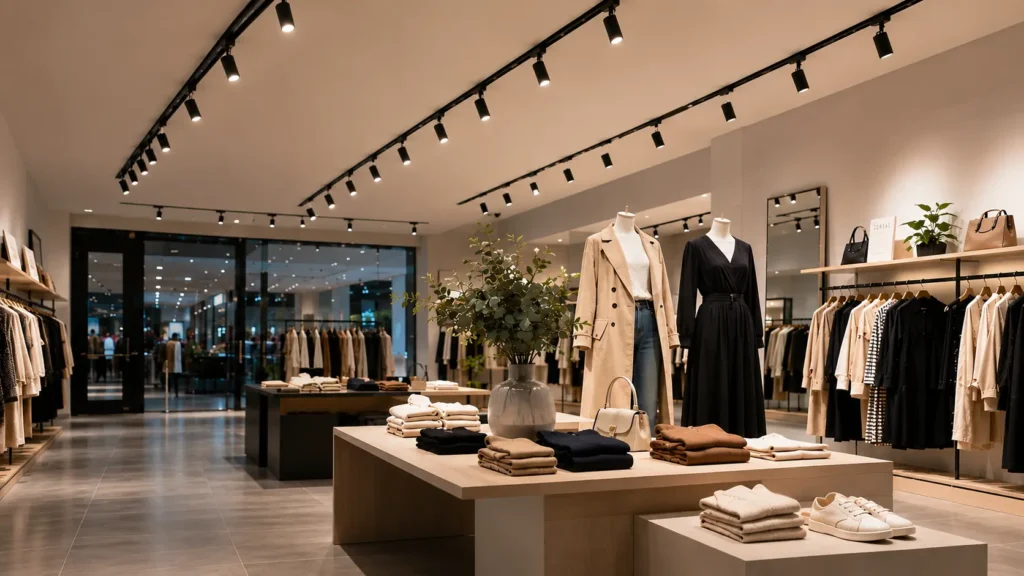
Rule of thumb for retail: for merchandise on shelves or racks positioned against a wall, mount the track 600–900mm from the wall surface. For centre-floor displays directly below the track at a 2-metre throw distance, a 24–36° beam provides a roughly 1–1.5-metre light pool at the target surface — sufficient to illuminate a standard display table or garment rack.
Common mistake: specifying all fixtures at the same beam angle. A single track run above a retail wall should typically mix 24° spots (for featured items at eye level), 36° floods (for general shelf coverage), and possibly 50° heads (for top-to-bottom wall washing). The same track can support all three beam angles simultaneously.
CRI and Colour Temperature in Retail
Colour rendering index (CRI) directly affects purchasing behaviour. A garment viewed under CRI 80 lighting may appear a different shade than under CRI 90+ lighting, leading to returns when the customer sees the item in natural daylight.
- CRI 90+ is the minimum specification for any retail space where colour influences the purchase decision — fashion, cosmetics, home décor, furniture, and food retail.
- CRI 95+ is recommended for spaces where colour accuracy is part of the brand positioning — luxury boutiques, flagship stores, and jewellery showrooms.
- R9 (deep red) value matters specifically for retail. A fixture may have CRI 90 but R9 below 50 — meaning reds, skin tones, and warm colours render poorly. Specify R9 > 50 for general retail and R9 > 80 for fashion and cosmetics.
For CCT, 3000K provides a warm, residential-feeling environment suitable for boutique and lifestyle retail. 3500K–4000K provides a cleaner, more contemporary appearance suitable for electronics, automotive, and modern fashion retail. The CCT should be consistent across all fixtures on the same sales floor — visible CCT variation between adjacent fixtures is distracting and unprofessional.
Gallery Lighting: The Added Complexity of Conservation
Gallery track lighting must balance two competing requirements: making artwork visible and attractive to viewers, while minimising cumulative light exposure that causes fading and material degradation. This is not a concern in retail, where products are sold within weeks or months — but in a gallery, a painting may hang for years under the same lights.
Key gallery specifications beyond standard retail:
- Total exposure control: cumulative light exposure is measured in lux-hours per year. Conservation standards for sensitive works (textiles, watercolours, photographs) typically limit exposure to 50,000–150,000 lux-hours annually. This requires either dimming the fixture, reducing the operating hours, or using occupancy-based control that switches off lighting when no viewers are present.
- UV elimination: LED sources produce negligible UV compared to halogen or fluorescent. However, some LED chips — particularly those with high CCT (5000K+) — produce slightly more near-UV output. For gallery use, specify LED fixtures with UV-filter glass or confirm UV output below 10 µW/lm from the manufacturer’s spectral power distribution data.
- Uniformity on vertical surfaces: gallery wall-wash fixtures should produce even illumination from the top to the bottom of the artwork. The standard guideline is a uniformity ratio (minimum illuminance ÷ average illuminance) of at least 0.7 across the entire artwork surface. Achieving this typically requires wall-wash optics rather than standard spot or flood reflectors.
- Dimming below 1%: conservation-grade dimming requires drivers capable of smooth dimming to below 1% of maximum output without flicker or colour shift. DALI is the preferred protocol for gallery applications because it supports per-fixture addressing and scene recall.
Fixture Spacing Guidelines
Fixture spacing depends on beam angle, mounting height, and the target surface distance. These are illustrative values for a 2-metre throw distance (track to target surface):
| Application | Beam Angle | Typical Fixture Spacing | Light Pool at Target |
|---|---|---|---|
| Retail shelf (wall-mounted) | 24° | 0.9–1.2m apart | 0.8–0.9m per fixture |
| Retail display table (centre-floor) | 36° | 1.2–1.5m apart | 1.3–1.5m per fixture |
| Gallery painting (single work) | 15–24° | 1 per artwork | Matched to artwork width |
| Gallery wall-wash (continuous) | Asymmetric wall-wash | 0.9–1.2m apart | Vertical uniformity 0.7+ |
These are starting points. The final spacing should be confirmed with photometric calculations using IES files for the specific fixture model, ceiling height, and target surface dimensions.
Track Positioning for Retail Ceilings
The two most common retail track layouts:
Parallel-to-wall layout: one or more track runs mounted parallel to the merchandise wall, positioned 600–900mm from the wall surface. Fixtures are angled toward the wall at 20–30° from vertical to avoid casting shadows from the customer standing in front of the display. This layout is suitable for shelf displays, hanging garments, and wall-mounted merchandise.
Grid layout: perpendicular track runs forming a ceiling grid, typically spaced 1.5–2.5 metres apart. This layout supports both wall displays (fixtures on the outermost track runs angled toward the walls) and centre-floor merchandise (fixtures on the internal track runs aimed straight down). Grid layouts are common in department stores and larger retail floors where merchandise positions change frequently.
For both layouts, the track should extend beyond the display area by at least 500mm at each end. This allows fixtures at the ends of the track to be angled inward toward the last display position without grazing the wall at an extreme angle.
Frequently Asked Questions
What to Do Next
Selecting track light fixtures for retail or gallery ceilings starts with mapping the display positions — not the ceiling grid. Determine what needs to be lit, from what distance, and to what standard of colour quality and beam control. The track layout follows the merchandise plan or exhibition layout, not the other way around.
Data notes: Beam angle coverage diameters are calculated values based on standard optical formulas for a 2-metre throw distance. Actual coverage varies by fixture model, ceiling height, and aiming angle. CRI, CCT, and UV output specifications should be verified against the manufacturer’s product data sheets. Conservation exposure limits are based on published guidelines from CIE 157:2004 and IESNA RP-30. Verify against the specific requirements of the collection or exhibition.