XHLUX
XHLUX
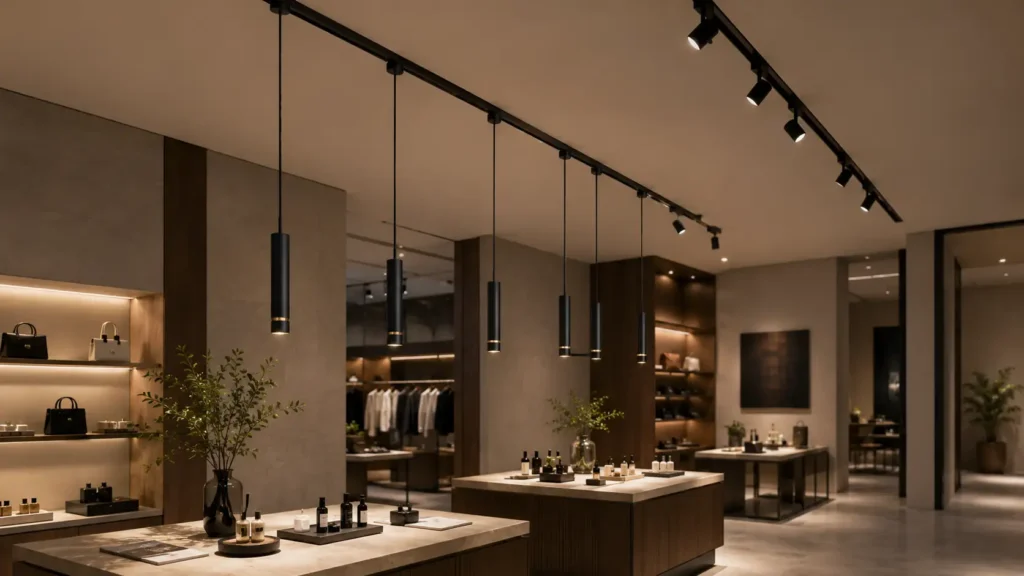
A magnetic hanging light is a pendant module that hangs from a powered magnetic rail so you can move the drop when furniture and displays move. It is not a battery puck stuck to a steel beam.
Use this page when retail, dining, gallery or showroom plans will keep shifting after handover. You need the hanging points to travel with the layout—not a new ceiling cut every season.
For the P5 mount map—suspend, surface or recess—start with How to Choose Linear LED Lighting: Suspended, Surface, or Recessed?. This page stays on magnetic hanging modules when the floor plan will keep moving.
If you only need a fixed linear drop over desks or a lobby axis, use the modern linear suspension guide for offices and lobbies.
For basic commercial pendant vocabulary, start here:
→ What Is Commercial Linear Pendant Lighting: Beginner Guide
TL;DR: Buy a hanging module that is listed for a named rail family. Lock voltage, driver headroom, mechanical rating and which zones may move—before you order pretty glass.
1. When a changing layout needs hanging modules
Magnetic hanging lights earn the extra system cost when the floor plan is not finished at handover.
Typical commercial fit:
- Retail tables and feature rails that move with seasons
- Restaurant and hotel seating that is reset for events
- Galleries and showrooms that relight objects without a shutdown
- Pop-up or phased fit-outs where hanging points are not final on day one
Poor fit:
- A locked desk grid that will not move for years—a fixed linear hang is simpler
- Closets, vans or site work that need a cordless magnet lamp
- A brief that only says “magnetic” with no rail family or drop height
Do not treat Amazon puck lights and 48 V rail pendants as one product. Search results mix both; your specification cannot.
| Situation | Better path |
|---|---|
| Seating and displays will move after opening | Magnetic hanging modules on a rated rail |
| Desk or lobby axis is locked | Fixed linear suspension, not a magnetic drop |
| Cordless task light on steel | Wireless magnetic lamp—not this brief |
| You still need spots, linears and pendants as one kit | Specify the full rail system, then this hanging module |
If the rail itself still has no mount decision—surface, recess or suspend—settle that in the suspend-or-recess guide first. Then come back to which pendants hang on it.
🎯 When do magnetic hanging lights beat fixed pendants?
When merchandising or seating will move after handover, so the drop can slide on a live rail without a new ceiling cut.
2. Spec the magnetic track pendant as a listed module
A magnetic track pendant is a hanging luminaire plus an adapter that is listed for one rail family. A magnet that merely sticks to steel is not a specification.
Write these on the submittal:
- Rail series name and adapter part number—not “fits magnetic track”
- System voltage, usually 48 V DC SELV / Class 2 on current commercial lines
- Pendant wattage against the driver’s remaining watts after every other module
- Drop length, cable type and whether the drop is field-cut
- Mechanical lock: magnets locate the adapter; a catch or latch carries the hanging load
- Finish, CCT, CRI and optic matching the rest of the rail family
Do not mix adapters across brands. Low-voltage magnetic rails are closed systems. Buschfeld’s 48 V Sense literature, for example, states that other makers’ components must not run on that system.
Check mass and drop against the adapter’s mechanical rating, not against magnet marketing copy. Electrical watts and hanging kilograms are two different limits.
For the whole rail kit—spots, linears and pendants as one platform—use the live ceiling magnetic track light complete guide. This page only chooses the hanging module when the layout will keep moving.
🎯 What must match on a magnetic track pendant?
The rail family, voltage, mechanical lock and drop length—not a generic magnet that happens to stick to steel.
3. What a tool-free hanging light fixture actually changes
A tool-free hanging light fixture means you can take the module off the live rail and put it back somewhere else without opening the ceiling. It does not mean the rail, driver and first-fix are DIY.
Keep the split honest on drawings:
- First-fix: rail, feed, driver and mechanical anchors—licensed electrical work
- Second-fix: hanging modules that relocate on that rail
- Not tool-free: new rail runs, extra feeds, or a heavier pendant than the adapter allows
Some 48 V systems allow hot-plug after a qualified person has instructed the crew. That is a manufacturer rule, not a reason to skip isolation when the job needs it.
If staff will move pendants after opening, write who may do it, how far a drop may travel, and what they must not hang. A glass globe that exceeds the adapter rating is still a fall hazard when the magnet “clicks.”
🎯 What part of the hang is actually tool-free?
Relocating the listed module on an installed rail. The rail, driver and first-fix still need a qualified installer.
4. Treat the magnetic ceiling light system as the limit
The magnetic ceiling light system is the rail, driver, feeds and mount kit. Hanging lights only work inside that envelope.
Ask for numbers, not adjectives:
- Driver wattage and whether the supply sits in the rail or remotely
- Current limit per feed—Buschfeld publishes 48 V, 12.5 A, 600 W, then a new feed
- Other lines publish smaller in-track supplies (for example 100 W / 150 W / 250 W packs)
- Mount of the rail: surface, recess or suspend is a ceiling decision, not a pendant SKU
- Listing: IEC/EN 60570 for luminaire track systems; UL 1574 where the project needs a US track listing
Lumenwerx’s Pivot pendant-track sheet is typical of the architecture: 48 V DC, Class 2 / SELV, with the supply limiting watts per section. If modules exceed that rating, the sheet describes overload behaviour such as flashing—not a silent “it will be fine.”
Leave spare watts. A layout that keeps changing will add a pendant later. A rail loaded to the last watt cannot.
🎯 What really limits the ceiling system?
Driver wattage, feed current, mechanical load and rail mount—not how strong the magnets look in a photo.
5. Spec reconfigurable pendant lighting as a change process
Reconfigurable pendant lighting is a documented move path, not a promise that “everything is magnetic.”
Put this in the lighting notes:
- Zones that may move in the first 24 months (and zones that must not)
- Spare driver capacity after the opening layout
- Drop lengths per zone so a relocated pendant still clears heads and tables
- Matching CCT/CRI so a moved lamp does not look like a different family
- Who relocates modules, and whether power stays on
- A labelled plan of the rail so staff do not park every pendant on one feed
If the hanging run is really a long linear bar that will never move, stop. That job belongs on a fixed linear suspension, not a magnetic drop.
🎯 How should you spec a layout that will move?
Name the zones that may move, leave driver headroom, freeze drop rules, and write who is allowed to relocate modules.
6. Approve a mock-up before you freeze SKUs
Use this order on one live rail sample:
- Confirm rail family and adapter part numbers
- Hang the heaviest specified pendant at the longest specified drop
- Move it to the farthest planned position on that feed
- Recheck driver load with every other module that will share the run
- Sight glare at seated and standing eye height
- Write the relocate rule into the O&M pack
Order production lengths only after that sample is signed on the real ceiling finish.
| Check | Pass if |
|---|---|
| Rail family | Adapter is listed for that series |
| Electrical | Opening layout plus spare watts sit inside the driver/feed limit |
| Mechanical | Mass and drop sit inside the adapter rating |
| Change path | Move zones, drop rules and responsible person are written |
🎯 When is the hanging-light spec ready to order?
After a mock-up on the real rail family, with driver load, drop heights and relocate rules signed.
What to weigh first on a changing ceiling
The chart below ranks checklist weight—not product scores.
FAQ
What to do next
Mock up the heaviest drop on the real rail family. Sign driver headroom, mechanical rating and the relocate rule before you freeze pendant SKUs.
For project magnetic hanging modules, XHLUX can review rail-family adapters, driver load and drop schedules before production.
Notes & Sources
- IEC/EN 60570, Electrical supply track systems for luminaires — ask which track standard the rail is listed to (plain-text citation; no outbound link).
- UL 1574, Track Lighting Systems — US projects that need a track listing (plain-text citation; no outbound link).
- LUMINES GENESIS magnetic pendant modules, 48 V DC; in-track supplies shown as 100 W / 150 W / 250 W — example of driver-limited module count, not a universal wattage.
- Buschfeld Sense System 48 V literature: 48 V, 12.5 A, 600 W then a new feed; closed system; hot-plug only after instruction — manufacturer limits, not a generic industry cap.
- Lumenwerx Pivot Track Pendant spec: 48 V DC, Class 2 / SELV architecture with supply-limited watts per section (plain-text citation; no outbound link).
- Project Serper PAA for
magnetic hanging light(2026-07-07) — FAQ from primary pool; work-light PAA skipped; secondaries had 0 PAA rows. - Project-specific electrical, structural, fire and accessibility rules remain applicable. Confirm local requirements before installation.