 XHLUX
XHLUX
Commercial LED downlights are a project specification decision — optics, ceiling build-up, controls, and supply risk — not a single catalog photo.
This page is the overview map for B2B teams (brands, distributors, contractors, consultants).
Use it to lock the type fork and the key parameters, then open the matching deep-dive.
It does niet replace ceiling-install routing or a full OEM audit checklist.
Kort samengevat: Pick mount and type family first. Then set CRI / CCT / beam / glare / controls. Confirm wet-location and fire/IC rules by product code. Deep detail lives in the linked guides — not only in this overview.
Inhoudsopgave
- Where should you start?
- Types of commercial LED downlights
- How to specify LED downlights for commercial projects
- Dimming and control protocols
- Modular downlight systems
- What to check in a manufacturing partner
- Commercial downlights by application
- Installation and compliance overview
- Veelgestelde vragen
- What to read next
Where should you start?
If you are in a hurry, use this table first. Only published guides are linked.
| Your situation | Go here next |
|---|---|
| Still choosing recessed vs surface vs adjustable mount | LED downlight installation methods |
| Ceiling type / void / cut-out questions | How to choose downlights for different ceiling types |
| Skip the cut-out / surface path | Surface-mounted vs recessed: when to skip the cut-out |
| Shallow void / slim housing | Slim & mini LED downlights for shallow ceilings |
| Deep recess vs flush look | Deep recessed vs flush downlights |
| Trimless / plaster-in architecture | Trimless LED downlights for architectural specification |
| Adjustable vs fixed aim | Adjustable vs fixed downlights + adjustable commercial downlights |
| Accent / task aiming | Directional downlights for accent and task |
| Wet / damp locations | IP65 waterproof LED downlights |
| Commercial recessed package checks | LED recessed luminaires for commercial ceilings |
| Track / rail instead of only recessed cans | Track and rail lighting systems guide |
🎯 Where should a commercial downlight project start? Lock mount and type family against the ceiling, then set optics and controls — open a deep-dive instead of stacking catalog SKUs first.
Types of commercial LED downlights
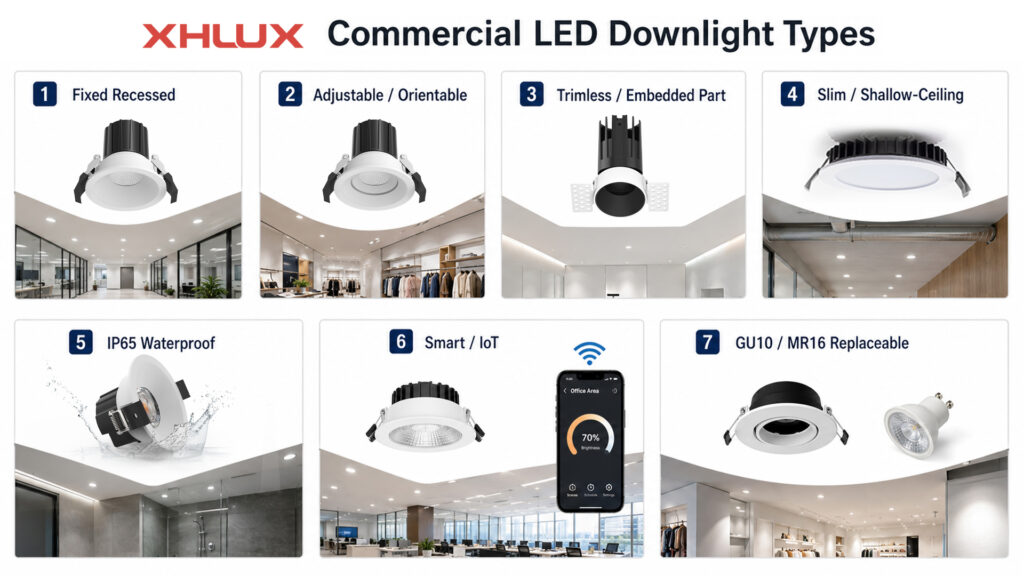
Commercial downlight types are easier to choose when you sort by job first — ambient, accent, wet zone, or shallow void — then by housing family.
Commercial projects usually mix several families in one building.
Think in those jobs, not in brand series names.
Fixed recessed
Straight-down ambient for offices, corridors, guest rooms, and general retail floors with a settled layout.
Best when the packing plan is uniform and aiming will not change.
For housing and commercial ceiling checks, open the recessed luminaires guide.
Adjustable / gimbal
Use when displays, art, or feature walls need controllable aim on top of a recessed or surface mount.
Confirm tilt / rotation per model before release.
Deep-dives: adjustable vs fixed En adjustable commercial downlights.
Trimless / plaster-in
The visible flange disappears into the finished ceiling plane.
Coordinate electrician and plasterer early; aperture changes after skim are expensive.
Deep-dive: trimless architectural specification.
Slim / shallow-ceiling
Remote the driver when the void cannot take a deep can.
Measure real depth, plan driver access, and confirm insulation-contact (IC) rules before you order.
Deep-dive: slim / shallow-ceiling downlights.
IP-rated / wet-adjacent
Bathrooms, spa areas, covered walkways, and food prep need a verified IP rating — and often front vs rear rated differently.
Deep-dive: IP65 commercial wet/damp locations.
Connected / protocol-ready heads
Specify DALI, 0–10V, Casambi/BLE, ZigBee, phase, or RF per product code.
Protocol choice is a system decision, not a late accessory add-on.
If the project needs wireless mesh examples, confirm the exact downlight SKU control option on the datasheet — do not assume a track-light control page covers the same head family.
Replaceable-lamp heads (GU10 / MR16 family)
Useful when maintenance plans prefer lamp swaps over whole-fixture replacements.
Trade-off: integrated LED usually wins efficacy and glare control; replaceable wins service habit.
Type comparison (overview)
| Type | Het beste voor | Aiming | Key check |
|---|---|---|---|
| Fixed recessed | Uniform ambient | Geen | Void + cut-out + fire strategy |
| Adjustable / gimbal | Retail / gallery accent | Ja | Tilt range + glare at viewing angles |
| Trimloos | High-end architectural finish | Fixed or adjustable | Plaster coordination; semi-permanent |
| Slim / shallow | Retrofit / low void | Usually fixed | Depth + remote driver access + IC |
| IP-rated | Wet / damp zones | Usually fixed | Full IP rating, not marketing shorthand |
| Protocol-ready | BMS / scenes | Variabel | Exact protocol per code |
| Replaceable lamp | Maintenance programs | Fixed or orientable | Efficacy vs service model |
🎯 How do you choose a commercial downlight type? Match the ceiling job first (void, wet zone, aim need), then open the deep-dive — do not start from a single wattage sticker.
How to specify LED downlights for commercial projects
Een complete commercial LED downlight specification is more than wattage + CCT on a purchase order.
The parameters below separate a clean install from a complaint cycle.
CRI and color quality
- Ra80+ — back-of-house, stockrooms, utility corridors.
- Ra90+ — most customer-facing retail, hospitality, workplaces.
- Ra95+ — galleries, museums, luxury retail where color accuracy is the job.
Ask for R9 when fashion, food, or skin-tone critical zones are in scope.
Ask for SDCM (often ≤3 for adjacent fixtures) when color matching across a floor plate matters; do not assume it is on every datasheet.
CCT by space (planning bands)
| Ruimte | Typical CCT band | Note |
|---|---|---|
| Hotel guest / lobby / restaurant | 2700K–3000K | Dim-to-warm helps evening scenes |
| Fashion / cosmetics / jewelry | 3000K–3500K | Pair with high R9 for merchandise |
| Supermarket / DIY | 3500K–4000K | Task visibility across aisles |
| Office general | 3500K–4000K | Confirm local workplace rules |
| Galerij / museum | 2700K–3500K | Conservation + UV-free LED |
| Clinical / healthcare | 4000K–5000K | Visual acuity; low flicker |
| Showroom | 3000K–4000K | Tunable white if displays change often |
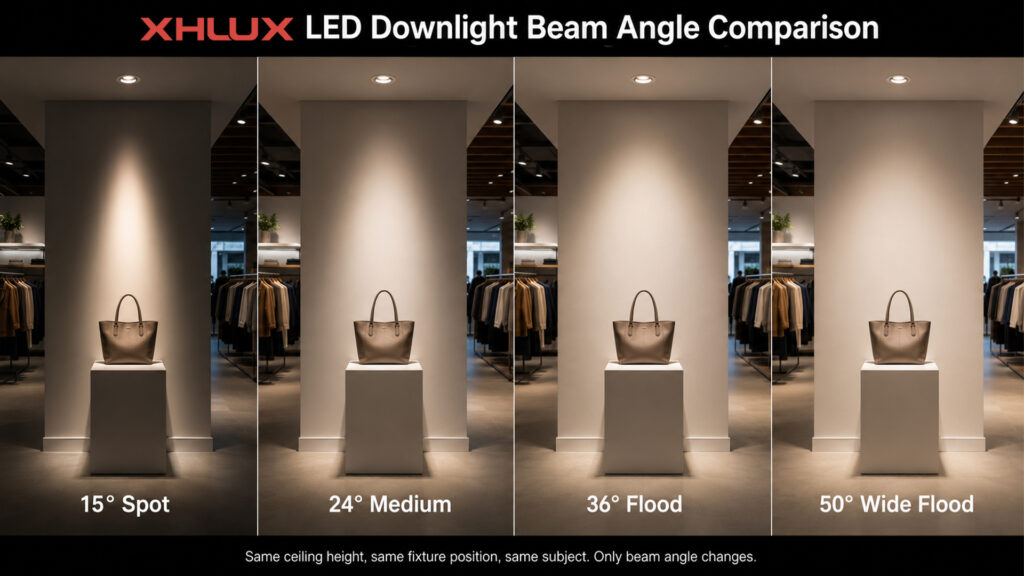
Straalhoek
| Straal | Character | Typical use |
|---|---|---|
| ~15° | Tight accent | Jewelry, small art, hero SKUs |
| ~24° | Defined medium | Racks, shelves, feature tables |
| ~36° | Even flood | General retail / hospitality ambient |
| ~50° | Wide soft wash | Aisles, large tables, corridors |
Mixed beams usually beat one angle everywhere.
Narrow-only plans create dark gaps; wide-only plans flatten hierarchy.
UGR and glare
For screen work and premium guest space, push for deep-source optics and published UGR where the project asks for it.
Accessories (louver / snoot) are secondary — the primary optic still has to be right.
Lumens and efficacy
Work from target lux, height, and beam — not wattage alone.
A lower-watt narrow beam can out-lux a higher-watt wide flood on a small task plane.
Use photometric sheets (LM-79 / IES) when the count of fixtures pays for itself.
IP and IC
- Indoor dry ceilings often land at IP20.
- Wet-adjacent zones need a verified IP family — confirm front vs rear.
- IC rating matters when insulation contacts the fixture; confirm per code if the catalog is silent.
Dimming and control protocols
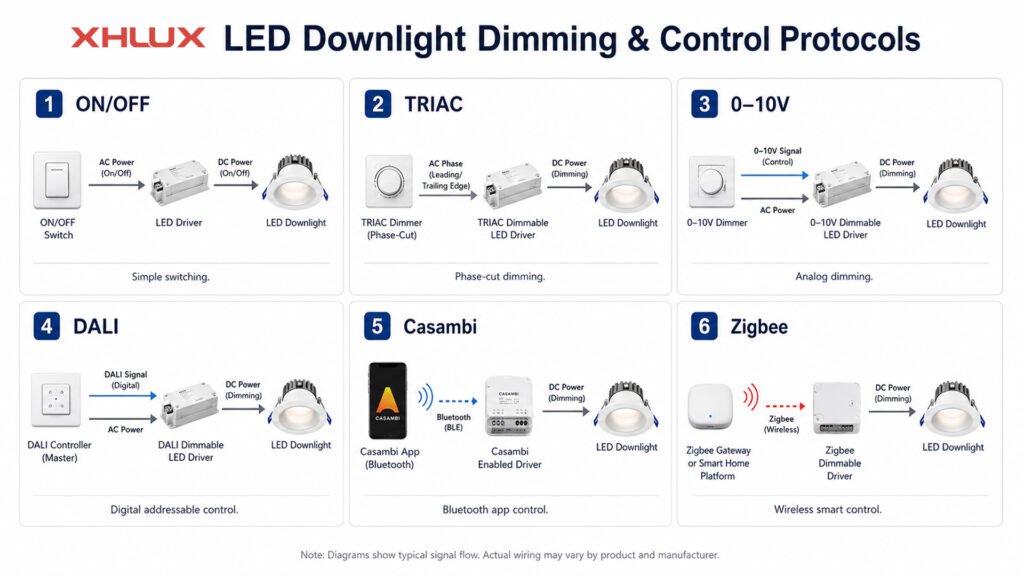
Pick the protocol with the building system, not after the fixtures are ordered.
| Protocol | Bedrading | Two-way data | Beste pasvorm |
|---|---|---|---|
| DALI / DALI-2 | Bus | Ja | Large sites, BMS, status reporting |
| 0–10V / 1–10V | LV pair | Nee | Simple zones, cost-sensitive |
| Casambi / BLE | Wireless | Ja | Retrofit / hard-to-wire spaces |
| ZigBee | Wireless | Ja | Broader IoT platforms |
| Phase (TRIAC) | Mains | Nee | Small commercial, basic dimming |
| 2.4G / RF | Wireless | Beperkt | Simple room-level control |
Confirm the exact head + driver + protocol matrix before bulk order.
Modular downlight systems
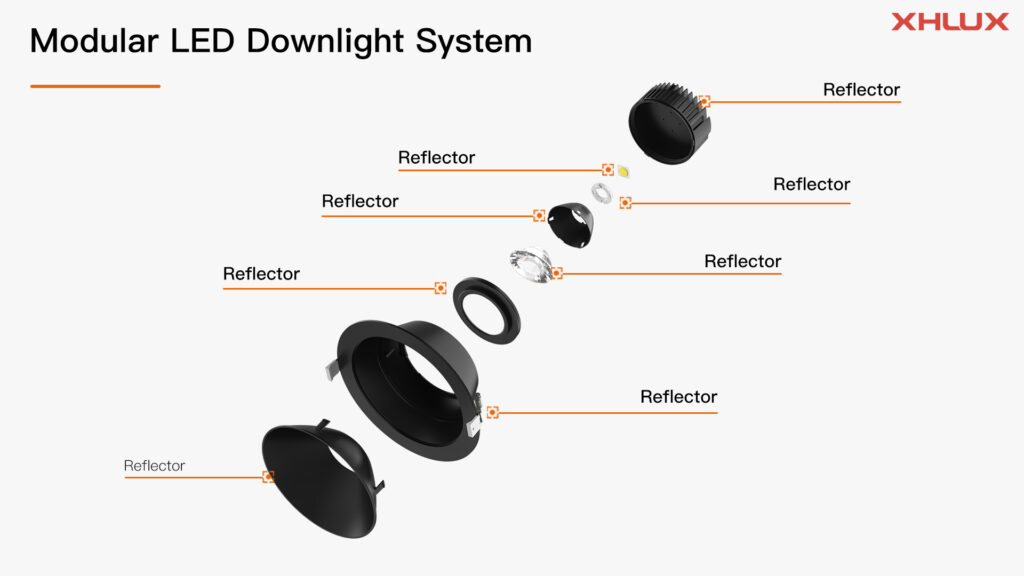
A modular platform lets distributors and brands cover more finishes and beams from fewer base SKUs.
Practical wins:
- Fewer complete fixture types in stock.
- Faster line expansion via reflectors / rings / optics.
- One platform configured differently room-by-room on the same project.
Still validate photometry and glare for each optical configuration — modularity is not a free pass on performance proof.
What to check in a manufacturing partner
This overview is not a full factory audit.
For commercial supply risk, check these points early:
| Rekening | Why it matters | What to demand |
|---|---|---|
| Cert / docs by exact code | Markets reject “family-level” paperwork | CE/EMC/RoHS/ErP, ENEC/CB/SAA/RCM where needed — for that code |
| Photometry pack | Specifiers need evidence | LM-79, LM-80 where relevant, IES, driver sheet |
| Kleurconsistentie | Adjacent fixtures show mismatch | SDCM / binning data on request |
| Thermal + warranty | Long-hour commercial duty | Housing/thermal design note + warranty term |
| Dimming matrix | Flicker and drop-out kill soft opens | Protocol compatibility under load |
| Samples | Spec sheets lie gently | Light quality, fit/finish, dimming, heat soak |
Customization (cut-out, CCT, beam, finish, labeling, packaging) is normal when you source oem odm led downlights for a brand or private-label program — lock MOQ, lead time, and sample sign-off before production volume.
Keep brand claims short: capability matters only when the documents match the shipped code.
Commercial downlights by application
Use this as a planning start — still prove lux and glare on the real RCP.
| Sollicitatie | Type mix | CCT | CRI | Beam notes | Watch-outs |
|---|---|---|---|---|---|
| Fashion retail | Adjustable + fixed ambient | ~3000K | Ra90+ | Narrow accent + medium ambient | High R9; accent:ambient hierarchy |
| Supermarket | Fixed high-efficiency | 3500K–4000K | Ra80+–Ra90+ | 36°–50° | Color consistency across aisles |
| Jewelry / luxury | Adjustable narrow | ~3000K | Ra95+ | ~15° | Contrast + UV-free |
| Hotellobby | Fixed + adjustable + wash | 2700K–3000K | Ra90+ | 24°–36° | Low glare; dim-to-warm |
| Guest room | Fixed; trimless optional | 2700K–3000K | Ra90+ | 36°–50° | Quiet driver; room control |
| Office general | Fixed / modular | 3500K–4000K | Ra80+ | 36°–50° | Workplace glare / flicker rules |
| Vergaderruimte | Fixed + adjustable | 3000K–4000K | Ra90+ | 24°–36° | Scene modes |
| Museum / gallery | Adjustable + wash | 2700K–3500K | Ra95+ | 15°–24° | Conservation; addressable control |
| Restaurant | Fixed + accent | 2700K–3000K | Ra90+ | Mengen | Dim-to-warm; low glare at tables |
| Gezondheidszorg | Fixed anti-glare | 4000K–5000K | Ra90+ | 36°–50° | Flicker-free; cleanable; IP where wet |
| Corridors / public | Vast | 3000K–4000K | Ra80+ | 36°–50° | Sensors; fire-rated where required |
Installation and compliance overview
Mount family follows ceiling construction:
- Suspended grid — recess into or onto the T-bar; check weight / independent support.
- Plasterboard — trimless before skim, or cut-in after finish; cut-out tolerance matters.
- Beton / geen holte — surface or pendant paths instead of forcing a can.
For the full recessed vs surface vs adjustable map, use the Overzicht van installatiemethoden.
Standards often referenced on commercial packages include IEC/EN 60598, workplace lighting rules, and local fire / emergency requirements.
Fire-rated downlights are mandatory where the ceiling is a fire barrier — confirm rating against the assembly, not against marketing copy.
Veelgestelde vragen
What is the difference between Ra80+, Ra90+, and Ra95+ downlights?
Ra80+ suits utility and back-of-house areas. Ra90+ is the usual customer-facing commercial baseline. Ra95+ is for color-critical spaces such as galleries, museums, and luxury retail. Always confirm the grade on the exact product code you will order.
Which dimming protocols are common on commercial downlights?
Projects typically choose among DALI/DALI-2, 0–10V/1–10V, Casambi/BLE, ZigBee, phase (TRIAC), and RF families. Availability is model-specific — confirm the head, driver, and controller together before bulk purchase.
Are IP65-rated downlights available for wet zones?
Yes on selected commercial families, but you must verify whether the rating applies to the front only or the full housing. Use the IP65 commercial wet/damp guide for zone thinking, then confirm the SKU sheet.
What warranty term is typical?
Commercial lines often quote about 3–5 years depending on family and duty cycle. Treat warranty as one quality signal alongside photometry, thermal design, and sample soak tests.
Can fixtures be customized for OEM/ODM projects?
Usually yes for oem odm led downlights on cut-out, CCT, beam, finish, protocol, labeling, and packaging within platform limits. Lock sample approval, MOQ, and lead time before production quantity.
Are SDCM values always published?
Often not on public catalog cards. For adjacent-fixture color risk, request binning / SDCM data and keep SDCM ≤3 as a common commercial target unless the consultant sets another limit.
What housing materials are common on quality commercial heads?
Die-cast aluminum housings are common for thermal and structural performance on commercial duty cycles. Still judge the full thermal path and driver quality, not material name alone.
What to read next
- LED downlight installation methods — recessed vs surface vs adjustable routing.
- How to choose downlights for different ceiling types — void and substrate checks.
- LED recessed luminaires for commercial ceilings — commercial recessed package depth.
- Adjustable LED downlights for commercial projects — aiming specification.
- IP65 waterproof LED downlights — wet/damp zones.
- Track and rail lighting systems guide — when the project needs track, not only recessed cans.
If a related deep-dive is still unpublished, keep it as a topic label in your internal notes — do not invent draft URLs on this page.