Introduction
If you specify, procure, or supply commercial LED downlights for hotel, retail, office, museum, or architectural projects, you are not just buying a lamp in a housing. You are specifying a fixture that determines how products look on a shop floor, how comfortable guests feel in a lobby, and whether an art gallery installation meets the lighting designer’s brief.
This article is written for B2B buyers — lighting brands building product lines, distributors expanding their commercial range, project contractors specifying for large-scale installations, and architectural firms evaluating OEM/ODM manufacturing partners. It walks through the downlight types available, the specification parameters that control real-world performance, the dimming and control protocols that determine how a system integrates into a building, and the criteria that matter when selecting a manufacturing partner who can deliver consistent quality across hundreds or thousands of fixtures.
The focus throughout is on commercial project applications, international sourcing requirements, and specification decisions that matter for lighting brands, distributors, contractors, and project teams.
Types of Commercial LED Downlights

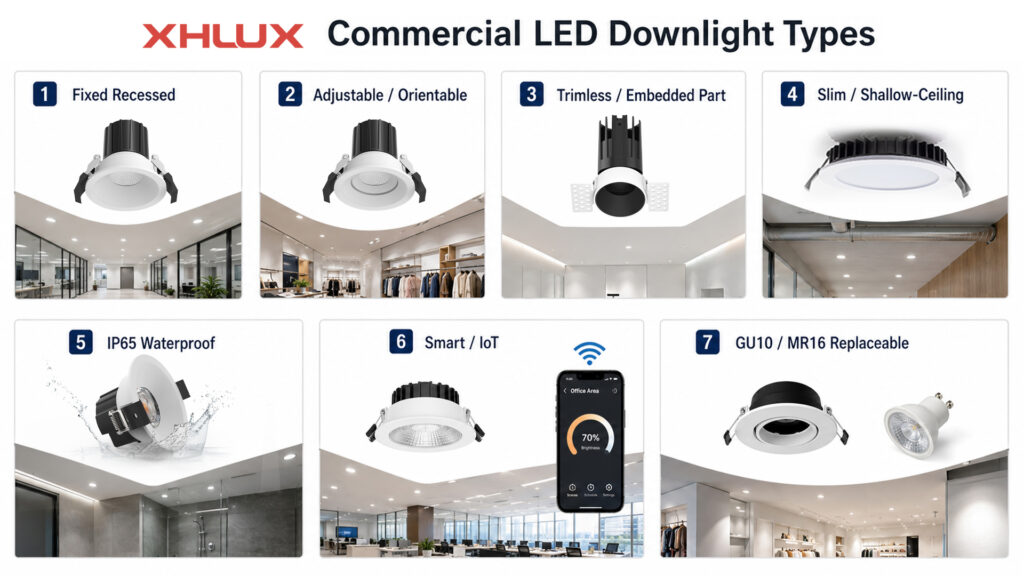
Commercial downlights do not fit neatly into one product box. Installation method, adjustability, environmental rating, and lamp type each define a different category, and most commercial projects use several types within the same building.
Fixed Recessed Downlights
The workhorse of commercial ambient lighting. Fixed recessed downlights direct light straight down and are used in offices, corridors, hotel guest rooms, and general retail floors where the lighting layout is uniform and predetermined.
Within the XHLUX range, the MR16 Modular Fixed LED Downlight and the Watex Modular Fixed Downlight provide fixed-output options with reflector or PC lens optics, available in Ra80+, Ra90+, and Ra95+ CRI grades. Cut-out sizes start from 55mm and go up to 95mm depending on the series and wattage.
Adjustable & Orientable Downlights
When the beam needs to be redirected to highlight a display, illuminate a feature wall, or create accent contrast against ambient lighting, adjustable downlights — also called gimbal or orientable downlights — are the appropriate choice.
XHLUX produces several orientable families for commercial projects. The Hotel Wall Washer LED Downlight series is available in round, square, trimless, and double-head configurations. The Second Generation Gimbal Down Light covers the 15W–45W range with Miro reflector optics and efficiency up to 130 lm/W for higher-ceiling commercial applications. The Modular Orientable LED Downlight adds COB and SMD module options in D90 and D110 form factors. Orientable versions are intended for directional wall-washing applications. Exact rotation and tilt ranges should be confirmed per model.
For a more detailed treatment of adjustable spotlight specification, see the article on adjustable LED downlights.
Trimless / Embedded Part Downlights
Trimless downlights — referred to in XHLUX documentation as Embedded Part downlights — install flush with the ceiling plane. The housing is fixed before the plasterer applies the skim coat, and joint compound is feathered over a perforated flange. After painting, only the inner aperture remains visible.
The XHLUX Trimless Wall Wash Downlight series covers D55, D75, and D95 form factors in both fixed and adjustable versions. The housings use ADC12 die-cast aluminum and carry a 3–5 year warranty.
This is a semi-permanent installation. Once plastered and painted, the fixture cannot easily be swapped for a different model or aperture size. It is best suited to new-build or full-refurbishment projects where the lighting design has been signed off and will not change. Coordination between the electrician and plasterer is essential — the housing must be correctly positioned and level before the plasterer starts, and the plasterer must work carefully around each aperture to avoid cracking or visible waves.
Slim / Shallow-Ceiling Downlights
Not every commercial ceiling has the depth for a standard recessed downlight housing. Older buildings with shallow ceiling voids, retrofit projects where existing services limit available space, and modern constructions using slim-profile ceiling systems all present the same problem: the downlight needs to be thin enough to fit where a traditional can-depth housing will not go.
Slim downlights — sometimes called wafer lights in contractor language — solve this by moving the driver to a separate junction box that can be placed away from the fixture, leaving only a thin LED panel and spring-clip mounting mechanism in the ceiling cavity. Typical slim downlight profiles can be as thin as 10–30mm, compared to 80–150mm for a standard recessed housing.
Before specifying slim downlights for a project, check the following:
- Available ceiling depth: Measure the actual void at the installation point. If the void is less than 50mm, slim downlights are likely the only recessed option.
- Driver location: Remote driver boxes need accessible placement — above a suspended ceiling grid is usually acceptable; buried in a sealed plasterboard ceiling is not. Plan driver access for maintenance.
- Thermal management: Slim form factors have less heat sink mass than full-depth housings. Confirm that the model is rated for the expected daily operating hours. Commercial spaces running 12–16 hours per day place higher thermal demands on fixtures than residential intermittent use.
- IC rating: If ceiling insulation contacts the fixture, the downlight must be IC-rated (Insulation Contact). IC rating is not shown in the XHLUX catalog — confirm per model before specifying for insulated ceilings.
- When to use full-depth fixtures instead: For high-ceiling commercial spaces (above 4m), full-depth recessed downlights with larger heat sinks and higher lumen outputs typically perform better. Slim downlights are best suited to standard-height ceilings (2.4m–3.5m) in retrofit or space-constrained scenarios. For new-build commercial projects without depth constraints, full-depth recessed fixtures offer more thermal headroom and generally higher maximum lumen output.
A dedicated technical page on slim and shallow-ceiling LED downlights covers this category in more depth.
IP65 Waterproof Downlights
Commercial bathrooms, spa areas, covered external walkways, and food preparation zones need downlights that can manage moisture, water jets, or dust ingress.
The XHLUX catalog shows IP-rated options on selected downlight families, including IP65 options on selected wall-washer or Watex models. Confirm the exact IP rating by product code before specifying for wet-location projects. A common point of confusion is that some IP65-rated downlights are IP65 from the front face only and IP20 from the rear — always verify the full rating rather than relying on a single IP65 claim. For a complete treatment of IP ratings, bathroom zone compliance, and wet-location specification, see the article on IP65 waterproof LED downlights for commercial projects.
Smart / IoT-Connected Downlights
Downlights with integrated ZigBee, Casambi, or DALI connectivity support dimming, scene setting, zoning, and — depending on the control system — status feedback or energy-related data. These are increasingly specified in commercial buildings where lighting forms part of a broader building management system.
Selected XHLUX downlight models can be configured with six control and dimming options across the product range: ZigBee, 2.4G/RF, Phase (TRIAC), DALI, 0/1-10V, and Casambi/BLE. Protocol availability varies by model — confirmation per product code is necessary. The article on smart LED downlights and lighting control options covers IoT and connected lighting in more detail.
GU10 Replaceable-Lamp Downlights
For commercial projects where maintenance access is difficult or ongoing lamp replacement is anticipated, downlights accepting replaceable GU10 or MR16 lamps offer a practical advantage: when a lamp fails, only the bulb is swapped, not the entire fitting. This keeps long-term maintenance costs lower than with integrated LED fixtures, where a failed driver or LED module means replacing the whole unit.
The XHLUX MR16 Modular series provides both orientable and fixed versions in D80 and D100 form factors, delivering 80–130 lm/W with reflector optics.
Downlight Type Comparison
| Taper | Best Application | Adjustability | Typical Wattage Range (XHLUX) | Key Consideration |
|---|---|---|---|---|
| Fixed Recessed | General ambient, offices, corridors | None | 3W–25W | Simplest installation; lowest per-unit cost in volume |
| Adjustable / Orientable | Retail display, gallery accent, hospitality feature lighting | Orientable (confirm rotation/tilt per model) | 5W–45W | Beam direction flexibility; higher per-unit cost |
| Trimless / Embedded Part | High-end architectural, hotel, minimalist interiors | Fixed or adjustable versions | 5W–25W | Requires plasterer coordination; semi-permanent |
| Slim / Shallow-Ceiling | Retrofits, low ceiling voids | Fixed typically | Varies by model | Solves depth constraint; confirm IC rating and thermal rating |
| IP65 Waterproof | Bathrooms, spas, covered outdoor, food prep | Fixed typically | Varies by model | Confirm full IP rating (front and rear); not all are IP65 both sides |
| Smart / IoT | BMS-integrated commercial buildings | Fixed or adjustable | Varies by model | Protocol compatibility per model essential |
| GU10/MR16 Replaceable | Hospitality, retail with maintenance programs | Fixed or orientable | 5W–15W | Lower long-term maintenance cost; lamp replacement without fixture swap |

How to Specify LED Downlights for Commercial Projects
A specification that only lists wattage and color temperature leaves too many variables open. Different manufacturers’ fixtures with the same paper specs can perform very differently in a real room. The parameters below are the ones that separate a well-specified installation from one that causes complaints.
CRI & Color Quality
Color Rendering Index (CRI, or Ra) measures how faithfully a light source renders colors compared to a reference illuminant. Selected XHLUX downlight families can be specified with CRI options such as Ra80+, Ra90+, or Ra95+, depending on the product model and configuration:
- Ra80+ — Sufficient for stockrooms, back-of-house corridors, and utility areas where color judgment is not part of the work.
- Ra90+ — The baseline for most customer-facing commercial spaces: retail floors, hotel lobbies, restaurants, office workspaces.
- Ra95+ — Appropriate where color accuracy is critical: art galleries, museums, luxury retail, high-end hospitality.
CRI alone is not the full picture. The R9 value — representing saturated red — matters for fashion (fabric tones), food retail (meat and produce appearance), and hospitality (how skin tones look under the light). R9 is not shown in the XHLUX catalog and should be requested per model when color quality is a project requirement.
Fixture-to-fixture color consistency is equally important. SDCM (Standard Deviation of Color Matching) quantifies the variation between fixtures. SDCM ≤ 3 is the industry recommendation for commercial spaces where a visible difference in color temperature between adjacent downlights would look unprofessional. SDCM values are not published in the XHLUX catalog — request per-model data when consistency across the installation is critical.
Color Temperature Selection by Application
Correlated Color Temperature (CCT) affects both atmosphere and the perceived color of merchandise and surfaces. Selected XHLUX downlight models can be specified with CCT options such as 2700K, 3000K, 3500K, 4000K, and 5000K, depending on the product family and configuration.
| Commercial Space | CCT recommandé | Notes |
|---|---|---|
| Hotels — guest rooms, lobbies, restaurants | 2700K–3000K | Warm, inviting; dim-to-warm useful for evening transitions |
| Retail — fashion, cosmetics, jewelry | 3000K–3500K | 3000K for luxury positioning; 3500K for mainstream retail |
| Retail — supermarkets, DIY, general merchandise | 3500K–4000K | Neutral appearance; supports task visibility across aisles |
| Offices — general workspace, meeting rooms | 3500K–4000K | Higher CCT for task-oriented spaces; confirm applicable workplace lighting standards |
| Museums, galleries | 2700K–3500K | Match to exhibit requirements; UV-free LED essential for conservation |
| Healthcare, clinical environments | 4000K–5000K | Cool, clinical; supports visual acuity for staff |
| Restaurants, bars | 2700K–3000K | Warm tones; dim-to-warm for evening ambiance |
| Showrooms, exhibition spaces | 3000K–4000K | Tunable white useful where displays change frequently |
Beam Angle Selection

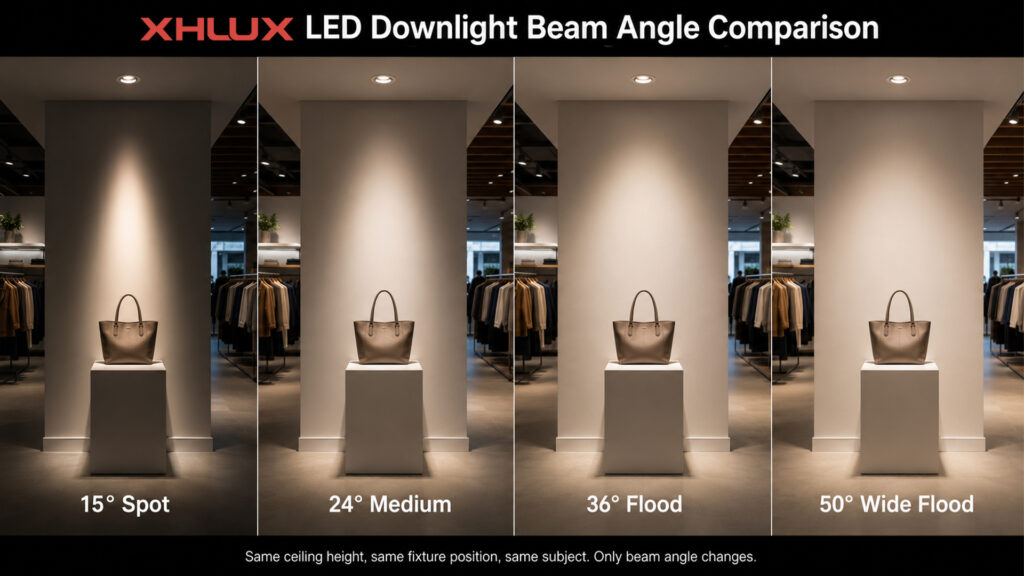
Beam angle governs how concentrated or spread the light is from a downlight. For commercial projects, it is one of the most consequential specification decisions because it directly determines whether merchandise is highlighted or lost in the general wash, whether a hotel corridor feels welcoming or harsh, and whether an artwork reads as intended.
Selected XHLUX downlight models are available with beam angle options such as 15°, 24°, 36°, and 50°, depending on the product series.
| Angle du faisceau | Light Distribution | Application typique | Example Ceiling Height |
|---|---|---|---|
| 15° | Tight, focused spot | Jewelry displays, mannequins, small artwork, hero products | 2.5m–4m |
| 24° | Medium, defined edge | Clothing racks, wall shelving, feature tables, accent lighting | 2.5m–3.5m |
| 36° | Flood, even coverage | General retail floor, hospitality ambient, office workstations | 2.5m–3m |
| 50° | Wide wash, soft edges | Supermarket aisles, wide display tables, corridor ambient | 2.5m–4m |
A single beam angle used throughout a space typically produces poor results. Narrow beams alone create harsh shadows and dark gaps between pools of light. Wide beams alone produce flat, undifferentiated lighting with no visual hierarchy. The most effective commercial installations combine angles: narrow beams for accent and feature lighting, medium or flood beams for general illumination, and wide beams for circulation.
UGR & Glare Control
Unified Glare Rating (UGR) quantifies discomfort caused by luminaires in a given installation. EN 12464-1 sets limits for indoor workspaces: UGR < 19 for general offices, UGR < 16 for display screen work and detailed visual tasks.
In the XHLUX product range, UGR < 16 is stated for the modular LED downlight system, which uses dark light output and interchangeable reflectors to control glare. For other product families, UGR values are not shown in the catalog — confirm per model when glare control is a specification requirement.
Deep-reflector designs physically recess the LED source so that it is not directly visible at typical viewing angles. Honeycomb louvers and snoots — available as accessories for XHLUX downlights — add further glare cutting for customer-facing spaces where visual comfort directly affects dwell time and experience.
Lumen Output & Efficiency
Rather than selecting by wattage alone, work backwards from the target illuminance (lux) for the space type, the ceiling height, and the beam angle. A 5W downlight with a 15° beam may deliver sufficient lux on a jewelry display at 2.5m, while a 45W downlight with a 50° beam may be needed for a high-ceilinged supermarket aisle.
XHLUX downlight efficiency ranges from approximately 40–50 lm/W for wall washer models with specialized optics to 100–130 lm/W for gimbal models with Miro reflector. Efficiency varies by product line and optical configuration — use per-model data when calculating the number of fixtures required for a given lux target.
IP & IC Ratings
- IP20: Standard for dry interior ceilings — the majority of commercial applications.
- IP54: Protected against dust and splashing water — noted on specific models.
- IP65: Dust-tight and protected against water jets — available on selected product families. Confirm the exact IP rating by product code and verify whether the rating applies to the front face only or to the complete housing.
IC (Insulation Contact) rating is relevant for retrofit installations where ceiling insulation contacts the fixture. IC rating is not shown in the XHLUX catalog — confirm per model before specifying for insulated ceiling voids.
Dimming & Control Protocols
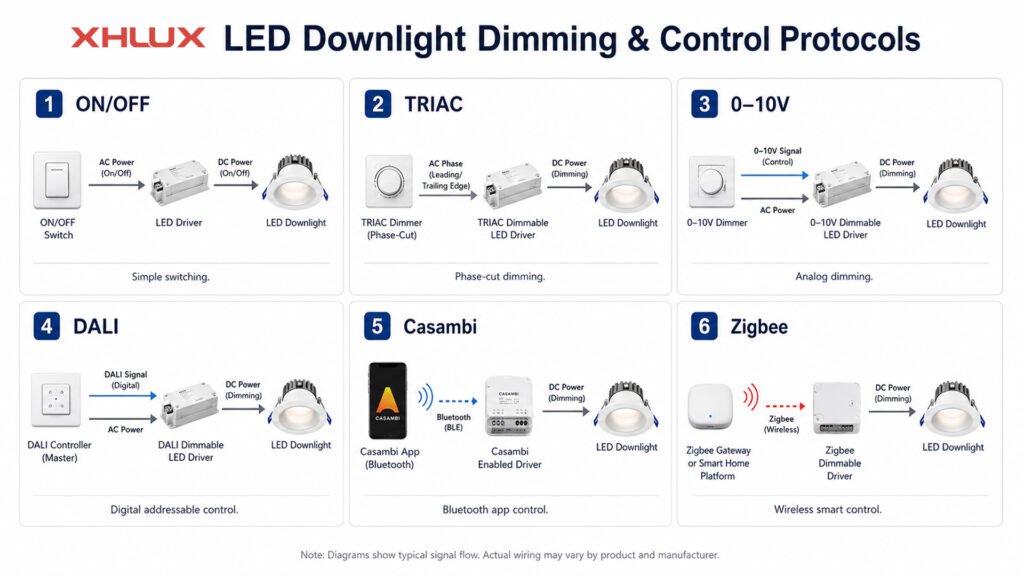
Commercial downlight projects increasingly require integration with dimming and building control systems. The protocol choice affects installation cost, wiring complexity, and how the lighting behaves over the building’s lifetime.
Selected XHLUX downlight models can be configured with six control and dimming options across the product range. Protocol availability varies by model — confirmation per product code is necessary.
| Protocol | Taper | Câblage | Two-Way Data | Devices per Segment | Best Application |
|---|---|---|---|---|---|
| DALI / DALI-2 | Wired digital | 2-wire bus | Yes | Typically 64 per bus | Large commercial, BMS integration, multi-zone with status reporting |
| 0-10V / 1-10V | Wired analog | 2 LV wires | No | ~10–15 per controller | Simple zoned dimming, cost-sensitive projects |
| Casambi / BLE | Wireless mesh | None | Yes | Depends on network design and project scale | Retrofit, flexible zoning, spaces where pulling control wire is impractical |
| ZigBee | Wireless mesh | None | Yes | Depends on gateway and mesh network design | Smart building integration, IoT platforms |
| Phase (TRIAC) | Mains dimming | None | No | 3–4 per dimmer | Basic dimming, small-scale commercial, retrofit-friendly |
| 2.4G / RF | Wireless | None | Limité | Varies by system | Simple wireless dimming, single-room control |

For new commercial construction where lighting is part of a building management system, DALI-2 (IEC 62386) provides addressable per-fixture control, two-way communication for fault reporting, and interoperability across certified manufacturers. For retrofit projects where pulling new control wiring would be disruptive or costly, Casambi or ZigBee wireless options allow dimming and scene control without structural changes. Phase (TRIAC) dimming is widely compatible but best suited to smaller installations where the dimmer-to-fixture ratio remains manageable.
Modular Downlight Systems
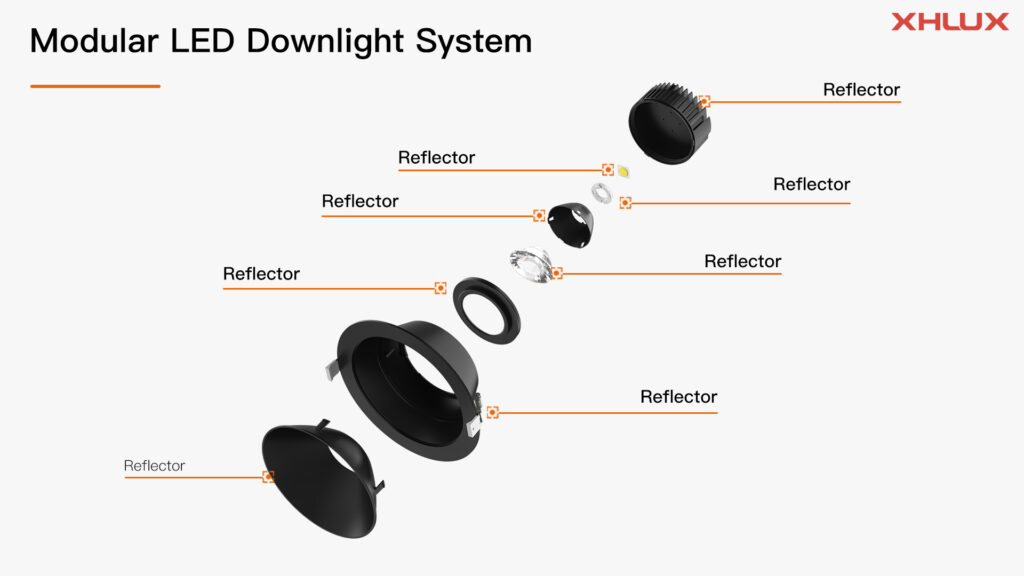
Modular downlight platforms give distributors and lighting brands a way to offer multiple visual styles and installation types from fewer base SKUs. A single module platform can support different reflector colors, beam angles, and mounting methods without requiring completely different product lines for each configuration.
The XHLUX Modular LED Lighting System demonstrates this approach. The platform uses interchangeable reflectors — available in black, white, silver, and gold — that can be changed without tools. The system specifies dark light output with UGR < 16 and COB LED modules with both single-color and dim-to-warm options.
The practical benefits for B2B buyers:
- Fewer SKUs to manage. One module platform covers several visual styles through reflector and front-ring interchangeability. This reduces the number of complete fixture models a distributor needs to stock.
- Easier product line expansion. Adding a new finish or beam option does not require developing and warehousing an entirely new product range — it can often be achieved through an additional reflector or optical accessory.
- Project-level flexibility. The same platform can be configured differently for different spaces within a single project — black reflectors for gallery areas, white for general commercial, gold for hospitality.
- Inventory efficiency. Stocking fewer complete fixture types while offering more end configurations reduces capital tied up in stock and the warehouse footprint required.

The Watex Modular series extends this approach with D65 and D80 lens and reflector options available in both orientable and fixed versions, covering 3W–12W. The MR16 Modular series applies the same principle to replaceable-lamp downlights in D80 and D100 form factors.
B2B Manufacturing: Evaluating a Commercial LED Downlight Partner
When sourcing from an OEM/ODM manufacturer, the evaluation extends beyond the individual product specification sheet to the manufacturer’s ability to deliver consistency, documentation, and certification support across production volumes.
Certification Support
For international commercial lighting projects, certification and documentation should be checked by product code, driver configuration, dimming version, installation environment, and local project requirements. A manufacturer may hold multiple certification resources, but buyers should always confirm whether the documents apply to the exact model and configuration being specified.
| Documentation / Certification | What It Supports | What Buyers Should Confirm |
|---|---|---|
| CE / EMC / RoHS / ErP documentation | Product conformity, electromagnetic compatibility, restricted-substance documentation, and energy-related documentation where applicable | Confirm whether the exact product code, driver version, and dimming configuration are covered |
| ENEC certification | Third-party luminaire safety certification for higher-assurance commercial lighting projects where accepted | Confirm whether ENEC applies to the specific model and configuration being specified |
| CB certification | IEC-based international certification support that can help with multi-country approval processes | Confirm whether the CB certificate and test reports match the product model and electrical configuration |
| SAA / RCM-related documentation | Regional electrical safety and compliance documentation for applicable project markets | Confirm whether the documentation applies to the supplied product version, importer requirements, and project location |
| IEC / EN test standards | Luminaire safety and performance references used in many commercial project specifications | Confirm which standards are required by the project consultant, importer, contractor, or local authority |
| Photometric and driver documents | IES files, LM-79 reports, LM-80 data, driver datasheets, dimming compatibility, and flicker-related information where available | Request per-model files before final specification or bulk order |
| Local compliance documents | Country-specific or project-specific approval requirements not covered by general certificates | Confirm with the importer, contractor, consultant, or local authority before procurement |
XHLUX can provide certification and documentation support for suitable commercial lighting projects. Available documents should always be checked against the exact product code, driver configuration, dimming version, and target project requirements.
Quality Indicators
Several indicators help assess manufacturing quality beyond the specification sheet:
- Housing material: ADC12 die-cast aluminum — used across most XHLUX downlight product lines — provides better thermal conductivity and structural rigidity than stamped steel or polymer alternatives. 6063 aluminum is used for specific linear/commercial series. The material choice directly affects how well the fixture manages heat over extended operating hours.
- Warranty term: 3–5 years is the stated warranty range across the product catalog. Longer warranty periods generally signal manufacturer confidence in product longevity.
- Color consistency: Although SDCM values are not published in the catalog, tight binning (SDCM ≤ 3) is the industry benchmark for commercial projects where visible color variation between adjacent fixtures is unacceptable. Request binning data when color consistency is a project requirement.
- Photometric documentation: For specification projects, buyers should request LM-79 reports, LM-80 data, IES files, and driver specification sheets where available. These documents are standard for commercial lighting projects and should be obtainable from the manufacturer.
- Driver specifications: Driver brand and detailed electrical specifications are not shown in the catalog. Request driver data per model — key parameters include power factor (> 0.9 for commercial loads), flicker performance (IEEE 1789), and the specific dimming compatibility matrix for the driver and protocol combination being specified.
OEM/ODM Customization
XHLUX downlights can be configured for OEM/ODM projects across several dimensions: cut-out sizes, CCT tuning, beam angle options, trim finishes and colors, dimming protocol selection, private labeling, and packaging. Customization scope, minimum order quantity, and lead time depend on the product model and the nature of the customization — confirm with the manufacturer during the specification phase. For more detail, see the page on XHLUX OEM/ODM lighting manufacturing.
Sample Evaluation
Before committing to production volumes, evaluating physical samples reduces the risk of specification surprises. Key areas to assess:
- Qualité de la lumière: Verify CRI, CCT accuracy, and beam pattern against the specification. Check for color consistency across multiple samples from the same batch.
- Build quality: Examine housing finish, heat sink design, spring clip tension for recessed models, and general fit and finish.
- Dimming performance: Test across the full dimming range with the specified dimmer or controller. Check for flicker, audible noise from the driver, and smooth transition at the low end of the dimming curve.
- Driver behavior: Run the sample for an extended period and check thermal performance. Confirm compatibility with the specified dimming protocol under load.
- Documentation: Verify that the LM-79 report, certification documents, and driver specification sheet match the physical sample received.
Commercial Downlights by Application
Different commercial environments make different demands on downlight specification. The matrix below maps common space types to recommended parameter ranges based on current industry practice.
| Application | Downlight Type | CCT | CRI | Angle du faisceau | Special Considerations |
|---|---|---|---|---|---|
| Retail — fashion | Adjustable + fixed ambient | 3000K | Ra90+ | 15° accent, 36° ambient | High R9 for fabric color. Accent-to-ambient 3:1 ratio. |
| Retail — supermarket | Fixed, high-efficiency | 3500K–4000K | Ra80+–Ra90+ | 36°–50° ambient | Confirm per project requirements and color consistency needs. |
| Retail — jewelry/luxury | Adjustable narrow beam | 3000K | Ra95+ | 15° | Maximum sparkle and contrast. UV-free. DALI per-fixture control. |
| Hotel — lobby | Fixed + adjustable + wall washer | 2700K–3000K | Ra90+ | 24°–36° | Dim-to-warm capability. Low glare for guest comfort. |
| Hotel — guest room | Fixed, trimless optional | 2700K–3000K | Ra90+ | 36°–50° | Quiet driver. Dimming compatible with room control system. |
| Office — general | Fixed recessed or modular | 3500K–4000K | Ra80+ | 36°–50° | Confirm applicable workplace lighting and glare requirements. Flicker-free for screen-based work. |
| Office — meeting room | Fixed + adjustable | 3000K–4000K | Ra90+ | 24°–36° | Scene control via DALI or Casambi for presentation modes. |
| Museum / gallery | Adjustable narrow + wall washer | 2700K–3500K | Ra95+ | 15°–24° | UV-free LED. DALI addressable. Low-glare optics recommended; request per-model UGR data where required. |
| Restaurant | Fixed + adjustable + pendant | 2700K–3000K | Ra90+ | 24°–36° ambient, 15° table accent | Dim-to-warm for evening. Low glare for dining comfort. |
| Salle d'exposition | Adjustable / orientable | 3000K–4000K | Ra90+ | 15°–36° mix | Tunable white useful for changing displays. Modular for flexibility. |
| Healthcare | Fixed, anti-glare | 4000K–5000K | Ra90+ | 36°–50° | Flicker-free. Easy-clean surfaces. IP-rated for wet clinical areas. |
| Public areas / corridors | Fixé | 3000K–4000K | Ra80+ | 36°–50° | Motion sensor integration for energy. Fire-rated where required by building code. |
Installation & Compliance Overview
The installation approach depends on the ceiling construction.
Suspended ceilings: Fixtures mount into or onto the ceiling grid. The grid must be capable of supporting the fixture weight, or independent support wires to the structural ceiling above should be used. Modular recessed downlights are built for standard T-bar grid dimensions.
Plasterboard ceilings: Fixtures are either fixed before plastering — as with trimless/embedded-part models — or cut in after the ceiling is finished, as with standard recessed downlights. Cut-out dimensions must match the fixture specification precisely; oversized cuts are difficult to remedy.
plafonds en béton: Where recessing is not practical, surface-mounted or suspended pendant versions of downlights are used. Fixings must be rated for the fixture weight and the substrate.
Standards and requirements often referenced in commercial downlight projects include:
- IEC / EN 60598 — Luminaire safety requirements
- Workplace lighting standards — Maintained illuminance, glare limits, and color rendering requirements may vary by project location
- Interior lighting standards — Local or regional interior lighting standards may apply depending on the project country
- Local building codes — Fire rating, installation method, emergency lighting, and ceiling requirements should be confirmed with the project consultant or local authority
Fire-rated downlights are required where the ceiling is a fire barrier between floors or between separate occupancies. The fire rating (30/60/90 minutes) must match the required fire resistance period of the ceiling assembly. Fire rating is not shown in the XHLUX catalog — confirm per model and per project requirement.
FAQ
What is the difference between Ra80+, Ra90+, and Ra95+ downlights?
Ra80+ is the entry CRI tier, suitable for general commercial areas where color accuracy is not critical. Ra90+ is recommended for most customer-facing spaces — retail floors, hotels, restaurants, offices. Ra95+ is appropriate for museums, galleries, and luxury retail where precise color rendering affects how merchandise or artwork is perceived. Selected XHLUX downlight families can be specified with Ra80+, Ra90+, or Ra95+ options depending on the product model and configuration.
Which dimming protocols are supported?
Six control options are available across the product range: ZigBee, 2.4G/RF, Phase (TRIAC), DALI, 0/1-10V, and Casambi/BLE. Protocol availability varies by model — confirm the specific dimming option for the product code being specified before ordering.
Are IP65-rated downlights available?
The XHLUX catalog includes IP-rated options on selected downlight families, including IP65 on selected wall-washer or Watex models. Confirm the exact IP rating by product code and verify whether it applies to the front face only or the complete housing before specifying for wet-location installations.
What warranty is provided?
3–5 years, depending on the product line.
Can downlights be customized for OEM/ODM projects?
Yes. Customization options include cut-out sizes, CCT tuning, beam angles, trim finishes and colors, dimming protocols, private labeling, and packaging. MOQ, lead time, and the scope of available customization depend on the product model — confirm during the specification phase.
Are SDCM values published?
SDCM values are not shown in the catalog. For projects where color consistency is critical, request per-model SDCM data. SDCM ≤ 3 is the industry recommendation for commercial spaces.
What material are the downlight housings?
ADC12 die-cast aluminum is used for the majority of product lines. 6063 aluminum is used for specific linear/commercial series. Die-cast aluminum provides better thermal management and structural durability than stamped metal alternatives.
Conclusion
The specification decisions that produce a successful commercial downlight installation — beam angle, CRI, CCT, UGR, control protocol, installation type — are interconnected. Changing one parameter affects how the others perform. A narrow beam in a low-ceilinged space creates glare. A high-CRI fixture on a poor-quality driver flickers and drifts. An IP65 rating on the front face means little if the rear of the housing is exposed to moisture.
For B2B buyers evaluating OEM/ODM manufacturing partners, the same principle of interconnection applies. A competitive unit price means less if the manufacturer cannot provide LM-79 reports, cannot support certification documentation for the target market, or cannot maintain color consistency across a production batch. The specification, the documentation, and the manufacturing capability need to be evaluated together — not as separate line items.
If you are developing a commercial LED downlight product line or sourcing downlights for hotel, office, retail, restaurant, showroom, or architectural projects, our team can help you evaluate suitable product options, cut-out sizes, beam angles, dimming versions, and OEM/ODM possibilities for your specific application.