XHLUX
XHLUX
The ceiling is cast concrete. The programme will not allow a suspended grid. Recessing is off the table. A surface mount linear led bar is the right luminaire family—but the electrician asks where the feed disappears when there is no void above the slab.
Surface mount solves mounting without a slot; it does not make wiring invisible by default. On a solid ceiling, the cleanest result depends on whether you can chase the slab, use an existing junction point, feed through the rear of the fixture, or accept aligned surface conduit.
This page is a wiring-route decision guide for ceiling surface linear light runs on non-accessible structure. It is not a step-by-step termination manual, not the surface-mounted linear lights for ceilings without recessing selection essay, and not open-ceiling suspended feed planning (see Hanging Linear Light Fixture: What Open Ceilings Expose when cables hang below structure).
For the wider mount map, see How to Choose Linear LED Lighting: Suspended, Surface, or Recessed?—then return here when the ceiling is solid and the feed path is still an open question.
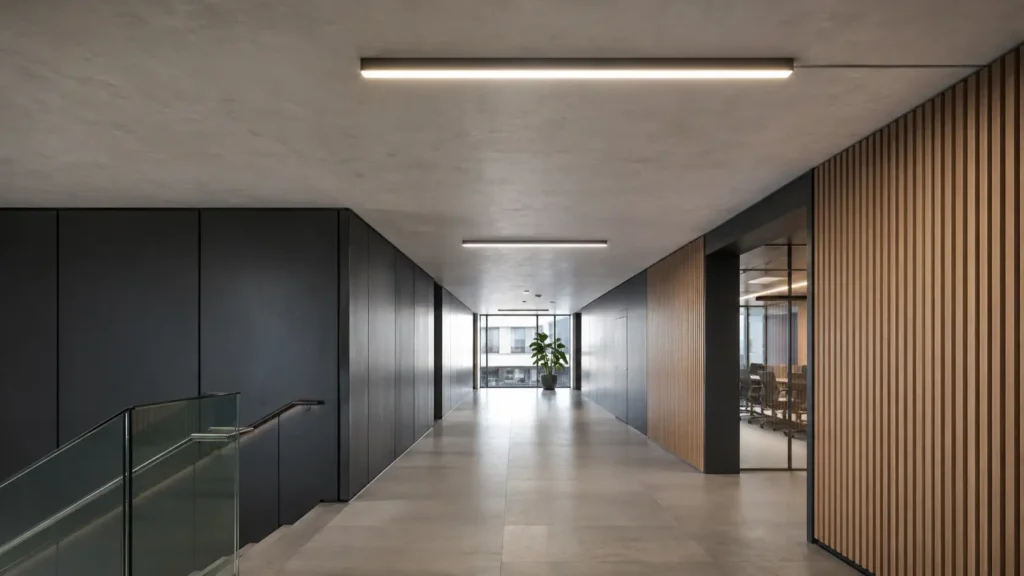
TL;DR: On a solid ceiling, wiring cannot simply disappear above the luminaire. Plan rear feed, end feed, surface raceway or a remote driver location before you set profile length and finish colour.
Table of contents
- 🧱 1. Why is wiring harder on a solid ceiling?
- 🔙 2. Rear feed: the cleanest option when the ceiling can be drilled
- ↔️ 3. End feed: when rear entry is not possible
- 📐 4. Surface conduit or raceway: when you cannot hide the cable
- 🔌 5. Where should the driver go?
- 🔗 6. What changes on a continuous linear run?
- 🎛️ 7. How do dimming and control wires affect a solid-ceiling installation?
- ❌ 8. Common wiring mistakes that make surface linear lights look bad
- ✅ 9. What to check before ordering
- What to do next
- 🏁 Conclusion
- FAQ
🧱 1. Why is wiring harder on a solid ceiling?
A surface mount linear ceiling fixture sits on the visible plane. There is no suspended ceiling void to absorb cable kits, junction boxes or driver boxes.
On solid concrete or similarly non-accessible structure:
- There is no cavity above the luminaire to hide excess cable
- The fixture profile sits tight to the slab—any exposed conductor or oversized box reads from the floor
- Linear runs are long—a small wiring fault at one metre repeats along the whole axis
The fixture can be surface-mounted, but the electrical feed still needs a route. Treat “hide wiring” as choosing the least visible acceptable route, not assuming the ceiling will swallow it.
🎯 Can you hide every conductor above a surface linear bar on concrete?
No. Without a void, chase, aligned conduit or a product-designed rear entry, some part of the feed will remain visible or require surface enclosure.
🔙 2. Rear feed: the cleanest option when the ceiling can be drilled
Rear feed means the supply enters through the ceiling behind the luminaire body—often the cleanest finish when the outlet aligns with the product wiring entry.
Best when:
- A cable outlet or junction already exists behind the run
- The surface mount linear ceiling fixture allows rear-entry grommets or a wiring cavity
- You can drill accurately without hitting structure or other services
Surface mount LED wiring through the rear works only when feed point and fixture entry match. Do not assume every profile accepts a hole at any coordinate—check the manufacturer drawing for permitted entry zones, terminal space and bend radius.
Coordinate any slab penetration with the approved RCP and structural/services information. Do not drill or chase the slab until the permitted penetration zone has been confirmed for the project.
🎯 Is rear feed always possible on site?
No. It needs alignment between ceiling outlet, permitted entry point and enough space inside the housing for terminations.
↔️ 3. End feed: when rear entry is not possible
End feed brings the cable in at one end of the linear body—typical when the power point approaches along a wall or when renovation cannot place an outlet behind the run.
Suits:
- Retrofit slabs where chasing is banned
- Runs that start adjacent to a column or bulkhead
- Products with manufacturer-approved end-entry ports or documented end-feed accessories
Trade-offs:
- Conductor path may remain visible along the ceiling edge or wall junction
- End caps must list cable entry size, gland type and bend radius
- On a continuous linear run, only the first module may accept mains—later sections may need internal feed-through rated for your load
End feed is a legitimate linear LED mounting options path when rear entry fails; it is not a failure—just a finish decision you should make before powder coat and length are fixed.
🎯 Does end feed always look worse than rear feed?
Not always—but expect visible routing unless conduit is coordinated with the fixture axis.
📐 4. Surface conduit or raceway: when you cannot hide the cable
Some sites cannot chase concrete, cannot add a ceiling void and cannot hit a rear outlet. Pretending the cable will vanish creates field hacks.
When concealed routing is impossible, specify intentional surface routing:
- Surface conduit or trunking on axis with the luminaire
- Entry at an end rather than mid-span
- Paint or finish matched to ceiling or housing colour
The goal is not invisibility—it is make the wiring intentional and aligned with the fixture. A short, straight raceway parallel to a 4 m bar often reads cleaner than multiple ad hoc drops.
Local rules may restrict chasing, conduit type or fire rating—check the project spec before you promise a fully flush result.
🎯 Should you avoid surface conduit on feature ceilings?
Only if the brief forbids it—otherwise aligned raceway beats random exposed cable.
🔌 5. Where should the driver go?
Driver placement splits into two common architectures.
Integrated driver
The driver lives inside the luminaire housing. On a solid ceiling this is often the simplest story: one body, one feed point, fewer external boxes—provided internal heat and access clearances are met on the datasheet.
Remote driver
When the driver must sit outside the profile:
- Surface junction or service box at an accessible location
- Nearby cabinet, riser or plant zone
- Listed surface enclosure with documented clearance
Remote driver must remain accessible; do not bury a serviceable driver inside concrete or an inaccessible cavity. Future maintenance is part of the wiring plan, not an afterthought.
🎯 Can a remote driver live inside the concrete ceiling?
No—only in an accessible enclosure you can open for service.
🔗 6. What changes on a continuous linear run?
Linear fixtures differ from a single disc luminaire: length introduces join logic.
On a continuous surface mount linear led row, clarify before order:
- Which module accepts the first mains entry
- Whether intermediate sections allow internal feed-through
- Driver count—one driver per segment versus distributed modules
- Connector current and voltage limits (product-specific, not a universal maximum length)
- Whether emergency or control conductors must pass through joins
A continuous run does not always mean one power feed for the entire run. Electrical design may require segmented feeds even when the visible profile reads as one line.
For join alignment and dark-seam risk on long rows, cross-check the continuous-run guidance in Stop Dark Seams Before You Join LED Linear Fixtures—mechanical joins and electrical feeds are separate approvals.
🎯 Can one ceiling outlet feed a 15 m surface bar by default?
Not without product documentation that explicitly allows that topology and load.
🎛️ 7. How do dimming and control wires affect a solid-ceiling installation?
A typical Class I ON/OFF feed may use L/N/PE, while dimming, emergency or control schemes can require additional conductors or a different wiring arrangement.
Common additions:
- DALI — separate control bus conductors
- 0–10 V / 1–10 V — dimming pair plus mains
- PUSH or proprietary dimming interfaces
- Emergency — maintained supply or monitoring conductors
Control lines increase conductor count. A ceiling outlet sized for L/N/PE only may be inadequate once dimming or emergency is added. Check:
- Total conductors at the outlet
- Gland and entry size on the first module
- Driver protocol compatibility
- Whether control wiring can pass through internal joins
This section names interfaces only—protocol detail belongs on the driver submittal, not in a generic site guide.
🎯 Does a dimmable linear bar always use the same wiring as ON/OFF?
No. Control type changes conductor count and entry requirements.
❌ 8. Common wiring mistakes that make surface linear lights look bad
Field problems that show up on long surface runs:
- Cable droops beside the profile instead of entering through a designed port
- Junction box wider than the luminaire body, centred on the run
- Conduit approaching at an angle while the bar is straight
- Rear feed hole misaligned with the wiring cavity—forcing sidewise strain on conductors
- Driver screwed into a cavity that cannot be opened later
- Cable compressed under the housing feet
- Every module on a joined run brought out to its own surface cable
Most are planning errors, not product defects. Mark feed type on the RCP before fabrication.
🎯 Is a visible cable always an installation error?
Often it signals the wrong feed strategy for a solid ceiling—not a call to “try harder” to hide wire without a route.
✅ 9. What to check before ordering
Solid-ceiling wiring checklist—run through these before PO:
- Is the ceiling solid concrete or another non-accessible structure?
- Where is the existing power outlet (or permitted new point)?
- Can the surface mount linear ceiling fixture accept rear feed at that coordinate?
- Is a documented end-feed option available if rear feed fails?
- Is the driver integrated or remote—and where will remote units be serviced?
- How many conductors are required (mains only vs dimming / emergency)?
- Does the run need DALI, 0–10 V or emergency wiring through joins?
- Can wiring pass internally between connected sections per the datasheet?
- Is surface conduit acceptable if concealed routing is impossible?
- Who maintains driver access after ceiling finishes are complete?
Wiring method comparison
| Wiring method | Best when | Main limitation |
|---|---|---|
| Rear feed | Power point can align behind fixture | Requires accurate ceiling outlet position |
| End feed | Cable approaches from one end | Cable or conduit may remain visible |
| Surface conduit | Solid ceiling cannot be chased | Must be visually coordinated with the bar |
| Remote driver box | Driver cannot fit inside fixture | Needs accessible location |
| Internal through-wiring | Continuous run product supports it | Limited by electrical design and connector rating |
What to do next
- Mark feed type (rear, end or conduit) on the RCP before length and colour are set.
- Request a wiring diagram for the exact SKU—including join modules and driver location.
- Install a short mock-up on the real ceiling substrate when finish is critical.
Installing surface mount linear led lighting on a solid ceiling? Send XHLUX the ceiling type, power-feed position, fixture length and control method. We can help check whether rear feed, end feed or surface conduit is the cleanest wiring approach before production.
🏁 Conclusion: How do you hide wiring for surface mount linear LED on a solid ceiling?
You do not hide it inside a void that is not there—you choose a route the ceiling and product can support. Rear feed when alignment is possible; end feed or aligned raceway when it is not; integrated or accessible remote drivers; segmented feeds when the electrical design demands it. Surface mount fixes the luminaire to the slab; wiring still needs its own drawing line.
Explore our related blog posts:
- How to Tell if Your Ceiling Needs Suspended or Surface Linear Lighting
- Stop Dark Seams Before You Join LED Linear Fixtures
- What Is an LED Linear Luminaire and How Is It Installed?
Technical Notes
- Conductor sizes, IP ratings, fire barriers and local electrical codes are project-specific—this page does not replace the licensed design or manufacturer instructions.
- No universal maximum run length appears here; use the submittal for connector, driver and thermal limits.
- Chasing concrete may be restricted structurally or by lease terms—check before promising concealed routes.