XHLUX
XHLUX
Two linear led fittings land on the same comparison sheet—both labelled 12 W/m, both 2 m long. One datasheet shows 1 800 lm/m; the other shows 1 200 lm/m. The buyer asks which line is “the brighter 12 W/m fitting,” as if wattage per metre were a brightness score.
Wattage per meter describes the electrical power assigned per unit length, but you must check whether the manufacturer means LED-module load or complete luminaire input power. It does not tell you, by itself, how bright the fitting is, how efficient it is, or how much useful light reaches the space.
This page explains what linear LED wattage per meter actually signals—and what it cannot replace. It is not a per-metre price breakdown (see What’s Actually Inside a Linear Light Price Per Meter), not how length and wattage move list price (see How Linear LED Lighting Prices Vary by Length and Wattage), and not hanging-bar quote row alignment (see Why Do Hanging LED Light Bar Specs Vary So Much Between Quotes?).
For the wider suspend / surface / recess map, start with How to Choose Linear LED Lighting: Suspended, Surface, or Recessed?—then return here when two fittings share a W/m headline but not the same light output.
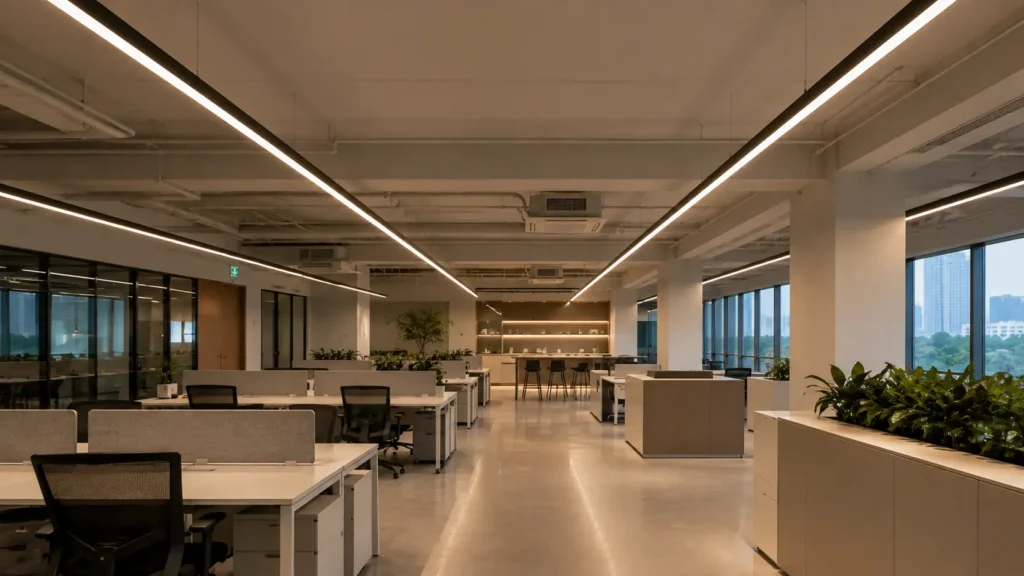
TL;DR: W/m is electrical power density along the bar. Same W/m does not mean same lm/m. Compare lm/m, lm/W, total fixture watts and lumens, optic losses and driver electrical match before you treat two catalogue lines as equivalent.
Table of contents
- ⚡ 1. What does W/m actually mean?
- 💡 2. Why W/m does not tell you how bright the fitting is
- 📊 3. W/m vs lm/m: which number should buyers compare?
- 🔍 4. Why two fittings with the same W/m can perform differently
- 📏 5. Does a longer fitting always use more power?
- 🔌 6. Why driver selection matters when W/m changes
- 📈 7. Does higher W/m mean better linear lighting?
- ✅ 8. When is W/m actually useful?
- 📋 9. What to check next to W/m before ordering
- What to do next
- 🏁 Conclusion
- FAQ
⚡ 1. What does W/m actually mean?
W/m (watts per metre) describes how much electrical power is attributed to each metre of rated fixture length—but check what the figure measures. On some datasheets it is LED module or board load only; on others it is complete luminaire input power at the terminals (including driver losses where the maker rolls them in). Do not compare two W/m lines until both use the same basis.
On a quoted linear LED wattage per meter figure, ask module-only versus fitting input before you multiply by length or match drivers.
At a fixed W/m rating for a given product family—and the same measurement basis:
- 10 W/m × 1 m ≈ 10 W total
- 10 W/m × 2 m ≈ 20 W total
- 10 W/m × 3 m ≈ 30 W total
That is a power scale along the body—not a brightness scale. W/m = electrical power density along the fixture length.
🎯 Does 10 W/m mean 10 lumens per metre?
No. W/m is watts per metre; lumens per metre is a separate number from efficacy and optics.
💡 2. Why W/m does not tell you how bright the fitting is
Two catalogue lines can both show 10 W/m and deliver very different light.
Illustrative example only—not a universal rule:
- Line A at 10 W/m and 100 lm/W → about 1 000 lm/m
- Line B at 10 W/m and 150 lm/W → about 1 500 lm/m
This calculation is valid only when W/m and lm/W use the same system boundary—for example, complete-luminaire input W/m paired with luminaire efficacy.
Same W/m does not mean same lm/m. To judge brightness on the schedule, read delivered lumens—usually as lm/m on the datasheet or total lm for the quoted length—not W/m alone.
🎯 Can you rank two linear fittings by W/m alone?
No. lm/m and lm/W (or total lm) tell you output and efficiency; W/m only tells you power density.
📊 3. W/m vs lm/m: which number should buyers compare?
Use each metric for what it actually measures:
| Metric | What it tells you |
|---|---|
| W/m | Power consumed per metre |
| lm/m | Light output per metre |
| lm/W | Luminous efficacy (note whether LED, system or luminaire level) |
| Total W | Total fixture power |
| Total lm | Total fixture output |
W/m helps you think about connected load and energy use. lm/m helps you think about how much light each metre of bar delivers. lm/W may refer to LED package efficacy, a driver-plus-LED figure, or luminaire efficacy (delivered lumens versus power in at the fitting)—those are different system boundaries. Read the test note before you rank two suppliers on lm/W alone.
On a linear LED fixture specs sheet, all three can appear on the same row—treat them as separate columns, not one interchangeable headline.
🎯 Is lm/m always the better number than W/m?
For brightness comparisons, usually yes. For circuit load and driver sizing, W/m and total W still matter.
🔍 4. Why two linear LED fittings with the same W/m can perform differently
Matching W/m on a quote does not prove matching performance. Common reasons:
- LED package efficacy — different chips or bins at the same drive power
- Drive current — same wattage, different current/voltage split on the board
- Diffuser transmission — same electrical load, less light leaving the aperture
- Reflector / optics — redistribution and losses
- Thermal design — junction temperature affects maintained output
- Internal geometry — cavity depth, LED pitch, aperture width
The gap is usually missing data, not necessarily “false” labelling. W/m alone does not carry enough information to compare linear ceiling fittings from two vendors.
🎯 Does identical W/m prove identical light on site?
No. Efficacy, optics and thermal path still separate the lines.
📏 5. Does a longer linear fitting always use more power?
When a series is built at a fixed W/m for all stocked lengths, total power usually rises with length: 12 W/m on a 3 m bar draws more watts than the same family at 1 m.
But longer catalogue lengths are not always simple multiples. A 3 m version may use a different LED board layout, drive current, driver model or factory W/m setting than a 1 m SKU in the same brochure family.
Do not multiply a short-length W/m by metres unless the manufacturer states that series scales that way. Linear fitting installation drawings should show the exact quoted length and total W for that code—not a guessed extension.
🎯 Can you scale total watts as length × W/m without asking the maker?
Only when the datasheet or submittal says that family uses constant W/m across lengths.
🔌 6. Why driver selection matters when W/m changes
W/m helps estimate nominal load—for example, 15 W/m × 2 m ≈ 30 W on paper—but the driver match is not only “≥ 30 W” on the label.
Check output current, output voltage range, loading versus rated power, dimming protocol, headroom for temperature, and whether the board is wired in series, parallel or hybrid.
W/m helps estimate load; it does not fully define the driver. A higher W/m band may need a different driver model or programmed setting—depending on whether the new load still sits inside the driver’s voltage and current operating window—not every W/m change automatically requires a new driver SKU.
🎯 Is matching driver wattage to length × W/m enough?
No. Current, voltage window and control compatibility still need to match the board build.
📈 7. Does higher W/m mean better linear lighting?
Not automatically. Higher W/m may mean higher output—or it may mean lower efficacy and more heat for the same lm/m.
Illustrative pair:
- 15 W/m at 100 lm/W → about 1 500 lm/m
- 10 W/m at 150 lm/W → about 1 500 lm/m
As above, this comparison is valid only when W/m and lm/W are reported on the same system boundary.
Same lm/m, different power and driver load. “More W/m” is not a shortcut to “better light” without the lm/m and lm/W columns.
🎯 Should you always pick the higher W/m line?
No. Compare lm/m and lm/W first; higher W/m can mean more power without more useful light.
✅ 8. When is W/m actually useful?
W/m earns its place when you need power density, not when you need brightness ranking:
- estimating total connected load on a circuit
- comparing power density between similar optical families
- planning driver capacity and panel loading
- checking energy use on long continuous runs
- sanity-checking whether total W fits the quoted length
Use W/m together with lm/m, total lm and driver data—not instead of them.
🎯 Is W/m useless for linear LED fittings?
No—it is essential for load and energy; it is just incomplete for brightness by itself.
📋 9. What to check next to W/m before ordering
When two lines show the same W/m, open these columns next:
- lm/m
- lm/W
- total fixture wattage for the quoted length
- total fixture lumens for the quoted length
- diffuser / optic type
- drive current
- driver output voltage and current range
- exact fixture length on the schedule
| If two fittings both say 12 W/m | What else should you check? |
|---|---|
| Brightness | lm/m |
| Efficiency | lm/W |
| Whole fixture load | Total W |
| Whole fixture output | Total lm |
| Optical loss | Diffuser / optic |
| Electrical match | Driver current / voltage |
This checklist stays on W/m comparison only—not a full project specification audit.
What to do next
- Copy W/m, lm/m, lm/W, total W and total lm into one comparison row per vendor.
- Ask whether longer lengths scale at fixed W/m or change board/driver build.
- Match driver electricals to the quoted board—not only nominal watts.
- Send one representative length to calculation or mock-up if the brief is illuminance-led.
Triage:
- Per-metre price breakdown → What’s Actually Inside a Linear Light Price Per Meter (plain text; not duplicated here).
- How list price moves with length and wattage → price-variation guide linked in the boundary.
- Hang-bar quote row alignment → hanging bar quote-variation guide linked in the boundary.
Comparing linear LED fittings by W/m? Send XHLUX the required length, target lm/m, efficacy and control method. We can help check whether two quoted fittings are really comparable—or only share the same wattage-per-metre number.
🏁 Conclusion: What does wattage per meter actually tell you about linear LED fittings?
W/m tells you how much power the fitting uses per metre. It does not tell you how much useful light you get per metre. Two lines can share 10 W/m or 12 W/m and still diverge on lm/m, lm/W, driver load and delivered lumens once length and optics are applied. Use W/m for load and energy; use lm/m, total lm and driver match for brightness and comparability.
Explore our related blog posts:
- What’s Actually Inside a Linear Light Price Per Meter
- How to Choose Linear LED Luminaires for Office and Retail Ceilings
- Do Linear Lights Need Different Ceiling Recess Depths by Mount Type?
Technical Notes
- Illustrative lm/W examples in this draft are teaching pairs only—not guaranteed performance for any XHLUX or third-party SKU.
- Per-metre pricing, hang-bar quote templates and full luminaire selection stay on the sister pages named in the boundary—not duplicated here.
- Local electrical, listing, dimming and emergency rules still apply. Check project specs and codes before install.