XHLUX
XHLUX
Two versions of the same suspended linear fixture sit in the quotation—one black, one white. Same wattage, same length, same LED specification. Does the black version actually produce less light because black surfaces absorb more light?
Not necessarily. If the colour change is limited to the outside housing, light output may remain essentially the same. The answer changes when black surfaces become part of the optical system.
This page explains when a black suspended linear light may—or may not—deliver fewer lumens than a white twin. It is not a finish-and-mount selection guide (that stays on How to Choose Black Linear Lighting for Commercial Ceilings), and it is not the visual-blend read covered in Does White Linear Lighting Read More Uniform Than Black in Commercial Ceilings? (draft).
For the wider suspend / surface / recess map, start with How to Choose Linear LED Lighting: Suspended, Surface, or Recessed?—then return here for black-versus-white optical questions only.
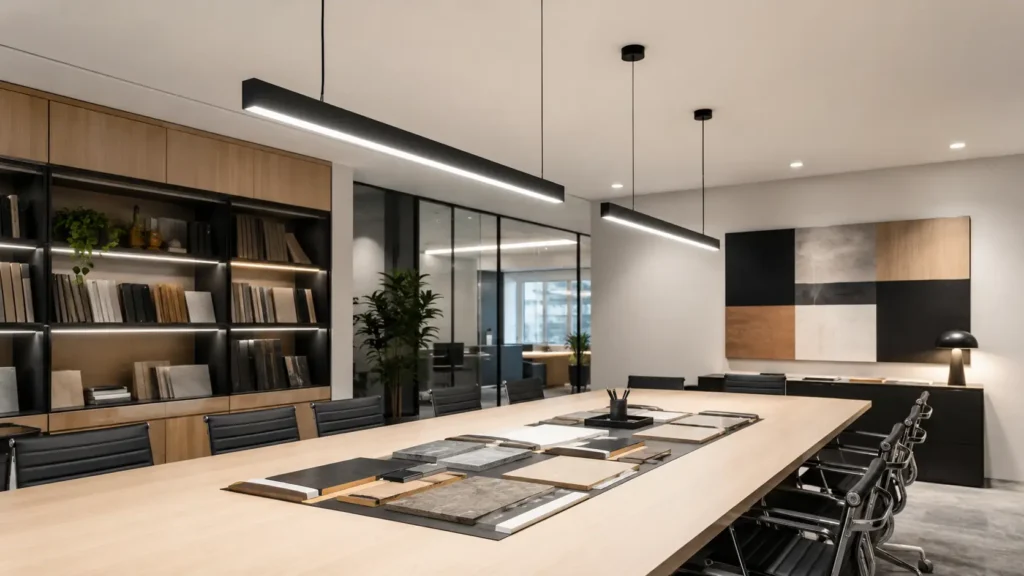
TL;DR: A black suspended linear light does not automatically produce fewer lumens than the white version. If LED modules, drive current, diffuser and internal optics are identical, an exterior black finish alone may have little effect on delivered light. Output can change when black louvers, reflectors, internal cavities or different optical accessories absorb or redirect light. Always compare the actual photometric data for the exact black and white configurations.
Table of contents
- 🔦 1. Does a black housing actually reduce light output?
- 📐 2. What actually determines lumen output?
- ⚠️ 3. When can the black version really produce less light?
- 👁 4. Why can a black fixture look darker when lumens match?
- 📂 5. Should black and white versions share the same photometric file?
- ✅ 6. How to compare black and white suspended linear versions
- 🎨 7. When should you choose black anyway?
- Change impact at a glance
- What to do next
- 🏁 Conclusion
- FAQ
🔦 1. Does a black housing actually reduce light output?
“Black absorbs light, so the black fixture must be dimmer” mixes a true physics note with the wrong object.
Exterior housing parts that sit outside the optical path—top surfaces, side walls, suspension canopy, end caps, external aluminium extrusion—do not usually redirect the beam. Painting those parts black instead of white should not be read as an automatic lumen cut.
Optical surfaces are different. Reflectors, optical chambers, louvers and baffles clearly sit in the light path. Diffuser surrounds, internal walls and lens holders matter for output only when they actually intercept, reflect or absorb light—not merely because they sit near the aperture. Turning true optical-path finishes from high reflectance to black can absorb more stray light and change delivered output or distribution.
| Part changes from white to black | Likely impact on light output |
|---|---|
| External housing | Usually limited if outside the optical path |
| Canopy / suspension parts | Normally no meaningful lumen effect |
| Internal reflector | Can affect output and distribution |
| Louver / baffle | Can reduce stray light and change efficiency |
| Optical cavity | May affect delivered lumens |
A matte black linear pendant finish on the bar body alone is still an exterior-colour question until you know whether the same SKU also changed the cavity or louver.
🎯 Does painting the housing black always cut lumens?
No. Exterior-only finish changes usually sit outside the optical path; optical-surface colour changes can matter.
📐 2. What actually determines lumen output?
When you compare black and white lines on a quote, housing colour is only one possible variable—and often not the first one a professional buyer should check.
Look at these drivers first:
- LED package — the module’s own lumen rating.
- Drive current — the same LED can deliver different output at different current.
- Optical efficiency — lenses, reflectors and baffles lose or redistribute light.
- Diffuser transmission — opal, microprismatic and clear covers transmit differently.
- Thermal design — different internal builds can change LED operating temperature and therefore actual output; that is a structure difference, not a finish-colour claim.
- Fixture geometry — source-to-diffuser distance, cavity depth and aperture width shape what leaves the aperture.
A black suspended ceiling fixture and its white twin should be compared on these items before anyone blames paint for a lux shortfall.
🎯 Is housing colour the first lumen variable to check?
Usually no. LED, current, optics, diffuser, thermal path and geometry come first.
⚠️ 3. When can the black version really produce less light?
Do not write the story as “black and white are always identical.” Output can diverge in real catalogues.
Black internal baffles or louvers. Black anti-glare grids are meant to absorb high-angle stray light, cut glare and control visual brightness. Luminaire efficiency can differ from a version without that black louver—even at the same LED wattage.
Black optical cavity. If the cavity takes part in multiple reflections, switching white → black can reduce light that would have bounced back toward the aperture.
Different optics bundled with the black SKU. On many quotations the black line is not “white fixture + black paint.” It is another product code that may also change diffuser, reflector, aperture, louver or LED board. Photos alone do not prove optical identity. That is a configuration difference, not light loss caused by black colour itself.
Decorative black parts in the beam path. Black trim, baffles or edges that enter the luminous aperture can affect cutoff, distribution or output. A black linear drop light kit may stay cosmetic on the drop alone—until those black parts sit inside the aperture.
🎯 When should you treat black as optically different?
When baffles, cavities, bundled optics or aperture edges change—not when only the outer paint code changes.
👁 4. Why can a black fixture look darker when lumens match?
Observers often say the black bar “looks darker.” That can be perception, not a lumen delta.
White housings bounce more ambient light, so the unlit or half-lit body reads brighter on the ceiling. Black housings absorb more ambient light, so the body reads as a darker object. People then equate “darker fixture” with “fewer delivered lumens.”
The reverse can also happen: a black body against a bright diffuser raises contrast, so the luminous opening can look punchier even when rated lumens match the white twin.
Treat “looks darker” as a visual-read note. Separate it from the rated lumen and IES comparison.
🎯 Does a darker-looking black bar prove lower lumen output?
No. Ambient absorption and contrast can change appearance without changing delivered lumens.
📂 5. Should black and white versions share the same photometric file?
If the finish is purely external and the optical system is identical, photometric performance may be effectively the same. Buyers should not assume that without the manufacturer’s data.
On the schedule, check at least:
- rated lumens and lm/W
- beam / distribution description
- UGR if the project specifies it
- LED module and drive current
- diffuser, reflector and louver callouts
- IES or LDT file
- exact product code for each finish
If separate photometric files exist for black and white, compare them side by side. If only one file is supplied, ask whether the internal optical configuration is identical across finishes—or whether the black code is a different optic package.
🎯 Can one IES file cover both finishes?
The same IES/LDT file is suitable for both finishes only when the manufacturer states that the black and white versions share the same optical configuration and that measured distribution is not affected by the finish change. Separate files—or a clear optical-identity statement—beat assumptions.
✅ 6. How to compare black and white suspended linear versions
Use this checklist only for the colour-versus-light question—not for cable kits or canopy hardware depth.
- Is only the exterior finish different?
- Is the internal reflector the same colour and material?
- Is the diffuser identical?
- Does either version include a black louver or baffle?
- Are LED module and drive current identical?
- Are rated lumen and efficacy identical?
- Are IES/LDT files identical, or issued separately by finish?
- Is the product code different because of finish only—or because of optics?
If several of items 2–8 diverge, treat the black and white lines as different luminaires that happen to share a family name.
🎯 What is the fastest red flag on a black/white quote pair?
A different product code plus a different diffuser, louver or IES file—paint was not the only change.
🎨 7. When should you choose black anyway?
Once photometric performance meets the project brief, black versus white often returns to design intent: ceiling contrast, visual integration, architectural statement, maintenance appearance and finish matching.
A black linear chandelier alternative may win on silhouette and contrast even when lumen tables match the white sibling. That is a design call, not proof of optical sacrifice—provided the optical path still clears the lux and glare targets.
If the open question is whether black suits the ceiling as a finish statement, read the black commercial-ceiling guide linked in the boundary. If the open question is why white often reads more blended on light ceilings, use the white visual-blend article titled in the boundary (plain text until that page is live).
🎯 Should you pick black only when lumens are higher?
No. Pick black when contrast and intent fit—and the photometric file for that exact black configuration still meets the brief.
Change impact at a glance
| Change between black and white versions | Can it affect light output? | Why |
|---|---|---|
| Exterior housing colour only | Usually little or no direct effect | Outside the optical path |
| Canopy / suspension cable colour | Normally no meaningful direct optical effect | Does not control emitted light |
| Internal reflector colour | Yes | Changes reflectance |
| Black louver / baffle | Yes | Absorbs and controls high-angle light |
| Different diffuser | Yes | Changes transmission |
| Different LED or drive current | Yes | Directly changes lumen output |
| Different optical cavity | Possibly | Changes internal reflection and distribution |
No universal “black loses X% lumens” figure appears here—percentage claims need the manufacturer’s paired data for the exact codes.
What to do next
- Mark whether the quote pair differs by finish only or by full product code.
- Line up LED, current, diffuser, reflector, louver and IES/LDT for both finishes.
- Separate “looks darker on the ceiling” from rated lumen differences.
- Check photometric and glare targets against the exact black configuration before PO.
Triage:
- Finish and mount selection for commercial black linear → black commercial-ceiling guide in the boundary.
- Visual blend of white linear on light ceilings → white visual-blend article titled in the boundary.
- Drop, cable and open-plan layout geometry → related posts below—not this optical-path page.
Comparing black and white versions of the same suspended linear light? Send XHLUX the required lumen output, optic, diffuser and glare-control specification. We can help review whether the finish change is cosmetic only or whether the black configuration uses a different optical system.
🏁 Conclusion: Does a black suspended linear light produce less light than a white one?
Back at those two quote lines, black paint on the outside of an otherwise identical optical package is not automatic proof of fewer lumens. Black absorbs light—but the useful question is where the black sits. Exterior housing usually stays outside the optical path; louvers, cavities, reflectors and swapped optics can change delivered light. Compare the real photometric package, not the paint chip alone.
Explore our related blog posts:
- Modern Linear Suspension Lighting for Offices and Lobbies
- Hanging Linear Light Fixture: What Open Ceilings Expose
- Linear Hanging Lights in Open-Plan Ceilings: Drop, Cables and Layout
Technical Notes
- This draft discusses optical-path vs exterior-finish reasoning for black and white suspended linear configurations. It does not invent percentage lumen losses, reflectance thresholds or paired photometric results for unnamed products.
- IES/LDT, rated lumen, lm/W, UGR and drive-current comparisons should use manufacturer project files for the exact product codes on the schedule.
- Finish selection, dark-ceiling contrast and white visual blend stay on the sister pages named in the boundary—not duplicated here.
- Structural, electrical, listing and accessibility rules still apply. Check local codes and the installation sheet before install.