XHLUX
XHLUX
Introduction
Standard commercial downlights carry an IP20 rating — protected against solid objects larger than 12mm but with no water ingress protection. That rating is sufficient for most interior commercial spaces: offices, retail floors, hotel lobbies, corridors. It is not sufficient for bathrooms, shower facilities, commercial kitchens, indoor pool areas, covered outdoor spaces, or any environment where water, steam, or high humidity is present during normal operation.
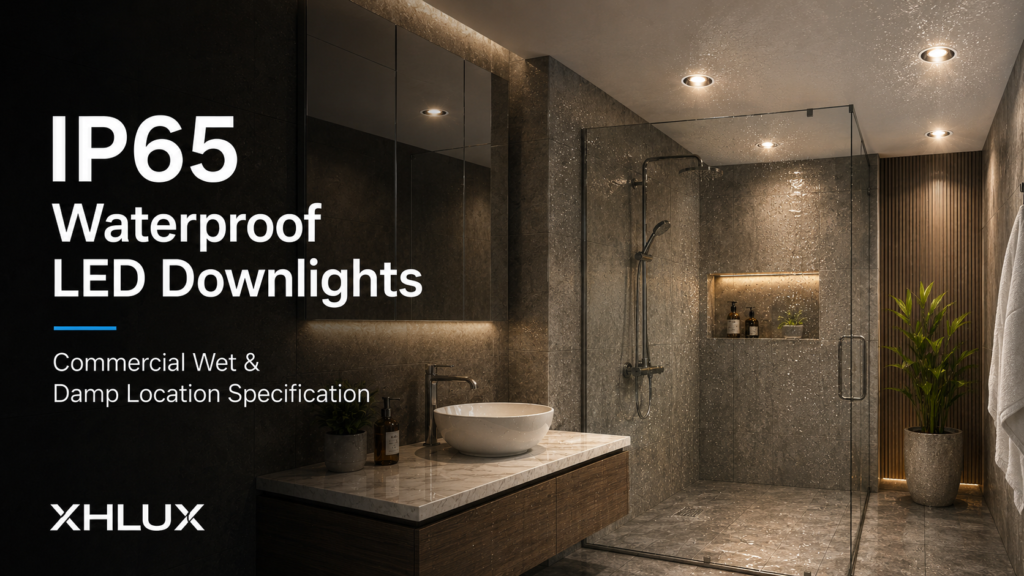
When water is a factor, the specification decision changes. You are no longer selecting a downlight by lumen output, CRI, and beam angle alone. You are first confirming that the fixture can safely operate in the target environment — then finding the best-performing model that meets the IP rating requirement and the project’s commercial performance expectations.
This article is written for B2B buyers — lighting brands, distributors, contractors, and specifiers — who are evaluating IP65 waterproof LED downlights for commercial projects with wet, damp, or high-humidity environments. It covers IP rating selection, bathroom zone requirements, the interaction between IP rating and fire rating, driver protection considerations, and the per-model checks to make before ordering.
Pour un aperçu plus complet de tous les types de luminaires encastrés commerciaux, consultez le Guide des spots encastrés LED commerciaux, which covers fixed, adjustable, trimless, slim, smart, and GU10 downlights at summary depth.
Understanding IP Ratings for Commercial Downlights
The IP (Ingress Protection) rating system, defined in IEC 60529, classifies the degree of protection provided by an enclosure against solid objects and water. For commercial downlights, the rating determines where a fixture can legally and safely be installed.
How IP Ratings Are Structured
An IP rating consists of two digits:
– First digit (0–6): Protection against solid objects and dust. 0 = no protection. 5 = dust-protected (limited ingress permitted). 6 = dust-tight (no ingress). – Second digit (0–9): Protection against water. 0 = no protection. 4 = splashing water from any direction. 5 = water jets from any direction. 6 = powerful water jets. 7 = temporary immersion. 8 = continuous immersion.
For commercial downlights, the most relevant ratings are:
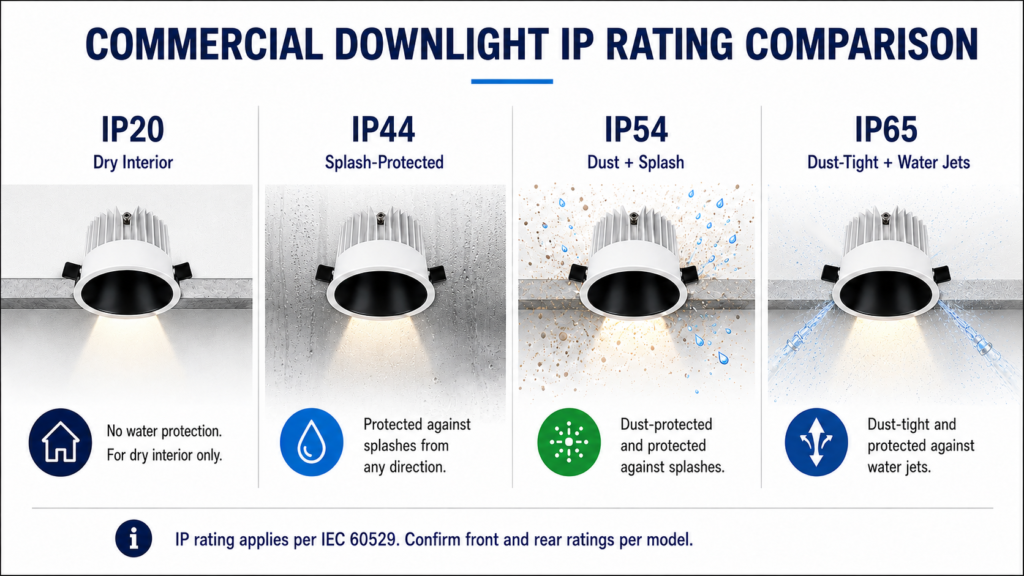
| IP Rating | Solids Protection | Water Protection | Application commerciale typique |
|---|---|---|---|
| IP20 | ≥12.5mm objects | Aucun | Dry interior: offices, retail, corridors, hotel lobbies |
| IP44 | ≥1mm objects | Splashing water, any direction | Bathroom zone 2, covered outdoor, kitchen away from direct spray |
| IP54 | Dust-protected | Splashing water, any direction | Industrial kitchens, laundry rooms, covered walkways |
| IP65 | Étanche à la poussière | Water jets, any direction | Bathroom zone 1, shower ceilings, commercial kitchens, indoor pool areas, spa facilities |
IP20 vs IP44 vs IP54 vs IP65 — The Specification Thresholds
IP20 is the default for dry commercial interiors. No water protection is required, and the fixture design can prioritise optical performance, thermal management, and cost. The vast majority of commercial downlights fall into this category.
IP44 provides splash protection. It is the minimum rating typically required for bathroom zone 2 and outdoor covered areas where direct water jets are not expected. An IP44 downlight can handle condensation, occasional splashing, and humid air — but it is not designed to withstand direct spray from a shower head, hose, or pressure washer.
IP54 adds dust protection to the splash rating. It is suitable for industrial kitchens, laundry facilities, and covered external areas where both dust and moisture are present. The dust-protected rating (5) means limited dust ingress is permitted — not fully dust-tight, but sufficient for environments where airborne particles are a factor alongside moisture.
IP65 is the benchmark for commercial wet locations. Dust-tight (6) and protected against water jets (5) from any direction. An IP65 downlight can be installed directly above a shower, in a commercial kitchen hood area, or in an indoor pool ceiling where water jets are used for cleaning. This is the rating most frequently specified for Zone 1 bathroom installations and commercial wet environments.
Front IP vs Rear IP — Why Both Matter for Recessed Downlights
A recessed downlight has two exposure surfaces: the front face (visible in the room, exposed to the environment) and the rear body (inside the ceiling void). The IP rating on a specification sheet may refer to the front face only, the complete fixture, or both — and this distinction matters.
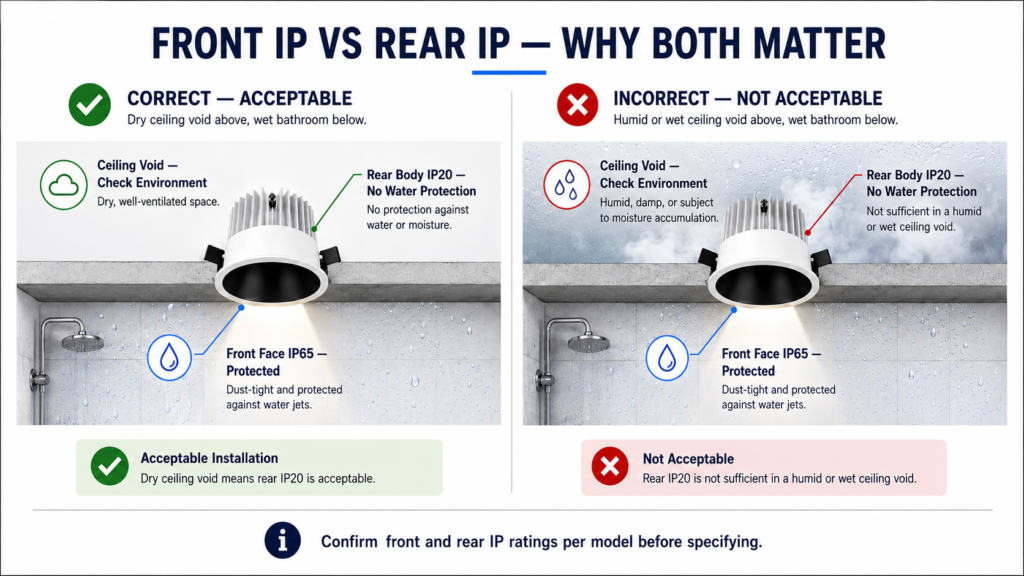
A downlight rated IP65 from the front but IP20 from the rear means the visible face can withstand water jets, but the body inside the ceiling void has no water protection. If the ceiling void itself is a dry environment, this may be acceptable. If the ceiling void is humid — above a swimming pool, in a steam room ceiling, or in a commercial kitchen with ceiling-level moisture — the rear rating must also be adequate.
Before specifying, confirm whether the IP rating applies to the front face only, the complete fixture, or both. If only one rating is shown, request clarification from the manufacturer.
Commercial Applications for IP65 Waterproof LED Downlights
Different commercial environments place different demands on waterproof downlight specification. The table below maps common wet and damp location types to recommended IP ratings and key considerations.
| Commercial Environment | Indice de protection IP minimum | Considérations clés |
|---|---|---|
| Hotel bathroom — zone 2 (outside shower/bath area) | IP44 | Condensation and occasional splash. Driver in accessible dry location. |
| Hotel bathroom — zone 1 (above shower/bath) | IP65 | Direct water jet exposure. Front + rear IP rating. Fire rating if ceiling is a fire barrier. |
| Gym / spa shower facility | IP65 | High humidity, frequent water jets, chemical cleaning agents. Corrosion-resistant materials. |
| Commercial kitchen — general ceiling | IP44–IP54 | Steam, condensation, airborne grease. Easy-clean surface. |
| Commercial kitchen — hood and wash-down area | IP65 | Direct water jets from cleaning. Chemical resistance. |
| Indoor swimming pool ceiling | IP65 | Continuous high humidity, chlorine vapour. Corrosion-resistant housing and fixings. |
| Poolside / changing room | IP44–IP65 | Depends on distance from water and ventilation. Splash risk assessment required. |
| Spa / sauna / steam room | IP65 minimum; IP67 for steam room ceiling | Extreme humidity and direct steam exposure. High-temperature rating also required. |
| Covered external walkway / entrance canopy | IP44–IP54 | Rain splash, condensation, dust. Not direct jet exposure. |
| Laundry / utility room | IP54–IP65 | Humidity, occasional splash, detergent exposure. |
Bathroom Zone Requirements and Installation Standards
Commercial bathroom and shower installations are governed by wiring regulations that define zones around water sources. These zones determine the minimum IP rating required for electrical fixtures. The most widely referenced standards are IEC 60364-7-701 (international) and BS 7671 (UK Wiring Regulations). While exact zone dimensions vary by national code, the principle is consistent: the closer a fixture is to a water source, the higher the IP rating required.
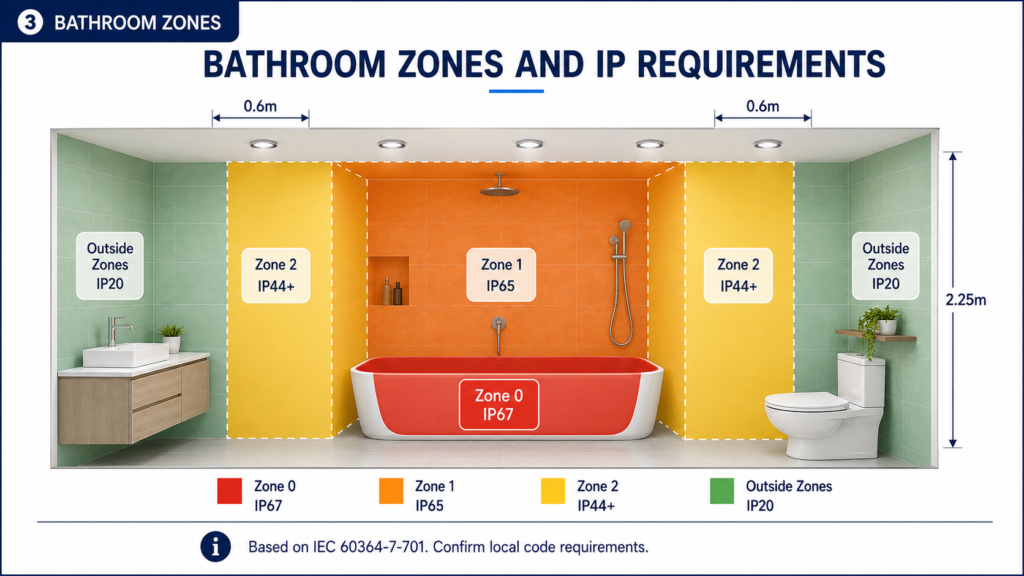
Zone Definitions
| Zone | Description | Typical Minimum IP Rating |
|---|---|---|
| Zone 0 | Inside the bath or shower tray — the volume occupied by water | IP67 (submersion) — recessed downlights are generally not installed here |
| Zone 1 | Above the bath or shower to a height of 2.25m from the floor | IP65 minimum |
| Zone 2 | 0.6m beyond zone 1, extending to 2.25m height | IP44 minimum (IP65 recommended for commercial) |
| Outside zones | Beyond zone 2 | No specific IP requirement for water, but IP20 minimum for general safety |
What This Means for Specification
A hotel bathroom with a shower enclosure requires IP65-rated downlights directly above the shower area (Zone 1). The same bathroom may use IP44-rated downlights in the general ceiling area outside Zone 2 — but for commercial projects, many specifiers standardise on IP65 throughout wet areas to avoid installation errors and simplify procurement.
The specifier is responsible for confirming which national or local code applies to the project. The manufacturer typically provides IP test certificates and installation instructions but does not determine zone compliance — that is a design and installation responsibility.
Key Specification Decisions for IP65 Downlights
Specifying an IP65 downlight involves several decisions that do not apply to standard dry-location fixtures.
Front IP vs Rear IP — The Recessed Downlight Complication
As noted above, the IP rating shown on a specification sheet may not tell the full story. An IP65 rating may apply to the front face only, to the front face and part of the body, or to the complete fixture including the rear. The ceiling void environment determines whether rear IP rating is critical:
– If the void is a dry, ventilated ceiling cavity above a bathroom, a front-IP65/rear-IP20 downlight may be acceptable. – If the void is above a swimming pool, steam room, or commercial kitchen, the rear rating must also protect against humidity and vapour. – If the void contains insulation, the rear body must also meet thermal safety requirements.
Confirm the IP rating scope — front only, or front and rear — per model before specifying.
Driver Protection and Location
IP65 downlights typically use a remote driver. The driver itself may have a different IP rating from the LED module. A common configuration is an IP65-rated LED panel connected to an IP20-rated driver — requiring the driver to be placed in a protected, dry, accessible location.
Before specifying, confirm: – The IP rating of the driver as well as the LED module. – Whether the driver can be located in a dry area away from the wet zone. – Whether the driver-to-fixture cable length is sufficient for the planned driver location.
If the driver cannot be placed in a dry location, it must carry its own IP65 rating or be installed in an IP65-rated enclosure.
Fire Rating and IP Rating Interaction
A downlight may need to be both IP65-rated (for water protection) and fire-rated (to maintain the fire resistance integrity of the ceiling). These are independent certifications — a fixture that is IP65 is not automatically fire-rated, and a fire-rated fixture is not automatically IP65.
If the ceiling is a fire barrier — for example, between hotel guest room floors, or between a commercial kitchen and an upper floor — every penetration, including downlight cut-outs, must be sealed to the same fire resistance standard. If the bathroom or wet area ceiling is also a fire barrier, the downlight must carry both certifications.
Confirm fire rating per model. If the selected IP65 model is not fire-rated and fire rating is required, either select an alternative model or install a fire hood.
IC Rating in Wet and Humid Environments
IC (Insulation Contact) rating certifies that a downlight can safely be in direct contact with ceiling insulation. In wet or humid ceiling voids, insulation contact creates an additional complication: moisture trapped between insulation and the fixture body can accelerate corrosion and reduce thermal dissipation.
If the ceiling void above a wet area contains insulation, confirm whether the selected IP65 downlight is IC-rated and whether the IC rating remains valid in high-humidity conditions.
Cut-Out Sealing and Gasket Requirements
An IP65 downlight achieves its water protection partly through seals and gaskets at the point where the fixture meets the ceiling surface. The cut-out must be precisely sized — an oversized cut-out may prevent the gasket from sealing correctly. An irregular or damaged cut-out edge can create a water path around the fixture.
Confirm the required cut-out diameter and tolerance per model. Test gasket seating with physical samples before committing to volume orders.
Material and Corrosion Resistance
In wet, humid, and chemically aggressive environments — swimming pools (chlorine), commercial kitchens (cleaning agents), spa facilities (chemical treatments) — the fixture housing, trim, springs, and fixings must resist corrosion. Standard powder-coated steel components may degrade rapidly in these conditions.
Confirm housing material per model. Aluminium alloy (such as ADC12 die-cast) with appropriate surface treatment is preferred for commercial wet locations. Stainless steel fixings and springs are recommended for pool and spa environments.
IP65 Downlight Types and Product Options
IP65-rated downlights are available in several form factors, each suited to different commercial applications.
Fixed IP65 Downlights
The standard wet-location solution. A fixed downlight with IP65-rated front face, sealed against water jet ingress. Suitable for general ambient lighting in bathrooms, shower facilities, kitchens, and pool areas where adjustable beam direction is not required.
Adjustable / Orientable IP65 Downlights
Allow beam direction adjustment while maintaining the IP65 seal at the front face. Used in wet areas where accent lighting is required — for example, highlighting signage in a pool area, or directing light onto a food preparation surface in a commercial kitchen. The adjustment mechanism must not compromise the IP seal.
Trimless IP65 Downlights
Plastered-in or flush-mounted downlights with IP65 rating for architectural wet-location applications — high-end hotel bathrooms, spa facilities, poolside lounges. The trimless installation creates a clean ceiling plane, but the sealing requirements are more demanding: the plaster-to-fixture interface must not create a water path.
GU10 IP65 Downlights
A replaceable-lamp option for wet locations. The GU10 lamp is user-replaceable, which introduces a practical consideration: the lamp change must not compromise the IP seal. GU10 IP65 fixtures typically require a sealed bezel or cover that maintains the IP rating after lamp replacement.
XHLUX Product Fit
XHLUX produces downlights with IP65 and IP54 ratings suitable for commercial wet and damp location projects. From the product catalog:
| Famille de produits | IP Rating | Notes |
|---|---|---|
| Watex D65 Fixed | IP65 | Fixed downlight with IP65 rating. Suitable for wet commercial locations. |
| Hotel Wall Washer | IP65 | Wall washer variant with IP65 rating. Suitable for wet-location accent and wall illumination. |
| Watex Fixed | IP54 | Dust-protected + splash-proof. Suitable for damp commercial locations, covered outdoor areas. |
No IP65-specific product page URL has been confirmed on the live xhlux.com English website. Use the LED Downlight parent category link until product pages are published. Confirm per-model IP rating scope (front only or front + rear), fire rating availability, and driver IP rating before specifying.
Éléments à vérifier avant de spécifier ou de commander
Before finalising a specification or placing an order for IP65 downlights, confirm the following per product code.
Vérifications par modèle
| Paramètre | Que confirmer |
|---|---|
| IP rating — front face | Confirm front IP rating and test standard |
| IP rating — rear body | Confirm whether the rear carries the same IP rating |
| IP rating — driver | Confirm driver IP rating; if IP20, confirm dry location availability |
| résistance au feu | Vérifier la résistance au feu (30/60/90 min) si le plafond est un coupe-feu. |
| Indice de qualité IC | Confirm if IC-rated for insulation contact; confirm validity in humid voids |
| Diamètre de découpe | Exact diameter and tolerance (mm) |
| Gasket / seal type | Material, expected service life, replacement availability |
| Matériau du boîtier | Confirm material and surface treatment for corrosion resistance |
| Fixing material | Confirm clip/spring/bezel material for wet-environment durability |
| Options CRI / CCT | Which CRI tiers and CCT options are available for the IP65 model |
| Protocole de gradation | Which dimming protocols are confirmed for this model + driver combination |
| documents de certification | IP test certificates, fire rating certificates, material compliance |
Documents à demander
For specification projects, request the following where available: – IP test certificates (IEC 60529) — confirming the IP rating for front face, rear body, and complete fixture – Fire rating certificates — if fire rating is claimed – Driver specification sheet — including driver IP rating and dimming compatibility – Material certificates — for corrosion resistance in the target environment – Installation instructions — zone requirements, cut-out sealing, gasket fitting – IES files — for photometric design in wet-area lighting layouts
Exemple d'évaluation
Test 2–3 physical samples in conditions representative of the target environment: – Verify the IP seal quality: check gasket seating, cable entry sealing, and bezel fit. – Test in a humid environment if possible: check for condensation inside the fixture after extended operation. – Verify dimming performance across the full range with the specified driver and protocol. – Check material quality: corrosion test if the environment is chemically aggressive (pool, kitchen, spa).
FAQ
What is the difference between IP44 and IP65 for downlights?
IP44 protects against splashing water from any direction. IP65 protects against water jets from any direction. For commercial bathrooms, IP44 is typically the minimum for Zone 2 (outside the shower area), while IP65 is required for Zone 1 (directly above the shower). IP65 also adds dust-tight protection (first digit 6 vs 4), which matters in environments with both dust and moisture — commercial kitchens, laundry rooms, industrial wash-down areas.
Can IP65 downlights be used in a shower area?
Yes. IP65 is the standard rating for Zone 1 — the area directly above a shower enclosure up to 2.25m height. The fixture must be installed according to the manufacturer’s instructions and the applicable local wiring regulations. Confirm that the specific model’s IP65 rating covers the complete fixture (front face and body) if the ceiling void is also humid.
Are IP65 downlights also fire-rated?
Not automatically. IP rating and fire rating are independent certifications. A downlight may be IP65-rated for water protection but not fire-rated for ceiling barrier integrity. If the wet-area ceiling is also a fire barrier, confirm fire rating (30/60/90 minutes) per model. If the selected IP65 model is not fire-rated, either select a fire-rated IP65 model or install an approved fire hood.
Can I install IP65 downlights in an outdoor covered ceiling?
Yes, if the ceiling provides overhead cover and the fixture is not exposed to direct weather. Under a covered walkway canopy, entrance lobby soffit, or covered external ceiling, an IP65 downlight provides protection against wind-driven spray, condensation, and humidity. For fully exposed outdoor ceilings without cover, confirm whether the fixture is also rated for the expected temperature range, UV exposure, and direct rain.
Does the driver need to be IP65 rated too?
Not necessarily, but the driver must be protected appropriately. If the driver can be located in a dry, accessible area — such as a service void separated from the wet zone, above a suspended ceiling with adequate ventilation, or in an adjacent dry room — an IP20 driver may be acceptable. If the driver must be located in the wet or humid zone, it must carry its own IP65 rating or be installed in an IP65-rated enclosure. Confirm driver IP rating and planned location per project.
What bathroom zone requires IP65 downlights?
Under IEC 60364-7-701 and BS 7671, Zone 1 — the volume directly above a bath or shower enclosure up to 2.25m from the floor — requires a minimum of IP65. Zone 2 (extending 0.6m beyond Zone 1) requires a minimum of IP44, though many commercial projects standardise on IP65 throughout wet areas. Confirm the applicable national or local wiring code for the specific project location.
Conclusion
Specifying IP65 waterproof LED downlights is about matching the fixture’s ingress protection to the environment’s actual water and humidity exposure. When the environment is wet — a hotel shower, a commercial kitchen, a pool ceiling, a spa facility — the IP rating is not an optional upgrade. It is the first specification filter, before lumen output, CRI, CCT, or dimming protocol.
The specification decisions that matter are practical: confirming whether the IP rating covers the front face only or the complete fixture, verifying that the driver is adequately protected, checking whether fire rating and IC rating are also required, and selecting materials that will not corrode in the target environment. These decisions determine whether the installation remains safe and functional over years of commercial operation in wet conditions.
Pour un aperçu de tous les types de luminaires encastrés commerciaux, consultez le Guide des spots encastrés LED commerciaux. For specification guidance on adjustable downlights, see our article on spots encastrés LED réglables pour projets commerciaux.
If you are specifying IP65 waterproof LED downlights for a commercial wet or damp location project, contact our specification team with the environment type, ceiling conditions, target IP rating, zone requirements, and preferred CRI/CCT for per-model confirmation.