XHLUX
XHLUX
Making a linear fixture thinner sounds simple, but every reduction in housing space creates new engineering decisions.
Low profile linear led lighting often solves shallow ceiling voids, tight install space and a cleaner architectural line. It can also tighten heat paths, limit optic options and constrain how drivers and modules are arranged.
Thinner is not automatically better. Low-profile is a balance of integration, performance and practicality—not a race to the smallest section.
For the wider mount map first, see Как выбрать линейные светодиодные светильники: подвесные, накладные или встраиваемые?—then return here when the question is profile depth versus performance trade-offs.
Browse the LED linear lighting category when you need families that include slim and standard-depth options for the same project language.
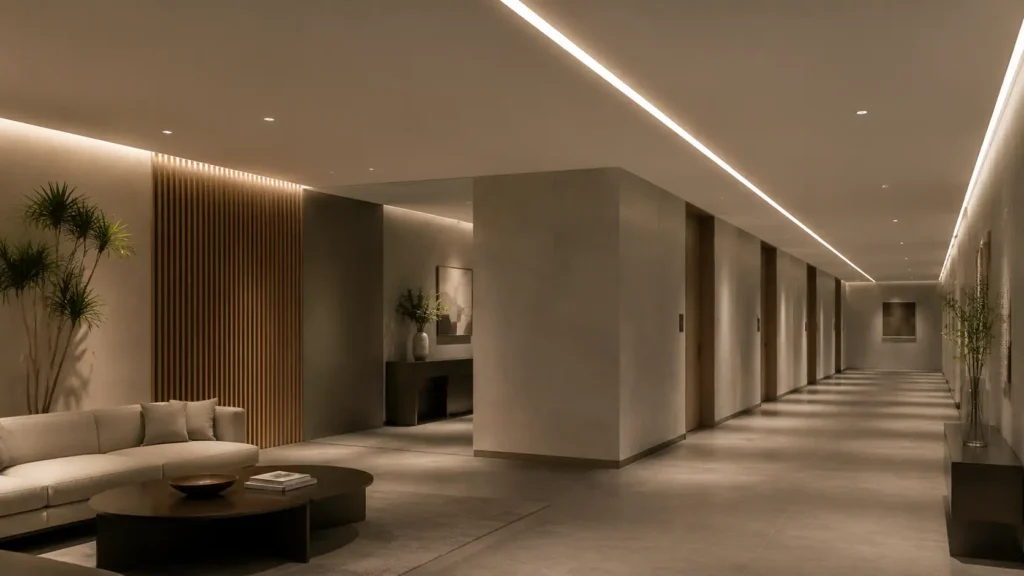
Вкратце: Low-profile linear LED lighting buys ceiling integration and a quieter look. You still need a workable thermal path, honest optics and a mount that fits the real ceiling—not a thinner housing alone.
Оглавление
- 🏗️ 1. Why low-profile linear LED lighting exists
- ✨ 2. What you gain: better integration with limited spaces
- 🌡️ 3. What you trade off: thermal and optical challenges
- 💡 4. Does a slimmer linear fixture always mean less performance?
- 📍 5. Where low-profile linear lighting makes the most sense
- ✅ 6. What should you check before choosing a low-profile linear fixture?
- Что делать дальше?
- 🏁 Conclusion
- Часто задаваемые вопросы
🏗️ 1. Why low-profile linear LED lighting exists
Projects reach for a thinner section when the ceiling will not forgive a deep housing.
We often see the need appear in renovation slabs with little void, compact corridors, and architectural ceilings that must stay visually quiet. Low-profile ceiling lighting exists to fit those constraints—not to win a catalogue “slim” contest.
Common drivers:
- Limited ceiling depth or congested services above the plane
- Renovation work where cutting a deep recess is costly or banned
- Compact volumes where a thick bar reads as clutter
- A cleaner ceiling appearance with less visible bulk
Do not treat this page as a millimetre schedule for every mount type. Recess depth by suspended, surface or recessed path belongs in a dedicated depth guide—not here.
When the ceiling plane must stay flush and shallow, recessed linear lighting is often the first form teams shortlist—then they still check depth against the real void.
🎯 Why do projects specify low-profile linear rows?
Usually because ceiling depth, renovation limits or appearance rules reject a standard-depth housing—not because thinner always performs better.
✨ 2. What you gain: better integration with limited spaces
The main value of a slim linear LED fixture is integration: it can sit in spaces a standard-depth bar cannot enter cleanly.
What you typically gain:
- Easier fit into shallow ceilings and crowded voids
- Cleaner architectural appearance with less visual interruption
- Less bulk in sightlines along corridors and open ceilings
- A workable option when structure or services block a deep housing
| Standard-depth fixture | Low-profile fixture |
|---|---|
| Needs more install depth or clearance | Reduced fixture depth for tight voids |
| Housing often more visible | Cleaner plane integration when detailed well |
| More room for thermal and optic packages | Tighter package—engineering must compensate |
Gain is about fit and appearance. It is not a free upgrade to every lighting metric.
🎯 What is the biggest gain from low-profile linear lighting?
Fit and quieter ceiling integration in depth-limited spaces—not an automatic win on every performance field.
🌡️ 3. What you trade off: thermal and optical challenges
A fixture cannot shrink forever without moving heat, optics and drivers into a smaller envelope.
A shallow linear light housing leaves less room for heat sinks, air paths and optic depth. We often see teams discover that late—after a thin sample looks right in a render but raises questions during longer operation checks.
Typical trade-offs:
- Less volume for heat dissipation
- Tighter limits on sustained LED performance if thermal design is weak
- Optical packages with less depth for glare control or beam shaping
- Driver location pushed remote, into end caps, or into crowded cavities
Lower profile requires better engineering—not simply a smaller extrusion photo.
A thin linear LED strip in an open channel is not the same product class as a complete low-profile linear luminaire with optics, driver path and service plan. Do not treat strip depth as proof that a commercial linear row is ready.
🎯 Why can linear housings not get infinitely thin?
Heat, optics and driver packaging still need space—or performance and reliability become the hidden cost of the slim section.
💡 4. Does a slimmer linear fixture always mean less performance?
Not automatically. Slim sections can still deliver the required light when the optic, LED package and thermal path are designed as one system.
What still needs a fair comparison—without inventing universal numbers:
- Light output for the quoted length or module
- Efficacy at the same system boundary (module vs complete luminaire)
- Optic and diffuser behaviour in the real mount
- How the line looks at full output and at the dimming levels you will use
Do not use wattage-per-metre headlines as a brightness score here. That metric belongs in its own deep dive when two quotes share a W/m label but not the same delivered light.
We often see “slim equals weak” as a stereotype—and “slim equals premium” as the opposite stereotype. Both skip the datasheet.
🎯 Does low-profile always cut light quality?
No. Poor thermal or optic design cuts quality—whether the housing is slim or deep. Compare the real photometric package.
📍 5. Where low-profile linear lighting makes the most sense
Choose low-profile when ceiling depth or appearance constraints dominate the brief.
Strong fits:
- Architectural ceilings that must stay visually quiet
- Renovation projects with limited void or no new recess budget
- Zones with restricted ceiling space above the finished plane
- Minimalist interiors where housing bulk fights the design language
Surface-mounted linear lighting can still be the right low-bulk answer when the ceiling cannot be cut—especially in renovations that forbid recess work. Suspended rows can use slim bars too, but hang geometry and feed planning stay a separate decision; do not treat suspension as the main story of this page.
Avoid turning this section into a full office or retail lighting guide. Application layout and mount selection stay on their own pages.
🎯 When is low-profile the right first shortlist?
When depth or visual bulk is the binding constraint—and the thermal and optic package still meets the task.
✅ 6. What should you check before choosing a low-profile linear fixture?
Use this table as a release gate before you treat “slim” as settled.
| Проверять | Почему это важно |
|---|---|
| Fixture depth | Shows whether the section fits the real void or face-fix clearance |
| Световой поток | Ensures the quoted package meets the lighting task |
| Тепловая конструкция | Supports reliability under expected operating hours |
| Optical performance | Controls distribution and comfort in the finished mount |
| Driver location | Simplifies access and spare-parts planning after handover |
| Способ установки | Avoids site clashes with recessed, surface or other mounts |
If depth wins the meeting but thermal notes, photometrics or driver access are blank, the package is still incomplete.
🎯 When is a low-profile linear package ready to shortlist?
When depth, output, thermal path, optics, driver access and mount method are filled—not when the section looks thin in a render.
Что делать дальше?
- Mark which zones are depth-limited versus appearance-driven before you shortlist slim sections.
- Request photometric files and thermal/operating notes for the exact low-profile build—not a standard-depth twin with a different section.
- Run the checklist table against every quote that leads with “slim” or “low-profile.”
- For application context, review решения для офисного освещения, то решения для освещения торговых помещений, и hospitality lighting systems.
- Need a project review or quotation? Contact the XHLUX team with ceiling void notes, mount intent and the task for each zone.
🏁 Conclusion: Low-profile linear LED lighting—what you gain and what you trade off?
Low-profile linear lighting is not about choosing the thinnest fixture. It is about balancing space integration, lighting performance and long-term reliability inside a smaller housing.
Ознакомьтесь с другими статьями в нашем блоге:
- How to Choose Modern Linear Lighting for Offices and Retail in 4 Steps
- Накладные линейные светильники для потолков без встраиваемого монтажа.
- What Makes a Linear Luminaire More Than a Long Light?
Примечания и источники
- No millimetre depth thresholds or universal lm/W “slim vs standard” deltas are claimed in this draft—compare project files and maker thermal notes for the exact build.
- Photometric comparison practice: use IES/LDT (or equivalent) for the quoted optic and length; do not rank housings by section height alone.
- Wattage-per-metre versus delivered light belongs in a separate metric guide when W/m headlines collide across quotes.