XHLUX
XHLUX
We often see two linear fixtures look almost identical in a render—then only one survives the contractor RFQ, because the datasheet cannot prove output, glare control or colour consistency under project conditions.
Appearance is not the grade. A commercial linear light fixture earns that label when the product package can be checked, installed and maintained like a commercial system—not when the housing simply looks architectural.
This page is the commercial-grade test. It is not Как выбрать линейные светодиодные светильники для потолков в офисах и магазинах—that guide covers application, mounting and run layout. It is not a wattage-per-metre deep dive, and not a surface-wiring how-to for solid ceilings.
For the suspend / surface / recess map first, see Как выбрать линейные светодиодные светильники: подвесные, накладные или встраиваемые?—then return here when the question is whether the fixture itself is commercial-grade.
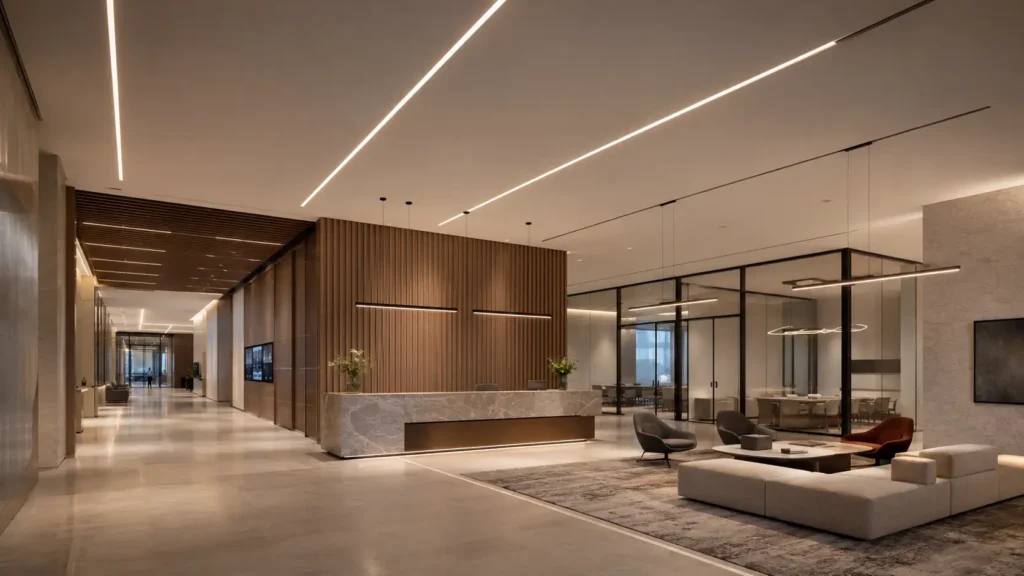
Вкратце: Commercial grade means documented light performance, optics suited to the task, colour consistency across batches, controls that match the building, and an install that stays serviceable. Use the checklist before you order.
Оглавление
- 🏗️ 1. Commercial vs decorative: what actually changes?
- 💡 2. Documented light performance, not wattage headlines
- 🔍 3. Optics matter more than brightness alone
- 🎨 4. Colour consistency that survives the project
- 🎛️ 5. Controls that match the building, not the brochure
- 🔧 6. Installation and maintenance as part of commercial grade
- ✅ 7. Commercial linear fixture checklist before you order
- Что делать дальше?
- 🏁 Conclusion
- Часто задаваемые вопросы
🏗️ 1. Commercial vs decorative: what actually changes?
Some linear fixtures may look architectural but still lack the documentation and service details required for commercial projects.
Commercial-grade linear lighting is judged by whether the package supports a multi-zone project—repeatable lengths, documented output, and a path for service after handover.
We often see “architectural” catalogue photos reused on residential pendants and commercial rows with no shared documentation depth. Treat the photo as styling; treat the datasheet as the grade claim.
| Сигнал | Decorative look-alike | Commercial-grade package |
|---|---|---|
| Photometrics | Often missing or marketing only | IES/LDT (or equivalent) available for the quoted optic |
| Joins / continuous runs | Optional styling detail | Defined joiner, feed and end-cap strategy |
| Услуга | Replace whole pendant | Driver/module access plan stated |
| Элементы управления | Basic on/off or proprietary | Protocol options listed for the building |
🎯 Is a slim housing enough for commercial grade?
No. Commercial grade is proven by documents, joins, service access and controls—not by housing silhouette alone.
💡 2. Documented light performance, not wattage headlines
Read linear fixture lumen output—usually as lm/m or total lm for the quoted length—before you rank two lines on watts or W/m alone.
Wattage describes electrical load. Lumens describe light leaving the fitting. Same wattage can still deliver different lumen output because LED efficiency, optics and driver performance affect the final luminaire output.
For how W/m is defined on datasheets—and why it is not a brightness score—see What Does Wattage per Meter Actually Tell You About Linear LED Fittings?.
Illustrative comparison only—not a universal threshold:
| Field to compare | Why it matters on a commercial schedule |
|---|---|
| lm/m (or total lm) | Output you can put against the lighting calculation |
| W/m or total W | Connected load and driver matching |
| lm/W (note system boundary) | Efficiency claim—module vs luminaire can differ |
| Photometric file | Distribution used in Dialux/Relux, not a catalogue claim |
Ask whether figures are LED-module, complete-luminaire, or another boundary. Mismatched boundaries make “same headline” quotes incomparable.
🎯 Can two bars with the same wattage perform the same?
Not reliably. Compare lm/m, efficacy boundary and photometric files before you treat them as equal.
🔍 3. Optics matter more than brightness alone
Extra lumens do not fix glare over desks or a mismatched light distribution on a retail ceiling.
Ан office linear fixture usually prioritises glare control and visual comfort. A retail ceiling linear light needs a light distribution suited to the sales plane—not brightness alone.
We often see teams raise wattage when the real gap is optic choice or mounting height, not raw output.
Check at least:
- Beam or distribution family on the datasheet
- Glare rating where desk sightlines matter
- Direct / indirect split if the ceiling plane is part of the design
🎯 Does higher lumen output always improve the space?
No. Wrong optics at higher output can raise glare or flatten contrast—match distribution to the task first.
🎨 4. Colour consistency that survives the project
Commercial rows fail visually when CCT or CRI drifts between phases, or when adjacent bars show a visible step.
Ask for CRI (or Rf where used), SDCM / MacAdam step, CCT options, and how batches are controlled across order phases.
Tunable white options belong on the schedule only when the control path, CCT range and appearance under dimming are stated—not when “tunable” is a brochure checkbox.
For multi-phase fit-outs, write the colour target into the RFQ so later packages cannot drift into a different bin without a review.
🎯 Is CRI 80 enough for every commercial linear row?
It depends on the visual task. Retail colour-critical zones and brand walls often need a tighter colour story than back-of-house corridors.
🎛️ 5. Controls that match the building, not the brochure
Commercial grade means the fixture can match the building control system—typically DALI, 0–10V or PUSH—with drivers that speak the same protocol as the installed backbone. Where the brief calls for CCT shift, treat tunable white linear lighting as a selectable control configuration—not a brochure checkbox.
The job is not to learn every protocol here. The job is to check that the quoted driver and the building control strategy share one language—and that spare drivers match that language.
We often see mixed protocols on one floorplate create commissioning delays that look like “fixture quality” problems.
List on the RFQ:
- Dim protocol per zone (DALI, 0–10V or PUSH)
- Tunable white range and control if used
- Driver location and spare-parts identity
🎯 Should every commercial linear row be DALI?
No. Match the building control design. Wrong protocol on a “premium” bar still fails commissioning.
🔧 6. Installation and maintenance as part of commercial grade
A fixture that cannot be joined, fed or serviced on the real ceiling is not commercial-grade for that project—even if the photometrics look strong.
Commercial linear lighting systems are usually designed as families that support different mounting configurations. Treat those forms as selectable product configurations for linear lighting for commercial spaces—not as afterthought brackets.
Start from the LED linear lighting category, then match the ceiling with suspended linear lighting, recessed linear lighting, or surface-mounted linear lighting where the family allows a face-fix mount kit. Detail wiring paths for solid-ceiling surface work belong in a dedicated surface-wiring guide, not here.
Before you order, check:
- Mount type vs ceiling void and access
- Continuous-run joiners and feed locations
- Driver access after the ceiling closes
- Cleaning and lamp/module replacement path
🎯 Does commercial grade require one mount type only?
No. Grade is documentation and serviceability across the mount you actually build—suspended, recessed or surface.
✅ 7. Commercial linear fixture checklist before you order
Use this table as a release gate—not as a substitute for photometric design.
| Проверять | Проходной сигнал |
|---|---|
| Application task | Office comfort vs retail visibility stated per zone |
| Световой поток | lm/m or total lm + photometric file for the optic |
| Optics / glare | Distribution and glare note fit the sightlines |
| Цвет | CRI/CCT/SDCM (and tunable range if used) on the RFQ |
| Элементы управления | Protocol + emergency path match the building |
| Install / service | Mount, joins, feed and driver access defined |
| Spares | Driver/module identity clear for handover |
If any row is blank, the package is still a look—not yet a commercial release.
🎯 When is a commercial linear package ready to order?
When output, optics, colour, controls and service access are filled—not when the render looks finished.
Что делать дальше?
- Mark office versus retail priority zones on the plan before you shortlist bars.
- Request photometric files and confirm the proposed configuration before approval.
- Run the checklist table against every quote row that claims commercial grade.
- For application packages, review решения для офисного освещения и решения для освещения торговых помещений, then browse примеры проектов for installed references.
- Need a project review or quotation? Contact the XHLUX team with zone tasks, mount types and control protocol.
🏁 Conclusion: What makes a linear light fixture commercial grade?
Commercial grade is a package you can check and maintain: documented light output, task-fit optics, colour that holds across batches, controls that match the building, and an install you can service. A decorative silhouette alone does not pass—appearance similarity is not commercial grade.
Ознакомьтесь с другими статьями в нашем блоге:
- How to Choose Modern Linear Lighting for Offices and Retail in 4 Steps
- Linear LED Suspension: What to Check Before You Order
- What Makes a Linear Luminaire More Than a Long Light?
Примечания и источники
- IES LM-79 / photometric file practice: compare luminaire output and distribution using the files supplied for the quoted optic; do not treat catalogue wattage headlines as brightness scores.
- Efficacy and W/m system boundaries: module-only versus complete-luminaire figures are not interchangeable—see the wattage-per-metre guide linked in section 2.
- Illustrative table rows in this article are comparison fields, not universal lux or lm/W thresholds for every project.