XHLUX
Buying teams often see “high CRI” on a datasheet and treat it as an automatic upgrade. For commercial LED downlights, that shortcut skips several decisions that still change how merchandise, food and interiors look on site.
A high-CRI LED downlight is designed to show object colors more accurately than standard general-purpose lighting. Products with a CRI of 90 or above are commonly described as high CRI. Higher CRI helps many color-critical views, but it does not replace checks on R9, color temperature, light output, beam angle, glare control, dimming compatibility or color consistency across a multi-fixture ceiling.
This buying guide explains what high CRI means in plain language, where it helps, when CRI 90 is enough, why R9 matters, and what to check before you place an order. It is written for commercial buyers, distributors, designers and project customers—not as a laboratory color-science course, and not as a deep CRI 80 versus CRI 90 comparison article.
TL;DR
- High CRI usually means stronger average color rendering (often CRI 90+); CRI 95 is a further step, not an automatic “must.”
- Check R9 when reds, food, fashion or skin-adjacent displays matter—Ra alone is incomplete.
- Keep CRI (color rendering) separate from CCT (warm vs cool white).
- Choose lumens, beam and optics for the room; do not use wattage or CRI as brightness proxies.
- Ask for matched test data (model, CCT, configuration) and a clear dimming/consistency plan before ordering.
Table of Contents
- What Is a High CRI LED Downlight?
- Where Are High CRI LED Downlights Most Useful?
- Is CRI 90 Enough, or Should You Choose CRI 95?
- Why Does R9 Matter When Choosing High CRI Downlights?
- How Does Color Temperature Affect Your Choice of High CRI Downlights?
- How Much Light Output Do You Need from a High CRI Downlight?
- Which Beam Angle Should You Choose for High CRI Downlights?
- How Do Optics and Glare Control Affect High CRI Downlights?
- Are High CRI LED Downlights Compatible with Dimming Systems?
- How Can You Keep Color Consistent Across Multiple Downlights?
- How Do You Verify the Color Rendering Performance of LED Downlights?
- What Should You Check Before Ordering High CRI LED Downlights?
What Is a High CRI LED Downlight?
A high-CRI LED downlight uses an LED light source rated for stronger color rendering than typical general lighting—most often discussed from about CRI 90 upward.
What Is Considered a High CRI Rating?
CRI (Color Rendering Index), often reported as Ra, scores how closely a light source shows a set of reference colors compared with a reference light. In simple commercial language:
- CRI 80 is a common general-purpose grade for many indoor spaces, depending on the application—it is not a fixed rule for every office or corridor.
- CRI 90 is widely treated as a “high CRI” starting point for color-sensitive retail and hospitality work.
- CRI 95 is a still higher declared average that some projects specify when color appearance is especially critical.
Public lighting resources such as the U.S. Department of Energy’s LED Basics discussion of light quality describe CRI around 90 or higher as excellent color fidelity language—while also noting that CRI is an imperfect, incomplete metric. Treat “high CRI” as a buying shorthand, not a single legal threshold for every country.
How Does a High CRI Downlight Differ from a Standard Downlight?
Under a higher-CRI source, fabrics, finishes and food often look closer to how they appear under a good reference white. Under a lower-CRI source, the same items can look flatter, duller or slightly “off,” even at the same brightness and CCT label. Commercial spaces care because customers judge product quality by color as much as by shape.
A high CRI label still does not guarantee identical reds, identical spectra between two “CRI 90” products, or a fair efficiency comparison. Those checks come later in this guide.
🎯 How can you verify a high CRI claim on a downlight datasheet?
Check the declared CRI/Ra rating and the exact product configuration. CRI 90 is commonly used as a high-CRI starting point, but the rating alone does not describe every aspect of color performance.
Where Are High CRI LED Downlights Most Useful?
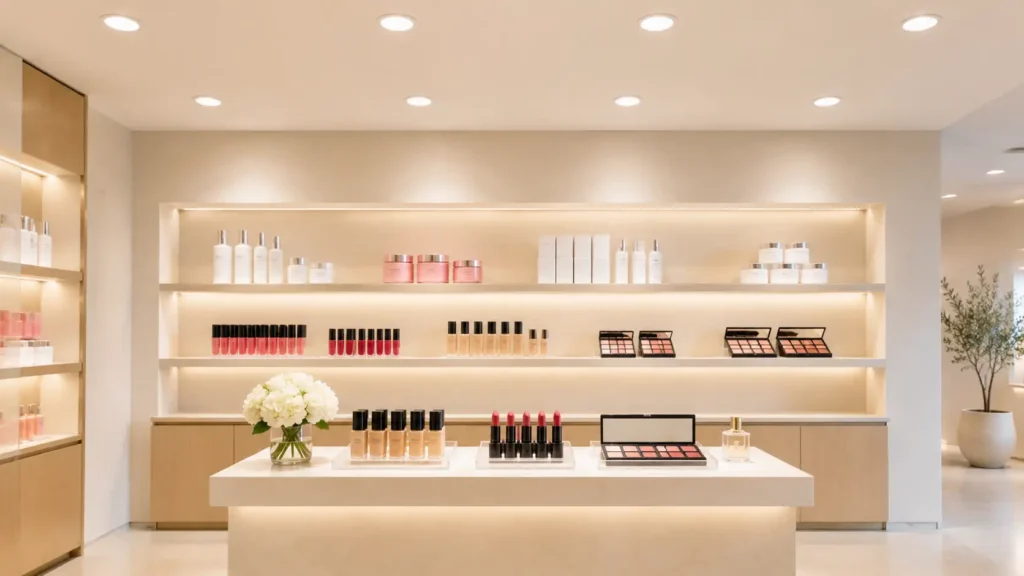
High CRI helps most where customers buy with their eyes—merchandise color, food freshness cues and carefully finished interiors.
Why Do Retail Stores Need High CRI Lighting?
Fashion floors, jewelry counters and cosmetics displays all sell color and finish. Clothing colors, metal finishes and makeup shades may look different under poor color rendering, making it harder for customers to judge products accurately and potentially affecting how a brand presents its merchandise. High CRI downlights are a common tool for keeping product color closer to reference appearance under the store’s electric light.
Why Is High CRI Lighting Useful for Food Displays?
Fresh produce, bakery cases and plated food all rely on reds, browns and warm tones that shoppers read as freshness or quality. Lighting that weakens those hues can make food look tired even when it is not. High CRI—and, later in this guide, a closer look at R9—helps presentation without promising that any single CRI number is a universal food-industry rule.
Are High CRI Downlights Suitable for Hotels and Galleries?
Hotels and hospitality lounges often want finishes, textiles and skin tones to look inviting. Galleries and exhibition spaces care about accurate object color. For museums and galleries, color quality is only one concern: artwork protection and light exposure must also be planned. Guidance such as the Canada Conservation Institute bulletin on LED lighting in museums and art galleries discusses color metrics together with conservation factors—do not treat “high CRI” as a complete museum lighting design.
| Application | Why high CRI helps | Extra check beyond Ra |
|---|---|---|
| Fashion / apparel | Fabric and brand color accuracy | R9; sample under final CCT |
| Jewelry / cosmetics | Metal, gem and makeup appearance | Glare; beam aim; R9 |
| Food / bakery / F&B | Freshness and plated-food cues | R9; CCT vs food style |
| Hotels / hospitality | Finishes and guest-facing comfort | Glare; dimming; consistency |
| Galleries / exhibits | Object color fidelity | Exposure limits; conservation plan |
🎯 Which commercial spaces benefit most from high CRI lighting?
Retail stores, jewelry displays, cosmetics counters, food displays, hotels and galleries can benefit from better color rendering. The required performance depends on the products and visual tasks in each space.
Is CRI 90 Enough, or Should You Choose CRI 95?
CRI 90 is enough for many commercial jobs; CRI 95 is worth considering when color risk and budget both justify the step up.
What Is the Difference Between CRI 90 and CRI 95?
Both numbers are average scores. CRI 95 claims a higher average fidelity than CRI 90 on the CRI test set. A higher number does not automatically guarantee a visibly better result in every room, on every product, or between every manufacturer. Two “CRI 90” products can still look different because spectra, R9 and optics differ.
Is CRI 90 Good Enough for Most Commercial Applications?
For many retail floors, restaurants and hotel public areas, a well-executed CRI 90 package—with suitable CCT, R9 disclosure and sample checks—already delivers strong color appearance. Retail lighting guidance from manufacturers such as LEDVANCE’s retail lighting overview commonly discusses high-quality color rendering as part of a broader retail design toolkit, not as a single forced CRI 95 mandate. Do not assume every project needs CRI 95.
When Should You Choose CRI 95?
Consider CRI 95 when the brief demands especially critical color matching, when brand standards call it out, or when sample comparisons show a clear visual gain for the merchandise that matters. Weigh real delivered performance, price, lead time and whether R9/TM-30 data are published for the exact SKU. Paying more only helps if the installed configuration—not just the headline CRI—improves what people see.
| Topic | CRI 90 | CRI 95 |
|---|---|---|
| Typical use | Common high-CRI commercial grade | Stricter color briefs |
| Always visibly better? | No | No |
| Also check | R9, CCT, samples | Same checks on the exact SKU |
| Cost | Practical starting point | Specify when samples justify it |
🎯 What should guide your choice between CRI 90 and CRI 95?
CRI 90 is suitable for many commercial applications. Consider CRI 95 when the project has stricter color requirements and sample testing demonstrates a meaningful visual improvement.
Why Does R9 Matter When Choosing High CRI Downlights?
R9 shows how well saturated reds appear—something the general CRI (Ra) score can hide.
What Is R9 in LED Lighting?
R9 measures how well a light source shows saturated red colors. Unlike the general CRI (Ra) score, R9 is reported separately. This matters when lighting needs to show red products, food or other color-sensitive items accurately. A product can advertise a solid Ra while still rendering saturated reds poorly. DOE’s LED quality discussion notes that R9 is often used for reds alongside broader metrics such as TM-30.
Should You Check R9 When Buying High CRI Downlights?
Check R9 when clothing reds, meat and produce, cosmetics, wood tones or brand-critical finishes matter. Ask the supplier for R9 on the same model, CCT and configuration you will buy—not a generic family claim. If R9 is unpublished, treat that as a gap for color-critical work and request data or samples before you scale the order.
🎯 When should you pay particular attention to R9?
Check R9 when your project needs to show saturated reds accurately, such as in food displays, fashion merchandise, cosmetics and other color-sensitive products.
How Does Color Temperature Affect Your Choice of High CRI Downlights?
CRI tells you about color rendering accuracy; CCT tells you whether the white light looks warm or cool—choose both, not one.
What Is the Difference Between CRI and Color Temperature?
CRI answers: how accurately does this light render object colors? CCT (correlated color temperature, in Kelvin) answers: does the light itself look warm (lower K) or cool (higher K)? A warm 2700–3000K source and a cool 4000–5000K source can share the same CRI grade and still create very different atmospheres.
Which Color Temperature Is Suitable for Different Commercial Spaces?
Warm white often suits hospitality, residential-feeling retail and many food concepts. Many commercial briefs also use mid-range whites around 3500–4000K for general retail floors and workplaces that want a cleaner white—but CCT category names (warm / neutral / cool) vary by market and manufacturer. The right CCT depends on products, interior finishes and the mood you want—there is no single best Kelvin for every store.
How Does the Same Product Look Under Different Color Temperatures?
The same garment, pastry or jewelry piece can look different under warm white than under a higher CCT, even when CRI is matched. Compare samples under the candidate CCTs with similar illuminance and the same viewing position before you finalize the schedule. Prefer real product photos or on-site samples over diagrams when you need to judge merchandise appearance.
🎯 Why should you compare CCT and CRI together when choosing downlights?
CRI describes how accurately a light source renders object colors, while CCT determines whether its white light looks warm or cool. Both affect the appearance of products and the overall atmosphere.
How Much Light Output Do You Need from a High CRI Downlight?
Choose delivered light for the room from lumens, layout and photometry—not from wattage or CRI grade alone.
What Is the Difference Between Watts and Lumens?
Watts measure electrical power the luminaire draws. Lumens measure total light output. Two downlights at the same wattage can deliver different lumens; two high-CRI options can also differ. Wattage alone cannot tell you how bright the floor will look.
How Do You Choose the Right Brightness for Your Space?
Consider room size, task, ceiling height, how many heads you will install and the beam pattern. Light output (lumens) is not the same as illuminance—the lux level on a desk, display shelf, floor or merchandise surface. Where the project is technical, ask for IES/LDT files for the exact optic and use them in a lighting calculation—without turning this buying guide into a full design tutorial. Do not assume that a higher CRI grade automatically means lower brightness or lower efficiency; compare published delivered lumens for the configurations you are quoting.
🎯 How can you determine whether a downlight provides enough light for your space?
Check delivered lumens, ceiling height, beam distribution and the lighting layout. Wattage and CRI alone cannot tell you how much light will reach the working or display surface.
Which Beam Angle Should You Choose for High CRI Downlights?
Beam angle shapes how light is concentrated; pick it with ceiling height and accent needs, then check real photometry.
What Is the Difference Between Narrow and Wide Beam Angles?
A narrower beam concentrates light into a smaller pool—useful for highlighting a display. A wider beam covers more floor area for general lighting. With the same lumen output, a narrow beam concentrates light into a smaller area, while a wider beam spreads it over a larger area.
How Do You Choose a Beam Angle for Your Space?
Higher ceilings often need a different coverage strategy than low ceilings for the same visual task. General ambient rows usually need broader distributions; accent and feature displays often need narrower beams or adjustable heads. Read beam angle together with lumen output and the manufacturer’s photometric distribution—angle labels alone do not predict lux on the merchandise.
🎯 How do you choose between narrow and wide beam angles?
Narrow beams concentrate light on specific objects or displays, while wider beams cover larger areas. Consider the ceiling height, lighting purpose and actual photometric distribution.
How Do Optics and Glare Control Affect High CRI Downlights?
Optics shape distribution and comfort; they do not rewrite the LED’s CRI or R9 score.
How Do Reflectors and Lenses Affect Light Distribution?
Reflectors and lenses steer and shape the beam. They influence where light lands, how soft the edge looks and how much spill hits walls or eyes. Beam shaping is an optical job—separate from the color-rendering grade of the LED package.
How Does a Deep-Recessed Design Help Reduce Glare?
A deep-recessed design places the light source further inside the fixture (behind the visible opening, or aperture). Shielding rings or baffles—the dark rings or cups around the source—can reduce direct views of the bright LED and help make the lighting more comfortable. That is why some downlights feel harsh to look into while others feel calmer at similar lumen levels. Comfort still depends on the room, mounting height and viewing directions. UGR (Unified Glare Rating) is calculated for a lighting layout. It is not a fixed value that applies to an individual downlight in every installation.
When Should You Choose Adjustable Downlights?
Adjustable (gimbal/aimable) downlights help when you need to aim light at specific objects. Aiming direction affects where the light falls and which objects receive more attention. Choose adjustable downlights when you need to highlight shelves, mannequins or feature walls; keep fixed heads where the layout is pure general lighting.
🎯 What should you consider when choosing downlight optics and glare control?
Check the reflector or lens design, light-source recess and shielding structure. These features affect light distribution and visual comfort, but they do not automatically improve the LED’s CRI or R9.
Are High CRI LED Downlights Compatible with Dimming Systems?
Dimming is a separate product choice—high CRI does not mean every control protocol is supported.
What Dimming Options Are Available for LED Downlights?
Common commercial options include TRIAC (phase-cut), 0–10V and DALI. Different downlight/driver packages support different methods. Some high CRI heads are non-dimmable; others support only one protocol family.
What Should You Check Before Choosing a Dimmable Downlight?
Check whether the exact SKU is dimmable, which driver it uses, which dimmer or control system you have, and whether low-level dimming performance matters for the scene. Align the control method before ordering. Keep CRI and dimming as parallel checklist items—neither replaces the other.
🎯 What should you confirm before using high CRI downlights with a dimming system?
Confirm that the exact downlight and driver support the intended dimming method, such as TRIAC, 0–10V or DALI. Also check low-level dimming performance and controller compatibility.
How Can You Keep Color Consistent Across Multiple Downlights?
Same CCT labels can still look slightly different—use published consistency tolerances and matched batches for multi-head ceilings.
Why Can Two Downlights with the Same CCT Look Different?
When you install several downlights in the same space, you want them to look consistent. However, two lights marked 3000K or 4000K may still have slightly different white-light appearances—one a bit greenish, another a bit pinkish—while sharing the same nominal Kelvin. That is a white-point consistency issue, not a CRI failure.
What Does SDCM Mean for LED Downlights?
SDCM (Standard Deviation of Color Matching) is one commonly used way manufacturers describe the permitted color variation between light sources. A smaller SDCM value generally indicates a tighter chromaticity tolerance, meaning less permitted variation in the white-light color between light sources. Ask for the declared tolerance when you order many heads or plan repeat batches.
MacAdam ellipses are a supporting idea behind many SDCM discussions: they describe regions of chromaticity that look similar to most observers. You do not need to plot ellipses to buy well—just ask what consistency tolerance the supplier will hold for your batch.
CIE TN 001:2014 advises against treating SDCM/JND as a general unit of chromaticity difference and recommends clearer specifications (such as u′v′-based circles) for general lighting sources. Do not treat SDCM as the only possible consistency language. Also separate initial color consistency from long-term color stability over life.
🎯 How can you avoid visible white-color differences between multiple downlights?
Choose products with a declared chromaticity tolerance, confirm batch consistency and coordinate the CCT of all fixtures. Check the manufacturer’s SDCM or other stated color-consistency specifications.
How Do You Verify the Color Rendering Performance of LED Downlights?
Ask for test data that matches the exact model, CCT and configuration you are buying—not a cousin SKU’s marketing page.
What Should You Look for in a High CRI LED Downlight Test Report?
Look for declared CRI/Ra, R9 where relevant, CCT, and the exact product model/configuration. Ask who tested it and which sample was measured. Where useful, IES TM-30 data (Rf, Rg and color vector graphics) add color-rendition detail beyond general CRI—without requiring every buyer to master the full method.
How Can You Make Sure the Test Report Matches the Product?
Check that the test report belongs to the exact product model, LED light source, color temperature and configuration you plan to order. Do not mix CRI from one CCT with photometry from another, or R9 from a different batch. If an SPD chart is provided, confirm that it comes from the same sample and product configuration as the reported CRI and R9 results. If different samples were used, make this clear in the documentation. Keep report types distinct:
- CRI/R9 → color rendering averages/special indices
- TM-30 → additional color-rendition information
- SPD → spectral power distribution
- IES/LDT → photometric distribution (not a CRI certificate)
| Field (illustrative sample) | Example value | Buyer check |
|---|---|---|
| Product / configuration | Sample SKU-CRI90-3000K | Must match quote line |
| CCT | 3000K | Same as ordered CCT |
| Ra (CRI) | 90+ (sample) | Declared grade vs brief |
| R9 | Published or “not stated” | Required for red-critical jobs |
| TM-30 Rf / Rg | If provided | Same configuration only |
| Report type | Lab / manufacturer sheet | Not an IES photometric file |
| Note | Sample data — illustrative | Do not treat as a live lab certificate |
🎯 How can you check whether a downlight’s color-rendering claims are supported by test data?
Request the CRI, R9 and available TM-30 or SPD data for the exact product configuration. Confirm that the reported results correspond to the same model, CCT and LED light engine.
What Should You Check Before Ordering High CRI LED Downlights?
Close the order with a short specification and installation checklist—without reopening every technical chapter.
Which Product Specifications Should You Confirm Before Ordering?
List CRI grade, CCT, wattage and delivered lumens, beam/optic, dimming method and any other project-specific needs (IP rating, emergency, finish color). Keep the list tied to the approved sample.
Will the Downlights Fit Your Ceiling and Lighting System?
Measure the ceiling cut-out and available installation depth before confirming your order. Also check the driver location and power supply requirements, plus control compatibility against the real ceiling and panel conditions.
What Should You Confirm Before Approving Your Order?
Review the sample appearance, final configuration codes, color-consistency requirement, relevant certificates/test documents, quantity breaks, lead time and packing. This is a purchasing gate—not an OEM capability brochure.
| Pre-order item | What to write on the PO / RFQ |
|---|---|
| CRI / R9 | Declared Ra; R9 if required |
| CCT | Exact Kelvin / product code |
| Output | Watts + delivered lumens |
| Optic | Beam / reflector code |
| Control | Non-dim / TRIAC / 0–10V / DALI |
| Fit | Cut-out, depth, driver type |
| Consistency | SDCM or equivalent note |
| Documents | Matching test sheet + certifications |
| Logistics | Qty, lead time, packing |
🎯 Which product specifications should be confirmed against the final order?
Confirm that the approved model, CRI, R9, CCT, lumen output, beam angle, dimming option and relevant test documents match the specifications stated in the purchase order.
FAQ
Conclusion: What should you know before buying?
Buy a high-CRI LED downlight when accurate color appearance matters for the project—then finish the practical checklist: CRI 90 or 95 for the brief, R9 when reds matter, CCT for the mood, lumens and beam for the room, optics for comfort, dimming and color consistency for the system, and test data that matches the exact SKU.
If you need help comparing high CRI downlight configurations, photometric files or sample programmes, see our custom lighting solutions or contact the XHLUX team.
Explore our related blog posts: