XHLUX
Many commercial ceilings look “flush” until a fixture keeps a visible cylinder or decorative body below the plasterboard. Buyers then ask whether that look is a different product family—or simply another way to mount an LED downlight.
Semi recessed downlights sit partly inside the ceiling and partly in view. The name describes installation structure, not a special light engine or beam technology. This guide explains what they are, how they differ from fully recessed models, where they fit commercial projects, and what to check before you order—written for buyers, distributors, designers, contractors and general readers, not as an engineering paper.
If you are comparing spotlight-style semi-recessed heads for accent work, see also our guide to semi-recessed spotlights.
TL;DR
- Semi-recessed means part of the fixture is above the ceiling line and part remains visible below.
- It is not the same as a fully flush recessed look—and it is not automatically low-glare.
- Fixed vs adjustable, beam angle, ceiling void and driver space decide real fitness.
- Check cut-out, recess depth, visible height and the installation drawing before you buy.
- Confirm light output, CCT, CRI, dimming and documents against the approved model.
Table of Contents
- What Are Semi-Recessed Downlights?
- How Are Semi-Recessed Downlights Different from Fully Recessed Downlights?
- What Are the Advantages and Limitations of Semi-Recessed Downlights?
- Where Can Semi-Recessed Downlights Be Used?
- Are Fixed or Adjustable Semi-Recessed Downlights Better?
- How Much Ceiling Space Do Semi-Recessed Downlights Need?
- Which Beam Angle Should You Choose for Semi-Recessed Downlights?
- How Does the Optical Design of Semi-Recessed Downlights Affect Glare?
- What Light Output and Color Specifications Should You Consider?
- What Should You Check Before Buying Semi-Recessed Downlights?
What Are Semi-Recessed Downlights?
A semi-recessed downlight is mounted so part of the housing sits in the ceiling void while a visible body extends below the finished ceiling.
What Does Semi-Recessed Mean in Downlight Design?
In product language, “semi-recessed” names an installation structure—how the fixture is seated in the ceiling—not a special LED light source, CRI grade or optical technology. Two fixtures may use the same LED package while differing in their mounting structures and how much of the housing remains visible below the finished ceiling.
What Does a Semi-Recessed Downlight Look Like?
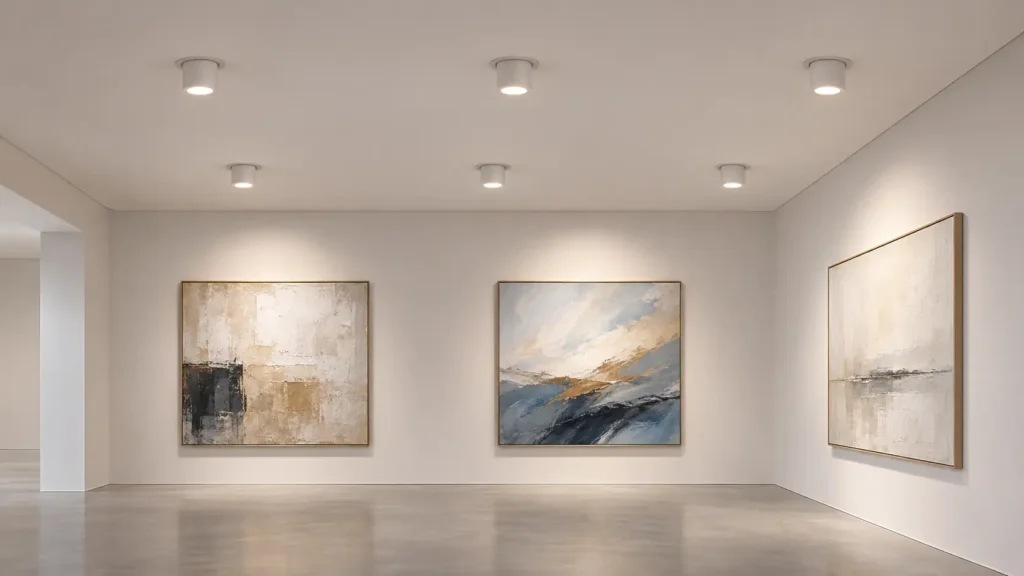
After installation you usually see a cylinder, round housing, decorative trim or glass body below the ceiling line, while the recessed section and often the springs or brackets stay hidden. Designs range from simple cylinders to decorative glass models. Exact style is a product choice; the shared idea is the split between hidden and visible parts. (Diagrams in this article are labeled conceptual illustrations—not product photographs.)
How Is a Semi-Recessed Downlight Installed?
In basic terms, the recessed section is pushed or fixed into a prepared opening so the visible body hangs or sits just below the ceiling. How it locks in place depends on the mounting kit. Detailed depths, cut-outs and driver space belong in the ceiling-space chapter—not here.
🎯 Which part of a semi-recessed downlight remains visible after installation?
A semi-recessed downlight has part of its housing positioned above the ceiling surface, while the remaining visible section extends below it. The exact appearance depends on the fixture design.
How Are Semi-Recessed Downlights Different from Fully Recessed Downlights?
Fully recessed fixtures aim for a flush or trim-led ceiling look; semi-recessed fixtures keep a deliberate visible body below the ceiling line.
What Is the Difference in Appearance Between the Two Types?
Fully recessed downlights are designed so the ceiling reads mostly flat, with only a trim or aperture edge in view. Semi-recessed models intentionally show more fixture body. That changes the overall appearance of the ceiling.
How Do Their Mounting Structures Differ?
Both types usually need a ceiling opening and a way to secure the housing. The difference is how much of the body is meant to remain below the finished surface and how the visible section is shaped. Specific millimetre depths and driver clearances are product data—covered when we discuss measuring the ceiling.
Can You Replace a Fully Recessed Downlight with a Semi-Recessed Model?
Sometimes—but not as a blind swap. Existing cut-outs, mounting brackets, void depth and the look of a protruding body must match the new fixture. Always check the manufacturer’s installation requirements before you replace an original fully recessed downlight.
🎯 Can a semi-recessed downlight replace a fully recessed model?
Sometimes, but not always. The existing ceiling opening, mounting arrangement and available space must be compatible with the new fixture. Check the manufacturer’s installation requirements before replacing the original downlight.
What Are the Advantages and Limitations of Semi-Recessed Downlights?
The visible body can support interior design—but it is also a limitation when a flush ceiling is the priority.
How Can Semi-Recessed Downlights Complement Interior Design?
Because part of the fixture stays in view, finish, shape and proportion become design tools. Matte black cylinders, metallic trims or decorative glass can align with retail brand language or hospitality interiors. Think of integration with the room, not only the cut-out.
What Are the Maintenance Considerations for Semi-Recessed Downlights?
Exposed surfaces may need occasional cleaning, depending on the fixture finish and installation environment. Smooth housings are generally straightforward to maintain, while textured or decorative surfaces may require more careful cleaning.
What Ceiling and Interior Conditions May Limit Their Use?
Very low ceilings, tight headroom under bulkheads, or interiors that demand a completely flush plane may make a protruding body unsuitable. Construction constraints above the ceiling still apply, but the detailed depth checklist belongs later.
🎯 What are the main limitations of semi-recessed downlights?
Their visible fixture body may not suit every interior design, and the protruding structure needs to be considered when planning the ceiling layout. Installation compatibility and the available ceiling space must also be checked for each model.
Where Can Semi-Recessed Downlights Be Used?
Semi recessed downlights fit many commercial spaces when appearance, distribution and install conditions match the brief—not every store or hotel needs them.
Are Semi-Recessed Downlights Suitable for Retail Stores?
Fashion, jewelry and cosmetics floors often use semi-recessed bodies as part of the overall retail design while still delivering accent or zone light on displays. Suitability depends on brand look and aiming needs—not a rule that “all retail must use semi-recessed.”
Can Semi-Recessed Downlights Be Used in Hotels and Restaurants?
Hotel rooms, corridors, reception desks and dining rooms may use the visible body to complement the materials and finishes. Lighting level and comfort still matter alongside appearance.
Are Semi-Recessed Downlights Suitable for Offices and Galleries?
Offices may use them in feature zones more than in dense open-plan grids. Galleries and artwork walls often need careful aiming and glare control—whether the housing is semi-recessed or fully recessed is only one decision among optics and layout.
| Space | Typical role | Selection note |
|---|---|---|
| Retail / display | Accent + design presence | Aiming and finish matter |
| Hotels / F&B | Atmosphere + usable light | Balance look and comfort |
| Offices | Feature zones | Flush grids may still dominate |
| Galleries | Accent on objects | Optics and glare first |
🎯 Are semi-recessed downlights suitable for different commercial spaces?
Yes. They can be used in retail stores, hotels, restaurants, offices and galleries when their appearance, light distribution and installation requirements suit the project.
Are Fixed or Adjustable Semi-Recessed Downlights Better?
Neither is universally better—choose fixed for stable layouts and adjustable when you need to aim at displays.
What Is the Difference Between Fixed and Adjustable Downlights?
Fixed models keep a set aiming direction. Adjustable models let you tilt or rotate the head within the product’s range. Beam-angle numbers are a separate choice covered later.
When Should You Choose Fixed Semi-Recessed Downlights?
Choose fixed when the lighting layout is planned and will not change often—circulation, general seating zones or repeating ceiling patterns that should look consistent.
Can You Aim an Adjustable Downlight at a Specific Display?
Yes—within the fixture’s tilt and rotation limits. Retail displays, artwork and feature tables are common uses. Aim carefully to avoid glare into seating or walkways; do not treat adjustability as a substitute for choosing the right beam distribution.
🎯 What is the main difference between fixed and adjustable semi-recessed downlights?
Fixed models maintain a set lighting direction, while adjustable models allow the light to be aimed at different positions. The choice depends on whether the project needs a stable lighting layout or flexible accent lighting.
How Much Ceiling Space Do Semi-Recessed Downlights Need?
For semi recessed downlights, separate visible body height from the recessed depth and driver space—and use the model’s drawing, not a single industry millimetre.
How Deep Does a Semi-Recessed Downlight Need to Fit into the Ceiling?
Recessed depth is the space needed above the finished ceiling for the hidden section of the housing. Visible height is what you see below. Models differ; never assume one depth fits every semi-recessed SKU.
Does the LED Driver Need Extra Space Above the Ceiling?
Some products integrate the driver; others use a remote or separate driver that needs its own void space and cable routing. Driver location changes what you must clear for joists and services. There is no universal clearance number.
What Should You Measure Before Installing Semi-Recessed Downlights?
Before ordering, measure or confirm:
- Ceiling cut-out size
- Ceiling panel thickness
- Available ceiling void / recess depth
- Joists, ducts, cables and other obstructions
- The manufacturer’s installation drawing for the exact model
🎯 What measurements are needed before ordering semi-recessed downlights?
Check the available ceiling depth, cut-out size and ceiling thickness. Also confirm the space required for the fixture, driver and electrical connections using the manufacturer’s installation drawing.
Which Beam Angle Should You Choose for Semi-Recessed Downlights?
Beam angle shapes coverage at a given mounting height—but photometry, not a sketch alone, decides the real result.
What Is the Difference Between Narrow and Wide Beam Angles?
Narrower beams concentrate light into a smaller pool—useful for accents. Wider beams spread light across a broader area at the same height. Coverage patterns are about distribution, not about glare shields (those come next).
Which Beam Angle Is Better for Accent and General Lighting?
Accent work often prefers narrower distributions aimed at products or features. General ambient layers often use wider distributions. Retail and hospitality frequently mix both. There is no single “best” angle for every project.
As a simple selection sketch—not a universal standard—think in three bands:
- Narrow beam: focused accent lighting on a display, artwork or feature.
- Medium beam: many product-display and feature-wall applications.
- Wide beam: broader general illumination across seating or circulation zones.
Exact beam-angle degree options belong on the product datasheet; do not treat any one set of angles as a rule for every ceiling.
How Does Ceiling Height Affect Your Beam Angle Choice?
Higher mounting usually enlarges the lit pool for the same beam angle. Distance to the target and the size of that target matter. Use the project height and photometric files when available—do not treat a simple cone drawing as a substitute for IES/LDT data.
🎯 Does a wider beam angle always cover a larger area?
Not necessarily. A wider beam generally spreads light over a broader area at the same mounting height, but actual coverage also depends on the fixture’s light distribution, mounting height and surrounding conditions.
How Does the Optical Design of Semi-Recessed Downlights Affect Glare?
Semi-recessed mounting alone does not guarantee comfort—optics, recess of the source and viewing angles do the real work.
How Does a Deep-Recessed Light Source Help Reduce Glare?
Pulling the LED source deeper into the housing can reduce how directly people see the bright point from typical viewing angles. That helps many projects, but deep recess is not an automatic “low glare” certificate without checking the full optic and the room.
How Do Reflectors and Baffles Help Reduce Glare?
Reflectors help direct and distribute light, while baffles and shielding structures can reduce the direct view of bright light sources from certain viewing angles. Their effectiveness depends on the overall optical design. A shielding angle is a practical way to talk about how much of the source is hidden from common sightlines—keep this separate from beam-angle coverage. Manufacturer optical notes and options (for example semi-recessed product optical configurations) show how those parts are combined on a specific model.
How Can You Check the Glare Performance of a Downlight?
Ask for optical notes, photometric data where available, and inspect how visible the source is in a sample. Evaluate under realistic viewing angles. UGR (Unified Glare Rating) is calculated for a lighting installation—layout, room reflectance and observer position matter—so do not treat one UGR figure as a fixed property of every semi-recessed product in every room. Use project photometry and the method described in lighting-design references such as the CIE glare evaluation framework when a formal glare assessment is required.
🎯 Does a semi-recessed design automatically reduce glare?
No. Glare performance depends on the optical design, light-source position, shielding and viewing conditions. A semi-recessed structure alone does not guarantee low glare.
What Light Output and Color Specifications Should You Consider?
Compare delivered light and color data for the exact SKU—wattage and the word “semi-recessed” do not define brightness or color quality.
How Do Wattage and Lumens Affect Downlight Performance?
Wattage is electrical power. Lumens describe light output. A higher wattage does not automatically mean a brighter fixture. Prefer delivered lumen data for the configuration you will buy.
Which Color Temperature Is Suitable for Different Spaces?
Common commercial CCT options include about 2700K, 3000K and 4000K. Warmer white light, such as 2700K or 3000K, is often chosen for spaces where a softer atmosphere is preferred. Neutral white, such as 4000K, may suit offices and retail areas that need a cleaner visual appearance. The final choice depends on the space, products and lighting design.
Does CRI Matter When Choosing Semi-Recessed Downlights?
CRI rates average color rendering. Higher CRI can help merchandise, food and finishes look more accurate. Color-critical spaces may need stronger CRI (and related checks such as R9). Treat CRI as color quality—not brightness.
🎯 Does a higher wattage always mean a brighter downlight?
No. Wattage measures electrical power consumption, while lumens indicate light output. To compare brightness, check the actual lumen output rather than relying on wattage alone.
What Should You Check Before Buying Semi-Recessed Downlights?
Before you buy semi recessed downlights, use a final purchasing checklist—confirm the approved configuration, do not re-learn the whole article here.
Do the Product Dimensions Match Your Ceiling Requirements?
Verify cut-out, recessed depth, visible fixture height and ceiling thickness against the project. This is purchase verification, not a second measurement tutorial.
Are the Driver and Dimming Options Compatible with Your Project?
Confirm supply voltage, driver type (integrated or remote), dimming method (for example TRIAC, 0–10V or DALI where specified) and controller compatibility. Keep CRI/CCT/lumen checks in the previous chapter’s data pack.
Which Product Documents and Samples Should You Request?
Request datasheets, installation drawings, IES/LDT files where available, relevant certifications or test documents, and physical samples for appearance and lighting evaluation.
| Check | Confirm on the PO / RFQ |
|---|---|
| Dimensions | Cut-out, recess depth, visible height |
| Driver / dimming | Exact method + controller match |
| Light / color | lm, CCT, CRI for the approved SKU |
| Documents | Datasheet, install drawing, photometry |
| Samples | Appearance + on-site look |
🎯 What should buyers confirm before approving a semi-recessed downlight order?
Confirm that the approved model, dimensions, installation requirements, light output, color specifications, driver and dimming options match the project requirements. Request the relevant product documents and samples before final approval.
Conclusion: When should you use semi-recessed downlights?
Use semi recessed downlights when you want a visible fixture body as part of the ceiling design and the available ceiling void, cut-out and optical requirements meet the project’s needs. Prefer fully recessed looks when a flush ceiling is the priority. Decide fixed vs adjustable, beam and glare optics from the task—then confirm the dimensions, driver, dimming method and documentation against the approved model.
If you need help comparing semi-recessed configurations, optics or sample programmes, see our custom lighting solutions or contact the XHLUX team.
Explore our related blog posts:
- Surface Mount Cylinder Downlights: When to Use
- How Do Deep Recessed Anti-Glare Downlights Work? A Guide to Glare Control
- What You Need to Know Before Buying High CRI LED Downlights