XHLUX
Commercial buyers often see RGB and RGBW on the same LED downlight datasheet and assume the only change is “more color.” That shortcut misses how white light is made—and whether the fixture can support everyday business lighting as well as scenes.
RGBW LED downlights add a dedicated white LED channel to the familiar red–green–blue set. RGB fixtures can still create visually white light by mixing those three colors, but the white appearance and how objects look under that light can differ from a true white LED channel. This guide compares RGB and RGBW in plain language for commercial buyers, distributors, designers and project customers—without turning into a DMX programming manual.
If you also need to separate RGBW from RGBWW or tunable-white products, see our companion article on RGBW vs RGBWW and tunable white.
TL;DR
- RGB mixes red, green and blue to create many colors—and can look white when channels are balanced.
- RGBW adds a dedicated white (W) channel; white CCT and CRI still depend on the actual product.
- RGBW is not automatically CRI 90, brighter, or tunable white by name alone.
- Choose RGB when color effects dominate; choose RGBW when everyday white light matters too.
- Match control protocol, driver and controller before you order.
Table of Contents
- How Do RGB and RGBW Downlights Produce Light?
- How Does a Dedicated White Channel Affect White-Light Quality?
- Can RGBW LED Downlights Be Used for Everyday Lighting?
- Where Are RGB and RGBW LED Downlights Used?
- How Does Light Output Differ Between RGB and RGBW Downlights?
- Which Control Systems Can Be Used with RGBW LED Downlights?
- How Do You Integrate RGBW Downlights with Smart or Building Control Systems?
- What Should You Check Before Choosing RGBW LED Downlights?
- How Do You Choose Between RGB and RGBW for Your Project?
How Do RGB and RGBW Downlights Produce Light?
RGB uses three color channels; RGBW adds a fourth dedicated white channel—both create colors by controlling how much light each channel contributes.
How Do Red, Green and Blue LEDs Create Different Colors?
RGB stands for red, green and blue. Those three LEDs (or LED groups) are the basic color channels. By changing how brightly each channel runs, the fixture mixes other colors—yellow, cyan, magenta, pastel tones and many more. This is additive color mixing: colored lights add together, rather than paint pigments subtracting light.
Can RGB LEDs Produce White Light?
Yes. When red, green and blue are balanced in the right ratios, the result can look white to the eye. That white is still made from three color channels, not from a separate white LED. It can work for scenes and temporary “white” looks, but it is not the same physical source as a dedicated white LED. Detailed CRI and R9 checks belong in the next chapter—not here.
What Does the White LED Add to an RGBW Downlight?
In RGBW, the W stands for white: an extra dedicated white LED channel alongside R, G and B. A basic RGB product is a three-channel set; a basic RGBW product is a four-channel set. The white-light color temperature (how warm or cool that white looks) depends on the actual white LED and product design—not on the letters “RGBW” alone.
🎯 What is the main difference in how RGB and RGBW downlights produce light?
RGB uses red, green and blue channels to create different colors, including visually white light. RGBW adds a separate white LED channel alongside the three RGB channels.
How Does a Dedicated White Channel Affect White-Light Quality?
A dedicated white LED and RGB-mixed white can both look white, but they may render object colors differently—so check the white channel’s real data.
Why Can RGB-Mixed White Light Look Different from Dedicated White Light?
RGB-mixed white is built from three colored spectra. A dedicated white LED typically produces white light using a blue or violet LED combined with phosphor. This creates a different spectral output from RGB-mixed white light. Two ceilings can both look “white” while making fabrics, food or finishes appear different. That does not mean every RGBW product automatically renders colors better than every RGB product—you still need the published white-channel data.
Does the White Channel in an RGBW Downlight Have a High CRI?
CRI (Color Rendering Index) is a simple score for how accurately a light source shows object colors compared with a reference. The W channel still needs its own CRI check. RGBW does not automatically mean CRI 90 or CRI 95. Ask for the white-light CRI (and related notes) for the exact model and CCT you will buy.
What Should You Check About the White Light Quality?
For everyday white use, review:
- CRI — how accurately white light reveals object colors
- R9 — extra information about saturated reds, when reds matter
- CCT — the white color temperature you specified
- Spectral data or test reports — when the project is color-sensitive
Keep brightness and total lumens for the light-output chapter; this section is about white-light quality.
🎯 Why should you check the white-light performance of an RGBW downlight?
The dedicated white channel has its own spectral characteristics and color-rendering performance. Check its actual CRI, R9 and CCT rather than assuming every RGBW product provides high-quality white light.
Can RGBW LED Downlights Be Used for Everyday Lighting?
They can support everyday white lighting when the dedicated white channel delivers enough usable light for the space—not every RGBW product is designed as main lighting.
Can RGBW Downlights Be Used as Main Lighting?
RGBW downlights are not “decoration only” by definition. Whether they can serve as main lighting depends on the actual white-channel output, beam and layout—not on the product name. Commercial spaces still need enough light for tasks, circulation and comfort. Do not classify all RGBW SKUs as primary lighting without checking white-mode performance.
Can You Switch Between White Light and Colored Light?
Many RGBW systems can run a white-light mode for normal hours and switch to colored scenes for events, branding or after-hours atmosphere. How you switch—separate white channel, scenes, or presets—depends on the controller and product. Protocol details come later; here the point is the operating idea: white for business, color when you need it.
What Should You Consider When Using RGBW for Everyday Lighting?
Check white-mode brightness, white CCT and CRI, beam coverage, and whether the fixture meets the room’s everyday needs. Separate general lighting (people work and shop under white light) from decorative color (accent and atmosphere). If white light is weak or poorly rendered, RGBW may still be fine for effects—but not as the only workhorse layer.
🎯 What determines whether an RGBW downlight can provide everyday lighting?
Its dedicated white channel must provide sufficient light output and suitable color quality for the space. Not every RGBW downlight is designed to serve as the main lighting source.
Where Are RGB and RGBW LED Downlights Used?
RGB suits color-first spaces; RGBW helps when the same ceiling must also deliver useful white light for normal business.
How Are RGB and RGBW Downlights Used in Hotels and Restaurants?
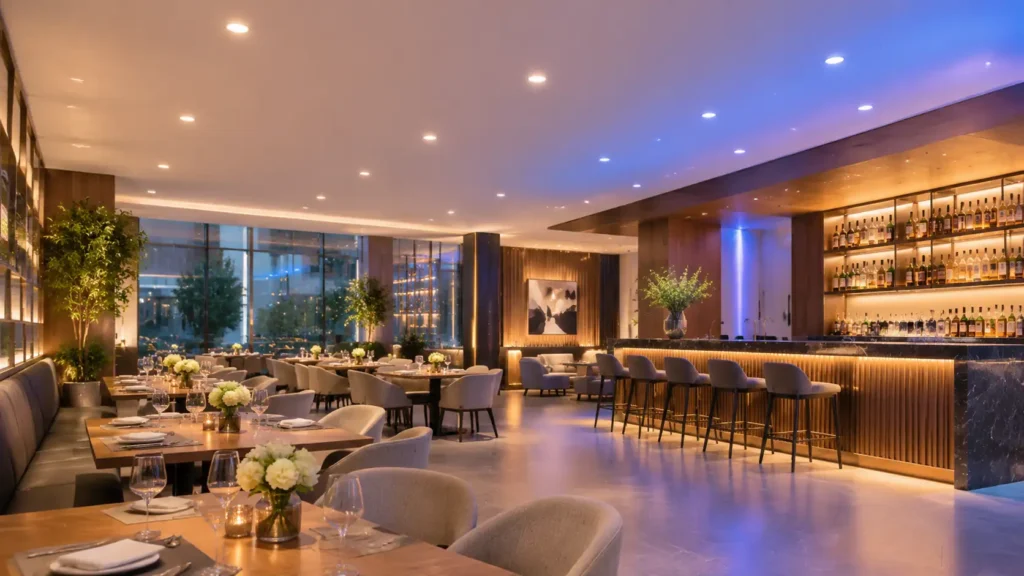
Hotel lobbies, bars, restaurants and leisure areas often want atmosphere after dark and clear, comfortable light during service. Colored scenes set mood; dedicated white light supports dining, reception and circulation. Match the mix to each zone’s function—a bar may lean more on color, while a breakfast area needs reliable white light.
Are RGBW Downlights Suitable for Retail Stores and Showrooms?
Retail floors, brand showrooms and product displays may use color for campaigns or feature walls, then return to white light for everyday merchandising. White-light color rendering matters when customers judge product color. RGBW is often considered when both jobs share the same ceiling family.
Where Are RGB Downlights a Suitable Choice?
Bars, entertainment venues, stages and decorative zones that primarily need colored effects may be well served by RGB—especially where high-quality white light is rarely required. If white is only occasional, RGB-mixed white may be enough. If white is daily business lighting, look harder at RGBW white-channel data.
| Space type | Typical need | Often lean toward |
|---|---|---|
| Hotel lobby / F&B | Atmosphere + usable white | RGBW when white is daily |
| Retail / showroom | Displays + product color under white | RGBW when white sells merchandise |
| Bar / entertainment | Color effects first | RGB may be enough |
| Stage / decorative accent | Scenes and color | RGB or RGBW by white demand |
🎯 How do RGB and RGBW suit different commercial applications?
RGB and RGBW can both be used in commercial spaces. RGB suits projects focused on color effects, while RGBW is useful when the same fixtures also need to provide dedicated white light for everyday use.
How Does Light Output Differ Between RGB and RGBW Downlights?
Compare white-mode and color-mode output separately—adding a W channel does not make every RGBW product automatically brighter.
Does RGBW Produce More White Light Than RGB?
A dedicated white channel provides a separate source for white light instead of relying on RGB mixing. Its actual brightness and performance depend on the LED configuration, driver and power allocation. Adding “W” to the name does not guarantee higher white lumens. Always compare white-light mode data for the exact SKU, not a marketing headline.
Does the Brightness Change When You Mix Different Colors?
Yes, it can. Different color mixes use different channel power. Actual output depends on LED chips, drivers and power limits. Perceived brightness of a saturated color is not the same as measured luminous flux. Do not treat a maximum “all channels on” RGBW figure as the white-mode output.
What Should You Compare When Checking Downlight Brightness?
Use a practical checklist:
| What to compare | Why it matters |
|---|---|
| LED / fixture power (W) | Electrical load—not brightness by itself |
| Luminous flux (lm) | Total light output when stated for a mode |
| White-mode lm | Everyday lighting performance |
| Color-mode data | Scene and effect levels |
| Beam angle / coverage | How light spreads on the floor or display |
Do not reuse CRI/R9 explanations here—those belong with white-light quality.
🎯 What should you compare when evaluating RGB and RGBW light output?
Compare the actual luminous flux in white-light mode and different color modes, along with rated power and beam angle. Do not assume that RGBW is always brighter simply because it has an additional white channel.
Which Control Systems Can Be Used with RGBW LED Downlights?
RGBW needs a control path that can address color channels—DMX, DALI color control and wireless options are common, but not interchangeable.
Can RGBW Downlights Be Controlled with DMX512?
DMX512 is widely used to drive entertainment and architectural color systems. It can control individual RGBW channels for centralized scenes across many fixtures—common in hotels, entertainment spaces and large displays. Exact channel mapping depends on the fixture profile and controller.
Can RGBW Downlights Work with DALI Systems?
DALI is common in commercial lighting for addressing and dimming. For RGBW color control, you need compatible drivers and controllers. DALI-2 DT8 can support RGBW color control when the driver and control system support the corresponding color type and configuration—do not assume ordinary DALI dimming alone equals full RGBW color control.
Are There Wireless Control Options for RGBW Downlights?
Some products offer Zigbee, Bluetooth or Wi-Fi control via apps, remotes or gateways. Protocols and ecosystems vary. Wireless is not automatically compatible across brands. Check the exact stack before you promise a phone-app experience to the client.
🎯 Which control methods can be used to operate RGBW downlights?
Depending on the product, RGBW downlights may support DMX512, DALI-2 DT8 color control or wireless systems such as Zigbee and Bluetooth. The driver and controller must support the required RGBW functions.
How Do You Integrate RGBW Downlights with Smart or Building Control Systems?
Integration means matching protocol, drivers, controllers and wiring—sharing a protocol name is not enough.
Can RGBW Downlights Connect to an Existing Lighting Control System?
Before connecting, check which protocol the building already uses, which drivers the downlights need, and whether the system can control individual RGBW channels (or only dim a single white output). Using “DALI” or “DMX” on both sides does not guarantee complete device compatibility.
Can Multiple RGBW Downlights Be Controlled Together?
Yes—through groups, zones and scenes—when the controller and network capacity allow it. Synchronized color and brightness changes are normal project goals. The controller’s capacity, device addressing and grouping settings can affect how reliably multiple lights work together.
What Should You Check Before Connecting RGBW Downlights to a Smart System?
Confirm controller and driver compatibility, communication protocol, power supply and wiring, and whether a gateway or extra interface is required. Ask the supplier to confirm compatibility in writing and provide a wiring diagram for the approved configuration.
🎯 What needs to match when connecting RGBW downlights to an existing control system?
The communication protocol, driver, controller and RGBW channel configuration must be compatible. For multiple fixtures, also confirm grouping, system capacity and any required gateway.
What Should You Check Before Choosing RGBW LED Downlights?
Use a short buying checklist for white light, fit and control—do not judge performance from the RGBW label alone.
What White-Light Specifications Should You Check?
Check white CCT, white CRI, R9 where relevant, and the actual luminous flux of the white channel. The product name “RGBW” is not proof of white-light quality.
What Power, Beam Angle and Installation Details Matter?
Review product power and real light output, beam angle, ceiling cut-out and installation depth, mounting style (recessed, surface-mounted and other options where offered), plus driver location and space. Measure the ceiling before you confirm the order.
What Control and Compatibility Details Should You Confirm?
Confirm RGBW channel configuration, control protocol, driver and controller models, dimming and color-control functions, plus certifications, test documents and project requirements.
| Checklist item | What to write on the RFQ / PO |
|---|---|
| White CCT / CRI / R9 | Exact white-channel data |
| White-mode lm | Not max RGBW headline only |
| Beam / cut-out / depth | Fit the real ceiling |
| Protocol + driver | DMX / DALI DT8 / wireless as specified |
| Documents | Matching sheet for the ordered SKU |
🎯 Which product details should you check before buying RGBW downlights?
Check the white-light CCT and CRI, actual light output, power, beam angle, installation dimensions, control protocol and driver configuration. Confirm that the specifications meet your project requirements.
How Do You Choose Between RGB and RGBW for Your Project?
Pick RGB when color is the main job; pick RGBW when the same fixtures must also deliver everyday white light—then verify the actual white channel.
When Is RGB Enough for Your Lighting Project?
Choose RGB when the project mainly needs colored lighting, white light is not a primary function, and the space is decorative, atmospheric or stage-oriented. Budget and control complexity still matter, but you may not need a strong dedicated white channel.
When Should You Choose RGBW Instead?
Choose RGBW when you need both colored light and normal white light—especially retail, hotel and showroom ceilings that combine displays with daily business lighting. Pay attention to the dedicated white channel’s real output, CCT and CRI.
What Is the Main Difference When Choosing Between RGB and RGBW?
| Topic | RGB | RGBW |
|---|---|---|
| Channels | R + G + B | R + G + B + dedicated W |
| White light source | Mixed from RGB | Dedicated white channel (plus optional RGB mix) |
| Everyday white lighting | Possible, but check quality/output carefully | Better starting point when white is daily—still verify data |
| Typical fit | Color-first / decorative | Color + usable white |
| Buying reminder | Confirm control and output | Confirm white-mode specs, not the name alone |
Simple selection logic: if white light is part of normal operations, shortlist RGBW and read the white-channel sheet; if color effects dominate and white is rare, RGB may be enough. Always check the specifications of the actual product before purchasing.
🎯 What is the deciding factor when choosing between RGB and RGBW?
The key question is whether the project needs only colored lighting effects or also requires a dedicated white-light channel for regular illumination. Compare the actual white-light performance and control requirements before making the selection.
Conclusion: Which should you choose—RGB or RGBW?
RGB and RGBW both create colored light; the practical difference is how white light is produced and whether that white is good enough for everyday use. Use RGB when color is the priority. Consider RGBW LED downlights when you need both colored lighting and a dedicated white-light channel. Check the actual white-light output, CCT and CRI to confirm whether the product meets your project requirements—and verify control compatibility for the exact SKU.
If you need help comparing RGB / RGBW downlight configurations, control options or sample programmes, see our custom lighting solutions or contact the XHLUX team.
Explore our related blog posts:
- What Are Colour Changing Downlights? Full Lighting Guide
- Bluetooth vs WiFi Downlights: Which Smart Lighting Fits You?
- What Is a Smart Downlight and How Is It Controlled?