XHLUX
XHLUX
An led linear lighting price list rarely shows what a project will actually cost.
Most lines print a length, a wattage label and a unit price—without the mounting kit, joiners, drivers, controls, emergency parts, freight or labour that turn a catalogue row into an installed run.
Use this page when you are doing a linear LED price comparison and two quotes look close until you notice one includes suspension and optics while the other is only a bare housing.
For basic linear forms and terminology, start here:
→ What Is Commercial Linear Pendant Lighting: Beginner Guide
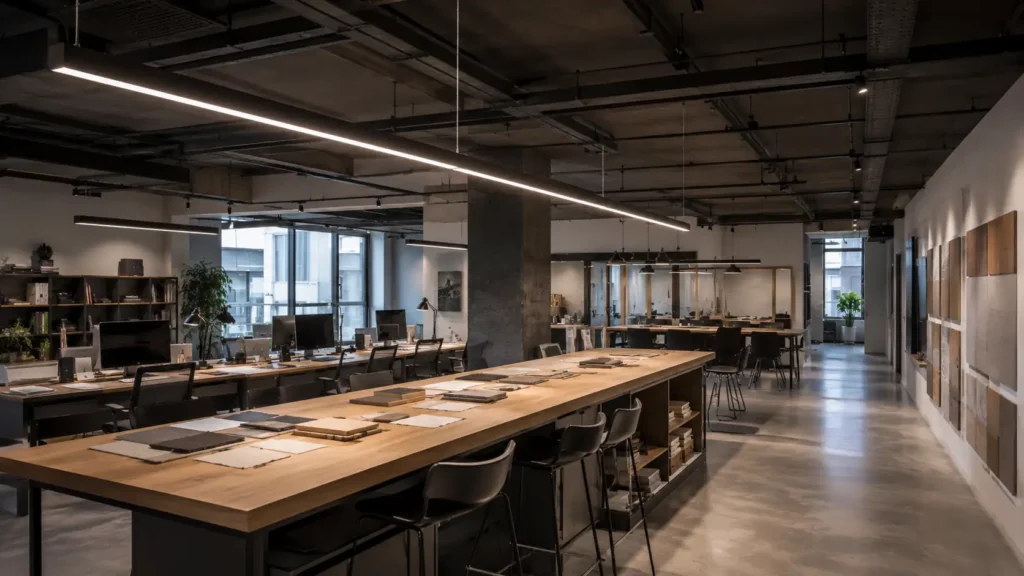
TL;DR: Length and wattage move the number on a list, but mounting method, output per metre, optics, drivers, joiners and quote packaging usually explain most of the spread. Compare complete scheduled builds—not isolated catalogue rows.
1. Treat every price-list line as a partial quote
Catalogue and distributor LED linear fixture pricing lines are useful starting points. They are not automatic project totals.
A typical list row may show:
- One standard length and one wattage label
- A single finish or CCT option
- A unit price without suspension, brackets or recessed frame
- No joiners, feeds, corners or blank sections
- No driver model, dimming protocol or emergency module
- No freight, installation or commissioning allowance
Two suppliers can quote the same nominal wattage at very different prices because one line is a basic direct-only strip and the other is a direct-indirect suspended assembly with controlled optics.
Before any linear lighting cost per meter calculation, freeze what the metre includes: luminous length only, total housing length, or a complete suspended drop with canopy and cables.
🎯 Does one list price define project cost?
No. Confirm whether the line covers the full installed configuration, accessories, controls and scope you will actually order.
2. Length changes more than the metre count
Longer runs are not simply “more metres at the same rate.” Length drives section count, joiner quantity, feed positions, driver loading, suspension points and alignment risk.
| Length factor | Why it moves price |
|---|---|
| Standard module lengths | Non-standard cuts may add factory work or waste |
| Joiner and feed count | Each interface adds parts, labour and optical risk |
| Suspension spacing | Long spans need more hangers and levelling effort |
| Corners and branches | Fittings may be priced separately from straight sections |
| Transport and handling | Long extrusions need different packing and site access |
| Replacement strategy | A failed mid-run section can cost more than one end module |
Retail and distributor ranges for fixed lengths already show how wide the band can be.
A 4-foot linear fixture often sits in a much lower band than an 8-foot architectural row of the same family—because length, mounting class and build grade travel together.
When buyers ask for linear lighting cost per meter, insist on the scheduled metre: housing length, luminous length and the accessory count that makes that length installable.
🎯 Is per-metre pricing always proportional to length?
No. Joiners, feeds, cuts, suspension points and non-standard modules can change the effective rate.
3. Wattage labels do not equal value
Wattage on a list is marketing shorthand. The procurement question is delivered light on the target plane at the proposed mounting height—with acceptable glare and uniformity—not the watts printed on a label.
Higher output per metre can raise price through:
- More LED modules or higher board current
- Larger or more efficient thermal paths
- Higher-grade drivers with lower flicker and better dimming
- Optics that shape output instead of flooding the housing
- Stricter efficacy, colour maintenance or warranty evidence
A lower-wattage row can still cost more if it uses a premium optic, a tunable-white driver or a direct-indirect split that a basic high-wattage strip cannot match.
For linear LED price comparison, align maintained lumens, distribution and mounting height before comparing wattage lines.
ENERGY STAR and the DesignLights Consortium Qualified Products List (DLC QPL) are useful sanity checks when suppliers claim exceptional efficacy. Both programmes verify energy performance through independent testing rather than brochure figures alone.
🎯 Does higher wattage always mean a better deal?
No. Compare delivered light, distribution, glare control and evidence at the real mounting height.
4. Mounting method resets the bill of materials
The same luminous line can be priced as surface, recessed or suspended goods. Each interface carries a different accessory stack.
| Mounting type | Common priced items beyond the luminous section |
|---|---|
| Surface | Brackets, feeds, end caps, alignment shims, substrate fixings |
| Recessed | Mounting frame, plaster-in trim, driver access path, ceiling cut coordination |
| Suspended | Canopy, cables or rods, stabiliser bars, alignment hardware, drop-height kit |
Sidebar filters on commercial shopping SERPs often group products by mount type and max wattage for a reason: those two fields change the bill of materials as much as length does.
A suspended quotation should show suspension centres, cable length and ceiling interface. A recessed quote should show frame depth and access—not only the visible trim width.
This is related to, but not the same as, Should You Suspend or Recess a Linear Light Fixture?. Pricing follows the interface you choose; that guide helps you choose the interface from ceiling conditions.
🎯 Can one housing price cover every mounting type?
No. Surface, recessed and suspended kits change parts, labour and coordination cost.
5. Optics, distribution and controls add real cost
Once length and output are defined, optical grade and control scope often explain the gap between commodity and architectural bulk linear lighting quotes.
Price movers include:
- Micro-prism or louvre optics versus basic diffusers
- Direct, indirect or direct-indirect distributions
- Fixed CCT versus tunable-white channels
- 0-10 V, DALI or wireless control compatibility
- Sensor, emergency and addressable modules per section
- Custom finish, cable colour and label requirements
- Independent test reports for glare, flicker or colour maintenance
Commercial distributor listings illustrate how wide the band can be. A basic utility strip and an architectural suspended row can sit in the same “linear LED” category while differing by several times in unit price.
That spread is normal when optics, drivers and certification differ. Do not compare a bare strip price with a suspended architectural row unless both quotations include the same performance evidence and installed scope.
🎯 Do optics and controls matter once wattage is fixed?
Yes. Distribution, dimming, sensors and emergency parts can move price more than a small wattage change.
6. Compare quotes at the same packaging level
Bulk linear lighting quotes vary by what the supplier bundles. A responsible comparison uses the same packaging level on both sides.
| Quote level | What should be visible |
|---|---|
| Unit line | Housing length, output, optic, finish, driver class |
| Run package | Joiners, feeds, corners, blanks, suspension or frame kit |
| Circuit package | Driver count, control wiring, emergency and sensor modules |
| Project package | Mock-up, freight, spares, commissioning support, warranty terms |
Ask each bidder to price the same scheduled bill of materials. If one quote assumes remote drivers and the other integrates them in the housing, the comparison is invalid even when the wattage label matches.
For phased fit-outs, confirm whether bulk pricing applies to the whole project, to one release, or only above a minimum order quantity.
An attractive list price can disappear when the first release is small or when mixed lengths break standard packing.
🎯 Can bulk pricing be compared across different BOMs?
No. Align lengths, joiners, drivers, controls and release quantities before comparing bulk lines.
7. Add installation, energy and service life to the decision
Fixture price is one slice of total cost.
A cheaper row can cost more over ten years if it needs more frequent driver replacement, more sections to hit the same illuminance, or expensive ceiling reopening for service.
Useful whole-project checks:
- Installation and alignment labour for long runs
- Ceiling rework for recessed frames or access paths
- Control commissioning and scene programming
- Annual energy use at the maintained output you approved
- Driver and module replacement cycles before LED lumen-maintenance limits
- Spare-part availability for joiners, drivers and diffusers
Lifespan claims on a led linear lighting price list should be read carefully.
Many commercial LED linear products are described around 50,000 operating hours under stated conditions. Higher-end builds may claim more; weaker builds can fail earlier.
L70 describes lumen depreciation to 70% of initial output. It is not a guarantee that the driver or connectors will last the same duration.
Approve the purchase order on the exact configuration: length, output, optic, driver, control, mounting, joiners and service plan. Price follows that boundary.
For what makes a complete linear luminaire—not just a glowing profile—use the linear luminaire definition guide.
🎯 Is the lowest fixture line always the lowest project cost?
No. Installation, energy, controls and replacement labour can reverse a cheap unit price.
What moves the number on a linear LED price list
The chart below is illustrative. It shows how different specification choices can shift relative cost within one project—not live market prices.
| Factor | Lower spec (index) | Higher spec (index) |
|---|---|---|
| Base housing | 100 | 150 |
| Length / joins | 100 | 157 |
| Output / efficacy | 100 | 133 |
| Optics grade | 100 | 218 |
| Mounting kit | 100 | 162 |
| Controls / emergency | 100 | 260 |
| Finish / custom | 100 | 189 |
Verify against project BOM and supplier quotations.
FAQ
What to do next
Freeze the scheduled bill of materials before you compare list prices. Ask each supplier for the same lengths, outputs, optics, drivers, joiners, mounting kits, control interfaces and emergency parts. Then compare maintained performance and service access—not wattage labels alone.
For project-based linear LED pricing, XHLUX can review required lengths, optics, mounting methods and control scope against your schedule before quotation.
Notes & Sources
- ENERGY STAR and DesignLights Consortium Qualified Products List (DLC QPL) — independent energy-performance verification for commercial LED products.
- User-authorized Google PAA screenshots for
led linear lighting price list(2026-08-20) — source of FAQ length-price bands and lifespan framing; ranges are SERP snapshots, not XHLUX list prices. - Project Serper organic results for
led linear lighting price listin this workspace — live SERPs mix distributor catalogues, architectural channels and commodity retailers at incompatible specification levels. - Project-specific electrical, structural and accessibility rules remain applicable. Confirm local requirements before installation.