XHLUX
Commercial teams comparing linear wall washers with LED strip systems need more than a fixture-versus-tape comparison. The useful question is which complete lighting system can deliver the required wall distribution under your mounting geometry, electrical plan and maintenance model.
This comparison separates three system types: a dedicated linear wall washer, an LED strip in a standard aluminum profile, and an LED strip paired with dedicated wall-wash optics. For a product-form definition of surface-mounted linear wall washers—not this selection duel—see What Is a Surface-Mounted Linear Wall Washer?.
When we review LED linear light quotations with project teams, we treat strip lumen-per-meter claims and finished-system photometry as different documents—because optical losses and mounting geometry change what the wall actually receives.
TL;DR
- Compare three systems: dedicated wall washer, strip + standard profile, strip + wall-wash optics.
- A standard diffuser does not automatically create asymmetric wall-wash distribution.
- Judge uniformity with photometry and equivalent installation conditions—not brochure watts alone.
- Cost and maintenance follow complete-system scope (profiles, optics, drivers, labour), not strip price alone.
Table of Contents
- What Types of Lighting Systems Are Being Compared?
- How Do Their Optical Designs Differ?
- Which System Provides More Uniform Wall Illumination?
- How Do Installation Requirements Differ?
- How Do Their Electrical and Photometric Specifications Compare?
- What Environmental Conditions Must Each System Meet?
- How Do Maintenance and Replacement Requirements Compare?
- Which System Is More Cost-Effective for a Commercial Project?
- How Should You Choose and Specify the Right System?
- Conclusion
- FAQ
What Types of Lighting Systems Are Being Compared?
These options are three different wall-washing system constructions—not three names for the same product.
Dedicated Linear Wall Washer Fixtures
A dedicated linear wall washer is usually supplied as a complete luminaire: LED modules, optics, housing, thermal path, driver arrangements and mounting hardware configured as one product family.
Optical packages vary by manufacturer and model. Some use asymmetric lenses; others rely on reflectors or mixed optics. Treat the product as a finished fixture, not as “an LED strip placed in a metal channel.”
LED Strip Lights in Standard Aluminum Profiles
This build pairs an LED strip with a standard aluminum profile and a general diffuser.
The profile manages mounting, heat sinking and mechanical protection. The diffuser softens LED images and spreads light for general linear illumination.
A standard diffuser does not automatically create the asymmetric distribution needed for wall washing. General linear light and directional wall wash are different optical jobs.
LED Strip Systems with Dedicated Wall-Wash Optics
Here the strip is combined with asymmetric lenses, wall-wash reflectors or other dedicated optics that redirect flux toward the wall plane.
These builds differ from ordinary strip-plus-diffuser kits. Construction may be flexible or rigid, depending on the profile and optic design.
Use the table below as a first-pass difference map—not a scorecard that ranks one system as always better.
| Comparison factor | Dedicated linear wall washer | Strip + standard profile | Strip + wall-wash optics |
|---|---|---|---|
| Optical design | Integrated optics | Standard diffuser | Dedicated asymmetric optics |
| Wall-wash capability | Product-dependent | Not inherently designed for wall washing | Product-dependent |
| System configuration | Integrated fixture | Separately assembled components | Strip and dedicated optics |
| Installation flexibility | Depends on fixture design | Depends on profile | Depends on strip and optic design |
| Photometric verification | Complete luminaire data | Finished-system data required | Finished-system data required |
| Maintenance | Model-dependent | Component-dependent | Component-dependent |
🎯 Is a strip a wall washer without wash optics?
Not by default. Without dedicated wall-wash optics, a strip-in-profile system is usually general linear lighting rather than a true wall-wash distribution.
How Do Their Optical Designs Differ?
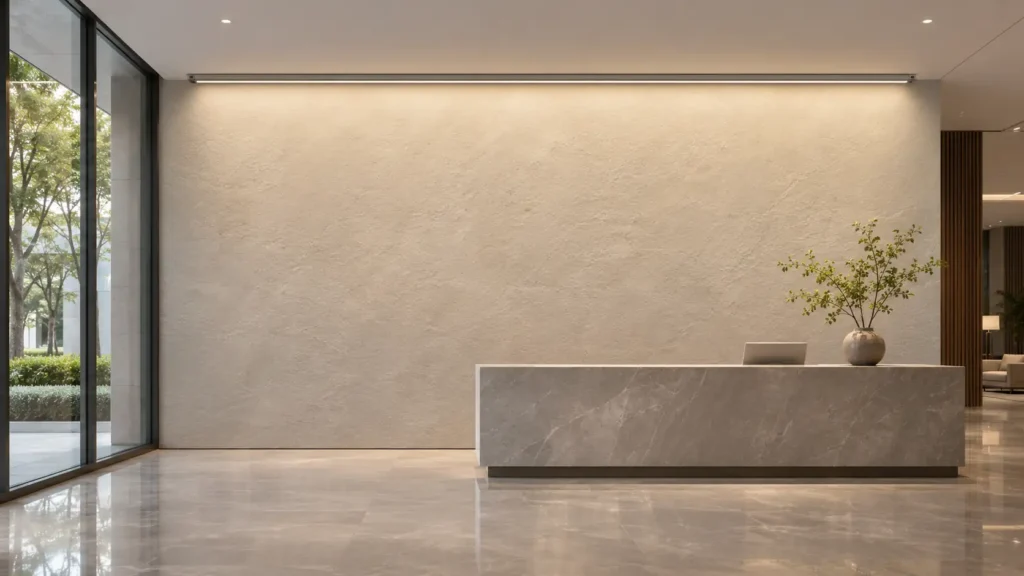
Wall-wash performance follows optical geometry and light direction—not whether the source looks like a strip or a sealed bar.
How Lenses and Reflectors Direct Light Toward the Wall
Asymmetric lenses and reflectors shape intensity toward the wall and away from unwanted zones.
Dedicated wall washers and strip-based wall-wash kits can both use these components, but the optical stack, aperture and setback geometry still differ by product. Do not assume two “asymmetric” labels produce the same candela distribution.
What Standard Diffusers Can and Cannot Do
Standard diffusers reduce pixelation and soften the near-field appearance of LED dots.
They mainly scatter and blend light. They are not interchangeable with asymmetric wall-wash optics. A milky cover alone often fails to create the directional wall distribution a wash project needs.
How Optical Distribution Affects Light Spill
Some flux may leave the target wall and reach ceilings, floors or adjacent surfaces.
Tighter directional control can improve wall utilization; broader diffusion can raise spill. Compare actual photometric files under equivalent aiming and setback—not product appearance photos.
🎯 Why do asymmetric optics differ from standard diffusers?
Asymmetric optics reshape intensity toward the wall, while standard diffusers mainly scatter light for softer general appearance without that directed wall-wash pattern.
Which System Provides More Uniform Wall Illumination?
No system type is automatically more uniform—results depend on optics, geometry and how sections join.
How Light Distribution Changes from the Top to the Bottom of a Wall
Vertical distribution often changes from the top band near the fixture to mid-wall and lower zones.
Judge the finished installation across the intended wall height and width. Avoid universal claims that dedicated washers always win, or that strip builds always fail.
Keep illuminance (lux on the wall surface) separate from luminance (how bright the wall appears). Spec sheets and meters can report either; mixing them produces false “uniformity” conclusions.
What Causes Hot Spots, Dark Bands and Uneven Coverage?
Common causes include mismatched optical distribution, uneven section joins, insufficient coverage length and visible LED imaging through weak diffusion.
Wall size, reflectance, setback and mounting height also change what you see. Diagnose the pattern before swapping product families.
How to Compare Wall-Wash Results Using Photometric Data
Request manufacturer IES or LDT files for the exact optic and lumen package you intend to buy, then pair those files with the supplier’s optical datasheet for that configuration. For IES-format photometric data exchange, see the official Illuminating Engineering Society listing for ANSI/IES LM-63-19(R25) and related individual standards. Verify results with a repeatable wall check—not a single lucky lux reading.
- Compare both systems under the same wall size, mounting positions, aiming and ambient conditions.
- Divide the wall into a measurement grid (several heights and widths)—do not judge from one centre point.
- Record illuminance at each grid point and review the top-to-bottom and side-to-side pattern.
- Use photometric simulation for the same geometry, then compare the pattern—not only the average lux.
- After installation, re-measure key points and locate gaps between simulation and site results (aiming, reflectance, joins or assembly differences).
A higher average illuminance does not prove better uniformity if hot bands or dark zones remain.
Review the illuminance distribution across the measurement grid rather than relying on average lux alone. Compare the minimum, maximum and variation between measurement points under the same test conditions. Look for abrupt steps between adjacent cells—those often mark aiming errors, join issues or optical mismatch more clearly than a single low reading. The acceptable variation should follow the project’s lighting specification rather than a universal threshold.
🎯 Does higher lumen output always mean more uniform walls?
No. More lumens can raise average brightness without fixing uneven distribution, hot spots or dark bands created by optics and layout.
How Do Installation Requirements Differ?
Installation effort differs because one path installs a finished fixture and the other often assembles a system from parts.
Mounting a Complete Wall Washer vs Building a Strip-Based System
A complete wall washer typically arrives as an integrated product with defined brackets, fixings and electrical interfaces.
Strip-based systems may require selecting profiles, optics, end caps, drivers and connectors separately, then integrating them on site or in the shop. Ask which tasks the supplier completes and which remain for the site crew.
| Installation work | Complete wall washer | Strip-based system |
|---|---|---|
| Fixture/profile mounting | Product-dependent | Required |
| Strip installation | Usually integrated | Required |
| Optical component assembly | Usually integrated | Depends on system |
| Driver installation | Product-dependent | Depends on configuration |
| On-site system integration | Product-dependent | Often required |
| Profile cutting / prep | Usually limited | Often required |
| Continuous-run join alignment | Product-dependent | Often critical for wash appearance |
| Later disassembly access | Model-dependent | Depends on how the build was assembled |
A strip-based wall-wash system is not automatically harder—but more of the BOM may arrive as separate parts that someone must integrate.
For continuous runs on long commercial walls, check joins before you treat every seam as a defect:
- Do adjacent fixtures or profiles share the same mounting reference line?
- Is there a visible interruption in light output at the joint under normal viewing, or only a mechanical seam?
- Do adjacent optical sections keep the same aiming direction and distribution family?
Not every join is a dark band. Some products are designed with continuous optics or controlled end treatments; verify the actual construction and a sample join under project-like aiming before rewriting the specification.
How Wall Shape and Available Space Affect System Selection
Flat walls, curved surfaces and columns need different mechanical flexibility.
Flexible strip constructions can follow some curves better than rigid housings; rigid dedicated fixtures can suit long straight runs with factory alignment. Confirm whether bends or columns keep optical aiming consistent—mechanical fit alone does not guarantee an even wash. Narrow niches and limited mounting depth also constrain which packages fit.
Where Do Drivers, Connections and Heat-Dissipation Components Fit?
Compare where drivers sit, how cables route and how heat leaves the LED path.
Confirm maintenance access for drivers and connectors before freezing the architectural detail. Thermal and wiring space are selection criteria, not afterthoughts.
🎯 Do strip wall-wash builds need more install planning?
Often yes. Separate strips, profiles, optics and drivers usually need more coordination than mounting a factory-integrated wall-washer fixture.
How Do Their Electrical and Photometric Specifications Compare?
Fair comparison uses finished-system electrical and photometric data under matching conditions.
Compare Delivered Lumens, Not Just LED Strip Output
LED strip lumen-per-meter figures describe the source before system losses.
Lenses, reflectors and diffusers change how much light leaves the finished optic and how that light is distributed—these are optical effects on delivered output. Compare delivered lumens of the complete lighting system—not strip catalogue lm/m against a finished luminaire’s published output.
How Do Power Consumption and System Efficacy Compare?
Compare electrical performance for the finished configuration: complete-system input power and system efficacy in lm/W.
The driver configuration sets electrical operating conditions (input power, current, dimming behaviour and control interface). Do not treat driver settings as if they were the same thing as optical losses from lenses, reflectors or diffusers. Include driver and accessory loads where they belong to the system. Avoid comparing bare LED chip claims with complete fixture ratings.
Two systems with similar wattage and similar catalogue lumens can still wash a wall differently. Optical distribution and mounting geometry decide the wall result—pair electrical numbers with IES/LDT under the same install conditions.
Which Color and Control Specifications Matter for the Project?
Separate the brief into layers so CCT/CRI are not mixed with control protocols:
- Light quality: CCT and CRI against the commercial appearance brief.
- Electrical performance: input power and system efficacy (covered above).
- Control compatibility: dimming method; RGB/RGBW only when colour change is required; DALI, DMX or other protocols only when the actual model supports them. For DALI claims, confirm the product and driver against IEC 62386-family declarations and the supplier’s interface datasheet—not a brochure keyword alone. Ecosystem reference: DALI Alliance.
Verify each layer on the manufacturer datasheet and optical documentation for the exact configuration—do not assume a wattage match means matching wall appearance.
What Photometric and Electrical Documents Should Suppliers Provide?
Request IES/LDT files, complete-system output data, electrical specifications, driver datasheets, dimming compatibility notes, installation drawings and relevant environmental or test evidence for the ordered linear wall-washing fixture or strip-based wall-wash kit.
Incomplete quotes that list only strip lm/m without system photometry are not ready for fair comparison. This guide does not invent SKU-level lumen, IP or efficacy figures—use the supplier documents for the quoted BOM.
🎯 Why compare system lumens, not strip output alone?
Because optical components change delivered light and distribution, while driver configuration sets the electrical operating point; strip catalogue output alone is not finished-system performance.
What Environmental Conditions Must Each System Meet?
Environmental suitability follows the finished assembly rating—not assumptions about fixture type.
What IP Rating Is Required for the Installation Environment?
IP ratings describe degrees of protection against solid objects and water for electrical equipment, as defined in IEC 60529. Apply the rating to the finished assembly in its intended environment—not only to a component label.
Indoor, damp and exposed outdoor locations need different protection. For LED strip + profile + optics builds, a strip IP mark does not automatically become the rating of the assembled system. Confirm seals at joints, end caps, cable entries and any field-cut openings against the project requirement and the manufacturer’s installation instructions for that exact BOM. Do not transfer a strip-only IP mark to a profile-plus-optic system without finished-assembly evidence.
How Do Temperature, UV Exposure and Corrosion Affect Product Selection?
Check operating temperature limits, UV exposure on polymers and seals, moisture or condensation risk, and corrosion in coastal or chemically aggressive spaces.
Housing materials, gaskets and coatings matter as much as the LED board choice.
Which Environmental Ratings Should Be Verified Before Specification?
Confirm IP, IK where impact resistance is required, operating temperature range, material/corrosion guidance and any manufacturer installation restrictions.
Do not assume a dedicated wall washer is outdoor-ready, or that every strip build is indoor-only.
🎯 Can an LED strip wall-wash system be used outdoors?
Only when the finished assembly—and not just the bare strip—meets the outdoor protection, temperature and material requirements for that location.
How Do Maintenance and Replacement Requirements Compare?
Service life cost follows what you can replace, access and still buy years later.
Can the LED Strip Be Replaced Without Replacing the Entire System?
Some strip-based builds allow strip replacement inside a retained profile and optic.
Access must exist without destroying the assembly. Integrated dedicated fixtures may require module or whole-fixture service paths instead—check the product service instructions.
What Happens When an Integrated Driver or Optical Component Fails?
Driver swaps differ between remote-driver strip systems and integral-driver fixtures.
Optic damage may mean replacing a lens kit, a profile section or an entire luminaire. Access and part compatibility decide the repair path.
How Do Spare Parts and Long-Term Compatibility Affect Maintenance?
Ask about replacement modules or strips, driver continuity, optic availability and product lifecycle plans.
Discontinued components can force larger replacements later. Continuity is a procurement question, not a brochure footnote.
🎯 Are strip wall-wash systems always easier to repair?
No. Repair ease depends on access, spare-part availability and whether optics or drivers are shared across compatible SKUs—not on the “strip” label alone.
Which System Is More Cost-Effective for a Commercial Project?
Value is total installed and maintained cost for the approved system—not the cheapest meter of tape.
Compare the Initial Cost of the Complete Lighting System
Add the complete fixture price, or the full strip-based bill: strips, profiles, diffusers or wash optics, drivers, mounts and required electrical accessories.
Do not compare a strip reel price with a finished luminaire price and call that a system comparison.
Procurement scenario (no assumed prices): a project needs a continuous wall-wash run of a defined length. Ask each bidder for a complete quotation path:
| Quotation path | Must include in the same quote |
|---|---|
| Dedicated linear wall washer | Fixtures for the run, mounts, drivers (integral or remote as offered), connectors and required control gear |
| LED strip + standard profile | Strip, profile, diffuser, drivers, end caps/connectors, mounts and required control gear |
| LED strip + wall-wash optics | Strip, carrier/profile, dedicated wash optics, drivers, connectors, mounts and required control gear |
Reject line-item battles that put strip price-per-metre against a complete luminaire unit price. Compare only when every path lists the same functional scope for the same wall length.
How Do Installation and Electrical Work Affect Project Cost?
Labour for assembly, alignment, driver placement and terminations can dominate short material savings.
Complex access, curved runs and multi-trade coordination raise strip-system install cost even when parts look inexpensive. Put that labour beside the hardware scope in the same evaluation—not after the purchase order.
How Should Maintenance and Replacement Costs Be Considered?
Include spare parts, access labour and the risk of replacing whole fixtures versus components.
Lowest first cost is not automatically lowest project cost over the maintenance window.
🎯 Compare price per meter or total installed cost?
Use total installed system cost—including optics, drivers, labour and likely replacements—not strip price per meter alone.
How Should You Choose and Specify the Right System?
Turn the comparison into a selection matrix, a specification checklist and supplier confirmation questions.
Which System Fits Different Commercial Project Requirements?
| Project requirement | What to evaluate | Suitable system to consider |
|---|---|---|
| Integrated fixture and defined optical configuration | Complete luminaire photometry and mounting design | Dedicated linear wall washer |
| General linear illumination without directional wall washing | Output, diffuser and profile | Standard LED strip + profile |
| Directional wall washing with flexible system construction | Asymmetric optics and finished-system photometry | LED strip + wall-wash optics |
| Curved architectural surfaces | Mechanical flexibility and optical consistency | Evaluate flexible strip-based systems |
| Strict maintenance and replacement requirements | Spare parts and component accessibility | Compare actual service designs |
This matrix is a starting filter, not a ranking. Final choice still needs product specifications and photometric verification for the real wall.
What Should Be Included in a Wall-Washer Specification?
Include construction type, optical distribution, delivered luminous flux, input power and system efficacy, CCT and CRI, dimming/control compatibility, environmental protection, driver and connection details, IES/LDT files, installation documentation, and maintenance/replacement information.
What Should You Confirm with the Supplier Before Ordering?
- Does the quotation cover a complete fixture or only LED strips?
- Are profiles, optics, drivers and mounts included?
- Is the quoted lumen figure LED-source output or finished-system output?
- Are photometric files available for the proposed configuration?
- Have the actual mounting conditions been considered?
- Are required certifications and test documents available?
- Are spare parts and replacement components available?
🎯 What should buyers confirm before approving a wall-wash system?
Confirm complete-system scope, delivered photometry, environmental ratings, control compatibility and spare-part continuity before approving the order.
Conclusion: How do you choose between a linear wall washer and an LED strip system?
Choose the system that can prove wall-wash distribution for your geometry—not the product with the loudest lumen claim. Use a dedicated linear wall washer when you need an integrated luminaire path; use strip + standard profile when general linear light is enough; use strip + dedicated wall-wash optics when you need directional wash with a build-up approach. Then lock the decision with complete-system photometry, environmental ratings and a quotation that lists every required component.
If you need help comparing wall-wash configurations or OEM/ODM packages for a commercial project, see our custom lighting solutions or contact the XHLUX team.
Explore our related blog posts:
- Are Ceiling Line Lights the Same as LED Strips?
- LED Wall Washers: Wash vs Graze and How Far to Space Them
- How to Connect LED Linear Lights in a Continuous Row: Best Guide for 2026