 XHLUX
XHLUX

Table of contents
- Definition of Industrial and Commercial Lighting
- Importance and Role of Industrial & Commercial Lighting
- Main Types of Lighting
- Benefits of Using Modern LED Solutions
- Applications & Use Cases
- Industrial vs Commercial Lighting: A Comparison
- Buying Guide & Tips
- Trends & Innovations
- Conclusion
- FAQ About Industrial And Commercial Lighting
- Market Insights: Data Snapshot
Lighting is more than just illumination; it is a fundamental element in modern architecture, industrial facilities, and commercial environments. From boosting workplace productivity to creating welcoming atmospheres in hospitality spaces, lighting plays a vital role in functionality and design.
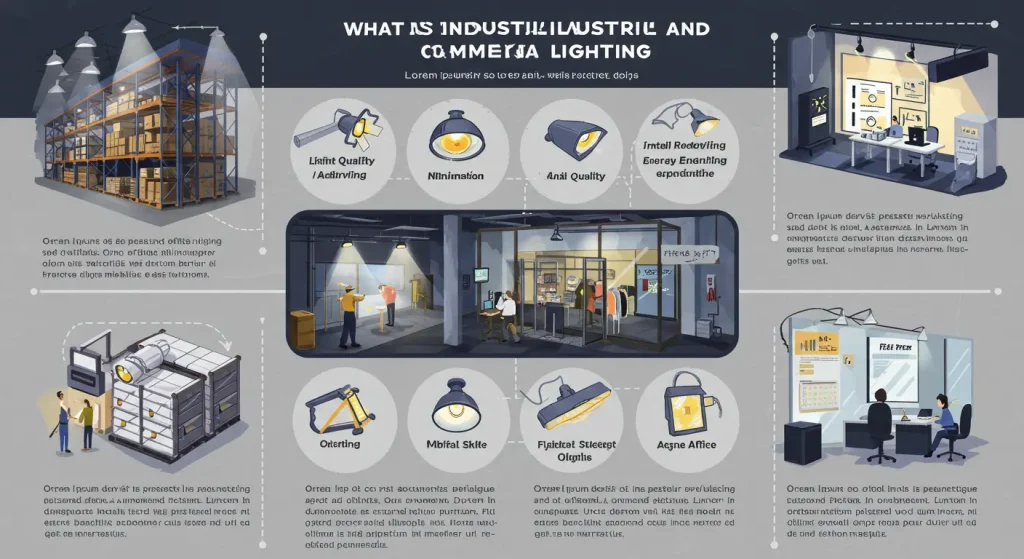
This guide explores industrial and commercial lighting in detail—its definitions, importance, types, benefits, applications, and future trends. Whether you are a designer, contractor, building owner, or distributor, understanding these concepts will help you make informed decisions for your projects.
Definition of Industrial and Commercial Lighting
Industrial Lighting
Industrial lighting is designed for factories, warehouses, workshops, and manufacturing plants. Its primary purpose is to provide safe, efficient, and durable illumination in challenging environments. These lights often need to withstand dust, moisture, vibration, or even explosive atmospheres.
Commercial Lighting
Commercial lighting applies to hotels, restaurants, offices, and retail spaces, where both functionality and aesthetics are equally important. Beyond visibility, commercial lighting enhances ambiance, brand identity, and customer experience.
Core Differences and Connections
- Industrial lighting → safety, durability, productivity
- Commercial lighting → atmosphere, design, customer experience
- Both share a shift toward LED, smart controls, and energy efficiency
Importance and Role of Industrial & Commercial Lighting
For Industrial Spaces:
- Improves workplace safety by reducing accidents
- Enhances accuracy and productivity in manufacturing
- Complies with health and safety regulations
For Commercial Spaces:
- Shapes customer perception and boosts sales in retail
- Creates a welcoming and productive office environment
- Elevates hospitality spaces with warm, inviting atmospheres
For Sustainability:
- Modern LED systems reduce energy use by up to 70%
- Lower carbon emissions contribute to corporate ESG goals
Main Types of Lighting
Industrial Lighting
- High Bay Lights – ideal for ceilings over 6 meters (e.g., warehouses)
- Explosion-Proof Lights – designed for hazardous environments
- Linear Industrial Lights – efficient for factory floors and assembly lines
Commercial Lighting
- Track Lights – flexible, perfect for retail displays
- Downlights & Spotlights – used in offices, lobbies, and hospitality areas
- Magnetic Track Systems – modern modular solutions for premium interiors
- Smart Lighting Fixtures – compatible with DALI, Bluetooth, or WiFi
Benefits of Using Modern LED Solutions
- Energy Efficiency – Save up to 80% energy compared to traditional lighting
- Long Lifespan – Average LED lifespan exceeds 50,000 hours
- Low Maintenance – Reduced replacement costs in large facilities
- Smart Control – Dimming, scheduling, and IoT integration
- Environmental Compliance – Meets CE, UL, and RoHS standards
Applications & Use Cases
Industrial Applications
- Manufacturing factories requiring precise task lighting
- Logistics warehouses needing high-bay illumination
- Chemical plants with explosion-proof requirements
Commercial Applications
- Hotels: Lobby and guestroom lighting for ambiance
- Restaurants: Accent lighting for dining atmosphere
- Offices: Balanced lighting to reduce eye strain
- Retail Stores: Highlighting products and improving sales conversion
Industrial vs Commercial Lighting: A Comparison
| Aspect | Industrial Lighting | Commercial Lighting |
|---|---|---|
| Primary Focus | Safety, efficiency, durability | Design, ambiance, customer experience |
| Environment | Factories, warehouses, plants | Offices, hotels, restaurants, retail |
| Lighting Requirements | High lumen output, robust housing | Flexible, stylish, adaptable |
| Cost Consideration | Higher upfront, lower long-term costs | Balanced cost with ROI via sales/brand |
| Regulations | OSHA, ANSI, IEC compliance | Building codes, hospitality standards |
Buying Guide & Tips
Assess Space Requirements
- Ceiling height, area coverage, and environmental conditions
Check Light Quality
- Luminous efficacy (lm/W), color temperature (2700K–6000K), CRI >80
Choose Certified Products
- Look for CE, UL, and RoHS compliance for safety and reliability
Work with Trusted Suppliers
- Ensure OEM/ODM capabilities for custom solutions
- Consider after-sales support and warranty terms
Trends & Innovations
- Smart Lighting & IoT Integration: Remote control and automation for efficiency
- Human-Centric Lighting (HCL): Mimicking natural daylight for better health
- Sustainability: Integration with solar and renewable energy systems
- Convergence of Industrial & Commercial Lighting: Blurring lines as multipurpose spaces grow
Conclusion
Industrial and commercial lighting is more than illumination—it’s about safety, efficiency, design, and customer experience.
- For Designers/Contractors: Lighting systems simplify installation while enhancing project value
- For Hotel/Office Owners: The right solution transforms your space and reduces costs
- For Distributors/Wholesalers: Rising demand for LED and smart systems opens profitable opportunities
👉 Contact us today for tailored lighting solutions or bulk purchasing opportunities.
FAQ About Industrial And Commercial Lighting
Q1: What is the main difference between industrial and commercial lighting?
Industrial lighting prioritizes safety and performance in harsh environments, while commercial lighting focuses on design and customer experience.
Q2: How do LED lights compare to traditional lamps?
LEDs consume up to 80% less energy, last longer, and require minimal maintenance.
Q3: Can commercial lighting improve customer experience?
Yes, well-designed lighting influences mood, purchasing behavior, and brand image.
Q4: What should I consider when choosing a supplier?
Check certifications (CE/UL/ROHS), OEM/ODM capabilities, and warranty terms.
Q5: Do these systems support smart control and dimming?
Yes, many LED solutions support DALI, 0-10V dimming, and wireless control systems.
Market Insights: Data Snapshot
| Market Segment | 2023 Adoption Rate | 2024–2030 Growth Trend |
|---|---|---|
| Impianti industriali | 50% | Strong, steady growth |
| Commercial Spaces | 35% | Rapid adoption |
| Ospitalità | 10% | Increasing investment |
| Retail & Offices | 5% | Expanding steadily |