 XHLUX
XHLUX

Sommario
- 1. What Is a Commercial Lighting Contractor?
- 2. Key Evaluation Criteria for Choosing a Commercial Lighting Contractor
- 3. Essential Questions to Ask a Lighting Contractor
- 4. Red Flags to Watch Out For
- 5. How to Collaborate Efficiently with a Lighting Contractor
- 6. How Contractors Work with Lighting Suppliers
- 7. Final Summary
- Comparison Table: Lighting Contractors vs General Electricians
- FAQ About Commercial Lighting Contractors
- 1. What is the difference between a lighting contractor and a regular electrician?
- 2. What certifications should a lighting contractor have?
- 3. How long do commercial LED fixtures last?
- 4. Why is CRI important?
- 5. Can fixtures be customized?
- 6. Do contractors help with lighting design?
- 7. How do I get a lighting quotation?
Commercial lighting contractors play a critical role in the success of any commercial project. Whether the space is a retail store, office, hotel, restaurant, or industrial facility, lighting is one of the few elements that simultaneously affects visual comfort, brand identity, operational safety, and long-term energy costs. Unlike residential lighting, commercial lighting engineering involves far more complexity: it requires professional lighting design, adherence to electrical and building codes, accurate fixture selection, smart control integration, and ongoing maintenance throughout the lifecycle of the space.
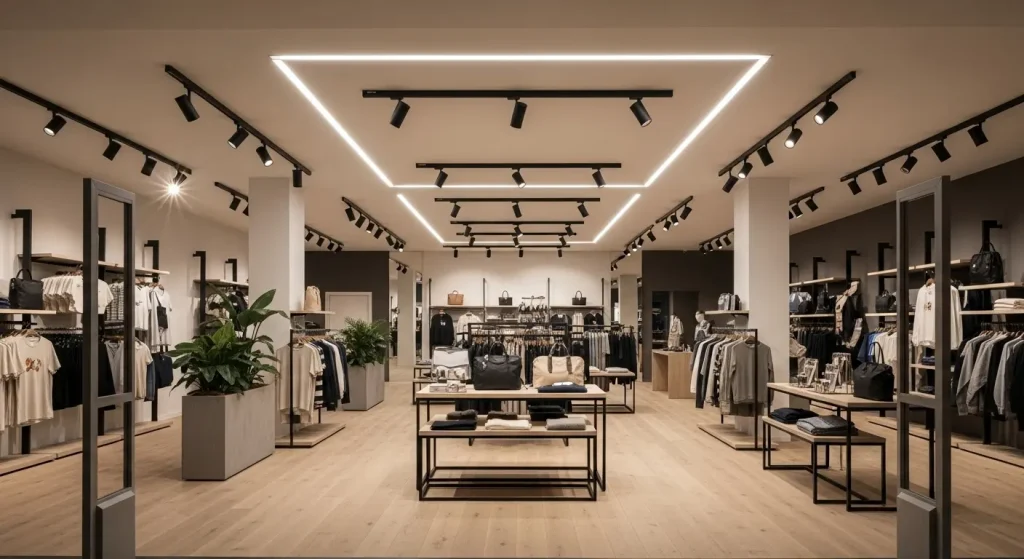
A well-qualified contractor must understand not only how to install fixtures, but how to translate design intent into precise lighting performance—managing illuminance levels, glare control, photometric distribution, CRI requirements, and compliance with standards such as EN12464-1 and IES recommendations. The wrong contractor can lead to safety risks, poor lighting quality, wasted energy, and even negative brand perception for end users or customers.
In other words, choosing the right commercial lighting contractor is not just a procurement decision—it directly impacts the project’s final appearance, operational efficiency, and long-term maintenance cost. This guide will help businesses evaluate contractors more effectively and ensure their lighting investment delivers maximum performance and reliability.
1. What Is a Commercial Lighting Contractor?
1.1 Definition of a Commercial Lighting Contractor
A commercial lighting contractor is a professional service provider responsible for executing end-to-end lighting engineering projects in commercial spaces. Instead of supplying individual lighting fixtures alone, a contractor integrates:
- Lighting design and planning
- Professional fixture selection
- Wiring and installation
- Control system configuration
- On-site commissioning
- After-sales maintenance
Commercial lighting is far more sophisticated than residential applications. It requires strict evaluation of lumen output, beam distribution, CRI, color uniformity (SDCM<3), glare control (UGR<19), electrical safety, and overall system compatibility. Professional contractors ensure these components operate as a complete system rather than disconnected products.
1.2 Complexity of Commercial Lighting Engineering
Commercial environments—offices, retail stores, hotels, warehouses, restaurants—have vastly different lighting requirements. Each functional zone demands unique illuminance (lux levels), beam angles, and lighting quality specifications.
Commercial lighting engineering includes:
- Specific light level requirements (per EN12464-1 or local standards)
- Optical performance optimization (beam angle, photometric distribution, uniformity)
- Smart control integration (DALI-2, 0-10V, Bluetooth Mesh, wireless systems)
- Safety compliance (local electrical regulations, UL, CE, RoHS, etc.)
- Installation complexities involving ceilings, wiring paths, suspension systems, junction boxes, etc.
This complexity requires professional design knowledge plus on-site construction experience.
1.3 Why Businesses Need Professional Contractors
Hiring a professional lighting contractor ensures:
- Safety Compliance
Incorrect wiring or overloaded circuits can cause serious hazards. Certified contractors avoid these risks. - Superior Lighting Quality
Proper selection of fixtures—such as Faretti a LED, downlights, E linear lights—creates better visibility and ambiance. - Energy Optimization and Long-Term ROI
Professional contractors choose high-efficiency LEDs (100–130 lm/W), long lifetime L70/B50 50,000-hour products, and smart controls to reduce operational cost.
2. Key Evaluation Criteria for Choosing a Commercial Lighting Contractor
2.1 Project Experience
Evaluate whether the contractor has experience with similar commercial environments:
- Retail stores, shopping malls
- Offices and co-working spaces
- Hotels, restaurants
- Warehouses and industrial plants
Ask for real project photos, lighting layout plans, Dialux simulations, and customer references. You can also compare their results with professional solutions from XHLUX—see Project Cases.
2.2 Technical Expertise
A qualified contractor must possess strong lighting engineering knowledge:
- Mastery of LED optical engineering: CCT, CRI>90/Ra97, SDCM<3, lumen efficiency
- Understanding of COB chips, PMMA lenses, die-cast aluminum heat sinks
- Ability to design photometric distributions: 15° spot, 24° accent, 36° flood
Experience integrating smart controls:
- DALI-2 (DALI Alliance)
- 0–10V dimming
- Tuya / Bluetooth / WiFi scene controls
- Familiarity with architectural installation methods: recessed, suspended, track-mounted, surface-mounted
Contractors should also understand how to apply fixture families like:
- Faretti a LED per binari for retail
- Luci lineari a LED for offices
- LED Spot Downlights for hospitality
2.3 Certifications and Compliance
A reliable contractor must:
- Hold valid electrical installation licenses
- Understand local electrical codes
- Use fixtures with UL, DLC, CE, RoHS certifications
- Ensure lighting meets local standards such as EN12464-1, IES recommendations, emergency lighting codes, etc.
2.4 Project Management Capabilities
Ask whether they can:
- Provide transparent quotations and itemized BOM
- Coordinate multiple teams (ceiling, electrical, HVAC, decoration)
- Meet deadlines for commercial openings
- Handle unexpected on-site issues quickly
Professional contractors work seamlessly with lighting suppliers like XHLUX to guarantee smooth onsite execution.
2.5 After-Sales Service
A good contractor offers:
- Installation warranty
- Fixture warranty (usually 3–5 years)
- Fast maintenance response
- Smart control system troubleshooting
This long-term support impacts the total lifecycle cost far more than initial pricing.
3. Essential Questions to Ask a Lighting Contractor
3.1 Can You Provide Past Project References?
Request real photos, CAD drawings, and lux simulations.
3.2 Which Lighting Standards Do You Follow?
They should reference IES, EN, DALI, UL, or local codes.
3.3 Which Fixtures Do You Recommend and Why?
Reasons should include optics, CRI, efficacy, beam angle, and installation method.
3.4 What Is the Project Timeline and Construction Plan?
Confirm each stage: procurement, wiring, installation, commissioning.
3.5 What Are the Warranty Terms?
Find out coverage periods and response speed.
4. Red Flags to Watch Out For
4.1 Extremely Low Pricing
Likely using low-quality fixtures or planning hidden fees.
4.2 No Certifications or Licenses
This creates major safety and compliance risks.
4.3 Vague Specifications
If CRI, CCT, beam angles, and efficiency are missing → avoid.
4.4 No After-Sales Commitment
A sign of unreliable businesses.
5. How to Collaborate Efficiently with a Lighting Contractor
5.1 Prepare Complete Project Information
Provide:
- Floor plans
- Ceiling height and structure
- Space functions
- Electrical routing
5.2 Define Lighting Objectives
Include:
- Target illuminance levels (lux)
- Desired lighting atmosphere
- Required CCT and CRI
- Smart control needs (DALI / 0–10V / wireless)
5.3 Request Samples or On-Site Mock-ups
Test fixture quality, glare control, CRI, and optical performance.
5.4 Sign a Detailed Contract
Define:
- Scope of work
- Delivery milestones
- Fixture specifications
- Warranty terms
5.5 Commissioning and Final Acceptance
A good contractor performs:
- Control system testing
- Lux measurements
- Aiming of track lights
- Color consistency verification (SDCM<3)
6. How Contractors Work with Lighting Suppliers
6.1 Professional LED Commercial Lighting Supply
XHLUX provides a full range of commercial fixtures:
- Faretti a LED per binari
- LED Spot Downlights
- Luci lineari a LED
- Smart Lighting Products
All with CRI>90, SDCM<3, high efficiency, L70/B50 50,000-hour lifecycle.
6.2 Strong Customization Capabilities
XHLUX supports full customization:
- Housing colors
- Lumen output
- angolo del fascio
- Dimensions and lengths
- Installation accessories
- DALI-2 / 0-10V / Tuya control compatibility
See full catalog: Catalogo prodotti
6.3 Professional Lighting Design Support
XHLUX provides:
- Dialux / CAD lighting layouts
- Photometric analysis
- Fixture configuration recommendations
- Scene design for offices, retail, hospitality
Explore service details: Lighting Solutions
6.4 Improving Contractor Efficiency
- Fast lead times
- Engineering-oriented customization
- Competitive pricing
- Stable supply chain
- One-stop technical support
These advantages make XHLUX an ideal partner for contractors seeking reliable, scalable lighting solutions.
7. Final Summary
7.1 Importance of Choosing the Right Contractor
A professional commercial lighting contractor ensures safety, compliance, high visual quality, and long-term energy savings.
7.2 Contractor Evaluation Checklist
- Relevant project experience
- Technical expertise
- Certifications & compliance
- Project management capability
- Warranty & after-sales support
- Transparent quotation
- Clear specifications
- Reliable supplier partnerships
7.3 Get Professional Lighting Consultation & Custom Solutions
XHLUX offers:
- Free lighting design
- Custom fixture OEM/ODM
- Project-ready lighting solutions
👉 Get a free project proposal:
Contattaci
👉 Explore lighting solutions:
Lighting Solutions
👉 Browse complete product range:
Catalogo prodotti
Comparison Table: Lighting Contractors vs General Electricians
| Criteria | Appaltatore di illuminazione | General Electrician |
|---|---|---|
| Lighting Design | ✔ Professional | ✖ Limited |
| Photometric Knowledge | ✔ Beam, CRI, CCT, optics | ✖ Basic wiring only |
| Standards (IES, EN, DALI) | ✔ Familiar | ✖ Often not trained |
| Fixture Selection | ✔ Professional | ✖ Generic products |
| Installation Quality | ✔ Specialized | ✔ Basic |
| Smart Controls | ✔ Expert | ✖ Usually limited |
| Maintenance | ✔ Faster, professional | ✔ But limited lighting expertise |
FAQ About Commercial Lighting Contractors
1. What is the difference between a lighting contractor and a regular electrician?
Lighting contractors specialize in optics, photometry, fixture selection, and commercial lighting standards. Electricians mainly handle wiring.
2. What certifications should a lighting contractor have?
Local electrical licenses, UL/CE compliant products, understanding of EN12464-1 / IES / DALI-2 protocols.
3. How long do commercial LED fixtures last?
High-quality fixtures from XHLUX offer L70/B50 50,000 hours.
4. Why is CRI important?
CRI>90 ensures accurate color rendering, especially critical for retail and hospitality.
5. Can fixtures be customized?
Yes. XHLUX offers custom lumen output, beam angles, sizes, finishes, and smart control compatibility.
6. Do contractors help with lighting design?
Professional contractors or suppliers like XHLUX can provide Dialux simulations and CAD layouts.
7. How do I get a lighting quotation?
Submit your floor plans and requirements to XHLUX for a customized proposal.