 XHLUX
XHLUX

Tabla de contenido
- Why Beam Angle Is the “Hidden Risk” in Commercial Track Lighting
- What Is Beam Angle in Commercial Track Lighting?
- Why Beam Angle Matters in Commercial Lighting Projects
- Common Beam Angles Used in Commercial Track Lighting
- The “Safe Professional Choice” Explained
- Beam Angle Decision Matrix (Application + Risk + Comfort)
- Technical Factors That Change the “Right Beam Angle”
- Glare Control and Visual Comfort (Why Beam Angle Alone Isn’t Enough)
- Beam Angle + LED Quality (The Specs That Prevent Rework)
- Best Beam Angle by Commercial Application
- Common Beam Angle Mistakes in Commercial Track Lighting
- How to Choose the Right Beam Angle for Your Commercial Project
- Comparison Table: Single Beam Angle vs Professional Beam Mix
- FAQ About Lighting Color Temperature For Hospitality
- Bienvenidos a conversar sobre cooperación empresarial.
Why Beam Angle Is the “Hidden Risk” in Commercial Track Lighting
Selecting the wrong beam angle para commercial track lighting often leads to uneven illumination, glare complaints, or spaces that feel “flat” and poorly highlighted—even when you’re using premium Focos LED para riel.
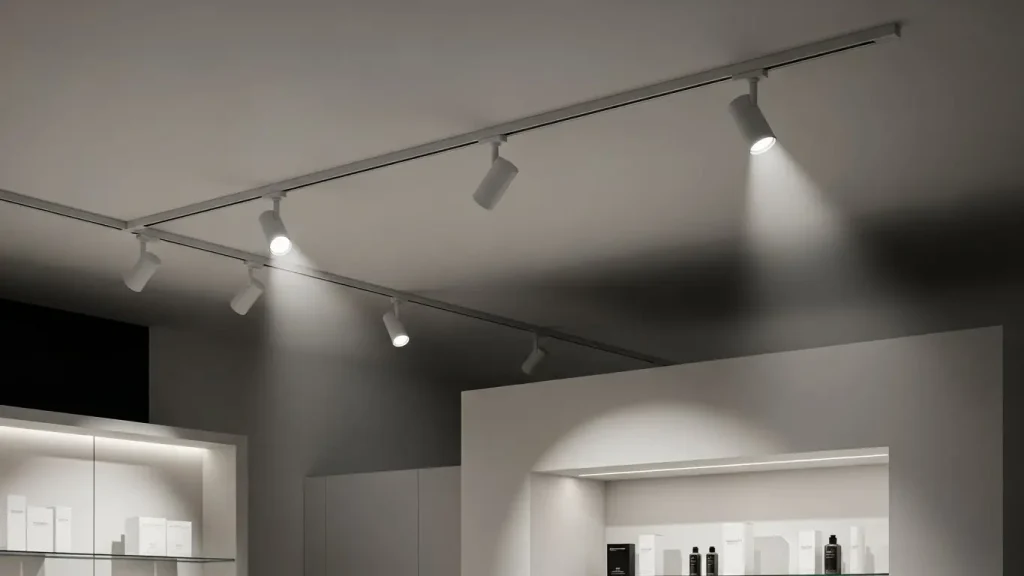
In commercial projects, beam angle mistakes are expensive. A wrong optical choice can cause:
- hotspots on floors and counters
- uncomfortable brightness and poor control del deslumbramiento
- weak product emphasis (especially in retail lighting design)
- low perceived quality in hospitality lighting zones
- redesigns, re-aiming chaos, and sometimes fixture replacement
There is no single “universal best” beam angle. The professional approach is risk-controlled beam angle planning: choosing the right mix of narrow beam, medium beam, y wide beam based on application type, mounting height, layout rhythm, and comfort targets—then validating with lighting distribution logic.
If you’re building a shortlist, these pages help you move from “concept → spec → purchase” faster:
- Core selection: LED Track Lighting Series
- Flexibility-first optics: Luces de riel con zoom
- Ambient base pairing: Focos LED empotrables
- Architectural layers: Iluminación lineal LED
- Quick comparison across families: Catálogo de productos
What Is Beam Angle in Commercial Track Lighting?
What is beam angle in commercial track lighting?Beam angle refers to the width of light distribution emitted from a track light, determining how focused or wide the illuminated area will be in a commercial space.
A simple way to explain beam angle to both engineers and non-technical stakeholders:
- Beam angle is no “how bright” a fixture is.
- Beam angle is how the light is distributed—where it lands, how wide it spreads, and how quickly it falls off.
Two track heads with the same wattage can feel totally different if one is 15° (tight spotlight) and the other is 60° (broad flood). In commercial projects, beam angle is a control lever for:
- accent lighting vs general support lighting
- perceived contrast and “premium” feel
- light uniformity and visual rhythm
- glare risk and comfort outcomes
- total fixture quantity needed to meet the lighting plan
Why Beam Angle Matters in Commercial Lighting Projects
Why is beam angle important in commercial track lighting?Beam angle directly affects visual comfort, lighting efficiency, and how well products or spaces are highlighted in commercial environments.
Beam angle controls three commercial outcomes that stakeholders actually care about
1) Visual hierarchy (what the client wants people to notice)
Commercial spaces are designed to guide attention—products, displays, artwork, counters, signage, reception desks. Beam angle defines whether emphasis is crisp or lost.
2) Visual comfort (whether people stay or leave)
Poor beam angle choices can create glare, harsh contrast, and “hotspot fatigue.” Comfort outcomes often connect to glare management thinking, including UGR-style comfort targets (many spec teams reference levels like UGR < 19 in comfort-sensitive areas).
3) Project risk (how likely you need rework)
Unlike residential installs, commercial projects are hard to “trial and error.” Ceilings, shopfits, opening schedules, and contractor coordination create real constraints. Beam angle errors become site problems—late-stage changes, unhappy client walk-throughs, and re-aiming fights.
Common Beam Angles Used in Commercial Track Lighting
Below is the practical beam angle framework used in real commercial projects. The exact optics vary by manufacturer, but the decision logic is consistent.
Narrow Beam (10°–24°) – Strong Accent Lighting
Ideal para:
- retail feature products and hero displays
- art galleries and exhibitions
- hospitality focal points (bar back, feature wall, reception branding)
- premium showcases and display windows
What it does well:
- creates strong contrast and a clear visual focal point
- increases perceived value by concentrating light on “important things”
- supports dramatic but controlled accent lighting
Main risk:
- glare and harsh hotspots if optics or aiming are wrong
- requires strong control del deslumbramiento (deep optics, shielding, honeycomb options)
- more sensitive to mounting height and aiming angle
Medium Beam (24°–36°) – The Most “Safe and Common” Commercial Choice
Ideal para:
- retail shelves, wall displays, mid-size product zones
- hospitality seating zones and restaurant table groups
- general accent lighting where you want focus + coverage
Why it’s the workhorse:
- balanced emphasis without extreme hotspot risk
- easier to keep a comfortable brightness ratio
- integrates well with ambient layers (downlights or linear lighting)
- usually the best starting point when a buyer asks: “What angle is professional and safe?”
Important note:
Medium beam is common, but not universal. If a project uses only 30°/36° everywhere, it often ends up visually flat or operationally inefficient (too many heads needed to cover varied zones).
Wide Beam (36°–60°) – General and Supporting Lighting
Ideal para:
- walkways and circulation zones
- open commercial areas where browsing comfort matters
- background fill supporting other accent layers
What it does well:
- improves light uniformity across larger surfaces
- reduces harsh contrast and makes spaces easier to navigate
- lowers hotspot intensity in lower ceiling heights
Main limitation:
- not ideal for focal emphasis and premium presentation
- overuse creates “flat department store” effect
What beam angle is best for commercial track lighting?There is no single best beam angle. Commercial projects typically use a combination of narrow, medium, and wide beams to achieve layered lighting effects.
The “Safe Professional Choice” Explained
When engineers and buyers ask: “What beam angle is safe?” they typically mean:
- Low risk of glare complaints
- Low risk of uneven lighting and patchy floors
- Works across common mounting heights
- Can support product highlighting without looking theatrical
- Doesn’t force a redesign after mock-up
Practical answer
- 24°–36° is usually the safest starting range for many commercial track lighting applications
- But the professional solution is always a beam mix, because commercial spaces have multiple tasks: focus + circulation + background
Think of medium beam as the “default lens,” then you add:
- narrow beams for hero moments
- wide beams for comfortable fill and uniformity
If you want to reduce risk further, a flexibility-first approach is to spec zoomable optics so beam angle can be adjusted later without changing fixtures: Luces de riel con zoom.
Beam Angle Decision Matrix (Application + Risk + Comfort)
This section turns beam angle into a commercial decision tool.
Chart 1 — Beam Angle by Commercial Application (Best Practice Ranges)
| Tipo de aplicación | Objetivo principal | Typical Beam Strategy | Risk Notes |
|---|---|---|---|
| tiendas minoristas | product emphasis + hierarchy | 15°–24° for hero, 24°–36° for shelves, 36°–60° for circulation | glare control is critical near sightlines |
| Hospitality (hotels & restaurants) | atmosphere + comfort + focal points | 15°–30° for features/tables, 24°–36° general accents, limited wide beams for paths | avoid harsh hotspots; warm CCT helps comfort |
| Art galleries & showrooms | precision + controlled contrast | 10°–20° for artworks, sometimes 24°–30° for larger pieces | strict glare control; careful aiming to avoid reflections |
| Office/public commercial | comfort + uniformity | 30°–60° for general, limited 24°–36° for feature walls | comfort targets like UGR-style thinking often matters |
| Brand showrooms | “premium storytelling” | mixed: narrow for hero products + medium for areas + wide for navigation | layered lighting prevents “flat” look |
Technical Factors That Change the “Right Beam Angle”
Beam angle is not selected in isolation. In professional specs, these variables decide whether 24° works beautifully—or fails.
Mounting Height (Ceiling Height) and Throw Distance
A narrow beam behaves very differently at 2.7 m vs 6 m.
- Lower ceilings: narrow beams can create harsh hotspots and glare
- Higher ceilings: narrow beams can be necessary to maintain punch and avoid “light loss” on the target plane
Rule of thumb:
- Low ceilings → shift toward medium/wide or use deeper glare control optics
- High ceilings → narrow beams for emphasis; medium beams for general accents
Target Size (What Are You Lighting?)
Beam angle should match the physical target:
- small objects (jewelry, hero products) → narrow beams
- shelves and wall displays → medium beams
- large zones and walkways → wide beams or multiple mediums with overlap
A common commercial mistake is using wide beams on small targets; you waste light and lose contrast.
Surface Reflectance and Materials (Hidden Glare Amplifier)
Glossy floors, glass cases, polished counters, mirrors, and metallic finishes increase glare risk. In these spaces:
- narrow beams must be paired with stronger glare control
- aiming angles become non-negotiable
- brightness ratios must be balanced with ambient layers
Light Uniformity vs Accent Contrast (Choose the Right “Look”)
Commercial design always balances:
- uniformidad for comfort and navigation
- contraste for focus, premium feel, and visual merchandising
Beam angle directly impacts that balance. Too much uniformity feels flat; too much contrast feels aggressive.
Glare Control and Visual Comfort (Why Beam Angle Alone Isn’t Enough)
Beam angle decisions fail when glare control is ignored. Commercial projects need comfort that supports people staying longer—whether shopping, dining, or browsing.
What actually drives glare in track lighting
- visible bright source at shallow viewing angles
- narrow beam intensity without shielding
- incorrect aiming (shooting into eyes rather than onto target surfaces)
- high contrast between very bright spots and dark background
Practical glare-control moves you can write into a spec
- optics with deep recessed structure or baffle
- optional honeycomb/louver accessories for sensitive zones
- aiming strategy: 30°–45° to target plane rather than straight down
- avoid “ultra-narrow everywhere” in low ceilings
- pair with ambient base lighting so contrast feels premium, not harsh
Spec-first comfort note:For comfort-sensitive areas, spec teams often use glare-management thinking similar to UGR control and may treat UGR < 19 as a conservative comfort reference in mixed-use zones.
Beam Angle + LED Quality (The Specs That Prevent Rework)
Beam angle is only meaningful if the optical system and LED quality are stable. In commercial LED lighting, the following specs reduce rework risk dramatically:
Spec-first baseline (professional commercial track lighting)
- CRI > 90 (premium projects: Ra97)
- SDCM < 3 for color consistency across multiple heads and batches
- Control de UGR/deslumbramiento optics for comfort-sensitive zones
- Efficiency 100–130 lm/W (project dependent)
- L70/B50 lifetime 50,000 hours planning
- robust thermal management: disipador de calor de aluminio fundido a presión
- controlled optics: Lente de PMMA and stable reflector design
- smooth beam options: chip COB (often preferred for clean, consistent beam edges)
- easy installation and serviceability for contractors
- ODM customization support where project requires special trims, beam sets, or branding
If your project includes mixed zones (retail + hospitality corners, gallery walls, circulation), flexibility is often the simplest risk-control strategy: Luces de riel con zoom.
Best Beam Angle by Commercial Application
Retail Stores (Visual Merchandising First)
Retail lighting design is where beam angle directly becomes sales performance. Typical approach:
- 15°–24°: feature products, mannequins, endcaps
- 24°–36°: wall displays, shelves, general accent lighting
- 36°–60°: aisles and browsing comfort zones
Why retail needs beam combinations:Retail layouts change. Promotions change. Product heights vary. A single angle cannot maintain hierarchy across the store.
Relevant selection pages:
- Accent system: LED Track Lighting
- Flexible for changing displays: Luces de riel con zoom
- Ambient base pairing: Focos LED empotrables
Hospitality (Hotels & Restaurants)
Hospitality lighting is about atmosphere + comfort:
- 15°–30° for focal zones (tables, bar details, reception features)
- 24°–36° as general accent range
- limited use of wide beams for circulation support
Hospitality also cares deeply about:
- warm or warm-neutral CCT for comfort
- high CRI for food and material quality
- glare control to increase dwell time
For broader zone planning support, use: Soluciones y servicios de iluminación and references in Casos prácticos de proyectos.
Art Galleries & Brand Showrooms
Galleries require:
- precise beam control
- strong glare control
- careful aiming to avoid reflections
- often tighter beams (10°–20°) with high CRI to preserve artwork appearance
In showrooms, beam angle is a storytelling tool—hero products get tight beams, navigation gets soft fill.
Office and Public Commercial Spaces
Offices prioritize comfort and uniformity:
- 30°–60° often dominates for general lighting
- medium beams used selectively for feature walls and branding elements
- glare control and visual comfort benchmarks are critical
Important difference:Offices punish high contrast; retail often requires it. That’s why “one universal beam angle” advice is usually wrong.
Common Beam Angle Mistakes in Commercial Track Lighting
What are common beam angle mistakes in commercial lighting?
Common mistakes include using one beam angle throughout the project, choosing overly wide beams, and ignoring glare control and mounting height.
Mistake 1: One beam angle for the entire project
Cost: flat look, wrong emphasis, wasted fixtures, re-aiming problems.
Mistake 2: Overusing wide beams
Cost: no hierarchy; “everything is equally lit,” so nothing stands out.
Mistake 3: Overusing narrow beams
Cost: hotspots, glare complaints, harsh contrast, poor comfort.
Mistake 4: Ignoring mounting height and target distance
Cost: wrong coverage; either dark gaps or over-bright circles.
Mistake 5: Ignoring glare control optics
Cost: comfort failure. People leave sooner; clients complain later.
How to Choose the Right Beam Angle for Your Commercial Project
Use these questions as a practical decision framework:
- What is the space function?
Retail, hospitality, gallery, office, or mixed-use? - Do you need visual focal points?
If yes, you need narrow/medium accents—not only wide beams. - What is the mounting height?
Lower ceiling increases hotspot risk; higher ceiling may need tighter beams. - What is your ambient base lighting?
Are you pairing track accents with downlights or linear lighting? - Do you need flexibility after opening?
If displays/layouts change, specify adjustable optics or zoomable options.
real project logic
In real commercial projects, the “safe” solution is rarely a single number like 30° or 36°. The safer commercial strategy is:
- standardize around a medium-beam core
- add narrow beams where you need punch
- add wide beams where you need comfort and uniformity
- reduce risk with zoomable optics when the layout is expected to change
This approach prevents the most common rework triggers: glare complaints, flat merchandising, and patchy illumination.
If you want a fast beam angle recommendation:Usar Contacto y presupuesto and provide your application type + ceiling height + target zones. We can propose a beam mix and fixture count logic that minimizes rework.
Comparison Table: Single Beam Angle vs Professional Beam Mix
| Approach | What It Looks Like | Project Risk | Best Use Case |
|---|---|---|---|
| Single beam angle everywhere | consistent but flat or uncomfortable | high (wrong zones can’t be fixed easily) | only for very simple, uniform spaces |
| Professional beam mix (narrow + medium + wide) | layered, premium, controlled hierarchy | low (design intent is resilient) | retail, hospitality, showrooms, mixed commercial |
| Zoomable optics strategy | adaptable without replacing heads | lowest (future changes protected) | spaces with changing layouts or merchandising |
For flexibility-first specs, start with Luces de riel con zoom.
FAQ About Lighting Color Temperature For Hospitality
What beam angle is best for commercial lighting?
There is no single best angle. Most commercial projects use a combination of narrow, medium, and wide beams to balance accent lighting, comfort, and uniformity.
Is a 30° beam angle good for track lighting?
30° is often a solid “medium beam” choice for general commercial accent lighting, but it should be combined with other beam angles for focal highlights and circulation support.
How many beam angles should be used in a commercial project?
Most professional projects use 2–3 beam types (narrow + medium + wide), depending on ceiling height and application zones.
Does beam angle affect glare?
Yes. Narrow beams increase glare risk if optics, aiming, and ambient balance are not properly controlled. Glare control is a key selection factor in commercial environments.
Can track lights use interchangeable beam angles?
Some systems support interchangeable optics or zoomable mechanisms. This is a strong risk-control option for projects where layout changes are expected.
What CRI should commercial track lighting use?
For commercial accent lighting—especially retail and hospitality—CRI > 90 is a practical baseline, with Ra97 preferred for premium presentation and food/material accuracy.
Bienvenidos a conversar sobre cooperación empresarial.
In commercial projects, beam angle determines whether the lighting feels:
- premium or flat
- comfortable or harsh
- efficient or wasteful
- stable or rework-prone
A professional beam angle strategy typically includes:
- medium beams as the safe core
- narrow beams for hero highlights
- wide beams for comfort and uniformity
- glare control thinking aligned with comfort targets (often referencing UGR-style management)
- commercial-grade specs: CRI > 90 / Ra97, SDCM < 3, 100–130 lm/W, L70/B50 50.000 horas, robust construction with disipador de calor de aluminio fundido a presión, controlled optics like Lente de PMMA, and smooth beam options such as chip COB
Next steps
- Choose your track system: LED Track Lighting
- Reduce risk with flexible optics: Luces de riel con zoom
- Pair with an ambient base: Focos LED empotrables
- Add architectural layers: Iluminación lineal LED
- See references: Casos prácticos de proyectos
- Get solution support: Soluciones y servicios de iluminación
- Compare product families: Catálogo de productos
- Request a beam-angle mix recommendation: Contacto y presupuesto
If you wish, please send us your application scenario (retail/hotel/gallery/office) + ceiling height + target area. We will provide a proposal including beam angle combination options (including glare risk assessment and spacing logic).