 XHLUX
XHLUX

Tabla de contenido
- Why Color Temperature Becomes a “Final Approval” Issue in Hospitality
- What Is Lighting Color Temperature?
- Why Color Temperature Matters in Hospitality Lighting
- What Is Warm Lighting in Hospitality Projects?
- What Is Neutral Lighting in Hospitality Projects?
- Warm vs Neutral Lighting — Key Differences at a Glance
- How to Choose the Right Color Temperature for Hotels
- How to Choose the Right Color Temperature for Restaurants
- Common Color Temperature Mistakes in Hospitality Projects
- How LED Downlights and Track Lights Support Proper Color Temperature Design
- A Practical “Decision Framework” for Hospitality CCT
- Comparison Table: Warm vs Neutral CCT + Recommended Fixture Mix
- FAQ About Commercial Track Lighting Beam Angle
- 1) What color temperature is best for hospitality lighting?
- 2) Is warm or neutral light better for hotels?
- 3) What lighting is best for restaurant atmosphere?
- 4) Does color temperature affect dining experience?
- 5) Can hotels mix warm and neutral lighting?
- 6) What CRI should hospitality lighting use?
- 7) Should hospitality lighting prioritize CCT or glare control?
- Bienvenidos a conversar sobre cooperación empresarial.
Why Color Temperature Becomes a “Final Approval” Issue in Hospitality
Choosing the wrong lighting color temperature can make hotel and restaurant spaces feel uncomfortable, uninviting, or inconsistent with brand positioning—even when the fixtures are high quality.
In many hospitality projects, the pain shows up after opening: lighting feels too yellow, too cold, or simply mismatched across zones. Guests may not explain it technically, but they feel it immediately—lobby looks “cheap,” corridor feels “harsh at night,” food looks less appetizing, and the property loses its premium perception.
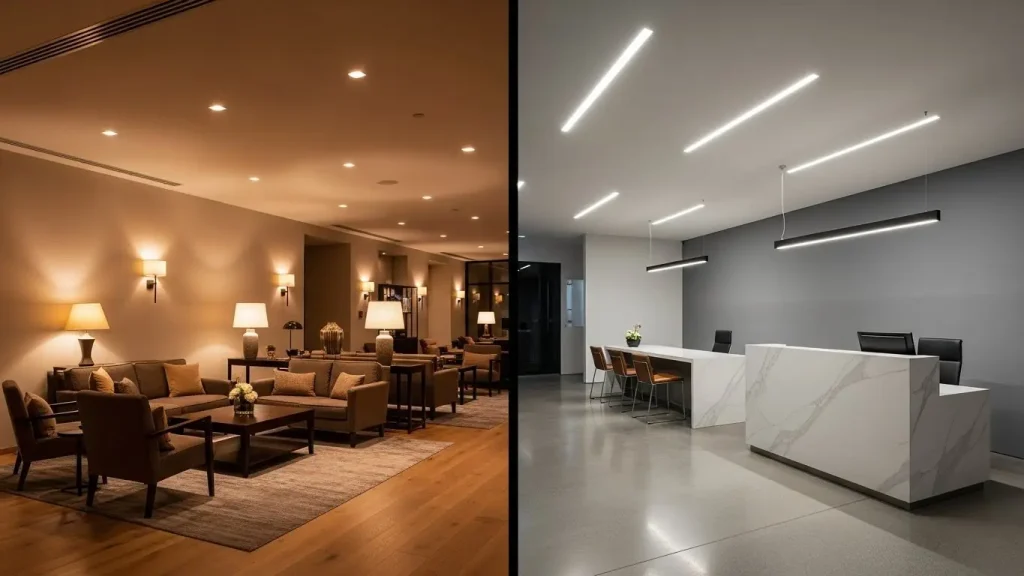
This guide explains warm lighting vs neutral lighting para hospitality lighting, using a zone-by-zone decision framework. You’ll get practical “where-to-use-what” rules for hotels and restaurants, plus the spec requirements that prevent rework (CRI, SDCM, glare control, and driver stability).
If you are building a fixture shortlist while locking CCT decisions:
- Ambient base (hotel & restaurant): Focos LED empotrables
- Accent + flexibility (public areas, dining, feature zones): LED Track Lighting
- Beam/CCT flexibility: Luces de riel con zoom
- Architectural mood layers (coves, lines, wall effects): Iluminación lineal LED
- Fast overview: Catálogo de productos
What Is Lighting Color Temperature?
What is lighting color temperature?Lighting color temperature describes the appearance of light, measured in Kelvin (K), ranging from warm yellow tones to neutral white tones.
Color temperature is “tone,” not brightness
A common confusion in project meetings is: “This feels too cold—can we dim it?”
But dimming changes brightness, not necessarily the tone of white light (unless you use warm-dim technology).
- Kelvin (K) = the color appearance of white light
- Lumens / lux = how much light you deliver
- Beam angle / distribution = where that light goes
In most industry descriptions, “warm white” is around 2000K–3000K, while “cooler/bright white” shifts upward into the 3000K–4500K range and beyond.
Quick reference: how people perceive typical ranges
- 2700K: warm, cozy, candle/halogen-like comfort
- 3000K: warm but cleaner (common hospitality baseline)
- 3500K: warm-neutral transition (often “modern clean” hospitality)
- 4000K: neutral-white clarity (functional public areas, cafés, BOH)
Why Color Temperature Matters in Hospitality Lighting
Why is color temperature important in hospitality lighting?Color temperature influences mood, comfort, and how welcoming a hospitality space feels to guests.
Hospitality is not retail and not office. Guests evaluate a hotel or restaurant with emotional heuristics:
- “Does it feel premium?”
- “Does it feel calm?”
- “Does it feel clean and trustworthy?”
- “Does the food look appetizing?”
Color temperature shapes those judgments through three mechanisms:
1) Comfort and relaxation
Warm lighting (lower Kelvin) is widely used to create calm and relaxing environments. Many CCT guides describe warmer ranges as softer and more inviting, while higher Kelvin is perceived as cleaner and more alerting.
2) Perceived quality and brand tone
Premium hospitality often avoids “clinical coolness” in guest-facing relaxation zones. Warm or warm-neutral CCT pairs better with natural materials (wood, stone) and soft finishes.
3) Visual merchandising—yes, hospitality has it too
Hotels “sell” experiences: lobby statement, lounge vibe, bar sparkle, dessert displays, buffet freshness. Restaurants sell dishes. CCT is one of the biggest drivers of how surfaces and colors are perceived.
Important reality: CCT alone cannot guarantee quality. A 3000K light with poor spectrum can still make food look dull. That’s why CRI and color consistency matter (we’ll cover it).
What Is Warm Lighting in Hospitality Projects?
What is warm lighting in hospitality?Warm lighting typically ranges from 2700K to 3000K and creates a cozy, relaxing atmosphere ideal for guest-focused spaces.
Warm lighting is the “hospitality default” for guest comfort
Warm CCT supports:
- relaxation after travel
- nighttime movement without harshness
- intimate dining mood
- premium lounge atmosphere
Best uses of warm lighting (2700K–3000K)
- Hotel guestrooms
- pasillos del hotel (especially night comfort)
- Fine dining restaurants
- Lounges & bars
- Spa / wellness zones
A number of hospitality-oriented writeups recommend 2700K–3000K to create warmth and intimacy in hotel spaces. (Sbicai Lighting Factory)
The “too yellow” risk—and how pros prevent it
Warm lighting becomes “too yellow” when:
- finishes are cool-gray/white (warm light + cool palette can look muddy)
- CRI is low (warm but color-dull looks cheap)
- brightness is too high in a warm tone (over-warm can feel heavy)
Professional fix: keep warmth, but upgrade quality:
- CRI > 90 / Ra97 in premium guest zones
- consistent binning: SDCM < 3 so adjacent fixtures don’t look mismatched
- add layered lighting so you don’t need overly bright warm ambient
For the ambient foundation in warm zones, recessed fixtures are usually the cleanest tool: Focos LED empotrables.
What Is Neutral Lighting in Hospitality Projects?
What is neutral lighting in hospitality?
Neutral lighting commonly ranges from 3500K to 4000K, delivering a cleaner, balanced appearance suited to functional hospitality areas.
Neutral CCT is not “cold.” It’s the choice when you want:
- clarity, cleanliness, and modern crispness
- better perceived brightness for wayfinding
- more accurate “white” surfaces (especially in modern interiors)
Best uses of neutral lighting (3500K–4000K)
- Vestíbulos de hotel (especially modern business hotels)
- All-day dining restaurants
- Cafés & bakeries (paired with high CRI)
- Back-of-house / kitchens / service corridors
- Conference / meeting areas (comfort + alertness balance)
A common rule-of-thumb approach is to match CCT to palette: warm woods pair well with 2700K–3000K, while cooler palettes often look cleaner in 3500K–4000K.
Warm vs Neutral Lighting — Key Differences at a Glance
Chart 1 — Warm vs Neutral: Hospitality Decision Table
| Dimension | Warm Lighting (2700K–3000K) | Neutral Lighting (3500K–4000K) | What It Means in Hospitality |
|---|---|---|---|
| Atmosphere | cozy, intimate, relaxing | clean, modern, balanced | mood + brand tone |
| Guest comfort | high night comfort | higher alertness/clarity | affects dwell time & relaxation |
| Food appearance | rich warmth for dining | “fresh/clean” for cafés | needs high CRI in both cases |
| Perceived brightness | feels softer at same lux | feels brighter/crisper at same lux | changes how “bright” a space feels |
| Best zones | guestrooms, corridors, lounges, fine dining | lobbies (modern), all-day dining, BOH | zone-based selection avoids mismatch |
| Main risk | too yellow / muddy if spec is low | too cold / clinical if overused | avoid “one CCT everywhere” |
How to Choose the Right Color Temperature for Hotels
Hotels are not one space—they are a sequence of experiences. The best hotel lighting design keeps CCT consistent within each zone and intentionally transitions between zones.
What color temperature is best for hotel lighting?
Most hotels use warm lighting (2700K–3000K) for guestrooms and corridors, and neutral lighting (3000K–4000K) for lobbies and public areas. (Sbicai Lighting Factory)
Chart 2 — Hotel CCT by Area
| Hotel Area | Recommended CCT | Por qué | Typical Fixture Strategy |
|---|---|---|---|
| Lobby (premium warm luxury) | 3000K (sometimes 2700K accents) | welcoming + luxury warmth | downlights for ambient + accent layers |
| Lobby (modern business) | 3000K–3500K | cleaner, modern clarity | downlights + linear layers |
| Reception desk / brand wall | 3000K (high CRI) | face tones + premium detail | track accents or focused downlights |
| Pasillos | 2700K–3000K | night comfort, calm rhythm | low-glare recessed downlights |
| Habitaciones para huéspedes | 2700K–3000K | relaxation, soft ambiance | recessed ambient + bedside layers |
| Bathrooms (guest) | 3000K–3500K | grooming clarity without harshness | downlights with glare control |
| Conference / meeting | 3500K–4000K | alertness + clean visuals | uniform ambient, controlled glare |
| Back-of-house | 4000K | functional clarity | uniform high efficacy lighting |
Hotel zone notes that prevent rework
- Corridors should not feel like offices
Night movement requires comfort. Warm CCT + glare control wins. - Guestrooms should be relax-first
Warm, dimmable ambient with layered bedside lighting. - Lobby is brand-dependent
Luxury hotels lean warmer. Modern business hotels often go warm-neutral.
If your hotel project needs a clean, reliable ambient backbone across guestrooms/corridors, start with recessed solutions: Focos LED empotrables.
For feature walls and brand moments (lobby art, signage), add precise accents: LED Track Lighting.
How to Choose the Right Color Temperature for Restaurants
Restaurant lighting design is more “experience-driven” than hotel lighting in many zones because dining mood affects comfort, appetite, and dwell time.
Chart 3 — Restaurant CCT by Concept & Area
| Restaurant Type / Zone | Recommended CCT | Por qué | Best Lighting Approach |
|---|---|---|---|
| Fine dining (tables) | 2700K–3000K | intimacy + premium warmth | narrow/medium accents + soft ambient |
| Casual dining | 3000K–3500K | warm comfort + clarity | layered ambient + table accents |
| Café / bakery | 3500K–4000K (high CRI) | clean freshness perception | uniform ambient + display accents |
| Bar / lounge | 2700K–3000K | relaxed mood + sparkle accents | focused accents + controlled background |
| Open kitchen / BOH | 4000K | functional clarity | uniform lighting, high efficacy |
A common restaurant lighting principle is to differentiate areas and activities when choosing CCT and lighting approach. (ledkia.com)
Why restaurants often need track lighting for CCT “control”
Restaurants frequently change layout (tables, seasonal décor, menu boards). Iluminación LED de riel supports:
- flexible aiming for table pools
- easy change when seating shifts
- better control of where warm accents land (so warmth feels intentional, not messy)
If you want flexibility while keeping CCT consistent across the space:
- Accent & layout flexibility: LED Track Lighting
- Future-proof beam needs: Luces de riel con zoom
Common Color Temperature Mistakes in Hospitality Projects
What are common color temperature mistakes in hospitality lighting?
Common mistakes include using one color temperature throughout, choosing overly cool lighting, and ignoring color rendering quality.
Mistake 1: One CCT across the entire hotel or restaurant
This is the most common “easy decision” that becomes a brand problem. Hotels and restaurants have different emotional tasks by zone.
Arreglar: Use a zone matrix (like Charts 2 and 3) and keep transitions intentional.
Mistake 2: Using cool white to “look premium”
Many teams assume cooler light feels more expensive. In hospitality, cool CCT often reads as clinical unless the interior concept is specifically modern-minimal and supported by materials.
Arreglar: Premium often comes from:
- warm or warm-neutral CCT in guest zones
- high color quality (high CRI)
- good glare control and layering
Mistake 3: Looking only at Kelvin, ignoring CRI and spectrum
Two 3000K products can make food and faces look completely different.
Fix (spec-first):
- minimum for quality hospitality: CRI ≥ 90
- premium/food critical: CRI > 90 / Ra97
- ensure color consistency across a project: SDCM < 3
- ask for photometric and binning documentation for large projects
(For reference, some lighting standards and documents emphasize that low CRI sources are not suitable for interiors where people stay for longer periods.) (Ageta)
Mistake 4: Inconsistent CCT across fixtures and batches
A lobby with downlights that look 3000K and wall washers that look 3500K feels “unfinished.”
Arreglar: control both:
- CCT target (e.g., 3000K)
- color consistency (SDCM < 3) and stable binning across batches
How LED Downlights and Track Lights Support Proper Color Temperature Design
Hospitality spaces rarely succeed with one fixture type. The professional approach is iluminación por capas:
- Iluminación ambiental for comfort and base visibility
- Iluminación de acento for focal points, mood, and storytelling
- Task lighting for service zones and functional operations
LED Downlights: the stable ambient backbone
Why downlights are essential:
- clean ceiling aesthetics (especially in hotels)
- stable, repeatable ambient distribution
- easier to keep CCT consistent across large areas
For hotel guestrooms, corridors, and many restaurant ambient zones, start your base layer here:
Focos LED empotrables
Spec-first baseline for commercial hospitality downlights
- Warm/neutral CCT options by zone (2700K–4000K)
- UGR-style comfort thinking where visual comfort matters (for office-like zones, many specs reference targets like UGR < 19)
- CRI > 90 / Ra97 for premium guest-facing areas
- SDCM < 3 for consistency
- Efficiency 100–130 lm/W (project-dependent target)
- lifetime planning: L70/B50 50.000 horas
- robust construction: disipador de calor de aluminio fundido a presión, conductor estable
- optics: Lente de PMMA and/or controlled reflectors
- light source options such as chip COB for smooth beam quality
(EN 12464-1 is widely referenced for indoor lighting quality thinking—illuminance, glare, and color rendering for workplaces—which can be useful when specifying hospitality “work-like” zones such as BOH or conference areas.) (lumenloop.co.uk)For a public reference on the standard: EN 12464-1.
LED Track Lighting: the mood + flexibility engine
Why track lighting matters in hospitality:
- adjustable aiming supports changing layouts (especially restaurants)
- accent layers are where atmosphere is “felt”
- easy to highlight brand walls, artwork, menu boards, bars, and feature zones
Explore hospitality-ready accent solutions here:LED Track Lighting
If your project is likely to change layouts, zoomable optics reduce rework risk:Luces de riel con zoom
Control and dimming: the “hidden” CCT comfort booster
Even with correct CCT, hospitality needs scenes:
- brighter daytime scene (lobby, all-day dining)
- softer evening scene (restaurant, lounge)
- low night scene (corridors)
For centralized hospitality control, many projects use protocols such as DALI-2. For broader ecosystem standardization references, see Zhaga.
A Practical “Decision Framework” for Hospitality CCT
When you need to decide warm vs neutral quickly, use these five checks:
1) Brand positioning
- Luxury, boutique, relaxation-driven → warmer base (2700K–3000K)
- Modern business, crisp minimal → warm-neutral (3000K–3500K)
- Functional operations and BOH → neutral (3500K–4000K)
2) Zone function (rest vs activity)
- Rest & comfort zones → warm
- High-activity and task zones → neutral
3) Interior palette
Warm materials (wood, warm stone) often look best in 2700K–3000K, while cool palettes can look cleaner at 3500K–4000K. (ledlightexpert.com)
4) Food/face criticality
If food and faces are a core part of the visual experience:
- choose high CRI and stable color consistency
- avoid “cheap warm” light that looks yellow-gray
5) Maintenance and lifecycle
The “perfect” CCT is meaningless if fixtures fail or replacements don’t match. Specify:
- stable driver
- consistent binning (SDCM < 3)
- project-level supply continuity
- long lifetime planning (L70/B50 50,000 hrs)
For project-based support (zone mapping, spec alignment, and BOM planning), use: Soluciones y servicios de iluminación.
Comparison Table: Warm vs Neutral CCT + Recommended Fixture Mix
Chart 4 — CCT + Fixture Mix (Hotel & Restaurant)
| Project Goal | Recommended CCT Strategy | LED Downlights Role | LED Track Lighting Role |
|---|---|---|---|
| Premium calm hotel | 2700K–3000K guestrooms/corridors, 3000K lobby | consistent ambient comfort base | feature accents for brand/art |
| Modern business hotel | 3000K–3500K public, 3000K rooms | clean ambient, uniformity | reception/feature wall accents |
| Fine dining mood | 2700K–3000K with dimming | soft ambient support, low glare | table pools + feature highlights |
| Café/bakery freshness | 3500K–4000K + high CRI | clean base for clarity | product/display accents (food truth) |
| Mixed-use hospitality | zone-driven mix | stable base by zone | flexible accents where story changes |
Internal pages to build the system quickly:
- Ambient base: Focos LED empotrables
- Accent & flexibility: LED Track Lighting
- Beam flexibility: Luces de riel con zoom
- Architectural mood layers: Iluminación lineal LED
- Full overview: Catálogo de productos
FAQ About Commercial Track Lighting Beam Angle
1) What color temperature is best for hospitality lighting?
La mayoría de los proyectos de hostelería utilizan 2700K–3000K for guest comfort zones and 3000K–4000K for public/functional zones, depending on brand positioning and interior palette. (westinghouselighting.com)
2) Is warm or neutral light better for hotels?
Warm light is typically better for guestrooms and corridors because it supports relaxation and night comfort. Neutral light often works better in lobbies (modern concepts), meeting areas, and BOH where clarity matters.
3) What lighting is best for restaurant atmosphere?
Restaurants usually favor warm lighting (2700K–3000K) for dining mood, paired with high CRI to keep food looking natural and appetizing. Cafés and all-day dining may use 3000K–4000K for cleaner brightness, depending on concept. (ledkia.com)
4) Does color temperature affect dining experience?
Yes. Color temperature changes mood, perceived comfort, and how food colors are perceived—impacting appetite and dwell time.
5) Can hotels mix warm and neutral lighting?
Yes—and they should. The professional approach is zone-based CCT planning: warm for rest and comfort zones, neutral for clarity and function zones, with consistent transitions and matched product binning.
6) What CRI should hospitality lighting use?
A practical baseline is CRI ≥ 90 in guest-facing hospitality areas, with Ra97 preferred for premium projects or food-critical restaurant zones. Also control consistency with SDCM < 3 for large installations.
7) Should hospitality lighting prioritize CCT or glare control?
Both. Correct CCT can still feel uncomfortable if glare is high. Use low-glare optics and comfort-minded targets (often discussed using UGR-style thinking in specifications), and combine that with the right CCT by zone.
Bienvenidos a conversar sobre cooperación empresarial.
Hospitality lighting color temperature is not “warm vs neutral by taste.” It’s a design + operations decision that affects:
- guest comfort and relaxation
- dining atmosphere and food presentation
- perceived quality and brand tone
- maintenance workload and long-term consistency
A professional hospitality CCT plan typically looks like this:
- Warm (2700K–3000K) for guestrooms, corridors, lounges, fine dining
- Warm-neutral (3000K–3500K) for many lobbies and mainstream dining
- Neutral (3500K–4000K) for cafés, all-day dining, BOH, meeting areas
- High CRI (CRI > 90 / Ra97) where faces, food, and materials matter
- SDCM < 3 for project consistency
- UGR comfort thinking (and low-glare optics) for visual comfort
- Efficiency 100–130 lm/W con L70/B50 50.000 horas planning
- Robust build: disipador de calor de aluminio fundido a presión, Lente de PMMA, chip COB options, stable drivers
Pasos siguientes directos
- Choose ambient base downlights: Focos LED empotrables
- Add flexible accent layers: LED Track Lighting
- Reduce rework with flexible beams: Luces de riel con zoom
- Add architectural mood layers: Iluminación lineal LED
- Review real implementations: Casos prácticos de proyectos
- Get project support (CCT + CRI + glare + layout): Soluciones y servicios de iluminación
- Request a quote/spec package: Contacto y presupuesto
If you provide the project type (hotel/restaurant), interior color scheme (warm wood tones vs. cool gray tones), and key areas (lobby/corridor/guest rooms or restaurant/bar/cafe), we can provide a “proposal-ready” lighting control plan: including color temperature (Kelvin) for each area, color rendering index/color difference tolerance targets, luminaire combinations (downlights + track lights + linear lights), and a procurement list to reduce the risk of rework.