 XHLUX
XHLUX

Inhaltsverzeichnis
- What Is Narrow Beam Track Lighting?
- Why Narrow Beam Track Lights Are Used in Commercial Lighting
- Ideal Applications for Narrow Beam Track Lighting
- When Narrow Beam Track Lighting Should Be Avoided
- How Narrow Beam Track Lighting Affects Glare and Visual Comfort
- Narrow Beam vs Medium Beam Track Lighting – How to Choose
- 📊 Narrow Beam Track Lighting – Application Reference Chart
- Design Tips for Using Narrow Beam Track Lights Effectively
- Externe Referenzen
- FAQ About narrow beam track lighting
- Geschäftliche Anfragen sind willkommen
In commercial lighting design, narrow beam track lighting is often associated with precision, drama, and high-end visual impact. Used correctly, it creates powerful focal points and elevates product or artwork presentation.Used incorrectly, it becomes one of the most common sources of glare, discomfort, and failed lighting schemes.
This is why narrow beam track lighting is not a default choice. It is a professional tool that requires correct conditions, clear intent, and careful calculation.
This article explains narrow beam track lighting from a technical decision and risk-avoidance perspective, helping lighting designers, architects, and commercial buyers understand where it works, where it fails, and how to use it safely in real projects.
What Is Narrow Beam Track Lighting?
Narrow beam track lighting refers to track-mounted luminaires with tight beam angles, typically in the range of 10°–24°.
Compared with medium or wide beam track lights, narrow beam fixtures are designed to:
- Deliver highly concentrated light
- Create strong contrast between lit objects and background
- Control spill light precisely
- Emphasize details rather than illuminate areas
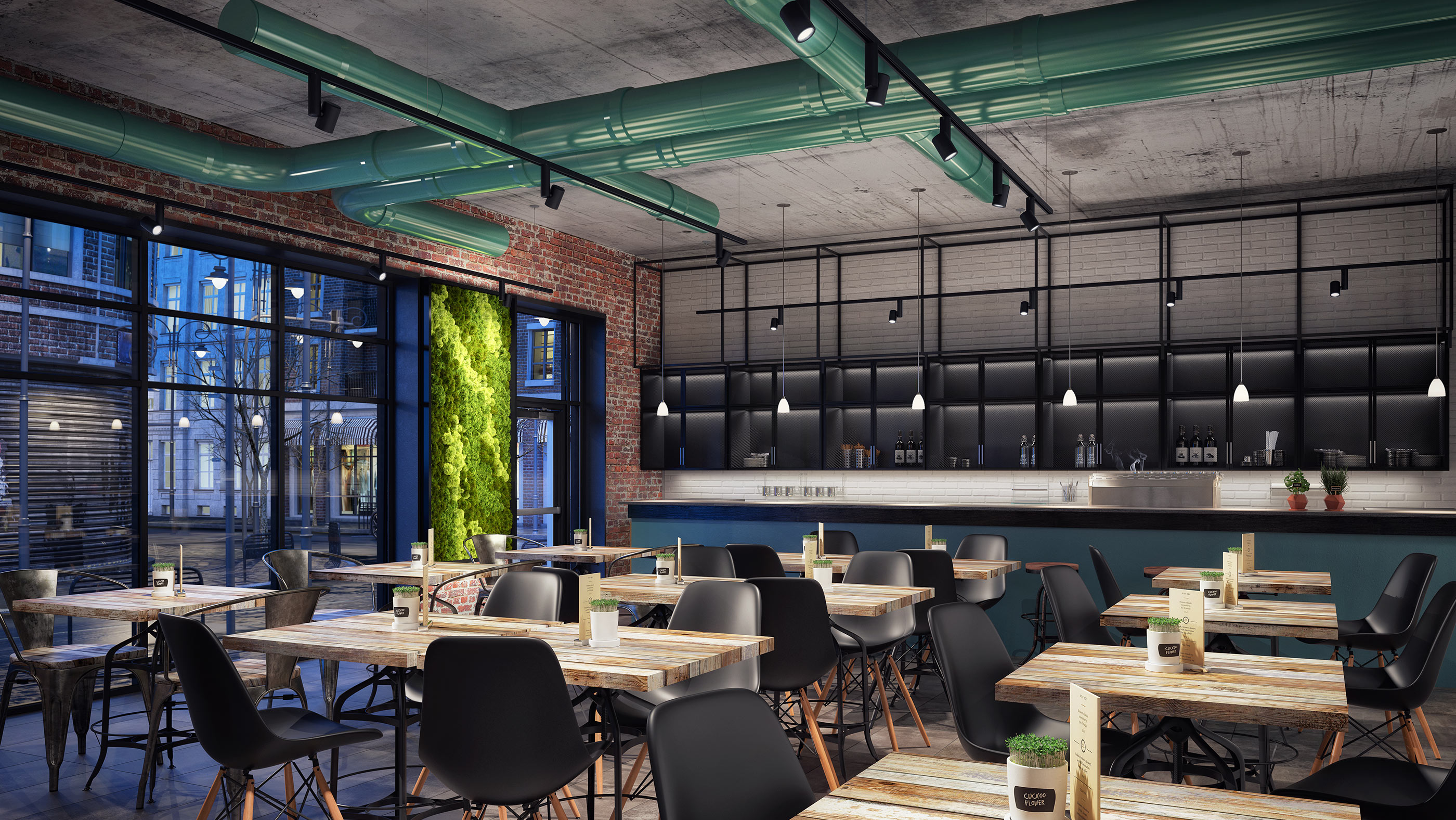
In practical commercial applications, narrow beam track lighting is almost always used as accent lighting, not general lighting.
🎯 What is narrow beam track lighting?
Narrow beam track lighting uses tight beam angles (typically 10°–24°) to create focused accent lighting in commercial spaces.
Why Narrow Beam Track Lights Are Used in Commercial Lighting
Narrow beam track lights exist for one core reason: visual focus.
Creating Clear Visual Hierarchy
In retail, hospitality, and gallery environments, not everything should receive equal attention. Narrow beam lighting allows designers to decide exactly what the customer should look at first.
Enhancing Drama and Depth
Because narrow beams produce strong contrast, they add a sense of depth and three-dimensionality that flat lighting schemes cannot achieve.
Precision Without Physical Changes
Unlike architectural modifications, lighting can be adjusted quickly. Narrow beam track lights can be re-aimed or repositioned without altering ceilings or layouts.
🎯 Why use narrow beam track lights?
They are used to highlight specific objects or areas with precision and strong visual contrast.
Ideal Applications for Narrow Beam Track Lighting
Retail Feature Products and Displays
Narrow beam track lighting is highly effective for:
- New product launches
- High-value merchandise
- Window displays
- Limited-edition collections
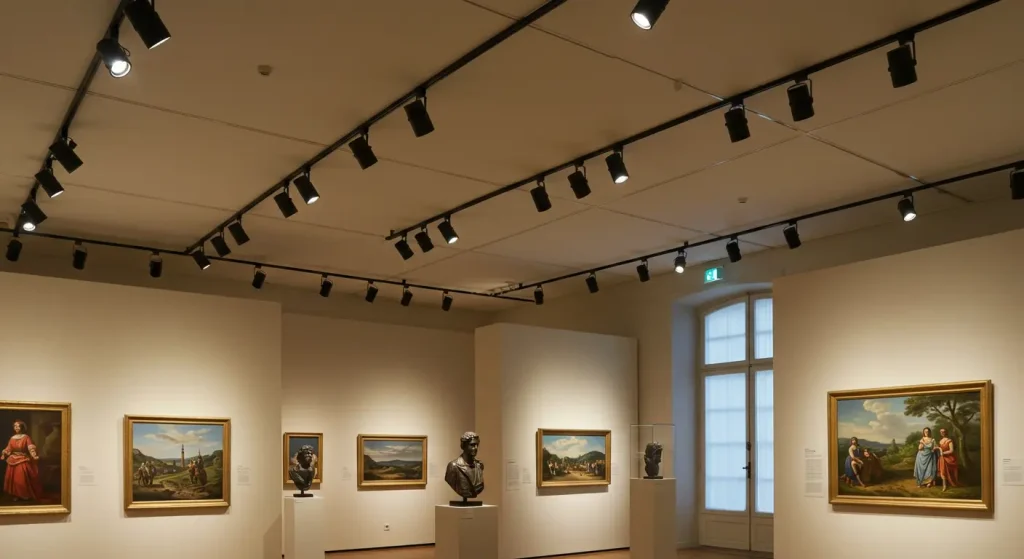
In retail projects, narrow beams are rarely used alone. They are usually combined with medium beam track lights to maintain balance and avoid excessive contrast. Adjustable systems such as LED-Schienenbeleuchtung allow designers to fine-tune this balance as displays change.
Art Galleries and Museums
This is where narrow beam lighting performs at its best.
- Precise control minimizes light spill
- Focus remains on the artwork, not the surrounding space
- Vertical illumination enhances texture and detail
High color fidelity (CRI ≥90 / Ra97) and stable color consistency (SDCM <3) are critical in these environments to preserve artistic integrity.
Hospitality Focal Points
In hotels and restaurants, narrow beam track lights are typically used for:
- Sculptures or art installations
- Feature walls
- Bar back displays
- Signature architectural details
Here, narrow beams add character and storytelling without overwhelming the entire space.
🎯 Where is narrow beam track lighting best used?
It is best used for feature displays, artworks, and focal points requiring precise accent lighting.
When Narrow Beam Track Lighting Should Be Avoided
This is where many projects fail.
Areas Where Narrow Beam Lighting Is a Poor Choice
- Main circulation corridors
- Customer waiting areas
- Seating zones with long dwell time
- Low-ceiling environments
- Areas requiring uniform illumination
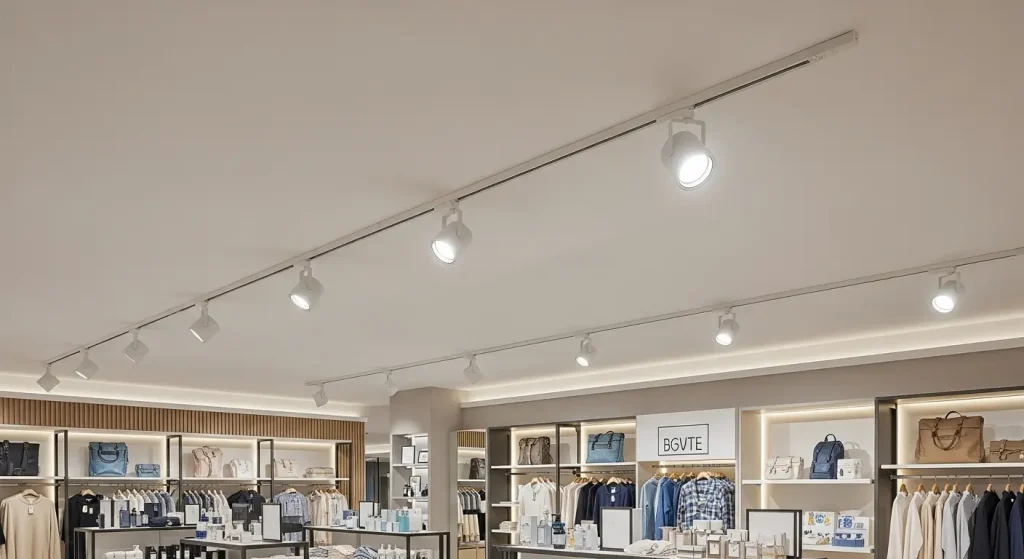
In these spaces, narrow beams often cause:
- Direct glare
- Harsh shadow transitions
- Visual discomfort
- Uneven brightness perception
🎯 When should narrow beam track lights not be used?
They should be avoided in general lighting areas or low-ceiling spaces where glare and harsh contrast may occur.
How Narrow Beam Track Lighting Affects Glare and Visual Comfort
Why Narrow Beams Increase Glare Risk
The tighter the beam, the higher the luminance concentration. Glare typically occurs when:
- The light source is within the normal field of view
- The aiming angle is incorrect
- The fixture lacks sufficient shielding
Effective Glare Control Strategies
Professional projects reduce glare by:
- Verwendung deep anti-glare designs
- Selecting proper cut-off angles
- Aiming luminaires at 30°–45° rather than vertically
- Combining narrow beams with softer ambient lighting
Following visual comfort principles such as those outlined by the Illuminating Engineering Society helps designers balance contrast and comfort.
Narrow Beam vs Medium Beam Track Lighting – How to Choose
📊 Beam Angle Comparison Table
| Kriterien | Narrow Beam | Medium Beam |
|---|---|---|
| Strahlwinkel | 10°–24° | 24°–36° |
| Primary Use | Strong focal accents | General accent lighting |
| Visual Effect | Dramatic, high contrast | Balanced and comfortable |
| Glare Risk | High if misused | Relatively low |
| Commercial Usage Frequency | Low but critical | High and versatile |
🎯 Is narrow beam or medium beam better for commercial lighting?
Narrow beam is ideal for focal highlights, while medium beam is better for general accent lighting.
In most retail and hospitality projects, medium beam lighting forms the backbone, while narrow beam fixtures are used selectively for emphasis.
📊 Narrow Beam Track Lighting – Application Reference Chart
| Anwendungsgebiet | Recommended Beam | Ceiling Height | Typical Illuminance | Risk Level |
|---|---|---|---|---|
| Retail Feature Display | 15°–24° | ≥3.5 m | 1200–2000 lx | Medium |
| Kunstgalerie | 10°–20° | ≥4 m | 800–1500 lx | Low (with control) |
| Hotel Feature Wall | 15°–24° | ≥3 m | 600–1000 lx | Medium |
| Walkways / Corridors | Not recommended | — | — | Hoch |
| Low Ceiling Retail | Avoid | <3 m | — | Very High |
This chart highlights why narrow beam lighting must always be context-driven, not preference-driven.
Design Tips for Using Narrow Beam Track Lights Effectively
Professional Best Practices
- Use narrow beams sparingly and intentionally
- Always combine with medium beam or ambient lighting
- Calculate beam spread based on mounting height
- Prioritize glare control over brightness
- Never use narrow beams as general lighting
In real commercial projects, we have seen lighting schemes improve significantly by reducing the number of narrow beam fixtures and refining aiming angles—achieving stronger focus with better comfort.
For projects requiring flexibility and precision, adjustable systems from LED-Schienenbeleuchtung allow designers to refine beam usage as layouts evolve.
When ambient balance is required, pairing track accents with LED-Spot-Downlights oder LED-Linearbeleuchtung helps maintain visual comfort while preserving contrast.
Externe Referenzen
Visual comfort and glare control principles referenced in this article align with recommendations from the Illuminating Engineering Society.
For commercial environments, designers also frequently follow guidance from EN 12464-1 regarding illuminance and glare limits.
Advanced track systems can be integrated with intelligent controls compatible with the DALI-Allianz for scene-based adjustments.
FAQ About narrow beam track lighting
Geschäftliche Anfragen sind willkommen
Narrow beam track lighting is not about brightness—it is about Kontrolle.
Used correctly, it creates clarity, focus, and dramatic emphasis.
Used incorrectly, it introduces glare, discomfort, and visual imbalance.
Successful commercial lighting projects treat narrow beam track lighting as:
- A specialized tool, not a default option
- Part of a layered lighting strategy
- Dependent on ceiling height, viewing distance, and context
If you are evaluating beam angles for a retail, hospitality, or gallery project, the next step is not choosing a fixture—but aligning beam selection with your actual space and use case.
You can explore how beam angle strategy is applied within complete systems through our Retail & Commercial Lighting Solutions.
👉 Submit your project details or layout via our Kontakt- und Projekt-Einreichungsseite
Our team can help you evaluate whether narrow beam track lighting is the right tool—or a risk—for your specific project, and recommend a balanced, professional solution.