 XHLUX
XHLUX

Inhaltsverzeichnis
- 1) Why adjustable gimbal downlights became a “default” for modern shop lighting
- 2 What an adjustable gimbal LED downlight really is
- 3 Where gimbal downlights work best inside a shop
- 4 Beam angle selection: the retail-friendly logic
- 5 Why CRI matters more than “brightness” in shops
- 6 Glare control: the “silent killer” of premium retail lighting
- 7 Rotation + tilt: the mechanical details that decide whether gimbals feel “professional”
- 8 Dimming & controls: what shops actually need
- 9 Choosing gimbal downlights for different shop types
- 10 Fixed downlight vs gimbal downlight vs track: a cost-and-ceiling reality check (table)
- 11 Contractor & wholesaler sourcing: what decides “yes” in real projects
- 12 SKD service: how some importers reduce duty and improve flexibility
- 13 a “safe” gimbal downlight configuration for many shops
- 14 FAQ About Rectangular gimbal downlight shop
- 15 Conclusion
- Welcome to collaborate
If your shop lighting keeps “going wrong” after merchandising changes, the problem usually isn’t the layout—it’s the fixture type. Fixed downlights lock your beam direction forever. Track lights solve flexibility but can clutter ceilings, add glare, and increase labor. Adjustable gimbal LED downlights sit in the sweet spot: clean recessed appearance + aimable accent control.
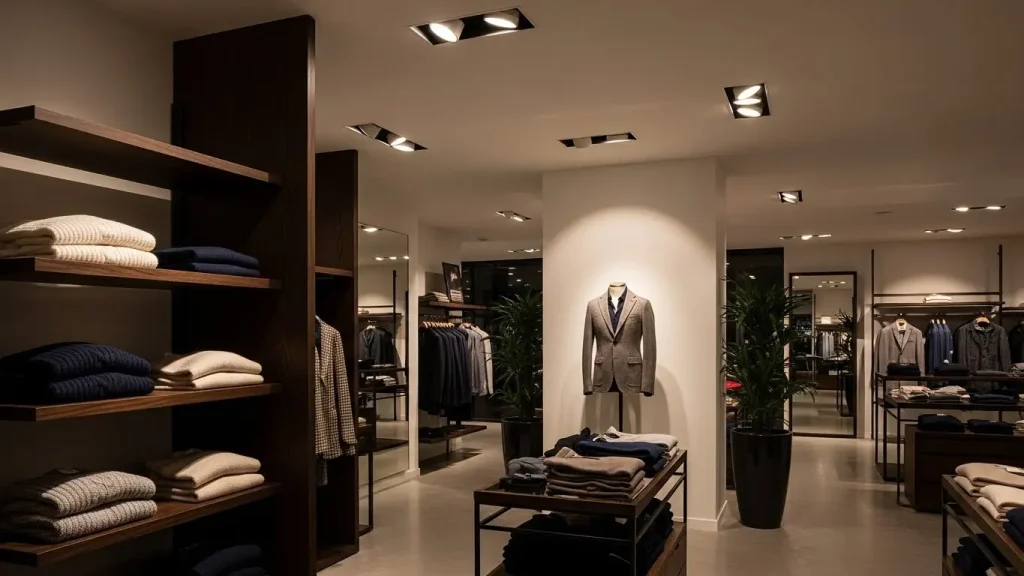
In this guide you’ll learn how to pick the right gimbal recessed downlight / adjustable recessed spotlight / directional LED downlight specs for retail—beam angles, CRI, glare control, dimming, cutout standards, and how contractors and brand teams standardize them for repeatable store rollouts.
1) Why adjustable gimbal downlights became a “default” for modern shop lighting
Retail lighting today is not about making a space bright. It’s about:
- Guiding attention to hero products and storytelling zones
- Improving perceived quality (materials look richer under the right spectrum)
- Keeping ceilings clean while still delivering directional punch
- Reduccing rework when displays change every season
A fixed downlight can provide ambient light, but it can’t reliably do “sell the product” tasks. That’s why many lighting plans now mix:
- Ambient: linear recessed / general downlights
- Akzent: track spots or gimbal downlights
- Vertical: wall wash / grazing for walls & brand graphics
Where a track system isn’t desired (aesthetic, ceiling height limits, or budget discipline), adjustable gimbal LED downlights become the hidden accent layer.
2 What an adjustable gimbal LED downlight really is
A gimbal downlight is a recessed luminaire where the light engine can tilt and/or rotate. In practical terms:
- Der cutout stays fixed
- Der beam direction changes as merchandise changes
- You get accent-like control without the ceiling clutter of track
Common search terms you want to cover (and what they usually mean in RFQs):
- Adjustable gimbal LED downlight (most common)
- Gimbal recessed downlight (same category)
- Adjustable recessed spotlight (accent intention)
- Directional recessed downlight / tilt downlight (aimability focus)
- Anti-glare gimbal downlight (comfort requirement)
- Trimless gimbal downlight (architectural finish)
- DALI / 0–10V dimmable gimbal downlight (controls requirement)
3 Where gimbal downlights work best inside a shop
These are the positions where adjustable recessed downlights consistently outperform fixed downlights:
Wall bays & shelving runs
Aim the beam slightly forward to reduce self-shadowing on products and improve vertical brightness without adding separate wall washers.
Feature tables / islands
Two or three gimbal points can “follow” seasonal displays—no re-cutting ceiling, no track relocation.
Mannequin / hero zones
Directional control shapes the brand image and creates a clean focal hierarchy.
Cash wrap / brand wall
Use tighter beams for logo/texture emphasis without lighting the entire ceiling plane.
Circulation “beats”
A gentle rhythm of aimed beams creates wayfinding without signage overload.
4 Beam angle selection: the retail-friendly logic
Choosing beam angles is not a catalog checkbox. It’s geometry + mounting height + product size.
Practical beam categories used in shops
- Narrow spot (10°–15°): jewelry, mannequins, small hero items
- Spot (18°–24°): most retail accent needs
- Flood (30°–36°): general accent, larger displays
- Wide flood (45°–60°): soft emphasis, background fill
Quick sizing table (beam diameter on target surface)
Approx. beam diameter = 2 × distance × tan(beam/2)
| Ceiling height / throw distance | 15° beam | 24° beam | 36° beam | 60° beam |
|---|---|---|---|---|
| 2.7 m (9 ft) | ~0.7 m | ~1.1 m | ~1.8 m | ~3.1 m |
| 3.5 m (11.5 ft) | ~0.9 m | ~1.5 m | ~2.3 m | ~4.0 m |
| 5.0 m (16.4 ft) | ~1.3 m | ~2.1 m | ~3.3 m | ~5.8 m |
What this means for shop lighting:
- If your store changes displays frequently, 24° and 36° are the safest “chain standard” beams.
- For premium focal points, add a small quantity of 15°.
- Avoid using 60° as your main “accent”—it becomes expensive ambient.
Mini chart: beam choice vs common retail task
Narrow (10–15°):   ██████████  Hero items / sparkle
Spot (18–24°):     ████████████  Shelves / mannequins
Flood (30–36°):    █████████  Tables / mid-size displays
Wide (45–60°):     █████  Background / soft fill
5 Why CRI matters more than “brightness” in shops
CRI (Farbwiedergabeindex) describes how accurately a light source reveals colors compared to a reference.
In retail, color accuracy directly impacts:
- perceived quality (fabric richness, leather depth)
- brand consistency (signature colors)
- customer trust (cosmetics, food, premium goods)
CRI90 vs CRI95/97: how to decide
- CRI 90: a solid baseline for most apparel, general retail
- CRI 95+ / CRI97: cosmetics, art, luxury accessories, high-end showcase
Also consider color temperature (CCT). CCT describes whether the light looks warm or cool. (Dominion Lighting)
Typical shop ranges:
- 2700–3000 K: luxury, hospitality retail, warm brand mood
- 3500–4000 K: balanced “true retail” clarity
- 5000K+: clinical clarity (less common for fashion)
Pro tip for chain standards:
Standardize one CCT per brand “tier” (e.g., 3000K for premium, 3500K for mainstream) to keep stores consistent across cities and seasons.
6 Glare control: the “silent killer” of premium retail lighting
A shop can have high CRI and perfect aiming but still feel uncomfortable if glare is unmanaged.
What to look for (spec language buyers actually use)
- Deep recess / black baffle (reduces bright source visibility)
- Honeycomb / louver option (especially for jewelry or glossy displays)
- Good cutoff (high-angle light controlled)
- UGR intent for visual comfort (UGR is a glare rating method commonly referenced in lighting standards guidance; lower is better). (The ANSI Blog)
Retail reality:
If customers can “see the LED,” they stop looking at the product.
Quick glare checklist for gimbal downlights
- Can you choose black anti-glare accessories?
- Does the fixture keep comfort when tilted (some don’t)?
- Is the beam clean with minimal spill (reduces reflective glare)?
7 Rotation + tilt: the mechanical details that decide whether gimbals feel “professional”
Not all adjustable downlights are equal. The difference shows up after 6–12 months.
Must-have mechanical qualities
- Tilt range: commonly 20°–30°; more isn’t always better if glare increases
- Rotation: 350° is ideal for aiming flexibility
- Locking stability: “aim it and it stays”—no droop after heat cycles
- Serviceability: driver access, module replacement, quick maintenance
Buyer question that filters suppliers instantly:
“Can your gimbal hold angle after continuous operation and repeated re-aiming?”
8 Dimming & controls: what shops actually need
For shop lighting solutions, dimming is not a luxury—it’s how you manage:
- day/night mood
- promotions
- seasonal resets
- energy and glare at close-up zones
Common options
- Phase-cut / Triac (simple, but compatibility can be tricky)
- 0–10 V (common in commercial builds)
- DALI / DALI-2 (project-grade digital control; DALI-2 focuses on stricter interoperability and certification).
- Wireless controls (e.g., Casambi) for retrofit speed and flexible zoning.
What to confirm in RFQ (don’t skip):
- tested dimming range (example: 100% → 1% smooth)
- flicker performance expectations
- driver brand/series consistency across batches
- multi-fixture behavior (group consistency)
9 Choosing gimbal downlights for different shop types
Apparel & lifestyle retail
- 3000–3500 K
- CRI90+
- 24° / 36° mix
- black baffle for comfort
Cosmetics / beauty
- CRI95+ (often requested)
- clean beam edge, low glare
- careful vertical lighting for faces (avoid harsh shadows)
Jewelry / watches
- narrow beams 10°–15° + honeycomb option
- strong glare control is mandatory
- dimming for sparkle tuning
Grocery specialty / premium food
- CRI90+ and stable spectrum
- targeted accents without overheating displays
10 Fixed downlight vs gimbal downlight vs track: a cost-and-ceiling reality check (table)
| Artikel | Fixed downlight | Adjustable gimbal downlight | Track spotlight |
|---|---|---|---|
| Ceiling look | Clean | Clean | Visible track |
| Flexibility after opening | Niedrig | Mittel bis hoch | Highest |
| Re-aim for new displays | NEIN | Ja | Ja |
| Risk of glare when aimed | Medium | Medium–High (if poorly designed) | Medium |
| Typical best use | Ambient | Hidden accent | Accent + frequent change |
| Chain rollout practicality | Hoch | Very high | Medium (aesthetic varies) |
Key takeaway:
For many shop lighting solutions, the best outcome is not “either/or,” but a balanced kit:
- gimbal downlights for hidden directional accent
- track for zones needing maximum change
- linear/ambient for comfortable base brightness
11 Contractor & wholesaler sourcing: what decides “yes” in real projects
If you’re buying for multiple stores or a rollout, these are the questions that matter more than brochures:
- Can you keep the same light quality across batches?
- Do you have stable drivers and LEDs (no surprise substitutions)?
- Can you support IES files / photometrics for approvals?
- Do you support OEM/ODM trims, colors, beam options?
- Can you ship by phase (store-by-store schedules)?
- What’s your warranty + spare parts plan?
Data snapshot: why “cheapest” loses in chain rollouts
Here’s a simple way contractors evaluate risk (example logic):
| Cost type | Low-price fixture risk | Project impact |
|---|---|---|
| Rework labor | Hoch | Ceiling patching, relamping, re-aiming |
| Store downtime | Mittel bis hoch | Lost sales during adjustments |
| Inconsistent appearance | Hoch | Brand damage across locations |
| Garantieabwicklung | Hoch | Admin time + replacements |
In other words: the cheapest unit price often creates the highest total cost.
12 SKD service: how some importers reduce duty and improve flexibility
For certain markets and importer setups, SKD (Semi Knocked Down) shipment—shipping track/gimbal components for local assembly—can reduce logistics cost, improve container efficiency, and sometimes support duty strategies when handled legally and correctly.
Where SKD helps most:
- repeat orders / chain rollouts
- markets that encourage local assembly
- buyers who want faster local response for spares
If SKD is part of your plan, confirm:
- local assembly capability
- local compliance responsibilities
- packaging lists and labeling discipline
- spare parts strategy (drivers, optics, trims)
13 a “safe” gimbal downlight configuration for many shops
If you want a reliable starting point for most retail projects, this configuration is commonly requested:
- CCT: 3000K or 3500K (brand dependent) (Dominion Lighting)
- CRI: ≥90 (≥95 for premium categories) (LED Lighting Retrofit Services)
- Strahlwinkel: 24° + 36° (optional 15° for hero zones)
- Anti-glare: black baffle + optional honeycomb
- Dimming: 0–10V or DALI-2 for large projects (dali-alliance.org)
- Build: stable tilt/rotation, easy driver access
- Deliverables: IES files, cut sheets, installation guide, warranty terms
14 FAQ About Rectangular gimbal downlight shop
Q1: Will an adjustable gimbal downlight ruin my clean ceiling look?
No. It stays recessed like a normal downlight. You gain aiming flexibility without adding track clutter.
Q2: Are gimbal downlights “accent lighting,” or are they still ambient?
They’re best used as hidden accent. They can contribute to ambient, but their value is directional control.
Q3: What beam angle should I choose for shop lighting?
For most stores: start with 24° and 36°, then add 15° for hero zones. Use ceiling height and display size to confirm.
Q4: Do gimbal downlights cause glare when tilted?
They can—if the optic and baffle design is weak. Choose deep recess / black baffle options and test aiming positions.
Q5: Should I choose DALI-2, 0–10V, or Triac dimming?
- Triac: simplest, but compatibility varies
- 0–10V: common for commercial builds
- DALI-2: best for large projects needing consistent digital control and interoperability (dali-alliance.org)
Q6: Can gimbal downlights replace track lights in retail?
Sometimes partially, yes. Many projects use both: gimbals for clean ceilings, track for maximum change zones.
Q7: How do I keep lighting consistent across chain stores?
Standardize: cutout size, CCT, CRI tier, two main beam angles, and one dimming protocol. Require IES files and batch consistency.
Q8: Does Tunable White make sense for shops?
For stores that shift mood by time-of-day or run frequent resets, Tunable White plus a good control platform can be valuable. Wireless systems like Casambi are often chosen for retrofit speed. (Casambi)
15 Conclusion
Adjustable gimbal LED downlights solve a real retail contradiction: you want a clean ceiling, but you also need lighting that can evolve with merchandising. When specified correctly—beam angles chosen by geometry, CRI aligned with product category, and glare controlled—gimbals become one of the highest-ROI fixtures in shop lighting design.
Welcome to collaborate
If you’re planning a retail project, a chain rollout, or you’re sourcing for wholesale supply, we can help you build a repeatable shop lighting kit (gimbal downlights + track spots + linear ambient) with the right photometrics, dimming options, and delivery plan—including OEM/ODM-Anpassung Und SKD component supply when it fits your import strategy.
Helpful links:
choose the one that matches your stage:
- Need a quick fixture shortlist? → Project Consultation
- Quoting a tender and need photometrics/IES files? → Contact Page
- Building a private label line or regional distribution? → OEM Inquiry
- Want to compare gimbal + track + linear as a kit? → Katalog herunterladen
If you want, tell me your ceiling height, store type (apparel/cosmetics/jewelry/etc.), and target CCT, and I’ll map a clean spec set (beam mix + glare options + dimming) you can paste directly into your RFQ.