 XHLUX
XHLUX

Inhaltsverzeichnis
- Dimming Basics (How LED Dimming Works)
- What Is TRIAC Dimming? (Phase-Cut / Mains Dimming)
- What Is 0-10V Dimming? (Analog Voltage Control)
- What Is DALI? (Digital Addressable Lighting Interface)
- Head-to-Head Comparison (TRIAC vs 0-10V vs DALI)
- Performance & Cost at a Glance (Illustrative Data)
- Which to Choose by Project Scenario
- Installation & Compatibility Checklist
- Data Tables You Can Paste into Specs
- FAQ About Dimmable Spotlights
- Abschluss
In modern commercial lighting, dimming is not a luxury—it’s a control strategy. The right system lowers energy consumption, elevates visual comfort, and enables flexible ambience for retail, offices, hotels, galleries, and public buildings. Yet project teams often struggle to decide between TRIAC (phase-cut), 0-10V (analog), Und DALI (digital).
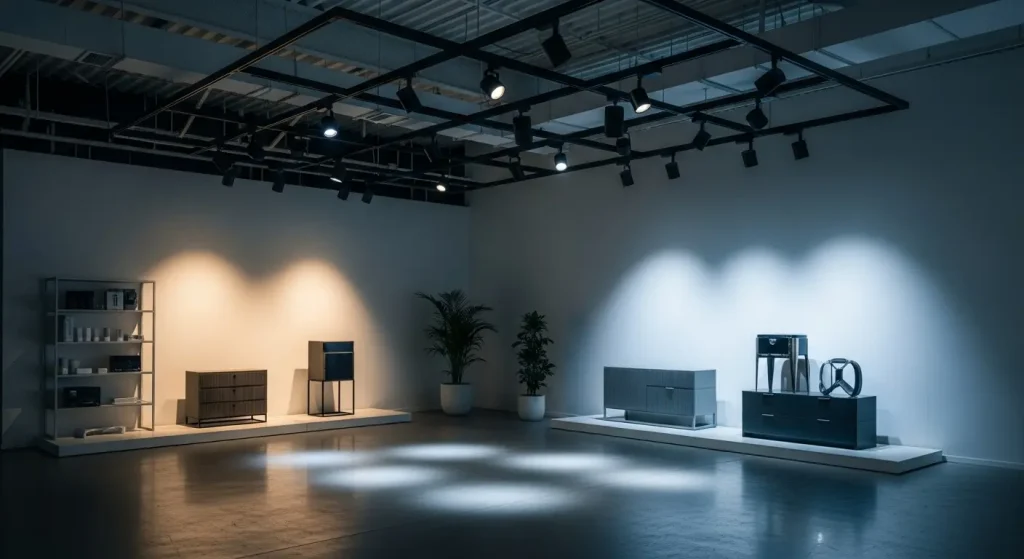
This comprehensive guide explains how each method works, clarifies strengths and limitations, and gives scenario-based selection rules so you can specify the best dimmable LED spotlights for your project with confidence.
Dimming Basics (How LED Dimming Works)
LED luminaires don’t dim like incandescent lamps. They require an electronic driver that translates a control method into regulated current. Every dimming system therefore has three layers:
- Control Input – a phase-cut AC signal, an analog control voltage, or a digital data bus.
- LED Driver – interprets the signal and modulates current (CC) to the LED module.
- LED Load – the COB/SMD engine plus optics and thermal path.
Control families
- Phase-cut / Mains dimming → TRIAC (a.k.a. leading/trailing-edge)
- Analog voltage dimming → 0-10V (sometimes 1-10V for minimum level)
- Digital addressable dimming → DALI (IEC 62386 standard)
Specification rule #1: Match the driver to the control. A DALI controller with a TRIAC driver won’t dim; a 0-10V driver on a TRIAC wall dimmer will flicker or fail. Always verify driver datasheets Und system topology before procurement.
What Is TRIAC Dimming? (Phase-Cut / Mains Dimming)
How it works
TRIAC (Triode for Alternating Current) “clips” part of the AC sine wave (leading-edge or trailing-edge). The shorter conduction angle reduces RMS voltage delivered to the driver, which in turn lowers LED current and light output.
Vorteile
- Lowest first cost – wall dimmers are inexpensive and widely available.
- Simple wiring – uses existing line/neutral; no extra control pair.
- Retrofit-friendly – ideal for small rooms Und hospitality guest rooms.
Einschränkungen
- Low-level performance – below ~10–20% output, many TRIAC drivers exhibit flicker oder dead travel.
- Electrical noise – phase chopping introduces EMI; loading/derating varies by dimmer model.
- Limited scalability – no grouping or feedback, not suited to large, zoned controls.
- Compatibility roulette – dimmer–driver pairings are not universal. Bench tests are mandatory.
Best-fit applications
- Boutique retail corners, small restaurants, show flats, hotel guestrooms, residential-style meeting rooms—where simplicity and cost beat granular control.
Pro tips
- Prefer trailing-edge (ELV) dimmers with LED drivers—they’re gentler on electronics.
- Maintain minimum load per channel as specified by the dimmer to avoid shimmer.
- For spotlighting, choose drivers with high PF & low THD at dimmed states to protect upstream equipment.
What Is 0-10V Dimming? (Analog Voltage Control)
How it works
A controller sources a separate 0–10V DC signal to the LED driver’s control input. The driver maps the voltage to current output (e.g., 1V ≈ 10%, 10V ≈ 100%). Some drivers use sink topology; check datasheets.
Vorteile
- Smooth, predictable curve – excellent low-level dimming down to 1–3% with quality drivers.
- Widely supported – abundant drivers and controllers; cost-effective for medium projects.
- Isolation from mains – the control pair is low voltage, reducing interference.
Einschränkungen
- Extra cabling – requires two additional control conductors (polarity matters).
- No native feedback – one-way control; status monitoring needs add-ons.
- Large zones drift – long runs and multiple drivers can yield slight level mismatches.
Best-fit applications
- Open offices, meeting rooms, clinics, galleries, mid-size retail, where smooth dimming Und reasonable cost are key, and full digital building integration isn’t mandatory.
Pro tips
- Keep analog control wiring separate from mains; use shielded cable in noisy environments.
- For big zones, use shorter control runs oder local controllers to minimize voltage drop.
- Confirm whether drivers are Quelle oder sink type to avoid wiring errors.
What Is DALI? (Digital Addressable Lighting Interface)
How it works
DALI (IEC 62386) is a two-wire, polarity-free, low-voltage digital bus that carries addressed commands: each driver (up to 64 per line) gets a unique address and can join up to 16 groups and 16 scenes. DALI-2 adds device types, sensors, and improved interoperability.
Vorteile
- Granular control – per-fixture addressing, grouping, scenes, transitions, Und fade times.
- Two-way communication – drivers report status, failure, runtime, enabling maintenance scheduling.
- BMS integration – bridges to BACnet/KNX/LON; ideal for smart buildings Und energy codes.
- Best low-level dimming – quality drivers hit 0.1–1% with clean curves.
Einschränkungen
- Höhere Anfangskosten – DALI drivers, gateways, and commissioning time add budget.
- Requires expertise – addressing, topology planning, and software commissioning.
- Bus limits – 64 addresses/line (extendable with routers), 300 m cable length typical.
Best-fit applications
- Premium hotels, corporate offices, museums, universities, airports—any site needing centralized control, reporting, and future reconfiguration.
Pro tips
- Verwenden DALI-2 certified components for cross-brand interoperability.
- Plan line segmentation (by floor/zone) to simplify maintenance and future expansion.
- Document address maps Und scene logic as handover assets for FM teams.
Head-to-Head Comparison (TRIAC vs 0-10V vs DALI)
| Criterion | TRIAC (Phase-Cut) | 0-10V (Analog) | DALI (Digital) |
|---|---|---|---|
| Control Signal | Mains waveform chopped | 0–10V DC control pair | 2-wire digital bus (IEC 62386) |
| Extra Wiring | None | 2-core control cable | 2-core DALI bus (polarity-free) |
| Dimming Range | ~20–100% typical | ~1–100% (driver-dependent) | 0.1–100% (best-in-class) |
| Curve Smoothness | Fair (risk of flicker low-end) | Smooth | Very smooth + programmable fades |
| Grouping / Scenes | None (per circuit only) | Limited (by controller, no feedback) | Native groups & scenes |
| Feedback / Diagnostics | NEIN | NEIN | Yes (two-way) |
| Scalability | Small rooms | Medium zones | Large, multi-zone buildings |
| Commissioning | Minimal | Low–medium | Professional commissioning |
| Best Use Cases | Guestrooms, small retail | Offices, clinics, showrooms | Hotels, HQs, museums, airports |
Specification rule #2: If your brief mentions BMS integration, scenes, schedules, or maintenance reporting, the answer is DALI. If the brief says simple and smooth at moderate cost, choose 0-10V. If the brief says retrofit, minimal wiring, tight budget, choose TRIAC.
Performance & Cost at a Glance (Illustrative Data)
Spotlight bundle: 12 m × 6 m meeting room, target average 300 lx, 2.8 m ceiling.
| System | Leuchtenart | Qty | Driver Cost/ea | Control Gear | Wiring Complexity | Est. System Cost | Notes |
|---|---|---|---|---|---|---|---|
| TRIAC | 12 W COB recessed | 10 | $18 | Wall dimmer $60 | Niedrig | $240 + $60 + labor | Might struggle <20% output flicker |
| 0-10V | 12 W COB recessed | 10 | $22 | Controller $180 | Medium (control pair) | $220 + $180 + labor | Smooth dimming; good value |
| DALI | 12 W COB recessed | 10 | $28 | DALI PS + Gateway $350 | Medium (bus) | $280 + $350 + labor | Scenes, feedback, BMS-ready |
Energy is similar across methods at the same illuminance; the control experience and maintainability drive ROI.
Which to Choose by Project Scenario
Hospitality (Guestrooms, Suites)
- Priorities: warm ambience, minimal wiring, fast install.
- Choose: TRIAC or compact 0-10V kits for suites where multiple scenes are needed.
- Add trailing-edge dimmers to reduce buzz and improve low-end stability.
Open Offices & Meeting Rooms
- Priorities: UGR ≤ 19 comfort, smooth low-glare levels for screen work, occupancy/daylight sensors.
- Choose: 0-10V for small floors; DALI for multi-zone, sensor-rich control and reporting.
Retail & Galleries
- Priorities: accent control, frequent layout changes, night scene.
- Choose: 0-10V when budgets are tight; DALI when scene recall Und per-fixture tuning matter.
Museums, Universities, Airports, Corporate HQ
- Priorities: central monitoring, energy dashboards, fault alarms, future reconfig.
- Choose: DALI (or DALI-2 with sensors) with BMS integration via BACnet/KNX gateway.
Installation & Compatibility Checklist
For all systems
- Verify driver input type (TRIAC/ELV, 0-10V, DALI) matches the control equipment.
- Confirm dimming range (specify 1% oder 0.1% if required).
- Require flicker performance (IEEE 1789 guidance, ≤8% at typical operating points).
- Check EMC/EMI compliance Und THD figures at dimmed states.
TRIAC specifics
- Verwenden trailing-edge dimmers where possible; verify minimum and maximum load.
- Avoid combining LED drivers of mixed brands on one dimmer without tests.
- Derate dimmer channels if installed in multi-gang boxes (heat).
0-10V specifics
- Keep control wiring separate from mains; use twisted pair shielded for long runs.
- Mind polarity if required by the driver; confirm source vs sink topology.
- Large zones: consider local repeaters oder shorter control branches.
DALI specifics
- Map addresses, groups, scenes in a commissioning plan; label junction boxes.
- One DALI PSU per bus; observe current limits and total device count (64/node).
- Verwenden DALI-2 certified gear when mixing brands; keep a digital copy of the project database for FM.
Data Tables You Can Paste into Specs
Electrical & Control Characteristics
| Artikel | TRIAC | 0-10V | DALI |
|---|---|---|---|
| Control Type | Phase-cut AC | Analog DC voltage | Digital bi-directional |
| Min Level (typ.) | 10–20% | 1–3% | 0.1–1% |
| Scene Support | NEIN | Controller-dependent | Native scenes |
| Feedback/Status | NEIN | NEIN | Yes (lamp fail, runtime) |
| Verdrahtung | L/N only | L/N + 2-core control | L/N + 2-core DALI bus |
| EMI Risk | Higher | Niedrig | Niedrig |
| Commissioning | Minimal | Niedrig | Professional |
Risk & Mitigation Matrix
| Risk | More Likely In | Mitigation |
|---|---|---|
| Low-level flicker | TRIAC | Use trailing-edge dimmers; bench test min level |
| Level mismatch across fixtures | 0-10V | Shorter runs; grouped local controllers |
| Addressing confusion | DALI | Use commissioning software; label all fixtures |
| Noise/interference | TRIAC/0-10V | Shielded cable; separate control from mains |
FAQ About Dimmable Spotlights
Q1: Can I mix TRIAC, 0-10V, and DALI in one building?
Yes—by zone with separate drivers and controls. Do nicht place different dimming types on the same circuit. Integrate zones via a master controller or BMS gateway.
Q2: Which system saves the most energy?
All three save energy when dimmed. DALI typically yields higher operational savings thanks to scheduling, sensor integration, and fine-grain control.
Q3: What about flicker and health concerns?
Specify drivers with low percent flicker across the operating range and test low-level scenes. TRIAC is most prone; 0-10V/DALI with quality drivers perform best.
Q4: We already have 0-10V wiring—can we upgrade to DALI later?
You’ll need DALI-capable drivers and a DALI bus, but existing mains runs may remain. Some gateways emulate 0-10V to DALI, but full benefits require a native DALI backbone.
Q5: Is DALI overkill for small projects?
Für single rooms oder simple suites, yes—TRIAC or 0-10V is enough. For multi-space venues needing central control and analytics, DALI is ideal.
Q6: Which is best for export/OEM to North America?
0-10V remains the dominant commercial standard across North America; pair with UL/ETL-listed drivers. Many hospitality retrofits still request TRIAC.
Abschluss
Choosing the right dimming platform is about matching control capability to business outcomes:
- TRIAC: retrofit speed and lowest cost for small rooms.
- 0-10V: smooth, reliable performance for offices and mid-size commercial spaces.
- DALI: enterprise-grade control, reporting, and future-proof flexibility.
If your brief mentions scenes, sensors, analytics, or BMS, go DALI. If it’s smooth and simple mit value pricing, choose 0-10V. For fast retrofits with minimal rewiring, TRIAC wins.
Need project-ready dimmable LED spotlights?
We supply OEM/ODM fixtures with TRIAC, 0-10V, and DALI drivers, complete with IES files, commissioning support, and international certifications.Get a tailored specification pack, photometrics, and a fast quotation today.