 XHLUX
XHLUX

Inhaltsverzeichnis
- 1. What Is Energy Efficient Commercial Lighting?
- 2. Key Technical Indicators of Energy Efficient Commercial Lighting
- 3. Types of Energy Efficient Commercial Lighting and Their Uses
- 1. LED Linear Lights — The Core of Office Efficiency
- 2. LED Panel Lights — High Uniformity + High Efficiency
- 3. LED Downlights — Low Glare, Professional Optics
- 4. LED Track Lights — Energy Efficient Accent Lighting
- 5. LED Highbay Fixtures — Industrial Energy Core
- 6. Linear Wall Washers — Maximum Effect, Minimal Energy
- 7. Smart LED Fixtures
- 4. Recommended Energy Efficient Lighting Solutions by Industry
- 5. A Systematic Method for Achieving Commercial Lighting Efficiency
- 6. Checklist for Selecting an Energy Efficient Lighting Supplier
- 7. Why Choose XHLUX for Energy Efficient Commercial Lighting?
- Comparison Table: Types of Energy Efficient Commercial Lighting
- FAQ — People Also Ask (Google PAA Optimized)
- 1. Which LED fixtures are most energy efficient?
- 2. How do I choose energy efficient lighting for commercial spaces?
- 3. Which is more efficient: linear lights or panel lights?
- 4. Can smart lighting significantly reduce energy usage?
- 5. Why is SDCM important in commercial lighting?
- 6. How can businesses build an energy saving lighting plan?
- Abschluss
Modern energy efficient commercial lighting is no longer defined simply by “switching to LED.”
In 2025, true energy efficiency is a System, combining:
- High efficacy (≥110–150 lm/W)
- Low glare optics (UGR<19 for offices)
- Consistent color quality (SDCM<3; CRI≥90/Ra97 optional)
- Intelligente Steuerung (DALI-2, 0-10V, Casambi, PIR / Microwave sensors)
- Long lifetime (L70/B50 50,000–100,000 hours)
- Optimized installation layout
- Stable supply chain & engineering documentation
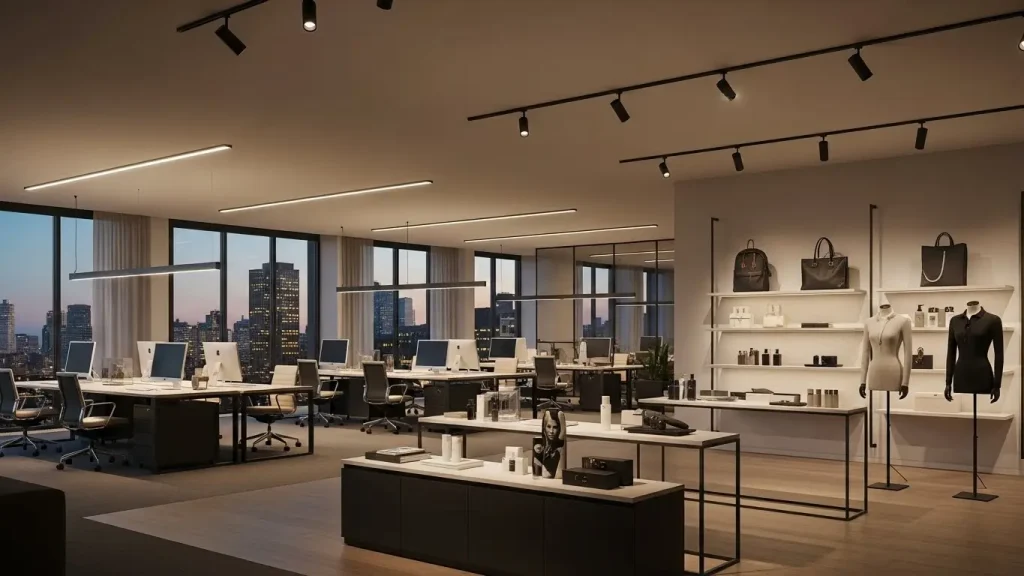
Commercial spaces—including offices, retail stores, hotels, malls, hospitality, warehouses, and healthcare environments—are under increasing pressure due to energy regulations (ESG), operational cost control, Und maintenance complexity.
1. What Is Energy Efficient Commercial Lighting?
1. True Definition = Optics + Drivers + Control + Lifetime + Intelligence
Energy efficient commercial lighting combines multiple engineering factors:
- Light Source Efficiency (lm/W):
LED chips delivering 100–150 lm/W usable system efficacy. - Driver Efficiency:
High quality drivers with PF>0,9, Low THD<15%, complying with
IEEE standards and supporting digital protocols like DALI-2. - Thermal Management:
Die-cast aluminum heatsinks maintain LED junction temperature <85°C, extending lifetime. - Optical Precision:
Beam control through PMMA lenses, reflectors, anti-glare cones delivering UGR<19. - Intelligente Steuerung:
- Anwesenheitserkennung
- Tageslichtnutzung
- Scene scheduling
- Wireless control (Bluetooth Mesh, Casambi)
- Long Operational Life:
- L70/B50 50,000–100,000 hours
- LM-80 / TM-21 validated
Energy efficiency = Full system optimization, not just lumen output.
2. Why Commercial Lighting Requires Higher Energy Efficiency
Commercial buildings consume 17–25% of total electrical load for lighting. Key drivers:
(1) Operational Cost Reduction
For facilities operating 10–18 hours / day, lighting costs accumulate massively.
(2) ESG Compliance
Corporate ESG goals require reduction of energy footprint and carbon emissions.
(3) Government Regulations
Regions follow standards like:
- EN12464-1 (Europe) → Lighting for indoor workplaces
- IESNA (US) → Design recommendations
- ASHRAE 90.1 → Building energy efficiency
Non-compliance increases cost and risk.
3. LED vs Traditional Lighting (60–80% Energy Savings)
| Technologie | Typical Efficacy | Power Usage | Lebensdauer | Ergebnis |
|---|---|---|---|---|
| Incandescent | 10–15 lm/W | Hoch | ~1,000 h | Obsolete |
| Fluorescent (T5/T8) | 60–90 lm/W | Medium | 8,000–15,000 h | Mäßig |
| Metal Halide | 60–100 lm/W | Hoch | 5,000–10,000 h | Very inefficient |
| Modern LED | 100–150 lm/W | Lowest | 50,000–100,000 h | Best |
LED retrofits typically reduce energy consumption by:
→ 60–80%
→ Additional 20–30% savings via smart controls
2. Key Technical Indicators of Energy Efficient Commercial Lighting
1. Luminous Efficacy (lm/W)—100–150 lm/W
High efficacy reduces power consumption without sacrificing brightness.
Premium commercial fixtures achieve:
- System efficacy: 110–150 lm/W
- COB or SMD light sources
- High-transmission PMMA lensing
2. Driver Efficiency (PF / THD / Stability)
Critical for energy reliability.
- Power Factor PF > 0.9
- THD <15%
- High-grade electrolytic capacitors for durability
- DALI-2 compliance for smart networks
3. Color Rendering Index CRI≥90 (Retail ≥95)
High CRI ensures visual comfort and accurate color reproduction.
- Offices → CRI ≥80–90
- Retail → CRI ≥95 (improves product appeal)
- Museums → CRI 95+ / TM-30 Rf & Rg high values
4. UGR (Unified Glare Rating) ≤19
UGR<19 is required for:
- Büros
- Classrooms
- Conference rooms
Following EN12464-1 ensures quality visual comfort.
5. Color Consistency SDCM ≤3
Key for large installations (offices, malls, hotels).
- SDCM ≤3 → No visible color shift
- Ensures batch consistency
- Reduces maintenance cost from color mismatch
6. Lifetime (50,000–100,000 h)
Commercial fixtures must meet:
- LM-80 tested LEDs
- TM-21 lifetime extrapolation
- L70/B50 ≥ 50,000 hours
- Heatsink ensures junction temperature stability
7. Smart Control Protocols (DALI / Casambi / 0-10V)
Energy savings + automation:
- Occupancy Sensors: 15–40% savings
- Daylight Harvesting: 10–20% savings
- Scene Scheduling: 5–10% savings
DALI-2 ensures interoperability → see DALI-Allianz
3. Types of Energy Efficient Commercial Lighting and Their Uses
1. LED Linear Lights — The Core of Office Efficiency
Linear lights provide:
- High uniformity
- Low glare (UGR<19)
- Modular lengths
- 110–130 lm/W
- Seamless continuous lighting
Ideal für:
Offices, commercial buildings, meeting rooms, co-working spaces
🟢 Explore XHLUX LED-Linearbeleuchtung
2. LED Panel Lights — High Uniformity + High Efficiency
- Ultra-thin
- 110–140 lm/W
- DALI compatible
- Ideal for troffer replacement
- Large area illumination with low power
Anwendungsbereiche:
Offices, education, hospitals, government buildings
3. LED Downlights — Low Glare, Professional Optics
Key features:
- Deep anti-glare design
- UGR<19
- CRI≥90 / optional Ra97
- Mehrere Strahlwinkel
- Die-cast aluminum body
Anwendungsbereiche:
Offices, hotels, retail stores, corridors
🟢 Explore XHLUX Spot & Downlights
4. LED Track Lights — Energy Efficient Accent Lighting
Strengths:
- High CRI 95+ (boosts sales in retail environments)
- Flexible aiming
- Beam angles: 15° / 24° / 36° / 60°
- Optional zoomable optics
Anwendungsbereiche:
Retail, galleries, museums, showrooms
🟢 Explore XHLUX LED-Schienenbeleuchtung
🟢 Zoomable Series → Zoomable LED Tracklights
5. LED Highbay Fixtures — Industrial Energy Core
Merkmale:
- 140–160 lm/W high efficacy
- Large heat sink
- Optional PIR / Microwave sensors
- IP65/IP66 for harsh environments
Anwendungsbereiche:
Warehouses, factories, logistics centers
6. Linear Wall Washers — Maximum Effect, Minimal Energy
- Low wattage, high visual impact
- PMMA lens with wall-gradient distribution
- Enhances architectural visibility
Anwendungsbereiche:
Hotels, malls, corridors, lobbies
🟢 Explore XHLUX Lineare Beleuchtung
7. Smart LED Fixtures
- DALI-2
- Casambi
- Bluetooth Mesh
- Sensors integrated
- HCL (Human Centric Lighting)
Energy Reduction: 30–50%
🟢 Explore XHLUX Beleuchtungslösungen
4. Recommended Energy Efficient Lighting Solutions by Industry
1. Office Energy Efficient Lighting Plan
- Linear lights + panel lights
- UGR<19
- Tageslichtnutzung
- Occupancy sensors
- DALI automation
Energy Savings: 60–75%
2. Retail Energy Efficient Lighting
- CRI95 track lights
- Accent & flood beam mixing
- Day–night dimming
- Scene pre-sets for promotions
Ergebnis:
Higher visual appeal → better conversion rate
Energy savings: 40–60%
🟢 Explore Track Lights
3. Hospitality Lighting
- Warm-dim LED
- Tiefe, blendfreie Downlights
- Linear coves in public areas
- Centralized control
4. Shopping Mall & Commercial Complex
- Linearleuchten
- Wall washers
- Smart control timers
Energy Savings: 50–70%
5. Healthcare Energy Efficient Lighting
- High CRI
- Flimmerfreie Treiber
- High efficacy panel lights
- Gleichmäßige Ausleuchtung
6. Warehouse / Industrial Lighting
- 140–160 lm/W highbays
- Bewegungssensoren
- High mounting heights
Energy Savings: Up to 80%
5. A Systematic Method for Achieving Commercial Lighting Efficiency
1. High Efficacy Fixtures × Lighting Layout
Efficiency improves when using optimized spacing & beam selection.
2. Sensors + Daylight + Scheduling
Core logic of energy automation.
3. Smart Lighting (DALI / Casambi)
Central control, flexible commissioning.
4. Reflectance & Interior Materials
Bright ceilings improve efficiency by 10–20%.
5. Follow Lighting Standards
- EN12464-1 (Europe)
- IESNA (USA)
🟢 Ask XHLUX for Dialux / Relux Simulationen
→ Beleuchtungslösungen
6. Checklist for Selecting an Energy Efficient Lighting Supplier
1. High-Efficacy Product Platform?
110–150 lm/W capabilities.
2. Provides IES / LDT Photometry Files?
Required for lighting design.
3. Supports Smart Controls?
DALI / Casambi.
4. Batch Consistency?
SDCM<3, flux tolerance.
5. Complete Certifications?
LM80, TM21, CE/CB/SAA.
6. Proven Project Experience?
Office, retail, hospitality, warehouse.
🟢 See XHLUX Project Cases
7. Why Choose XHLUX for Energy Efficient Commercial Lighting?
1. High-Efficacy Platform (110–150 lm/W)
Across linear, track, downlights.
2. CRI95+ / UGR<19 / SDCM<3
Premium optical comfort.
3. DALI / Casambi / Sensor Integration
Smart building ready.
4. Full Engineering Documentation
IES / 3D / Dialux layout.
5. Strong Project Portfolio
Offices • Retail • Hotels • Warehouses.
6. ODM Customization
Optics / modules / housing / beam angles.
7. 5-Year Warranty & Stable Delivery
Commercial project reliability.
🟢 Contact XHLUX →
Get Samples / Catalog / Energy Saving Consultation
Comparison Table: Types of Energy Efficient Commercial Lighting
| Beleuchtungsart | Efficacy | CRI | UGR | Intelligente Steuerung | Best Application |
|---|---|---|---|---|---|
| Lineares Licht | 110–130 lm/W | Ra90 | <19 | Ja | Büro |
| Panel Light | 110–140 lm/W | Ra80–90 | <19 | Ja | Education / Hospital |
| Downlight | – | Ra90–95 | <19 | Ja | Office / Hotel |
| Schienenstrahler | – | Ra95 | – | Ja | Retail / Museum |
| Highbay | 140–160 lm/W | Ra80 | – | Ja | Industrial / Warehouse |
| Wall Washer | 90–110 lm/W | Ra90 | – | Optional | Mall / Lobby |
| Smart Fixtures | – | Ra90 | <19 | DALI / Casambi | All |
FAQ — People Also Ask (Google PAA Optimized)
1. Which LED fixtures are most energy efficient?
Highbay fixtures (140–160 lm/W) and linear lights (110–130 lm/W) offer maximum efficiency.
2. How do I choose energy efficient lighting for commercial spaces?
Look for high efficacy, UGR<19, CRI≥90, SDCM<3, and smart control compatibility.
3. Which is more efficient: linear lights or panel lights?
Panel lights often reach 140 lm/W, but linear lights offer better uniformity and smart integration.
4. Can smart lighting significantly reduce energy usage?
Yes—30–50% additional savings via sensors and automated dimming.
5. Why is SDCM important in commercial lighting?
SDCM<3 ensures no visible color difference across large installations, reducing long-term costs.
6. How can businesses build an energy saving lighting plan?
Start with audits, select high efficacy fixtures, use daylight sensors, and adopt DALI automation.
Abschluss
Energy efficient commercial lighting requires a holistic approach:
✔ High-efficiency luminaires
✔ Optimized lighting layout
✔ Smart control integration
✔ Optical comfort & consistency
✔ Strong engineering support
✔ Stable supply chain
When executed properly, companies achieve:
- 60–80% direct energy savings
- 20–30% additional automation savings
- Better visual comfort
- Reduced maintenance cost
- ESG compliance