 XHLUX
XHLUX

Inhaltsverzeichnis
- What Are COB and SMD? (Foundations)
- Optical Performance: Brightness, Beam, and Glare (UGR)
- Construction & Thermal Management (Reliability)
- Efficiency, CRI, and Color Stability
- Dimming & Control Compatibility (TRIAC / 0-10V / DALI / Bluetooth)
- Applications & Selection Guidance
- Cost, Lifetime, and TCO (Total Cost of Ownership)
- Comparison Tables (Copy-Ready for Specs)
- Practical Spec & Compliance Tips
- FAQ About LED Recessed Spotlights
- Abschluss
When specifying LED recessed spotlights for commercial interiors—offices, hotels, galleries, retail—your first big choice is often COB vs SMD. Each light engine affects beam quality, glare (UGR), efficiency, color fidelity, thermal behavior, dimming stability, and even total cost of ownership (TCO).
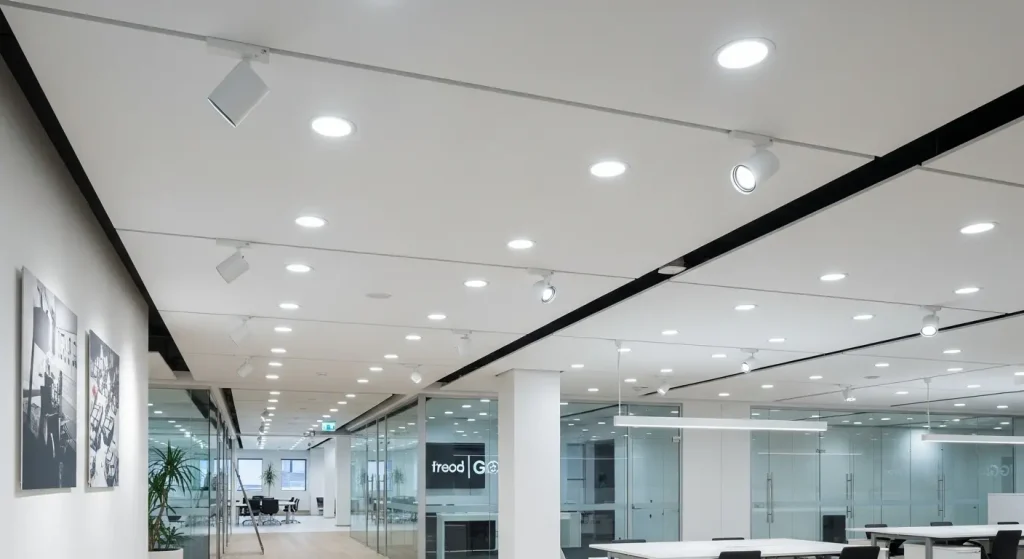
This guide gives you a clear, engineering-level comparison, then translates that into practical selection rules for B2B projects. You’ll also find data tables Und Häufig gestellte Fragen to address the most common due-diligence questions from clients and consultants.
What Are COB and SMD? (Foundations)
COB—Chip On Board
A COB package bonds multiple LED dies directly onto a single substrate, creating one contiguous luminous surface (“single LES”). That LES sits behind a deep reflector oder TIR lens, producing a crisp, artifact-free beam.
Strengths
- Uniform luminous disk → clean beam with a sharp, elegant falloff
- Easy low-glare design with deep-set optics → UGR≤19 achievable in offices
- Excellent for narrow beams (15°–24°) and accent lighting with high center lux
Considerations
- Concentrated point heat source; needs robust heatsinking
- Typically slightly higher BOM cost when paired with premium optics
SMD—Surface Mount Device
SMD downlights use arrays of discrete LED chips soldered to a PCB. The “multi-point” emission spreads over a larger area; combined with a diffuser/reflector, SMD produces soft, wide beams with high uniformity.
Strengths
- Broad beam (36°–60°+) for general illumination
- Thermal load is spread across the board; often slimmer heat sinks
- Often cost-efficient at scale for standard lumen packages
Considerations
- Multi-point emission can show multi-shadow artifacts unless optics are well engineered
- Achieving very narrow beams oder deep cut-off is less straightforward than COB
Optical Performance: Brightness, Beam, and Glare (UGR)
How light looks is as important as how much light you get.
Beam and Center Illuminance
- COB + deep reflector = tight, high-contrast beams with strong center lux. Great for merchandising, artwork, textures.
- SMD + diffuser/shallower optics = soft, wide illumination, ideal for ambient/general lighting.
Glare Control (UGR)
- COB fixtures naturally support deep recess Und cut-off angles ≥30–40°, helping achieve UGR≤19 for office standards.
- SMD can also reach UGR≤19 when paired with micro-prismatic lenses, honeycomb louvres, or deeper baffles, but efficiency may drop slightly versus a high-efficiency smooth diffuser.
Illustrative Optical Data (typical single fixture at 1 m)
| Parameter | COB (24°) | SMD (60°) |
|---|---|---|
| Nominal Power | 10 W | 10 W |
| Luminous Flux | ~950 lm | ~950 lm |
| Center Illuminance (lux) | ~800 lx | ~250 lx |
| Beam Profile | Tight, crisp | Wide, diffuse |
| UGR Potential | Easier ≤19 (deep cut-off) | ≤19 with prismatic/honeycomb |
Spec tip: If the design brief calls for accent layers Und low-glare task areas, a hybrid plan—COB for accents + SMD for ambient—often gives the best visual hierarchy and energy performance.
Construction & Thermal Management (Reliability)
COB: Point Heat Source
- Heat concentrates beneath the single LES; requires larger heat sinks, quality TIM (thermal interface material), and good driver thermal design.
- Benefits: compact optical train, robust module, excellent shock/vibration resistance.
SMD: Distributed Heat
- Heat spreads across many chips and the PCB, easing thermal density.
- Benefits: potentially shallower housings, good for tight ceiling voids; watch PCB design to avoid hot spots.
Impact on Lifetime
Both technologies can reach L70 ≥ 50,000 h with proper thermal engineering. Long life depends more on heat path & driver quality than on COB/SMD alone.
Efficiency, CRI, and Color Stability
Luminous Efficacy (lm/W)
- Modern COB and SMD downlights both achieve ~90–120 lm/W at the luminaire level (optic + driver losses included). High-end modules go higher.
- Differences in lm/W are usually project-specific (optic choice, CCT, CRI, diffuser type) rather than inherent to COB vs SMD.
CRI and TLCI
- Both deliver CRI ≥ 90; premium lines offer CRI 95+ for galleries and luxury retail.
- COB often leads for high-CRI narrow beams, while SMD is widely used for CRI 90 wide-beam office packages.
CCT Consistency
- COB with a single LES can show very uniform chromaticity across the beam.
- SMD relies on binning consistency and diffuser quality to avoid color rings.
Dimming & Control Compatibility (TRIAC / 0-10V / DALI / Bluetooth)
Both COB and SMD recessed spotlights can be paired with drivers that support the major control ecosystems:
- TRIAC (phase-cut): budget-friendly, retrofit-ready, but low-end flicker risk and limited scalability
- 0-10V (analog): smooth curve and good value for offices and clinics
- DALI (digital): per-fixture addressing, scenes, feedback, BMS integration; best for hotels, museums, HQs
- Bluetooth mesh / Casambi: app-based control, scene recall without a centralized gateway (check project policy)
Low-level dimming
- With premium drivers, COB commonly achieves 1% and even 0.1% in DALI scenarios.
- SMD also dims smoothly to 1–3% with quality 0-10V/DALI drivers; TRIAC remains the most sensitive to flicker.
Flicker & Standards
- Ask for flicker metrics (e.g., IEEE 1789 guidance) and verify low-frequency artifacts at dim levels used for ambience or AV.
Applications & Selection Guidance
Retail / Showroom / Gallery
- Primary goal: drama, texture, highlight hierarchy
- Recommend: COB mit 15°/24°, CRI ≥ 90/95, deep cut-off for low glare; mix a few wide-angle SMD for fill
Office / Education / Healthcare
- Primary goal: uniformity + UGR≤19 für Sehkomfort
- Recommend: SMD wide-beam packages with micro-prismatic or deep baffle designs; add COB accents for collaboration zones
Hospitality (Lobby, Corridor, Guestrooms)
- Primary goal: layered ambience, warm CCT (2700–3000 K)
- Recommend: Hybrid—SMD for base layer, COB accents for artworks and focal points; ensure 0-10V/DALI Kontrolle
Residential High-End / Show Flats
- Primary goal: premium “quiet ceiling,” low glare, deep dimming
- Recommend: COB trimless with deep cut-off; add Bluetooth/Casambi for scene control
Cost, Lifetime, and TCO (Total Cost of Ownership)
While unit prices vary by brand and optic, the system cost Und TCO depend on quantity, spacing, power, runtime, maintenance.
Illustrative TCO Model (Single Zone, 5-Year Horizon)
Assumptions: 2.8 m ceiling; target avg. 300 lx on task plane; 12 h/day; $0.12/kWh; labor not included.
| Option | Engine | Fixtures Needed | Power / ea | System Power | Annual Energy Cost | Notes |
|---|---|---|---|---|---|---|
| A | COB (24° accents + some 36°) | 10 | 12 W | 120 W | ~$63 | Fewer fixtures, higher center lux |
| B | SMD (60° general) | 12 | 10 W | 120 W | ~$63 | More fixtures, more uniformity |
| C | Hybrid (SMD base + COB accents) | 11 | 10–12 W | ~120 W | ~$63 | Best balance of contrast & comfort |
Takeaway: Energy can be identical; the visual outcome and quantity drive the true value. Evaluate layout density Und Blendschutz—not just lm/W.
Comparison Tables (Copy-Ready for Specs)
1) Optical & Comfort
| Attribute | COB Recessed Spotlight | SMD Recessed Spotlight |
|---|---|---|
| Beam Character | Tight, high center lux | Wide, soft, uniform |
| Common Beam Angles | 15° / 24° / 36° | 36° / 60° (+) |
| UGR Achievement | Easier UGR≤19 with deep cut-off | UGR≤19 with prismatic lens/honeycomb |
| Accent vs General | Best for accent | Best for general |
2) Electrical & Control
| Attribute | COB | SMD |
|---|---|---|
| Dimming Options | TRIAC / 0-10V / DALI / BT | TRIAC / 0-10V / DALI / BT |
| Low-End Dimming | to 1% (0.1% with premium DALI) | 1–3% typical; some to 1% |
| Flicker Risk | Driver-dependent; TRIAC most sensitive | Driver-dependent; TRIAC most sensitive |
3) Mechanical & Thermal
| Attribute | COB | SMD |
|---|---|---|
| Heat Profile | Point source; bigger heatsink | Distributed; smaller heatsink often OK |
| Fixture Depth | Medium–deep | Shallow–medium possible |
| Module Service | Modular COB swap easy | PCB/board replacement more common |
4) Commercial Factors
| Attribute | COB | SMD |
|---|---|---|
| Unit Cost (like-for-like) | Mid to mid-high | Mid to mid-low |
| Best Use Cases | Retail/galleries, premium hospitality, residential high-end | Offices, education, healthcare, corridors |
| OEM/ODM Versatility | Excellent with narrow beams and trims | Excellent with wide beams and slim profiles |
Practical Spec & Compliance Tips
- Ask for IES LM-79 files Und UGR tables for each optic; validate in Dialux/Relux with your ceiling height and layout.
- For offices, specify UGR≤19, CRI≥90, CCT 3000–4000 K, Und flicker limits per IEEE guidance.
- For galleries/retail, specify CRI 95+, R9>50, Und narrow beams (15°/24°) with DALI deep dimming.
- Confirm driver compatibility with your control system (TRIAC/0-10V/DALI/BT) before procurement.
- Include thermal clauses: case temp limits (Tc) Und ambient ranges (Ta) to protect lifetime.
FAQ About LED Recessed Spotlights
Q1: Is COB always brighter than SMD?
No. For the same wattage, lumens can be similar. The difference is distribution: COB typically gives higher center lux; SMD provides broader, softer spread.
Q2: Which is better for UGR≤19 offices?
Both can meet UGR≤19. COB reaches it more easily with deep cut-off; SMD needs micro-prismatic lenses or deeper baffles to control high-angle light.
Q3: Which is more energy efficient?
At the luminaire level, efficacy overlaps (90–120 lm/W). Real energy savings hinge on layout density, Strahlauswahl, controls (schedules/sensors), and dimming behavior.
Q4: Which dims lower without flicker?
With premium drivers, COB often hits 1% (even 0.1%) under DALI. SMD also achieves 1–3% smoothly with good 0-10V/DALI drivers. TRIAC is the most sensitive; always bench test.
Q5: For galleries and luxury retail, which should I choose?
COB mit narrow beams, high CRI (95+), Und deep cut-off creates the most dramatic, artifact-free accents.
Q6: For large office floors on a budget?
SMD wide-beam packages with UGR≤19 optics and 0-10V/DALI controls usually deliver the best value and uniformity.
Q7: What about maintenance?
COB modules are often easier to swap as a unit; SMD typically requires board-level service. In both cases, driver quality and thermal design dominate lifetime.
Abschluss
There is no universal “winner.” Instead, match the visual task to the engine:
- Choose COB for accent precision, narrow beams, low glare, Und deep dimming.
- Choose SMD for wide, uniform general lighting with excellent value Und shallower profiles.
- For the best real-world results, run a hybrid layout: SMD for the base layer, COB for focal points—then integrate controls (0-10V/DALI) for energy and experience.
Need project-ready specifications, photometric files, and OEM/ODM options?
We supply UGR≤19 COB and SMD recessed spotlights compatible with TRIAC / 0-10V / DALI / Bluetooth, complete with IES files, CRI 90/95 options, and custom optics.
Talk to our engineering team for a tailored layout, sample kits, and a fast quotation.