XHLUX
XHLUX
Two spotlights can look equally quiet on a table.
One is a normal commercial price. The other is tagged luxury / premium / designer and costs much more.
The useful question is not whether the expensive one “looks more high-end.”
It is what changes in the light, the hardware and the installation when the price goes up.
That is the real brief behind luxury spot lights—not a prettier word on the carton.
TL;DR: A higher price can buy tighter beam control, better glare management, more consistent finishes, a more suitable driver, cleaner mechanics and matching across a run. A higher price alone does not prove any of those items improved. Check the details you can see on a sample and on the sheet.
Innehållsförteckning
- 💡 Quick answer: why do luxury spot lights cost more?
- 🔦 1. Better optics can cost more
- 🕶️ 2. Glare control is more than a deep black opening
- ✨ 3. Finishes and materials change the perceived quality
- 🎚️ 4. Dimming performance can be part of the price
- 🔧 5. Mechanical precision costs money too
- 📦 6. Product-to-product consistency matters more on large projects
- 🏷️ 7. Are you paying for the brand or for the product?
- 📋 8. What should you compare before paying more?
- ⚖️ 9. When is a more expensive spotlight worth it?
- ❌ Common mistakes
- 📝 Final checklist — is the higher price actually buying something useful?
💡 Quick Answer: Why Do Luxury Spot Lights Cost More?
A higher-priced spotlight can cost more because of better optical control, glare management, finishes, dimming performance, mechanical precision and product consistency. But a higher price alone does not prove that every one of those things is better.
| What may cost more | What the buyer should actually check |
|---|---|
| Optik | Beam quality and control |
| Anti-glare design | Visual comfort at normal viewing angles |
| Avsluta | Surface consistency and durability |
| Förare | Dimming compatibility and stability |
| Mechanics | Adjustment feel and installation precision |
| Consistency | Matching appearance across multiple fixtures |
| Stöd | Documentation, options and project service |
Luxury should be visible in measurable or inspectable details—not only in the catalogue wording.
🔦 1. Better Optics Can Cost More
Optics are usually the first real cost driver.
Look past the word “premium optic.” Check:
- reflector / lens design
- beam control
- beam edge
- spill light
- consistency between fixtures
- available beam angles
Two heads can both print 24°. The hotspot, the edge and the spill outside that cone can still differ.
The price question is narrower than a full beam walkthrough: why did this optic cost more than another head with the same degree number?
You are not only paying for a beam angle number. You may be paying for tighter control of what happens inside and outside that beam.
🎯 What optical extra can raise the price?
Tighter control of the cone, the edge and the spill—not a second copy of the same degree number on two sheets.
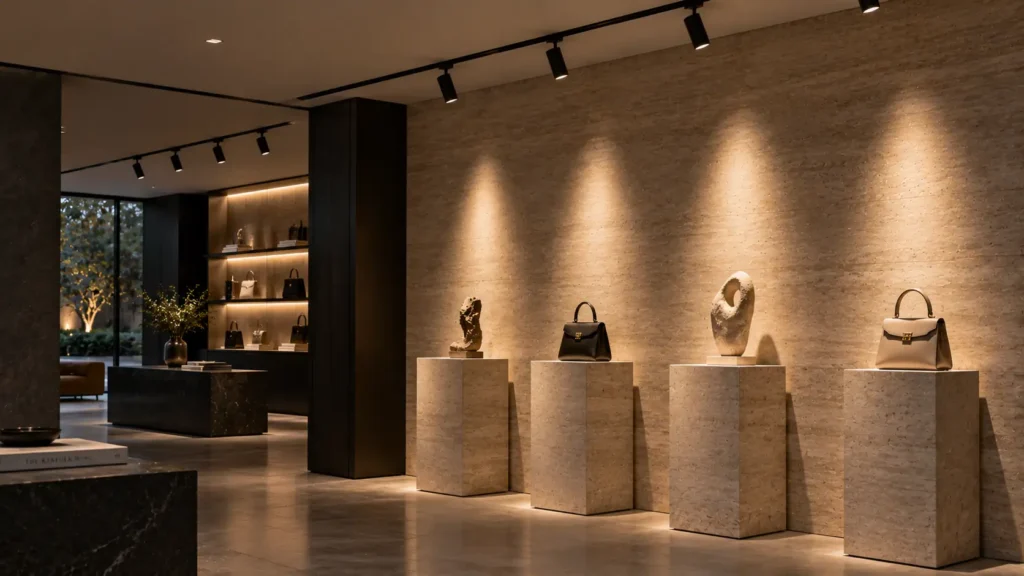
🕶️ 2. Glare Control Is More Than a Deep Black Opening
Many catalogues can show:
- a deep recess
- a black reflector
- a dark trim
- a honeycomb
None of those accessories automatically make a luxury head.
Check the system:
- light source position
- shielding geometry
- reflector design
- viewing angle
- whether glare control removes too much useful light
Premium glare control is a system decision, not just a black accessory.
Do not treat a UGR value on a datasheet as proof of project glare performance. Check the exact SKU, stated calculation conditions and the actual lighting layout.
🎯 Is a black opening enough to call it luxury?
No. Source position, shielding and the viewing angle still have to work together—or the black ring is only styling.
✨ 3. Finishes and Materials Change the Perceived Quality
This is the part people see before they switch the head on.
On designer spotlight fixtures och luxury ceiling spotlights, check:
- coating uniformity
- colour consistency
- machining quality
- gaps and joints
- trim edge
- visible screws
- reflector finish
- how the fixture sits against the ceiling
In luxury retail and hospitality the luminaire often stays in the architecture, not only in a void.
A premium-looking finish does not automatically mean better optical performance.
A quiet housing can still throw a messy beam.
🎯 Does a luxury finish prove a better beam?
No. Finish is what the ceiling shows. Optics still need their own sample check.
🎚️ 4. Dimming Performance Can Be Part of the Price
Hotels, restaurants and high-end retail are often not simple ON/OFF rooms.
The extra money may sit in:
- driver selection
- dimming method
- low-end dimming behaviour
- compatibility
- flicker control
- control integration
You will see pairings such as DALI, Casambi, 0–10V / 1–10V or TRIAC.
That list is a compatibility check, not a controls encyclopedia.
If the project needs smooth, repeatable dimming, the driver and control pairing matter as much as the fixture body.
🎯 When does the driver belong in the luxury price?
When the room actually dims. An unused hospitality stack does not earn its surcharge on an ON/OFF store room.
🔧 5. Mechanical Precision Costs Money Too
On a sample table, move the head.
Kontrollera:
- aiming movement
- rotation feel
- tilt resistance
- whether the head drifts after aiming
- trim alignment
- track adapter fit
- ceiling fit
- repeated adjustment
Premium recessed spotlights earn part of their price when the trim sits true and the aim holds.
Mechanical precision becomes visible when dozens of fixtures have to align, aim and stay in position.
🎯 What mechanical extra shows up on site?
Heads that aim, hold and sit in a straight trim line—not only a housing that photographed well.
📦 6. Product-to-Product Consistency Matters More on Large Projects
One beautiful sample is not a corridor.
Large hospitality and boutique runs fail on:
- finish shade mismatch
- beam mismatch
- CCT inconsistency
- different adjustment resistance
- inconsistent trim gaps
Part of the price can be batchkonsistens.
If the SKU publishes a colour-consistency figure, read it on that sheet. A catalogue adjective is not a substitute.
🎯 Why is one sample a weak luxury proof?
Because the project buys a matching run. Shade, beam and aim have to repeat, not only impress once.
🏷️ 7. Are You Paying for the Brand or for the Product?
Sometimes both.
In a supplier comparison, the luxury label and the optic, driver or aiming hardware do not always improve together.
High-end lighting brands can put real work into design, testing, distribution, warranty, project support and custom options.
They can also put money into positioning.
So do not collapse the quote to:
- expensive = better, or
- brand premium = waste
Ask whether the product gives project value you can see on a sample or list on the sheet.
🎯 Is the extra always a brand tax?
No. It can be design, testing and support—or positioning. The sample and the sheet still have to show the gap.
📋 8. What Should You Compare Before Paying More?
Do not stop at the price column.
Ljus
- beam shape
- spill
- lysa skarpt
- konsistens
Hardware
- aiming
- joints
- finish
- trim / adapter fit
Elektrisk
- förare
- dimning
- control options
Project fit
- available wattages
- strålvinklar
- CCT
- mounting types
- accessories
Commercial side
- documentation
- certifiering
- garanti
- anpassning
- lead time
When you read a published commercial head sheet, an adjustable D90 round LED spot downlight shows how optic, wattage and finish options sit on one page—then run the same habit on the luxury SKU in the quote.
🎯 What should sit next to the luxury price?
The light, the hardware, the driver and the project options—on one row. Price without that row is a weak comparison.
⚖️ 9. When Is a More Expensive Spotlight Worth It?
Pay more where the room will use the difference.
It is more likely to earn its keep when:
- the fixture is visually exposed
- precise accent lighting matters
- glare is sensitive
- dimming is important
- many fixtures must match
- repeated aiming is required
- interior finish quality is critical
It is less likely when:
- the zone is simple utility
- the circuit is ON/OFF only
- the fixture is mostly hidden
- the beam job is undemanding
Pay more where the project will actually use the difference.
🎯 When is the surcharge idle?
When the head is hidden, undimmed and optically undemanding. Unused premium features do not light the room.
❌ Common Mistakes
Mistake 1 — Assuming a higher price means better light
Price is not a candela file.
Mistake 2 — Judging luxury from the housing only
A quiet shell does not prove optics, driver or mechanics.
Mistake 3 — Comparing wattage instead of the full system
The same wattage can hide different beams, glare and control.
Mistake 4 — Testing only one sample
A run cares about matching, not one hero piece.
Mistake 5 — Paying for features the project does not need
Hospitality dimming on a closet circuit is unused spend.
Mistake 6 — Comparing brands before comparing specifications
Align the sheet first. Then look at brand and price.
📝 Final Checklist — Is the Higher Price Actually Buying Something Useful?
- [ ] Is the beam visibly better controlled?
- [ ] Is glare better managed?
- [ ] Is the finish more consistent?
- [ ] Does the fixture aim and stay in position accurately?
- [ ] Is the driver suitable for the required dimming system?
- [ ] Are multiple fixtures consistent with one another?
- [ ] Are mounting and adjustment details cleaner?
- [ ] Does the project need these improvements?
- [ ] Are certification, warranty and documentation adequate?
- [ ] Is the price difference tied to something you can check on a sample or datasheet?
Vad man ska göra härnäst
- Put optics, glare, finish, driver and mechanics on the same row as the two prices.
- Aim a sample, dim it if the brief dims, and look at a second piece from the same batch when the run is long.
- Need a project review or quotation? Contact the XHLUX team with the two SKUs, the dimming path and whether the heads stay in view.
Pay for the gap you can see—not for the adjective.
🏁 Conclusion: Why do luxury spot lights cost more?
Luxury spot lights can cost more because precision is being added across optics, glare control, finishes, drivers and mechanics. But the word “luxury” itself is not proof of any of those things.
Pay for the differences you can check—not for the adjective on the catalogue.
Utforska våra relaterade blogginlägg:
- Does an Anti-Glare Spotlight Really Reduce Glare?
- How to Check COB Spotlight Beam Quality in 3 Easy Steps
- Vilken strålvinkel är bäst för kommersiell spårbelysning