XHLUX
XHLUX

An LED wall washer is specified to light a vertical plane evenly — a feature wall, gallery surface, or façade — not to put a bright cone on the floor.
Most commercial fails are not “wrong wattage.”
They are the wrong technique (wash vs graze), the wrong wall wash beam angle, eller wall washer fixture spacing that leaves dark bands.
This guide is a how-to for that decision path.
For aimable downlight basics (gimbal vs fixed), use the directional and adjustable guides linked below.
For ceiling mount family (recessed vs surface), start from the installation-methods hub.
Viktiga slutsatser
– Wash = even vertical brightness from a real setback; graze = texture drama from a near-wall mount.
– Start spacing from setback: many lens-wallwasher rules of thumb use setback ≈ 1/3 room height and spacing ≤ about 1.3 × setback — then verify with the product wallwasher table / IES.
– Pick wall wash beam angle with height and setback together; wider is not always smoother.
– Feature wall lighting design fails when furniture, niches, or art blocks the wash plane you just calculated.
Before you begin
Have these on hand:
- Finished wall height and length (and any recesses / columns)
- Ceiling type and whether recessed wallwash optics are allowed
- Target look: smooth “painted with light” vs strong texture
- Product sheet with wallwasher table or IES file
- Access to the installation-methods hub if mount family is still open
Difficulty: intermediate (specifier / designer).
Time: one planning pass before RCP freeze — not a DIY wiring tutorial.
Step 1: Decide wash vs graze first
Facade grazing vs wall washing is the first fork.
Do not pick a catalogue “wall washer” SKU until you know which effect you want.
| Wall washing | Grazing | |
|---|---|---|
| Goal | Even vertical brightness; softens contrast | Reveal texture (stone, brick, wood, relief) |
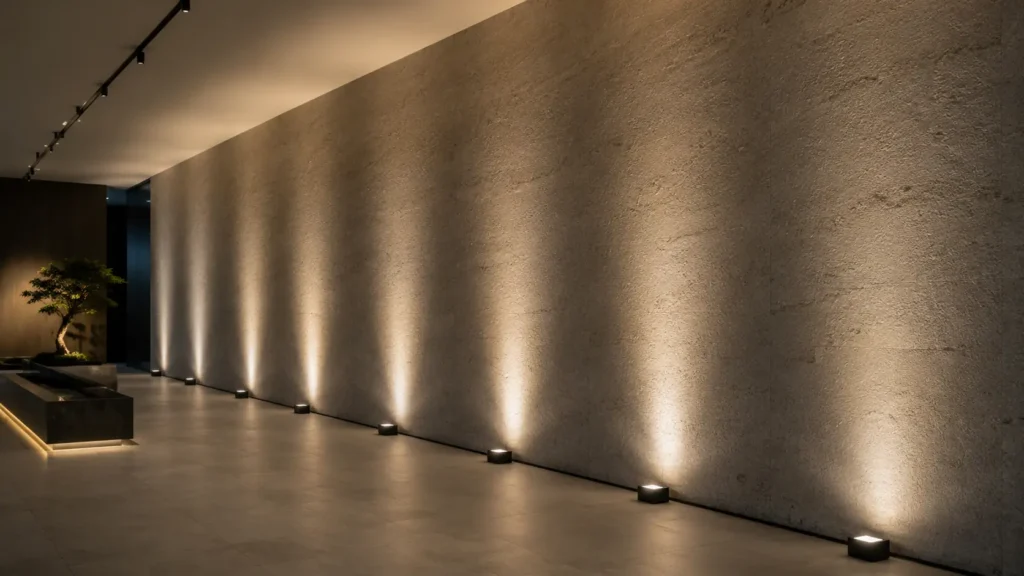
| Typical setback | Measurable distance from wall (often ~1/3 room height as a start) | Very close to the wall (special grazing optics; often on the order of ~10 cm in published grazing examples) |
| Shadows | Minimised scallops / bands | Strong shadowing is the point |
| Best when | Smooth drywall, gallery walls, reception feature planes | Textured façades and materials you want to “read” |
| Risk if wrong | Hot spots and dark bands | Hot blob at the head + ugly texture exaggeration on imperfect plaster |
Wash when the wall should feel bright and calm.
Graze when the material is the story.
If the wall is smooth and you still mount inches away with a narrow beam, you get scallops — not a wash.
🎯 When do you wash instead of graze?
Wash for even vertical brightness on smooth planes; graze only when texture should cast strong shadows from a near-wall mount.
Step 2: Lock setback — how far from the wall
“How far” starts with setback (fixture centreline to wall), not with catalogue lumen columns.
For uniform vertical lighting with many lens wallwashers, published arrangement guides (e.g. ERCO) use a common starting rule:
- Setback a ≈ 1/3 × room height h
- Then check the manufacturer’s wallwasher table for that optic
Example start: 3.0 m room height → try ~1.0 m setback, then adjust from the sheet.
This is a planning heuristic, not a code.
Tall façades, cove mounts, asymmetric wallwash optics, and double-wallwash corridors need product-specific tables.
Furniture, desks, or display cases that sit in the setback zone will cut the wash — move the plane or accept a broken gradient.
🎯 How far should the washer sit from the wall?
Start near one-third of room height for many lens wallwashers, then lock setback from the wallwasher table — not from a photo.
Step 3: Set wall washer fixture spacing
Once setback is chosen, space the row so beams overlap enough to hide dark bands.
The same arrangement family often caps longitudinal spacing at about:
- d ≤ 1.3 × a (spacing up to ~1.3 times setback)
Some efficient wallwash photometrics allow wider spacing (product sheets may quote up to ~1.5 × a) — only use that when the sheet says so.
Wall washer fixture spacing checklist:
- Fix setback a from Step 2.
- Draft spacing d ≤ 1.3 × a (unless the sheet allows more).
- Walk the wall length and place heads so end bays do not starve.
- Mark columns, niches, and art that break continuity.
- Re-check glare toward seating and circulation.
Do not space from “nice round metres” alone.
Space from setback and optic.
🎯 What spacing rule should you start with?
After setback is fixed, start near 1.3× setback, then change spacing only when the wallwasher table supports a different ratio.
Step 4: Match wall wash beam angle to height and setback
Wall wash beam angle is not a fashion pick.
It has to throw light from your setback across the full height without a ceiling hot spot or a dark floor band.
Practical pairing habits (always confirm on the sheet):
- Taller walls / longer throw → often need optics that push further up the plane (not blindly “wider”)
- Shorter feature walls with generous setback → medium/wide wash distributions may smooth faster
- Grazing → specialised near-wall optics; do not substitute a wide ambient downlight
If you only widen the beam to “fix” bands, you may wash the floor and seating instead of the wall.
Aim, distribution, and setback move together — same discipline as directional accent work.
For tilt maths on adjustable heads aimed at a wall, see the tilt-angle spoke.
🎯 How do you choose wall wash beam angle?
Match beam to height and setback for an even floor-to-ceiling plane — confirm on the wallwasher table, not by widening for glow.
Step 5: Apply the plan to feature wall lighting design
Feature wall lighting design is where the math meets furniture and art.
Before you freeze the RCP:
- Keep the wash plane clear of tall cabinets that eat setback
- Place art after you know scallop risk — frames create local shadows
- For reception feature walls, prefer wash when the brand wall should feel large and calm
- For stone feature walls in lobbies, prefer graze only if the texture is intentional and the plaster joints can survive scrutiny
- Façade washes outdoors add IP, aiming locks, and glare to neighbours — treat as a separate outdoor package, not a copy-paste of the indoor table
Indoor commercial default on this page: ceiling-mounted or recessed wallwash optics aimed at the vertical plane.
If the mount family is still open (recessed void vs surface), return to the hub:
→ LED Downlight Installation Methods: Recessed vs Surface Mount vs Adjustable
🎯 What breaks feature-wall washes on site?
Blocked setback, ignored niches/columns, and art placed into scallop zones after the spacing was already frozen on the RCP.
Step 6: Verify before you order
Run this pass once:
- [ ] Wash vs graze decided and written on the concept
- [ ] Setback a measured from the real finished wall
- [ ] Spacing d derived from a and the wallwasher table
- [ ] Wall wash beam angle / distribution matches height + setback
- [ ] End bays, columns, and furniture clearances checked
- [ ] Glare toward primary views checked
- [ ] Mount family compatible with ceiling void / surface rules
- [ ] IES or wallwasher table filed with the issue set
If the head is adjustable, confirm tilt lock and depth on the same sheet.
Deep dives:
| Need | Spoke |
|---|---|
| Aimable vs fixed type | Adjustable vs fixed |
| Accent / task aiming context | Directional downlights |
| Tilt vs lux on target | Tilt angle performance |
| Recessed vs surface mount | Installation methods hub |
🎯 What should you verify first on a wall-washer package?
Confirm wash vs graze, measured setback, and spacing from the wallwasher table before you freeze wattage or finish colour.
Soft brand (fit only)
XHLUX supplies commercial LED families that include wall-wash and directional distributions for indoor projects.
Match optic and spacing to the plane first.
Then shortlist a product family that clears the verified setback and ceiling constraints.
Notes on evidence
Arrangement heuristics cited above (a ≈ h/3, d ≤ 1.3 × a, grazing near-wall examples around ~10 cm) follow published luminaire-arrangement guidance from manufacturers such as ERCO — Arranging luminaires and related wallwashing notes.
Always override heuristics with the specific product’s wallwasher table or IES file.
Floodlights for area lighting are a different tool than wall washers; do not specify them interchangeably for even vertical planes.