XHLUX
XHLUX
Spots downlight searches usually mean one decision: is this head a broad ceiling wash, or a focused accent beam?
The real difference is not the brand name on the trim.
utan spotlight vs downlight beam angle, mounting language, and spot vs downlight use on the plan.
Get that wrong and you buy “downlights” that punch hot cones — or “spots” that never fill the room.
This page is fixture terminology explained for commercial ceilings.
It also covers when an adjustable recessed downlight eller adjustable pot lights belong in the mix — without replacing the fixed-vs-adjustable comparison guide.
Viktiga slutsatser
– Downlight (wide) ≈ ambient layer; spotlight (narrow) ≈ accent / task punch.
– Spotlight vs downlight beam angle is the first sheet check — typical planning bands are wide (~60°+) vs narrow (~15–45°), always confirm on the optic.
– Recessed mount ≠ “must be a downlight”; many spots are recessed too.
– If the target moves off-nadir, you need aiming (adjustable / gimbal) — that is a second fork after spot vs downlight.
1. Recessed fixture terminology in one pass
Recessed fixture terminology confuses teams because shops mix three ideas:
| Word people say | What it usually means | Funktion inte guarantee |
|---|---|---|
| Nedåtriktad belysning | Ceiling head aiming mainly downward with a wider wash | That it cannot be aimed, or that beam is always wide |
| Spotlight / spot | Narrower, more directional beam for a target | That it must be track-mounted or surface-only |
| Pot light / can light | North-American name for a recessed ceiling head | Beam class or adjustability |
Pot light vs downlight is often the same recessed family with different regional words.
A “spot” can still sit in a cut-out.
A “downlight” can still be a narrow optic if the sheet says so.
Read the optic — not the aisle label.
🎯 What does “recessed” actually decide?
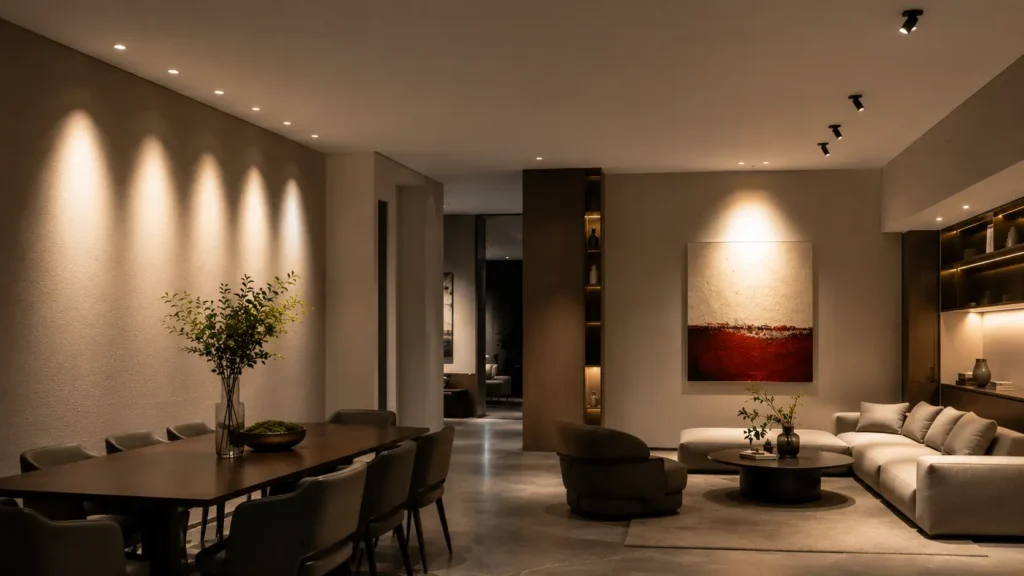
Recessed only means the housing sits in the ceiling void — it does not decide wide ambient wash versus a narrow spot beam.
2. The real difference: beam and job
Choosing between spot and downlight starts with the lighting layer you need.
| Typical downlight role | Typical spotlight role | |
|---|---|---|
| Jobb | Ambient / general fill | Accent, display, task punch |
| Spotlight vs downlight beam angle | Wider distribution (often ~60°–120° on planning guides) | Narrower distribution (often ~15°–45°) |
| Look on the plane | Soft, even, fewer hard cones | Crisp hotspot, higher contrast |
| Commercial habit | Offices, corridors, open retail ambient | Feature walls, merch, art, focused task |
These degree bands are a coarse family split (ambient-style downlight vs accent-style spotlight) from common education guides — not a code.
De är inte the same scale as the narrow / medium / wide beam class table on the directional accent guide (~15–24° / ~25–38° / ~40–60°), which grades optics inuti accent/gimbal use. A “wide” ambient downlight (~60°–120°) and a “wide” accent beam (~40–60°) are different labels on different ladders — see Notes.
Always lock the candela distribution on the product sheet or IES file.
If both layers are required, specify both — do not force one optic to do the other’s job.
🎯 Vad är den verkliga skillnaden på en rad?
Downlights usually wash a wider ambient layer; spotlights punch a narrower beam on a target — beam and use decide, not trim.
3. Spot vs downlight use on a commercial plan
Använd den här spot vs downlight use checklist before you freeze the RCP:
Prefer a downlight (wide) when:
- The room needs even working light with low drama
- You are filling open offices, circulation, or back-of-house ambient
- Ceiling aesthetics want a quiet grid of similar apertures
Prefer a spotlight (narrow) when:
- Merchandise, art, or architectural detail must “pop”
- You need higher contrast on a small target
- Task lux must land on a bench or display, not the whole bay
Use both when:
- Ambient base + accent layer is in the concept
- One wide grid would flatten the brand wall
- One narrow grid would leave dark floors between cones
Do not “fix” ambient with a forest of narrow spots.
That raises glare and energy for the wrong reason.
🎯 When should you mix spots and downlights?
Mix when you need an ambient base plus accent punch — one optic class rarely replaces both layers cleanly on a commercial plan.
4. Directional vs fixed — the second fork
After spot vs downlight, decide whether the head must aim.
Directional vs fixed recessed lighting is not the same question as wide vs narrow.
- Fast = beam locked straight down (or factory-aimed)
- Adjustable / directional = tilt/rotate so the beam can leave nadir
A wide fixed downlight is still a downlight.
A narrow adjustable recessed downlight is still a spot-class optic with aiming hardware.
For the full fixed-vs-adjustable matrix, use the published comparison:
→ Vad är skillnaden mellan justerbara och fasta downlights?
For accent/task aiming habits:
→ Riktade downlights för accent- och arbetsbelysning
For what tilt does to lux on target:
→ Hur lutningsvinkeln påverkar justerbar LED-downlights prestanda
🎯 Does “spotlight” always mean adjustable?
No — spotlight is a focused beam job; adjustable is aiming hardware. Fixed narrow and adjustable wide optics both exist on sheets.
5. Adjustable recessed downlights and pot lights
North-American packages often say adjustable pot lights eller adjustable recessed can lights.
In specifier English that usually means a recessed head with tilt/swivel — the same family as a recessed adjustable downlight / tiltable pot lights.
Bring them in when:
- The target is not under the cut-out
- Displays will move after opening
- You need a narrow accent from a recessed aperture
Skip them when:
- The grid is pure ambient and nadir is correct
- Void depth cannot take the gimbal envelope
- You only needed a wider fixed wash
Adjustable pot lights do not change the spot-vs-downlight beam decision by themselves.
They add aiming on top of the optic you already chose.
Mount family (recessed vs surface) still sits on the installation-methods overview:
→ Installationsmetoder för LED-downlight
🎯 When do adjustable pot or recessed heads matter?
When the beam must leave straight-down after install — choose aiming only after you know wide wash versus narrow punch.
6. Side-by-side matrix (specifier freeze)
| Kontrollera | Downlight-leaning | Spotlight-leaning |
|---|---|---|
| Primärt jobb | Ambient fill | Accent / focused task |
| Beam on sheet | Bredare ljusfördelning | Smalare distribution |
| Kontrast | Lägre | Högre |
| Typical partner | Occasional spots on features | Ambient downlight grid behind |
| Sikta | Often fixed | Often adjustable / gimbal |
| Felläge | Room feels flat if over-used alone | Scallops and glare if used as ambient |
Freeze beam class and aiming in that order.
Then pick CCT, CRI, and wattage.
🎯 What order should you specify in?
Decide wash-wide vs punch-narrow first, then fixed vs adjustable aiming, then mount depth — not the reverse.
Anteckningar om bevis
Wide-vs-narrow degree bands in §2 follow common education/manufacturer ranges used in downlight-vs-spotlight guides (often ~60°–120° ambient-family vs ~15°–45° accent/spot-family).
Treat them as starting bands only.
Beam-scale note: on this page, “wide / narrow” means the coarse split between ambient downlight families and spotlight/accent families. On Riktade downlights för accent- och arbetsbelysning, narrow / medium / wide (~15–24° / ~25–38° / ~40–60°) grades beam class inuti accent, task, and wash aiming. The spotlight column’s ~15–45° here can span more than one of those accent classes — that is expected, not a contradiction.
The product photometric file is the authority for commercial issue sets.
![Vad är en downlight-ram: Bästa dekorationsguiden [2025]](https://www.xhlux.com/wp-content/uploads/2025/07/What-is-A-Downlight-Bezel-560x560.webp "Vad är en downlight-ram: Bästa dekorationsguiden [2025]")