XHLUX
XHLUX

Directional downlights — also called adjustable beam downlights, gimbal downlight fixtures, or tiltable recessed spotlights — give specifiers control over where light lands, not just how much of it there is. Unlike fixed downlights, a directional fixture can be aimed at walls, displays, worktops, and architectural features. This guide covers how to specify directional accent lighting and task lighting for commercial projects, from beam angle selection to installation.
Key Takeaways: Directional Downlights
– Directional downlights incorporate a gimbal mechanism that tilts the LED module 20-35 degrees off vertical with up to 360 degrees of rotation, enabling the beam to target surfaces not directly below the fixture.
– They are available as recessed gimbal fixtures (mechanism concealed within the ceiling void) and surface-mounted tiltable spotlights (mechanism below the ceiling). Ceiling type determines which format is feasible.
– Primary applications are directional accent lighting for retail displays and architectural features, and task lighting for workspaces where desk positions do not align with the ceiling grid.
– Tilt range, beam angle, and fixture-to-target distance must be specified together — none works in isolation. [1]
What Are Adjustable Beam Downlights and How Do They Differ From Fixed Models?
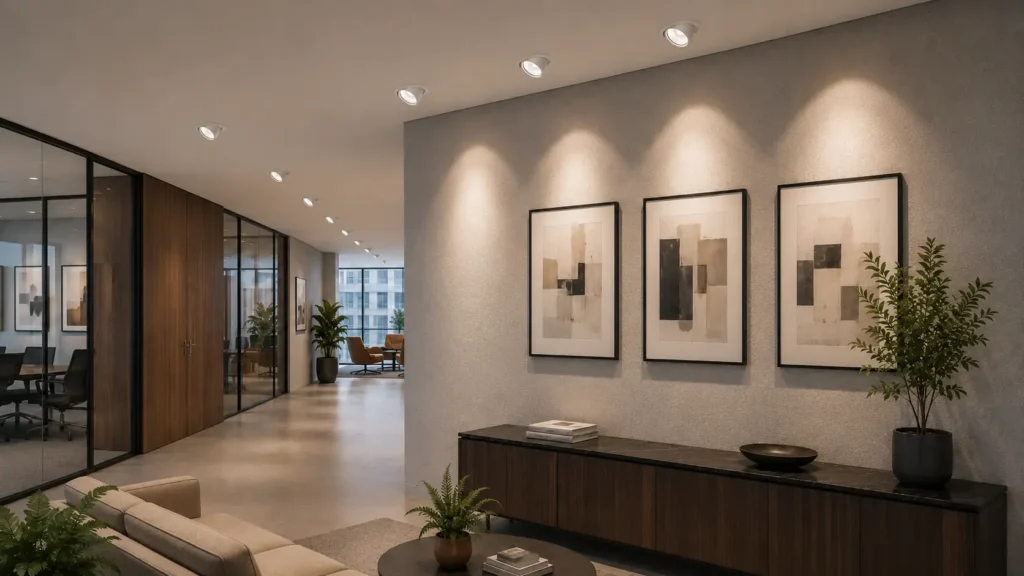
A directional downlight uses a built-in gimbal or ball-joint mechanism to angle the LED module after installation. A fixed downlight projects light straight downward; a directional fixture redirects that cone toward a wall, display, workstation, or architectural feature — anywhere within the tilt and rotation range. The mechanism is integrated into the housing, so no external bracket or supplementary hardware is required. [1]
The trade-off is housing depth. A directional recessed downlight adds depth compared to a fixed fixture with the same aperture because the gimbal mechanism occupies space behind the LED module. For suspended grid ceilings with accessible voids, this is rarely a constraint. For plasterboard ceilings with limited voids, it can be the deciding factor. Always verify the directional model’s housing depth against the measured ceiling void before ordering. [1]
Key Specifications for Tiltable Recessed Spotlights
Tilt Range and Rotation
Commercial directional downlights typically offer 20-35 degrees of tilt and 350-360 degrees of rotation. A 25-degree tilt at a fixture-to-wall distance of 600 mm places the beam centre at approximately eye level on the wall. For sloped ceilings, verify that the gimbal mechanism holds the set angle against gravity — a fixture with 30-degree tilt can compensate for a 15-degree ceiling slope. [1]
Adjustable Beam Angle Selection
Beam angle determines the illuminated area on the target surface. For accent applications using tiltable recessed spotlights, match the beam angle to the target size:
| Stråltyp | Angle Range | Bäst för |
|---|---|---|
| Narrow | 15-24 degrees | Individual products, small architectural details, artwork |
| Medium | 25-38 degrees | Display tables, shelving runs, feature walls |
| Bred | 40-60 degrees | General wall washing, large surface illumination |
A 24-degree beam from a fixture 600 mm from a wall produces a light pool approximately 250 mm in diameter — suitable for a single mannequin or framed artwork. For a 2 m-wide merchandise display, a 38-degree beam from the same distance covers the width with one fixture. Beam diagrams from photometric data should inform these calculations. [1]
CRI and Colour Temperature
For retail displays where colour accuracy matters, specify directional accent lighting with CRI 90 or above. For museum and gallery applications, CRI 95+ is the standard. Colour temperature should match the application: 2700 K-3000 K for hospitality, 4000 K for office task lighting and general commercial interiors. [5]
Common Applications
Directional Accent Lighting for Retail
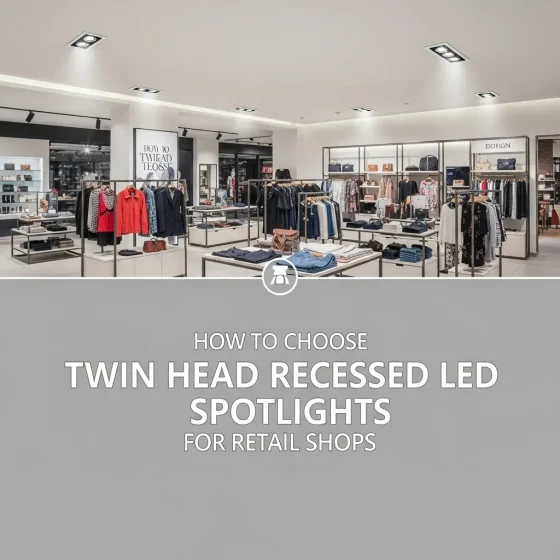
Directional downlights provide accent illumination on merchandise without the visible ceiling hardware of track lighting. A combination of fixed downlights for ambient coverage and gimbal downlight fixtures for accent creates a clean-ceiling flexible lighting infrastructure. For fashion and cosmetics retail, CRI 90+ is the minimum. For fresh food displays, a CRI below 90 can make produce appear less vibrant.
Task Lighting for Offices
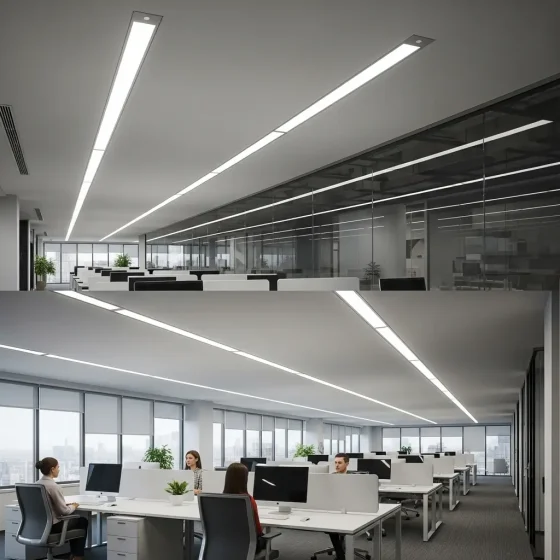
In benching-system and activity-based offices, tiltable recessed spotlights provide task illumination that can be re-aimed when furniture layouts change — without relocating ceiling cutouts. The key specification concern is glare: a fixture aimed toward a workstation can place the LED source within the occupant’s field of view. Deep-recessed gimbal housings or honeycomb louvre accessories shield the source. UGR should be below 19 per EN 12464-1 for office environments. [5]
Väggtvätt
Wall washing — aiming a row of directional downlights at a perimeter wall — creates even vertical illumination that makes rooms feel larger. For hospitality spaces, warm-white wall washing at 2700 K-3000 K adds depth. For offices, 4000 K wall washing increases perceived brightness. Fixture spacing along the wall should approximately equal the fixture-to-wall distance; verify with photometric data. [1]
How to Choose the Right Gimbal Downlight Fixture
Ceiling Type First, Fixture Second
The ceiling structure determines whether recessed or surface-mounted gimbal downlight fixtures are feasible. Suspended grid and plasterboard ceilings with adequate void depth accept recessed gimbal fixtures. Concrete soffits, timber-clad ceilings, and heritage surfaces require surface-mount directional fixtures. For a full ceiling compatibility matrix, see the pillar guide on LED Downlight Installation Methods.
Verify Void Depth
A recessed directional downlight needs more clearance above the ceiling than its fixed counterpart. Measure the ceiling void at multiple positions and confirm the model’s total housing depth against the shallowest measurement. If the model exceeds the void, switch to a shallower model or a surface-mount fixture. [1]
Fire-Rating Check
For compartment ceilings, the directional model’s fire test certificate must cover the intended tilt angle. Some fire-rated gimbals are certified only within a restricted tilt range. The fire certificate, not the catalogue specification, governs. [2][3]
Installationstips
Test Gimbal Holding Force
The gimbal must hold the set angle against gravity for the life of the installation. For sloped ceilings, request a sample and verify holding force at the required tilt angle before bulk ordering.
Coordinate Aiming with the Reflected Ceiling Plan
For accent applications, the reflected ceiling plan should specify not just fixture positions but also the intended beam direction for each directional fixture. If the aim direction is not documented, it becomes a subjective on-site decision.
Vanliga frågor
Vad man ska göra härnäst
Directional downlights are the right specification when the light beam needs to reach a surface not directly below the fixture. For each space, identify whether accent lighting or task lighting is required, then confirm ceiling type, void depth, and fire-rating requirements before selecting a model.
XHLUX manufactures recessed gimbal and surface-mounted directional LED downlights with tilt ranges from 20 to 35 degrees, adjustable beam angles from 15 to 60 degrees, and CRI options up to 97. As a direct factory supplier with 1,000+ private moulds, XHLUX supports OEM/ODM projects with 3D design drawings in 2 hours, samples in 1 week, and bulk delivery in 3-4 weeks. All fixtures undergo 100% aging testing with SDCM less than or equal to 3 colour consistency. CE, ENEC, and TUV certified. For technical datasheets, IES/LDT files, or samples: View XHLUX Downlight Products or contact [email protected]. [1]
Related Guides
– LED Downlight Installation Methods: Recessed vs Surface Mount vs Adjustable — Pillar guide with ceiling compatibility matrix.
– How to Choose Downlights for Different Ceiling Types — Ceiling type selection and mounting guidance.
– What’s the Difference Between Adjustable and Fixed Downlights? — Gimbal specification and accent lighting compared.
—
Sources
1. XHLUX. LED Downlight Product Catalogue and Technical Datasheets. Shenzhen Xinghuo LED Tech Limited. Retrieved July 2026. https://www.xhlux.com/led-downlight-manufacturer/
2. BSI. BS 476-21:1987 Fire tests on building materials and structures. British Standards Institution. Retrieved July 2026. https://www.bsigroup.com/
3. CEN. EN 1363-1:2020 Fire resistance tests — General requirements. European Committee for Standardization. Retrieved July 2026. https://www.cen.eu/
4. IEC. IEC 60529:1989+AMD1:1999+AMD2:2013 Degrees of protection provided by enclosures (IP Code). International Electrotechnical Commission. Retrieved July 2026. https://www.iec.ch/
5. CEN. EN 12464-1:2021 Light and lighting — Lighting of work places — Part 1: Indoor work places. European Committee for Standardization. Retrieved July 2026. https://www.cen.eu/
—
Technical notes: Tilt range, beam angle, and fire-rating specifications should be verified against the specific fixture model’s datasheet and fire test certificate. Photometric calculations should use IES or LDT files for the specific fixture. Electrical installation must be performed by a licensed contractor.