XHLUX
XHLUX
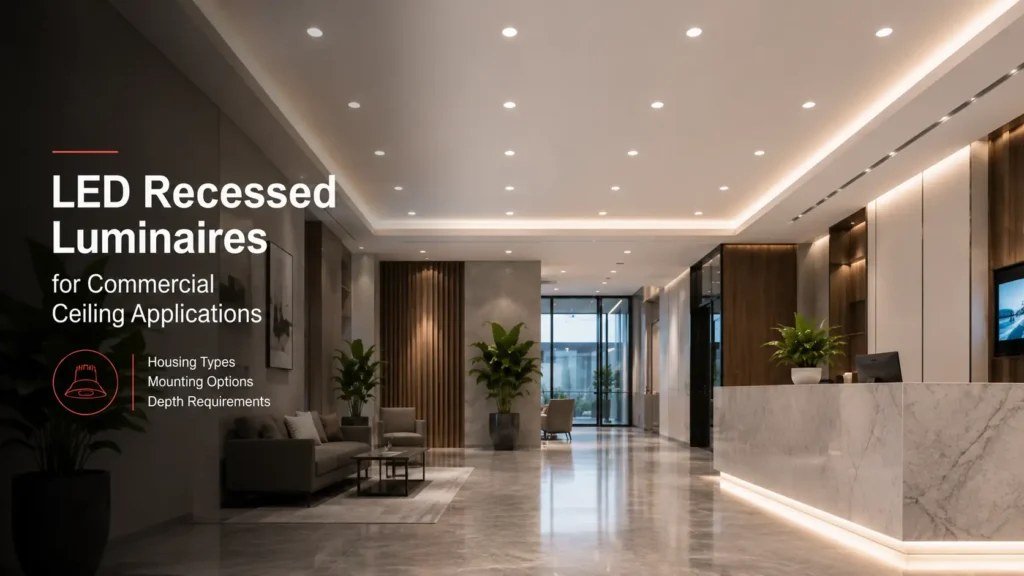
Ан LED recessed luminaire is a ceiling fixture whose housing and light source sit in the void, with only the aperture or trim visible below.
On commercial schedules it is the formal name for what many quotes still call a recessed downlight.
Неправильно recessed luminaire housing types, recessed mounting options, или recessed luminaire mounting depth create cutout rework and change orders.
This page is for specifiers choosing ceiling-recessed light fixtures for offices, retail, and hospitality ceilings.
It covers housing, mounting, depth, beam options, and commercial recessed lighting layout checks.
For ceiling-type routing (grid vs plasterboard vs concrete), use the ceiling-types guide linked below.
Основные выводы
– LED recessed luminaire = housing + optic in the void; confirm depth before lumen packages.
– Housing types: standard-depth, slim with remote driver, and fire-rated assemblies matched to the ceiling strategy.
– Mounting options follow the ceiling: grid, plasterboard clips, or no recess on solid slabs.
– Beam angle and spacing belong in the same commercial layout pass — not as afterthought catalogue picks.
1. What an LED Recessed Luminaire Is
An LED recessed luminaire places the housing, LED module, and usually the driver in the ceiling cavity.
The finished plane shows a trim, bezel, or trimless aperture.
Это ceiling-recessed light fixture, not a surface cylinder and not a track head.
“Luminaire” is the complete light fitting (IEC term).
“Lamp” is the replaceable source — often irrelevant on integrated LED modules.
Commercial sheets should state cut-out, recessed luminaire mounting depth, IP (if needed), and photometry on one page.
🎯 What is an LED recessed luminaire?
A complete ceiling fitting with housing and LED source in the void — only the aperture or trim shows on the finished plane.
2. Recessed Luminaire Housing Types
Выбирать recessed luminaire housing types from void depth and fire strategy — not from a mood image.
| Housing type | Typical use | Осторожно |
|---|---|---|
| Standard-depth | New grid or plasterboard with enough void | Needs full datasheet depth clear of services |
| Slim / remote driver | Shallow voids and many retrofits | Driver must stay accessible for service |
| Fire-rated assembly | Where the ceiling is part of a fire strategy | Match the product’s fire-test certificate to the written strategy |
Standard-depth packs driver in or beside the can.
Many commercial models need about 100–150 мм clear above the finished plane — confirm per sheet.
Slim housings move the driver off the can so the recess can run thinner.
Plan cable length and a service loop.
Fire-rated housings use tested construction (often intumescent seals) so the cut-out does not open a fire path.
Do not assume every recessed LED is fire-rated.
Ask for the product fire-test certificate against the architect’s fire strategy — not a packaging slogan.
🎯 How do you pick a housing type?
Match void depth and fire strategy first — standard, slim remote-driver, or fire-rated with a matching product certificate.
3. Recessed Mounting Options by Ceiling
Recessed mounting options are set by the ceiling build-up.
| Потолок | Typical mounting | Примечания |
|---|---|---|
| Suspended T-bar grid | Grid-compatible / lay-in or grid clips | Check weight; heavy cans may need independent wires |
| Plasterboard | Spring-clip or friction retention through cut-out | New-build vs retrofit access differs |
| Concrete / solid | No true recess void | Add a false ceiling, or switch to surface mount |
On grid, ceiling-recessed light fixtures often sit on or clip to the T-bar.
Keep cable and driver access above the tile.
On plasterboard, the cut-out must match the sheet; retention arms need clear space.
On concrete, there is no recessed luminaire mounting depth to “solve” — you build a void or leave the ceiling.
🎯 What decides recessed mounting options?
Ceiling construction: grid clips, plasterboard spring/friction fit, or no recess on solid slabs without a new void.
4. Recessed Luminaire Mounting Depth
Recessed luminaire mounting depth is the go/no-go field check.
Architectural sections often disagree with as-built services.
Measure the void at at least three points per zone.
Use the shallowest reading as the governing depth.
If no recessed model clears that depth plus cable bend and fire hood (when required), change housing type or move to surface mount.
Do not order from catalogue depth alone.
🎯 Why measure mounting depth on site?
Drawings often miss as-built services; the shallowest measured void governs which recessed housing — if any — will fit.
5. LED Luminaire Beam Angle Options
LED luminaire beam angle options set pool size on the work plane and on verticals.
| Beam habit | Typical role in commercial ceilings |
|---|---|
| Узкий | Accents, features, tight displays |
| Средняя | Desks, circulation, general ambient grids |
| Широкий | Broader wash / larger open planes |
Fixed-beam recessed luminaires suit stable ambient grids.
Where aiming is required, use adjustable / gimbal recessed heads — that is an aiming choice, covered in the adjustable-vs-fixed and directional guides.
Lock beam with spacing and mounting height in one pass.
A wide beam on a tight grid creates overlap glare; a narrow beam on a wide grid leaves dark patches.
🎯 How should you choose beam angle?
Match beam to target size and spacing at mounting height: narrow for accents, medium for desks, wider for open wash.
6. Commercial Recessed Lighting Layout
A commercial recessed lighting layout starts from task zones, not from equal tile centres alone.
- Mark ambient, task, accent, and circulation on the RCP.
- Set target lux / uniformity from the project brief (offices often reference EN 12464-1 ranges — confirm with the lighting designer).
- Place fixed recessed luminaires on ambient grids; reserve directional heads for off-axis targets.
- Check glare (UGR) where desks face bright apertures.
- Re-check recessed luminaire mounting depth under every selected SKU.
Spacing rules of thumb are starting points only.
Finish with photometry or a layout calculation for the chosen optic.
🎯 What makes a commercial layout hold up?
Zone the RCP first, then match beam and spacing to task lux and glare limits — and re-check housing depth per SKU.
7. Verification Before You Order
| Проверять | Проходить | Common fail |
|---|---|---|
| Housing type | Matches void + fire strategy | Ordering fire-rated “just in case” without a certificate match |
| Mounting option | Matches ceiling (grid / board / solid) | Assuming plasterboard clips work on concrete |
| Mounting depth | Datasheet ≤ shallowest measured void | Using drawing depth only |
| Beam options | Beam + height + spacing modelled | Picking beam from a photo |
| Компоновка | Zones and UGR / lux brief addressed | Equal grid with no task map |
| Доступ | Driver reachable for maintenance | Remote driver buried behind sealed board |
🎯 Что следует проверить в первую очередь?
Confirm housing type, mounting method, and measured mounting depth — then beam and commercial layout against the brief.
8. Manufacturer Fit (Soft)
A fit supplier lists recessed luminaire housing types, mounting kits, and mounting depth on the same datasheet.
It offers matching beam options for ambient grids and can support layout checks against your RCP.
XHLUX supplies commercial LED recessed luminaires, including standard and slim housings and grid or plasterboard mounting paths.
Treat every depth and fire claim — including ours — as a datasheet and site check.
Что делать дальше?
- LED downlight category — recessed commercial shortlist.
- Ceiling types guide — recessed vs surface by substrate.
- Installation methods — recessed vs surface mount paths.
- Регулируемый против фиксированного — when the recessed head must aim.
- Контакт — send void depth, ceiling type, and layout brief for sheet matching.
Часто задаваемые вопросы
Sources
- XHLUX. LED Downlight Product Catalogue and Technical Datasheets. https://www.xhlux.com/led-downlight-manufacturer/
- CEN. EN 12464-1 (Light and lighting — Lighting of work places — Indoor). https://www.cen.eu/
- IEC. IEC vocabulary / luminaire terminology (complete light fitting vs lamp). https://www.iec.ch/
Technical notes: Confirm housing type, mounting kit, mounting depth, fire-test certificate (when required), beam photometry, and layout against the fixture sheet and lighting design. Use qualified electrical labour for mains work.