XHLUX
XHLUX

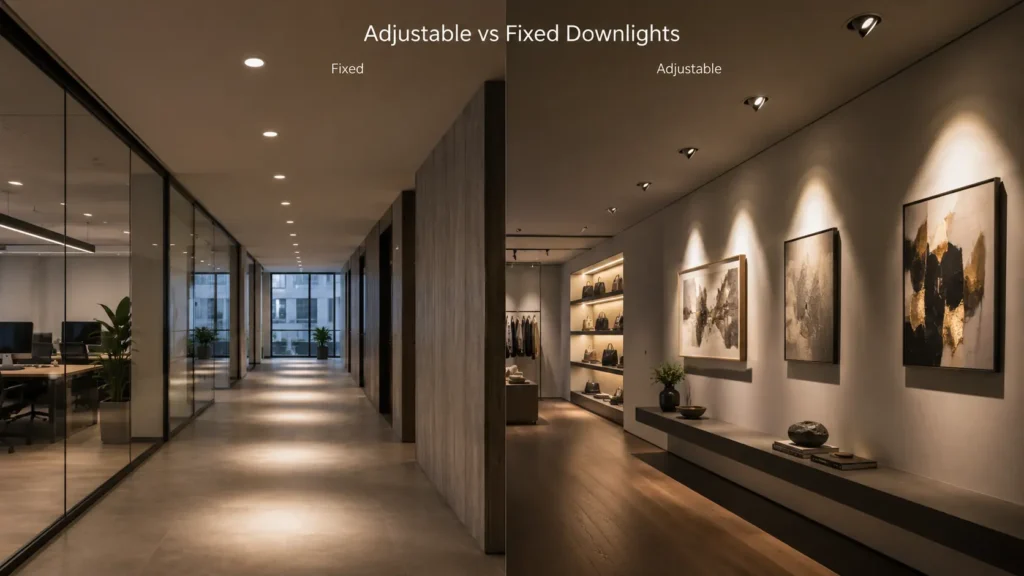
A fixed downlight sends light straight down from the ceiling plane.
Ан adjustable downlight (gimbal / tilt / swivel) can aim that beam toward a wall, display, or work surface.
The mechanical difference is small.
The specification mistake is expensive: wrong type means re-aiming with ladders, extra fittings, or cutout moves.
Choose by whether the lighting target sits directly below — and whether that target will stay put.
Key Takeaways
– Fixed = straight-down ambient; adjustable = aimable beam for accent, task, and wall wash.
– Gimbals usually need more housing depth than a same-aperture fixed model — check the datasheet against measured void.
– Use fixed for stable general coverage; use adjustable where targets move or sit off-axis.
– Recessed vs surface is a ceiling decision; adjustable vs fixed is an aiming decision.
1. What Each Type Means
Fixed downlight
The LED module is locked vertical.
The beam centre stays on the nadir (straight down).
No tilt. No rotation in normal use.
Best when the job is even ambient on the floor or desk plane directly below.
Adjustable downlight
A gimbal, ball-joint, or tilt ring moves the optic.
Typical commercial ranges: about 15–35° tilt and up to 355–360° rotation — product-dependent; read the sheet.
Names you will see on quotes: tiltable, gimbal recessed, swivel, directional recessed.
“Adjustable” here means aim, not CCT switchable or wattage selectable.
🎯 What does the gimbal change on a downlight?
It tilts and rotates the optic so the beam can aim off vertical — something a fixed downlight cannot do.
2. Why Specifiers Mix Them Up
Teams often buy “nice looking” recessed rings first.
Then they discover art walls, feature endcaps, or pitched soffits need off-axis light.
Common outcomes:
- Fixed rows that leave vertical surfaces dark
- Adjustable rows used as ambient with deep-set glare
- Retrofit swaps because housing depth was never checked
Separate two decisions:
- Ceiling format — recessed or surface (void / fire / substrate)
- Aim format — fixed or adjustable (target location)
🎯 Which decision should come first?
Decide recessed vs surface from the ceiling first, then choose fixed or adjustable for aiming needs.
3. Side-by-Side Comparison
| Criterion | Зафиксированный | Регулируемый | Who wins |
|---|---|---|---|
| Beam direction | Straight down | Tilt + rotate (datasheet range) | Adjustable for off-axis targets |
| Best job | Ambient / circulation | Accent, task, wall wash, slopes | Depends on scene |
| Housing depth | Usually shallower | Usually deeper for same aperture | Fixed when void is tight |
| Moving parts | None in optic path | Gimbal / tilt mechanism | Fixed for lowest complexity |
| Unit cost (typical) | Ниже | Higher for same lumen class | Fixed on cost-sensitive ambient |
| Re-aim after install | Cutout move or add fittings | Re-tilt / re-rotate | Adjustable when layouts change |
| Glare risk if misused | Lower if correctly spaced | Higher if aimed into sight lines | Specifier discipline |
Table rows are planning defaults.
Confirm depth, tilt, UGR / shielding, and IP on the product sheet.
🎯 When does a fixed downlight win the matrix?
It wins for stable ambient under the fixture, tight ceiling voids, or cost-led general coverage layouts.
4. When to Choose Fixed
Use fixed when:
- The lighted plane is directly below the cutout
- Layout is stable (corridors, open office ambient grids, back-of-house)
- You need maximum fixtures per budget for even lux
- Void depth is tight and a gimbal will not fit
Avoid treating fixed as “always cheaper overall.”
Wrong ambient that forces later accent adds often costs more than specifying a mixed layout once.
5. When to Choose Adjustable
Use adjustable when:
- You must light a wall, graphic, shelf, or artwork from the ceiling
- Merchandise or furniture positions change
- The soffit is sloped and a fixed nadir beam will skew
- Task points sit off the fixture centreline
For wall wash, plan fixture-to-wall distance and spacing together.
A common planning start (rule of thumb, not a cited standard): spacing along the wall ≈ distance from wall — then refine with beam angle and tilt from the datasheet. Add an IES (or equivalent) wall-wash reference when available.
For deep aiming and glare detail, use the directional / tilt guides linked below — this page only decides type.
🎯 When must you pick an adjustable downlight?
Choose adjustable for off-axis targets, changing displays, wall washing, or pitched soffits that skew a fixed beam.
6. Cost and Install Drivers
| Водитель | Зафиксированный | Регулируемый |
|---|---|---|
| Fixture price | Usually lower | Usually higher |
| Aiming labour | Minimal | Aim + lock after power-up |
| Void / cutout risk | Lower depth demand | Higher depth demand |
| Future change | Expensive (move cutouts) | Cheap (re-aim) |
Ask suppliers for clear depth drawings (recessed) and max tilt before award.
Fire-rated and IP-rated versions exist in both families — do not assume “adjustable” skips fire or wet rules.
🎯 What drives total cost most?
Depth fit and whether you will re-aim later usually matter more than trim colour or ring finish.
7. Verification Before You Order
| Check | Pass | Common fail |
|---|---|---|
| Aim need | Target under fixture → fixed; off-axis / wall → adjustable | Buying all fixed for a feature wall |
| Void depth | Datasheet min ≤ measured min (3 points) | Assuming gimbal fits like fixed |
| Tilt / rotate | Range covers the geometry | Ordering 15° tilt for a steep wash |
| Блики | Shielding / baffle matches viewing angles | Aiming bright aperture into eyes |
| Mixed layout | Ambient fixed + accent adjustable mapped | One type forced everywhere |
| Ceiling format | Recessed/surface already decided | Mixing aim debate with void debate |
🎯 What should you verify before ordering?
Confirm aim need and measured void depth first, then check tilt range and glare control on the sheet.
8. Decision Checklist
- Mark every zone: ambient-only vs accent/task/wall.
- For ambient-only with stable layout → prefer fixed.
- For off-axis or changing targets → prefer adjustable.
- Measure void; reject any gimbal that fails datasheet depth.
- Confirm tilt/rotation covers the geometry.
- Then lock CCT, CRI, lumens, and beam angle.
🎯 What order should you specify in?
Map zone aim need, pick fixed or adjustable, confirm void and tilt, then lock CCT, CRI, lumens, and beam.
9. Manufacturer Fit (Soft)
A fit supplier publishes tilt range, rotation, and recessed depth on the same sheet.
It stocks both fixed and gimbal families in matching apertures.
It can sample aiming against a wall-wash or slope mock-up.
XHLUX supplies commercial fixed and adjustable LED downlights.
That includes recessed gimbal options and surface adjustable formats where void is limited.
Treat every tilt and depth claim — including ours — as a datasheet check on your measured ceiling.
Что делать дальше?
- LED downlight category — fixed and adjustable shortlist.
- Ceiling types guide — recessed vs surface by substrate.
- Directional downlights — accent and task aiming.
- Installation methods — recessed vs surface process.
- Контакт — depth and tilt sheets against your layout.
Часто задаваемые вопросы
Sources
- XHLUX. LED Downlight Product Catalogue and Technical Datasheets. https://www.xhlux.com/led-downlight-manufacturer/
- IEC. IEC 60529 (IP Code). https://www.iec.ch/
Technical notes: Confirm tilt, rotation, housing depth, fire rating, and IP on the fixture sheet and against site measurement. Use qualified electrical labour for mains work.
![Что такое диммируемый трековый светильник для галереи: лучшее руководство [2025]](https://www.xhlux.com/wp-content/uploads/2025/06/Dimmable-Track-Light-for-Art-Gallery-Accent-Lighting-560x560.webp "Что такое диммируемый трековый светильник для галереи: лучшее руководство [2025]")