 XHLUX
XHLUX

Índice
- Getting to Know Zigbee: The Low-Power Hero of Smart Lighting
- The Perks of Picking Zigbee for Your Dimmable Track Lights
- The Flip Side: Potential Hurdles with Zigbee Track Lighting
- Zigbee Track Lights on the Smart Stage: How Do They Compare?
- Where Zigbee Dimmable Track Lighting Excels in 2025
- Your Zigbee Track Lighting Journey: Setup and Considerations
- Zigbee and the Matter Revolution: Friends or Foes in 2025?
- The Verdict: Is Zigbee Dimmable Track Lighting the Bright Choice for You?
Let’s talk smart lighting. You’ve probably dreamt of it: lights that dim with a word, change color to match your mood, and create the perfect ambiance for any occasion, all without a fuss. But then reality hits – a clunky app, lights that drop off your Wi-Fi, or a system that just doesn’t play nice with your other gadgets. If you’re nodding along, you might be ready to hear about Zigbee Dimmable Track Light systems. This isn’t just another smart lighting buzzword; it’s a well-established technology that’s quietly (and reliably) powering millions of smart homes and businesses.
But what exactly is Zigbee, and why should you consider it for your track lighting in 2025, especially with all the other options out there? Is it the key to unlocking that seamless, stable smart lighting experience you’ve been craving, or just another piece of tech jargon?
Getting to Know Zigbee: The Low-Power Hero of Smart Lighting
Zigbee is a low-power wireless protocol designed for smart lighting and IoT devices. Want to know how Zigbee enables efficient, responsive, and scalable lighting control systems in residential and commercial spaces? Read on.
What’s the Buzz About Zigbee?
At its heart, Zigbee is a wireless communication protocol specifically designed for low-power, low-data-rate applications – think smart home devices like sensors, locks, and, importantly for us, lighting. It’s built upon the IEEE 802.15.4 standard, which means it has a solid technical foundation. Its primary goal? To enable reliable communication between devices without draining their batteries (for battery-powered devices) or hogging your Wi-Fi bandwidth.
The Magic of Mesh: How Zigbee Creates a Robust Network for Your Lights
This is where Zigbee truly shines, especially for lighting spread throughout a space, like with track systems. Instead of every light trying to connect directly to your Wi-Fi router (which can cause congestion and range issues), Zigbee devices create a mesh network.
Imagine it like a team of little messengers. Each mains-powered Zigbee device (like a Zigbee dimmable track light adapter or a smart plug) can act as a messenger, relaying signals from one device to another. So, if a light is too far from the central hub to get a direct signal, other Zigbee devices in between can pass the message along. This has several cool benefits:
- Extended Range: The network can cover a larger area than a single Wi-Fi router might reliably reach.
- Increased Reliability: If one “messenger” (device) drops out or has an issue, the signal can often find an alternative route through other devices in the mesh. It’s self-healing, to an extent.
- Stronger Network with More Devices: Paradoxically, the more mains-powered Zigbee devices you have, the stronger and more robust your mesh network can become.
Hubs, Gateways, and Bridges: Do You Always Need One for Zigbee Track Lights?
Generally, yes. Most Zigbee devices, including track lights, need a Zigbee hub (also called a gateway or bridge) to connect to your home network (Wi-Fi/Ethernet) and thus to the internet for app control from your phone when you’re away, or for voice assistant integration.
Think of the hub as the central coordinator and translator for your Zigbee network. Popular examples include the Philips Hue Bridge, Amazon Echo devices with built-in Zigbee hubs (like some Echo Plus or Echo Show models), Samsung SmartThings Hub, or Hubitat Elevation.

While some devices might claim “hubless” operation, they often achieve this by having Wi-Fi built-in alongside Zigbee, or by connecting directly to a compatible smart speaker. For the full benefits of a dedicated Zigbee mesh network, a hub is usually part of the equation. The good news? One hub can typically manage dozens, if not hundreds, of Zigbee devices.
Zigbee 3.0: Aiming for Universal Harmony in Smart Lighting
One of the historical criticisms of Zigbee was that, despite being a standard, different manufacturers sometimes implemented it in ways that didn’t allow their devices to talk to each other perfectly. Enter Zigbee 3.0. This latest iteration aims to solve that by unifying various Zigbee profiles (like Zigbee Light Link, Zigbee Home Automation, etc.) into a single, comprehensive standard.
What does this mean for you? When you choose Zigbee 3.0 certified devices, you have a much better chance of them working seamlessly together, regardless of the brand. This is a big step forward for user-friendliness and future-proofing your smart lighting setup.
The Perks of Picking Zigbee for Your Dimmable Track Lights
Why has Zigbee become such a popular choice for smart lighting, and how do these benefits translate to your track lighting aspirations?
Low Power, Long Life
While your track lights themselves will be mains-powered, the low-power nature of Zigbee is a huge advantage for other devices within its ecosystem – think battery-operated dimmer switches, motion sensors, or remote controls. These can last for years on a single battery, giving you more flexibility in how you control your Zigbee smart track lighting.
Reliable Mesh Network: Say Goodbye to Dead Spots?
The mesh network is Zigbee’s superpower. For track lighting that might extend across large rooms or multiple zones, the ability of each light (or its Zigbee module) to act as a repeater significantly boosts reliability and coverage. This helps avoid frustrating “device unresponsive” messages that can plague systems relying on a single central router.
Less Wi-Fi Congestion: Keeping Your Internet Speedy
If you’re loading up your home with Wi-Fi smart plugs, Wi-Fi cameras, and Wi-Fi light bulbs, your wireless router can start to feel the strain, potentially slowing down your internet for streaming or gaming. Zigbee operates on its own separate network (though it shares the 2.4GHz frequency band with Wi-Fi, so careful channel selection on your router and Zigbee hub can be beneficial), offloading all that smart device traffic. This means your Zigbee dimmable track lighting won’t be fighting for Wi-Fi bandwidth.
Scalability: Connecting a Houseful of Smart Devices
A single Zigbee network can theoretically support up to 65,000 devices! While you’re unlikely to hit that limit with track lights alone, it means the system can easily scale to include not just your lighting but also sensors, switches, smart locks, and thermostats throughout your entire home or small business.
Growing Ecosystem of Compatible Products
Thanks to its established presence and the push with Zigbee 3.0, there’s a vast and growing range of Zigbee-compatible devices from many different manufacturers. This gives you more choice and flexibility in building out your smart environment beyond just your track lights.
The Flip Side: Potential Hurdles with Zigbee Track Lighting
It’s not all sunshine and perfectly dimmed rainbows. There are a few practical considerations to keep in mind with Zigbee.

The Hub Requirement (Usually): An Extra Box to Consider
As mentioned, most Zigbee setups require a dedicated hub. This is an extra piece of hardware to buy, set up, and find a place for. While hubs are central to Zigbee’s strengths, it’s a factor to include in your planning and budget.
Past Interoperability Quirks (And how Zigbee 3.0 helps)
While Zigbee 3.0 has made huge strides, if you’re dealing with older Zigbee devices or less reputable brands, you might still encounter occasional interoperability hiccups. Always look for that Zigbee 3.0 certification for the best chance of seamless integration.
Range Per Hop and Potential Latency
The direct range of a single Zigbee device is typically modest (around 10-20 meters or 30-60 feet indoors, depending on obstructions). The system relies on the mesh to extend this. While generally responsive for lighting commands, in very large or complex mesh networks, there could theoretically be slight latency as signals hop between devices, though this is rarely an issue for typical lighting scenarios.
Not Ideal for High-Bandwidth Data
Zigbee is designed for small packets of data – perfect for “turn on,” “dim to 50%,” or “change color to blue.” It’s not designed for streaming video or audio. But for controlling your Zigbee dimmable LED track lights, its bandwidth is more than sufficient.
Zigbee Track Lights on the Smart Stage: How Do They Compare?
To really see where Zigbee fits, let’s briefly compare it to other common smart lighting control methods.

Zigbee vs. Wi-Fi Connected Track Lights: The Great Network Debate
- Zigbee: Needs a hub (usually), creates its own low-power mesh network, less Wi-Fi congestion.
- Wi-Fi: Hubless (connects directly to your router), can be simpler for a few devices, but more devices can slow your Wi-Fi and it’s more power-hungry.
- Verdict: For a few track lights, Wi-Fi might be fine. For a whole-home or larger setup, Zigbee’s mesh and lower Wi-Fi impact are often preferable.
Zigbee vs. Bluetooth Mesh: Similar Goals, Different Paths
- Zigbee: More established smart home ecosystem, often relies on a hub for full functionality.
- Bluetooth Mesh: Also low power, also mesh. Can sometimes allow direct control from a phone without a hub for basic functions. Ecosystem is growing.
- Verdict: Both are good options. Zigbee has a broader device ecosystem currently. Bluetooth is ubiquitous on phones.
Zigbee vs. Z-Wave: The Other Low-Power Mesh Giant
- Zigbee: Operates in the 2.4GHz band (can have more potential for interference but also higher data rates than Z-Wave). Generally more manufacturers and often seen as more “open.”
- Z-Wave: Operates on a sub-GHz frequency band (less interference from Wi-Fi/Bluetooth). Very robust, but often a more tightly controlled ecosystem and potentially slightly more expensive.
- Verdict: Both are strong contenders for reliable smart home mesh networks. Choice can come down to specific product availability or ecosystem preference.
Zigbee vs. DALI/0-10V: Smart Wireless vs. Professional Wired
- Zigbee: Wireless, primarily app/voice/automation controlled, great for retrofits and user-friendly smart features.
- DALI/0-10V: Wired protocols, known for robustness and precision in commercial settings. DALI offers individual addressability and feedback. 0-10V offers simple analog zonal dimming. These are generally more complex/costly to install, especially in existing buildings.
- Verdict: For most homes and many small businesses wanting smart, flexible track lighting, Zigbee is often more practical and feature-rich than traditional wired pro systems. For large, complex commercial projects with specific management needs, DALI might be preferred.
Quick Comparison Chart: Finding Your Smart Lighting Fit
| Recurso | Zigbee Dimmable Track Light | Wi-Fi Track Light | Bluetooth Mesh Track Light | Z-Wave Track Light | Iluminação de trilho DALI |
|---|---|---|---|---|---|
| Network | Mesh (via Hub) | Star (direct to Router) | Mesh | Mesh (via Hub) | Wired Bus |
| Hub | Usually Yes | No | Sometimes | Sim | Yes (Controller) |
| Power Use | Baixo | Médio-Alto | Baixo | Muito baixo | Low (bus) |
| Wi-Fi Impact | Mínimo | High (many devices) | Mínimo | None (diff. freq.) | Nenhum |
| Interoperab. | Good (Zigbee 3.0) | Varies | Growing | Good | Excellent (DALI-2) |
| Ideal para | Whole-home, reliable mesh | Few devices, simple setup | Direct control, small mesh | Robust smart home | Pro architectural |
Where Zigbee Dimmable Track Lighting Excels in 2025
Zigbee isn’t just a theoretical marvel; it’s incredibly practical for a range of track lighting applications.
- The Smart Home Sweet Spot: Whole-House Lighting Control: This is where Zigbee truly comes into its own. You can easily control Zigbee dimmable track lights in your kitchen, living room, hallways, and bedrooms, all from one app, voice assistant, or through automated routines. Think “movie night” scenes that dim your track lights perfectly.
- Small to Medium Commercial Spaces (Cafes, Boutiques, Offices): Zigbee offers a cost-effective way to bring smart lighting control to smaller businesses without major rewiring. Create inviting ambiance in a cafe, highlight products in a boutique, or automate lighting in an office based on occupancy.
- Installations with Many Lights Requiring Stable Group Control: The robust mesh network handles numerous lights well, making it great for creating and managing different lighting zones or groups across an entire floor.
- Environments Where Wi-Fi Congestion is a Concern: If your Wi-Fi network is already groaning under the weight of computers, phones, and streaming devices, Zigbee keeps your lighting traffic separate and happy.
- Integrating Lighting with Other Zigbee Devices: The real power of Zigbee emerges when you combine your track lights with Zigbee motion sensors (lights on when you enter a room), door/window sensors (lights on when a door opens), or smart switches/remotes for physical control.
Your Zigbee Track Lighting Journey: Setup and Considerations
Ready to explore Zigbee for your track lights? Here’s what to keep in mind.
- Choosing Your Zigbee Hub and Ecosystem: This is a key first step. Popular choices like Philips Hue (via their bridge), Samsung SmartThings, Amazon Echo (with built-in Zigbee), or open-source options like Home Assistant with a Zigbee stick offer different features and levels of complexity. Research which ecosystem best fits your technical comfort and desired integrations.
- Selecting Compatible Zigbee Dimmable Track Lights and Drivers: Look for track fixtures or track adapters that are explicitly Zigbee certified (ideally Zigbee 3.0). Ensure they offer the dimming performance and any color control (tunable white, RGB) you need.
- The Pairing Process: Getting Your Lights Talking to the Hub: This usually involves putting your Zigbee hub into “pairing” or “discovery” mode via its app, then powering on your Zigbee track light or putting it into its own pairing mode (often by a specific sequence of power cycles). Follow the manufacturer’s instructions carefully.
- Designing for Mesh Network Strength: While Zigbee is robust, think about the placement of your mains-powered Zigbee devices. Try to ensure good “stepping stone” coverage, especially in larger or oddly shaped spaces, to maintain a strong mesh. Avoid large metal obstacles that can block signals.
- Leveraging Zigbee for Scenes, Automation, and Voice Control: Once set up, dive into your hub’s app to create lighting scenes (e.g., “Reading,” “Dinner Party”), set schedules (lights on at sunset), or link your Zigbee system to Alexa, Google Assistant, or Apple HomeKit (often via the hub) for voice control.
Zigbee and the Matter Revolution: Friends or Foes in 2025?
You can’t talk about smart home tech in 2025 without mentioning Matter. This new industry-unifying standard aims to make devices from different brands work together seamlessly. So, where does that leave Zigbee?
Understanding Matter’s Goal of Interoperability
Matter is essentially an application layer that can run on top of different network technologies, including Thread (which, like Zigbee, is based on IEEE 802.15.4) and Wi-Fi. Its primary aim is to break down the walled gardens of different smart home ecosystems.
How Zigbee Devices Can Work with Matter
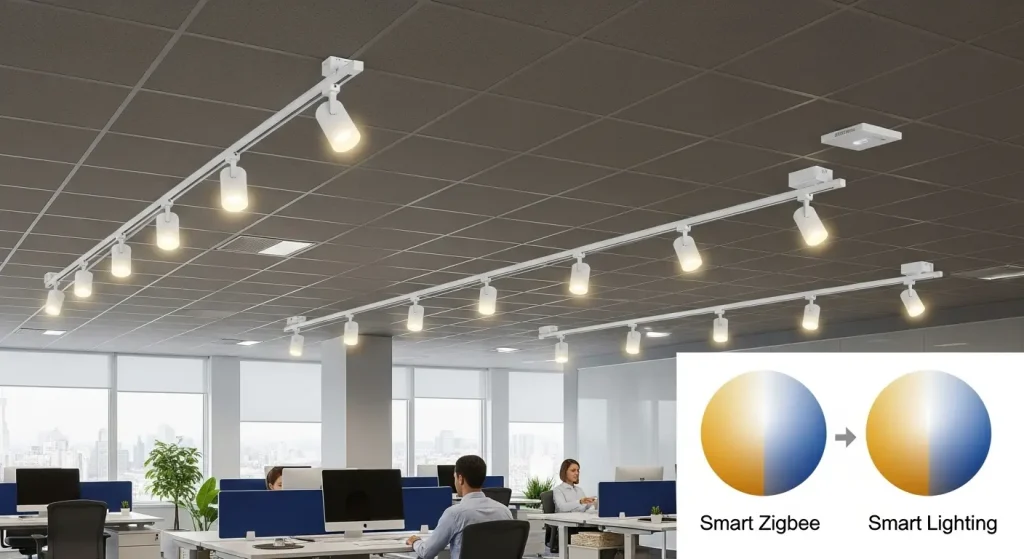
The good news is that Zigbee isn’t being replaced overnight. Many existing Zigbee hubs from major manufacturers (like Philips Hue, Amazon, SmartThings) are being updated to act as Matter bridges. This means your existing (and future) Zigbee dimmable track lights connected to these updated hubs can then be controlled by any Matter-compatible app or voice assistant, regardless of the ecosystem. Your Zigbee devices effectively become part of the broader Matter fabric.
The Future Role of Zigbee in a Matter-Dominant World
Zigbee’s massive installed base and its strengths in low-power mesh networking mean it will remain highly relevant. It’s a mature, cost-effective technology for device manufacturers. With Matter bridging, Zigbee devices gain enhanced interoperability, making them an even more attractive option. Think of Zigbee as a strong foundational network technology that Matter can leverage.
Expert Take: Why Zigbee Isn’t Going Away Quietly
Industry experts widely agree that Zigbee has a strong future, particularly because of its synergy with Matter. The Connectivity Standards Alliance (CSA), which developed Zigbee, is also behind Matter. This close relationship ensures that Zigbee will continue to be a key part of the evolving smart home landscape.
The Verdict: Is Zigbee Dimmable Track Lighting the Bright Choice for You?
So, after exploring the ins and outs, is Zigbee Dimmable Track Light the way to go for your project in 2025?
Zigbee is likely an excellent choice if:
- You’re looking for reliable, whole-home (or whole-small-business) smart lighting control with robust mesh networking.
- You want to avoid bogging down your Wi-Fi network with dozens of lighting devices.
- You value a large ecosystem of compatible devices beyond just lighting (sensors, switches, etc.).
- You’re aiming for good interoperability, especially by choosing Zigbee 3.0 products and a hub that will support or bridge to Matter.
- You appreciate the low-power benefits for auxiliary battery-operated Zigbee devices.

Zigbee might be less ideal if:
- You only have one or two track lights to control and want the absolute simplest, hub-free setup (where a direct Wi-Fi light might appeal, despite its cons).
- Your budget absolutely cannot accommodate a hub (though the overall system cost can still be competitive).
For most people looking to create a truly smart, responsive, and scalable lighting environment with their track systems, Zigbee offers a compelling blend of reliability, features, and future-readiness (thanks to Matter bridging). It’s a mature technology that has learned from its past and is well-positioned to be a cornerstone of your smart space.
Ready to explore the world of Zigbee for your track lighting? Start by researching compatible hubs and ecosystems, and then dive into the exciting range of Zigbee-enabled track lights and accessories. Your perfectly controlled, effortlessly smart space awaits!