 XHLUX
XHLUX

Índice
- What Is General Lighting in Commercial Spaces?
- What Is Accent Lighting in Commercial Spaces?
- General vs Accent Lighting – Key Differences
- Why Both Lighting Types Are Essential in Commercial Design
- How to Balance General and Accent Lighting
- 📊 Chart: Recommended Brightness Ratios by Commercial Application
- Application Examples in Commercial Spaces
- Common Mistakes When Combining General and Accent Lighting
- Choosing the Right Fixtures for Each Lighting Layer
- 📊 Chart: Fixture Selection Matrix for Lighting Layers
- Practical Design Workflow
- External References
- FAQ About general and accent lighting
- Conclusão
- Consultas comerciais são bem-vindas.
Many commercial spaces fail visually for one of two reasons:they are flat and uninspiring because everything is lit “evenly,” or they are overly dramatic and uncomfortable because accent lighting is overused without a stable base.
That imbalance creates real business problems:
- Customers feel disoriented or visually fatigued
- Products and focal points don’t stand out (or feel harsh)
- Circulation becomes less intuitive
- Glare complaints increase, especially in retail and hospitality
The solution is not “more lights.” It is understanding general lighting vs accent lighting as a structural lighting design system—a method to build visibility, comfort, hierarchy, and sales-focused emphasis in the same space.
This article explains what general and accent lighting do, how they interact, what ratios actually work (and why), and how to choose the right fixture types—so your commercial lighting design performs reliably in real projects.
What Is General Lighting in Commercial Spaces?
Iluminação geral (often called ambient lighting) is the base layer that provides overall visibility. It is responsible for the fundamental “can people safely see and move” requirement.
In commercial design, general lighting should deliver:
- Uniform illumination across the functional area
- Safe navigation (walkways, entrances, transitions)
- Low visual fatigue for longer dwell time
- A neutral, consistent background that supports the next layers
In engineering terms, general lighting is where you protect comfort first:
- UGR <19 is commonly targeted in areas where visual comfort matters (offices, circulation zones, service areas).
- Stable chromaticity improves perceived quality; for demanding environments, designers often prefer SDCM <3 to keep the space from looking patchy across fixtures.
General lighting is not supposed to be “exciting.” Its job is to make everything else possible.
🎯 What is general lighting in commercial design?
General lighting provides overall illumination that ensures visibility, safety, and basic visual comfort in commercial spaces.
What Is Accent Lighting in Commercial Spaces?
Iluminação de destaque is the layer that creates focus and hierarchy. It is concentrated illumination aimed at:
- Products (retail shelves, mannequins, feature tables)
- Architectural elements (columns, textures, signage, feature walls)
- Focal points (art, reception desks, bar displays)
Accent lighting is where commercial lighting becomes persuasive. It shapes what people notice first, how long they look, and what they perceive as “premium.”
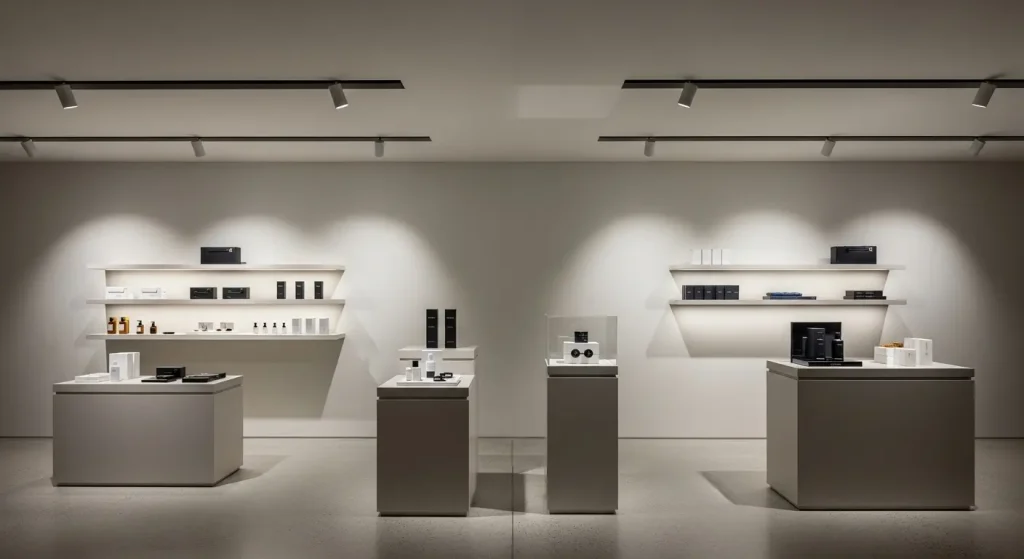
From an engineering perspective, accent lighting demands tighter control and higher quality:
- CRI ≥90 / Ra97 helps maintain accurate, attractive color—critical for fashion, cosmetics, food presentation, and hospitality finishes.
- Beam control (beam angle and cut-off) matters more than raw wattage.
- Glare control becomes a risk factor if the design is overly aggressive.
Accent lighting is typically delivered through iluminação de trilho, spot downlights, or directional fixtures designed for aiming flexibility—especially in spaces with changing merchandise or seasonal layouts. A common approach is pairing adjustable accent fixtures with modular systems such as Iluminação de trilho LED to keep zoning flexible without reworking ceilings.
🎯 What is accent lighting in commercial design?
Accent lighting is focused illumination used to highlight products, architectural features, or focal points.
General vs Accent Lighting – Key Differences
The easiest way to understand general vs accent lighting is to treat them as two different “jobs” in the same system:general lighting builds the stage; accent lighting directs the audience.
📊 Comparison Table: General vs Accent Lighting
| Item | General Lighting | Iluminação de destaque |
|---|---|---|
| Primary Role | Overall visibility & comfort | Visual focus & hierarchy |
| Coverage | Wide, across the area | Localized, targeted |
| Brightness Behavior | Uniform, controlled | Higher contrast, directional |
| Typical Fixtures | Downlights / panels / linear | Track lights / spotlights |
| Main Risk if Misused | Space feels flat | Glare, harsh contrast |
🎯 What is the difference between general and accent lighting?
General lighting ensures overall visibility, while accent lighting creates visual focus and hierarchy.
Why Both Lighting Types Are Essential in Commercial Design
Commercial projects are outcome-driven. Lighting must support:
- Customer comfort and orientation
- Product presentation and brand experience
- Operational efficiency and safety
- Adaptabilidade a longo prazo
If you only use general lighting, the space is technically visible—but it lacks hierarchy and emotional pull.
If you only use accent lighting, the space becomes dramatic, but uncomfortable and visually unstable.
What happens when general lighting dominates?
- The environment feels “safe” but forgettable
- Products don’t pop; visual merchandising loses power
- Branding elements blend into the background
What happens when accent lighting dominates?
- Customers experience glare and eye fatigue
- Harsh shadows make faces and products look distorted
- Staff areas and circulation become functionally weak
- The space may feel chaotic or overly theatrical
Balanced layering makes the difference between a store that looks “lit” and a store that looks designed.
🎯 Do commercial spaces need both general and accent lighting?
Yes. Balanced commercial lighting requires both general and accent lighting to function well and look appealing.
How to Balance General and Accent Lighting
Balancing general and accent lighting is not about personal taste—it is about layer logic, glare control, and ratio discipline.
Use General Lighting as the Base Layer
General lighting should be:
- Consistent across the working zone
- Low-glare and comfortable
- Strong enough to avoid “dark voids” between accents
- Neutral enough to not fight with focal points
In many commercial environments, base layer selection often includes:
- Recessed or surface downlights
- Architectural iluminação linear for circulation and ambient fill
For clean ceiling layouts and glare-controlled ambient illumination, designers frequently mix downlights with Iluminação linear LED to maintain uniformity while keeping the ceiling organized.
Engineering checkpoints for the base layer:
- Target comfort: UGR <19 where appropriate
- Consistency: SDCM <3 for premium projects
- Performance: many modern commercial LED systems target 100–130 lm/W efficiency to reduce power density while maintaining lux targets
Add Accent Lighting to Create Focus
Accent lighting should be:
- Directed at products, features, or decision points
- Precisely aimed and adjustable
- High color fidelity: CRI ≥90 / Ra97
- Controlled to avoid spill and glare
This is where adjustable systems matter. A track-based approach—especially with modular heads and optics—helps the design adapt as the retail layout changes. For flexible accent layouts, Iluminação de trilho LED is commonly used to maintain easy aiming and fast re-merchandising.
If you need a cleaner ceiling without visible track while keeping directional accents, Spots de LED embutidos can serve as an alternative accent layer, especially in hospitality and premium retail.
Control the Brightness Ratio
The most useful rule in commercial lighting layering is not “use accent lighting.”
It is: control the ratio.
A typical guideline:
- Accent lighting is often 2–3× brighter than the general base on the target surface.
- In special feature displays or hero zones, accent may reach 3–5×, but only if glare is controlled and the background is designed to support it.
This ratio is why stores can look premium without being painful: contrast is intentional, not random.
🎯 How do you balance general and accent lighting?
General lighting sets the base, while accent lighting adds focus using controlled brightness contrast.
📊 Chart: Recommended Brightness Ratios by Commercial Application
| Tipo de espaço | General Lighting Role | Accent Lighting Role | Typical Ratio (Accent : General) | Key Risk to Manage |
|---|---|---|---|---|
| Retail (fashion, cosmetics) | Comfortable browsing base | Product focus and hierarchy | 3:1 typical, up to 5:1 on hero | Glare + overly harsh contrast |
| Retail (supermarket, general goods) | Safe, uniform navigation | Feature end-caps, promos | 2:1 to 3:1 | Visual clutter |
| Restaurant dining | Calm ambient mood | Table and feature wall highlights | 2:1 to 3:1 | Hot spots, unflattering faces |
| Lobby do hotel | Orientation + comfort | Art, reception, brand elements | 2:1 to 4:1 | Reflections, glare on glossy surfaces |
| Gallery / museum | Low ambient control | Artwork illumination | 2:1 to 4:1 | Spill light, conservation constraints |
Use this chart as a starting point—not a substitute for photometric design. Ratios must align with ceiling height, beam angles, and surface reflectance.
Application Examples in Commercial Spaces
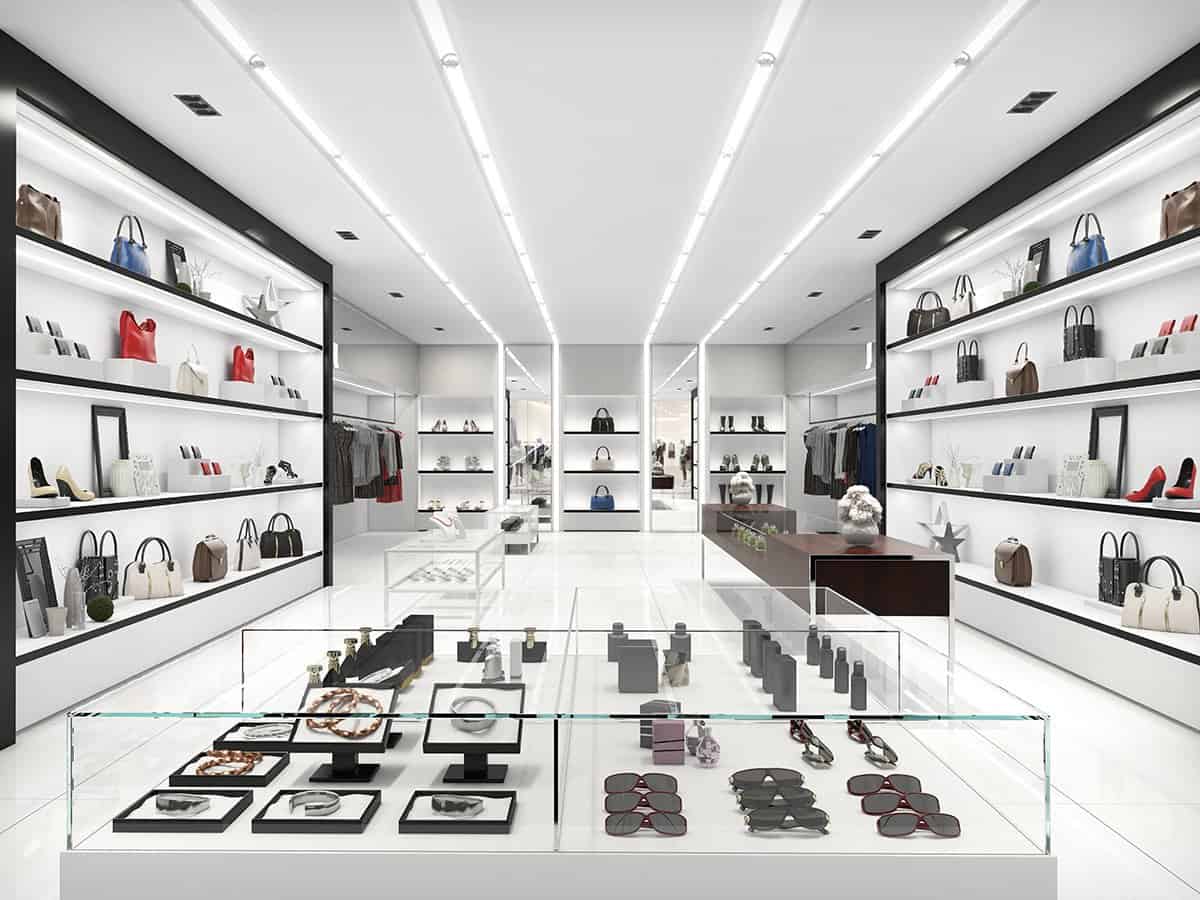
Lojas de varejo
General lighting responsibilities:
- Walkways and general browsing zones
- Comfortable brightness for longer dwell time
- Low glare to prevent fatigue
Accent lighting responsibilities:
- Feature tables, mannequins, window displays
- Brand walls and signage
- New arrivals and premium merchandise
A practical fixture mix often includes:
- Base layer from downlights and/or Iluminação linear LED
- Accent layer from Iluminação de trilho LED for fast re-aiming
- Targeted premium displays supported by Trilhos de luz com zoom when a single luminaire must adapt to changing display sizes or distances
Restaurantes
General lighting responsibilities:
- Maintain a consistent ambient mood
- Support safe service operations
- Keep faces readable without harsh shadows
Accent lighting responsibilities:
- Table highlights (avoid hot spots)
- Feature walls, artwork, bar displays
- Architectural textures (wood, stone, finishes)
Restaurants often benefit from softer general lighting and carefully aimed accent lighting that avoids direct glare. Deep anti-glare optics and correct aiming angles are critical.
Hotéis
General lighting responsibilities:
- Lobby orientation and circulation comfort
- Corridor safety with low glare
- Consistent brand feel
Accent lighting responsibilities:
- Reception desk emphasis
- Art installations and signature elements
- Lounge focal points and feature corners
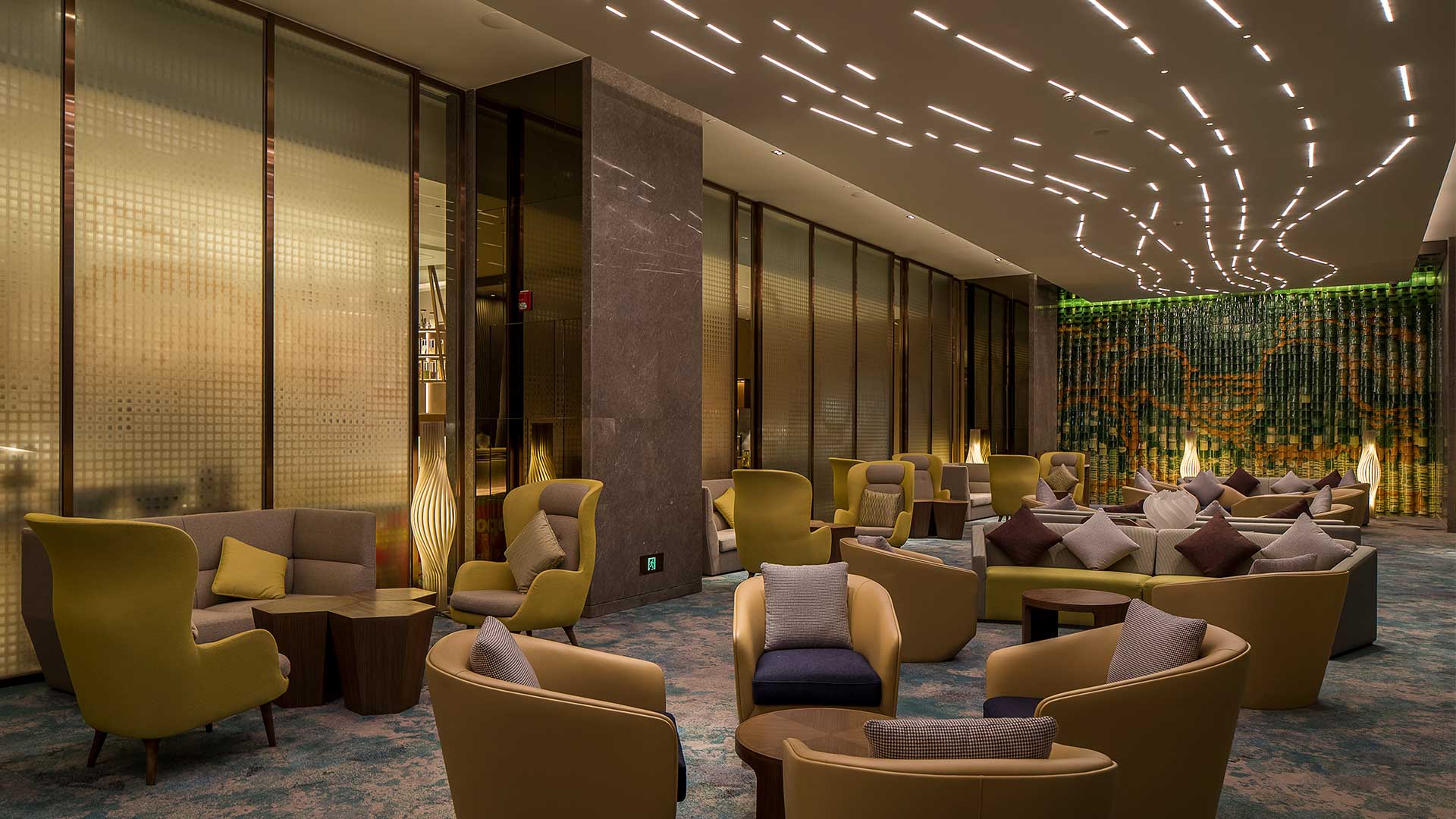
A layered approach that combines downlights and decorative elements (e.g., Luminárias pendentes de LED) with controlled accent lighting creates a premium atmosphere without sacrificing function.
Common Mistakes When Combining General and Accent Lighting
Most commercial lighting failures are not caused by “bad fixtures.” They are caused by bad layering logic.
Mistake 1: Overusing Accent Lighting
If accent lighting becomes the main light, the space feels sharp and tiring:
- Glare risk increases
- Shadow contrast becomes aggressive
- Customers and staff experience eye fatigue
Mistake 2: Insufficient General Lighting
If the base layer is too weak:
- The store feels dim and unsafe
- Accents become isolated “pools of light”
- Navigation suffers, especially for older customers
Mistake 3: No Ratio Discipline
Random contrast creates visual chaos. Without a consistent ratio strategy:
- Some displays look premium, others look ignored
- Customers don’t understand hierarchy
- The space feels inconsistent across zones
Mistake 4: Ignoring Glare and Cut-Off
Especially with track lights and spot optics, poor cut-off and shallow shielding cause discomfort. Comfort is not optional in commercial environments—customers leave faster when lighting feels harsh.
🎯 What are common mistakes in commercial lighting layering?
Overusing accent lighting, insufficient general lighting, and poor brightness balance.
Choosing the Right Fixtures for Each Lighting Layer
Fixture selection should follow function—not trend. The most effective commercial lighting schemes are often built with a small set of reliable luminaire families, chosen for performance, comfort, and flexibility.
General Lighting: What to Prioritize
General lighting fixtures should prioritize:
- Low glare performance (comfort first)
- Wide and even distribution
- Stable output and color consistency
- Efficiency and lifetime performance
Common solutions include:
- Recessed downlights for clean ceilings
- Linear luminaires for structured ambient fill and circulation guidance
For scalable commercial projects, selecting from a consistent product family improves installation speed and long-term maintenance. Many projects start with standardized base layers from Iluminação linear LED and complement with downlights based on ceiling conditions.
Accent Lighting: What to Prioritize
Accent lighting fixtures should prioritize:
- Aiming flexibility
- Beam angle options (narrow, medium)
- High CRI (CRI ≥90 / Ra97)
- Strong glare control and cut-off
- Optics stability over time
The most common accent solution in commercial projects remains track lighting. Systems like Iluminação de trilho LED make it easy to reconfigure lighting as merchandising changes. For focal displays where beam flexibility is required, Trilhos de luz com zoom can reduce SKU complexity by allowing beam adjustments without swapping optics.
For recessed applications requiring directional accents, Spots de LED embutidos are commonly used to maintain clean ceilings while delivering product-focused illumination.
📊 Chart: Fixture Selection Matrix for Lighting Layers
| Layer | Objetivo principal | Recommended Fixture Types | Key Specs to Demand | Best-Fit Use Cases |
|---|---|---|---|---|
| General (Ambient) | Visibility + comfort | Downlights, linear | UGR<19, SDCM<3, 100–130 lm/W | Walkways, browsing zones, corridors |
| Sotaque | Focus + hierarchy | Track lights, spot downlights | CRI≥90/Ra97, beam control, glare shielding | Retail displays, signage, feature walls |
| Hybrid / Flexible | Adaptability | Zoomable track | Adjustable beam, stable optics | Seasonal retail, changing exhibits |
Engineering note: In commercial LED luminaires, long-term reliability depends on thermal management and optical stability. Well-built systems often use a dissipador de calor de alumínio fundido, stable optics such as a Lente de PMMA, and high-performance LED packages (commonly Chip COB configurations for clean beam control). For project buyers, lifetime targets such as L70/B50 50.000 horas are a practical baseline for commercial deployments.
If you need to standardize products across multiple sites or rollouts, using a consistent supplier catalog reduces risk. You can browse a full range of commercial families in the Catálogo de Produtos.
Practical Design Workflow
When commercial teams ask “how much general vs accent do we need,” a reliable workflow looks like this:
- Define the functional zones (circulation, display, service, seating)
- Set general lighting targets for safety and comfort (UGR control in sensitive areas)
- Identify focal points (where you want attention and conversion)
- Assign accent lighting only to focal points and hierarchy nodes
- Apply ratio discipline (2–3× typical; 3–5× for hero areas when controlled)
- Check glare risk from customer sightlines (especially near entrances and checkout)
- Confirm color quality (CRI≥90/Ra97 for product-critical areas; SDCM<3 for consistency)
- Plan for change (track systems, adjustable optics, replaceable drivers)
This is also why many commercial projects prefer track-based accent systems: they are inherently designed for easy installation and re-aiming, making them practical for retail and hospitality operations that evolve over time.
For a better understanding of how layered lighting strategies are applied in complete commercial projects, you can review Casos de Projeto and see how different lighting layers support different business goals.
External References
For professional lighting design decisions—especially illuminance targets, visual comfort, and glare control—designers frequently reference organizations and standards such as:
- IES (Illuminating Engineering Society) for lighting practice guidance and metrics
- EN 12464-1 for European guidance on workplace/commercial illuminance and glare considerations
- Aliança DALI for interoperable digital lighting control protocols (useful when layering and scenes are required)
In practice, smart control is not mandatory for layering—but it can make layered scenes more consistent (day/night, weekday/weekend, seasonal re-merchandising), especially in retail and hospitality.
FAQ About general and accent lighting
Conclusão
General and accent lighting are not “two options.” They are two structural layers that must work together.
- Iluminação geral creates visibility, safety, and comfort
- Iluminação de destaque creates focus, hierarchy, and commercial impact
- The success of a commercial lighting scheme depends on ratio discipline, glare control, and correct fixture selection
In real projects, the best results come from treating lighting layers as a system—aligned with ceiling conditions, merchandising strategy, and customer sightlines.
If you are planning a retail or hospitality project and want to align general vs accent lighting ratios, fixture types, and performance specs into one coherent solution, review our Soluções de Iluminação to see how layered design is translated into project-ready recommendations.
Consultas comerciais são bem-vindas.
1) From Reading → Project Alignment
If you already have:
- A floor plan / reflected ceiling plan
- Ceiling height and mounting conditions
- Store type (retail / hospitality / showroom)
- Key focal areas (hero products, feature walls, reception, etc.)
Then the next step is to convert general vs accent principles into a layered layout with the right brightness ratios, beam angles, and glare control strategy.
You can also learn more about our production and ODM support capabilities through Sobre nós.
2) Submit Your Project / Let Us Configure a Lighting Plan
👉 Use our Contact & Project Submission Page to send your plan or requirements.
We will help you match:
- Base layer (UGR<19 comfort where needed)
- Accent layer (CRI≥90/Ra97, controlled beams)
- Consistency targets (SDCM<3)
- Efficiency goals (100–130 lm/W)
- Lifetime expectations (L70/B50 50,000 hrs)
- Product families from our Iluminação de trilho LED, Spots de LED embutidos, e Iluminação linear LED ranges
So your project achieves both visual impact and long-term comfort—without guesswork.