 XHLUX
XHLUX

Índice
- 2. Reason One: Protect Eye Comfort and Improve Visual Experience
- 3. Reason Two: Enhance Spatial Aesthetics and Design Appeal
- 4. Reason Three: Boost Work Efficiency and Concentration
- 5. Reason Four: Improve Lighting Quality and Energy Utilization
- 6. Reason Five: Elevate Brand and Project Value
- 7. How to Choose the Right Low Glare Downlight
- 8. FAQ: Low Glare Downlights
- 9. Data Chart: Energy & Comfort Comparison
- 10. Conclusion
- 11. Related content
Lighting plays a decisive role in how people experience a space. From retail shops to hotel lobbies and residential living rooms, downlights remain one of the most popular choices thanks to their clean lines and ability to provide targeted illumination.
Yet not all downlights are created equal. The latest trend among designers and contractors is low glare downlighting, a category of luminaires engineered to deliver comfortable, uniform light while minimizing harsh reflections and discomfort glare.
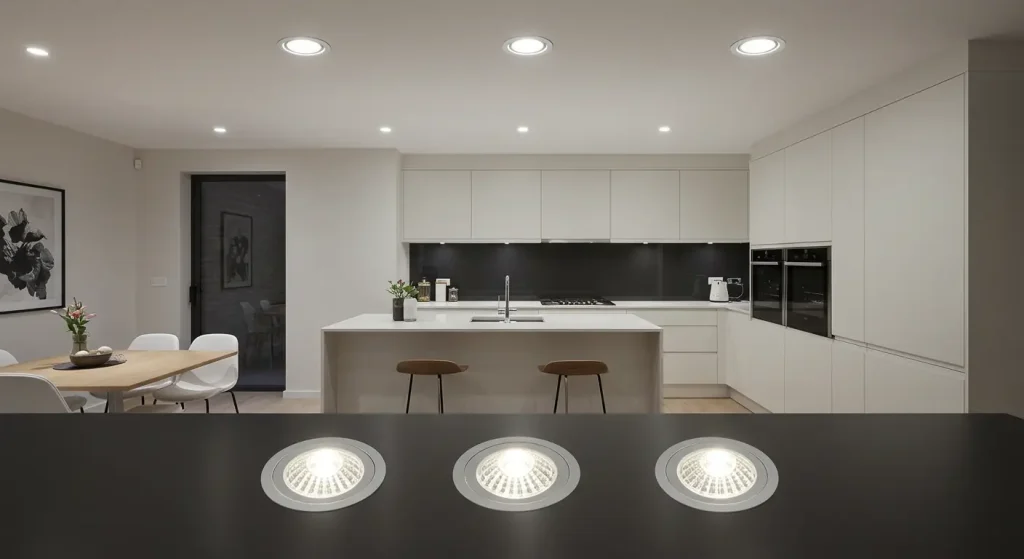
In professional lighting standards, glare is measured using the Classificação Unificada de Ofuscamento (UGR). A lower UGR means less discomfort for occupants. Many premium fixtures now advertise “UGR<19,” making them suitable for offices, hospitality, healthcare, and high-end homes.
This article explores five compelling reasons to invest in low glare downlights, along with guidance on product selection, data-driven insights, and FAQs to help you make informed decisions.
2. Reason One: Protect Eye Comfort and Improve Visual Experience
Bright but uncontrolled light can cause squinting, headaches, or even eye fatigue after prolonged exposure. In workplaces, this may reduce productivity; in homes, it can compromise relaxation.
Low glare recessed downlights address this by:
- Using deeper lamp positioning or “baffles” to shield the light source.
- Employing advanced optics to direct beams precisely without spilling light.
- Offering diffusers or micro-prisms to soften brightness.
Recommended Applications
| Setting | Why Low Glare Helps |
|---|---|
| Open-plan offices | Reduces reflected glare on screens |
| Classrooms & libraries | Keeps students focused for longer |
| Clinics & hospitals | Supports visual comfort for staff/patients |
| Living rooms | Creates relaxing, glare-free ambience |
Dica profissional: Check the fixture’s UGR value—look for UGR <19 for offices or study areas.
3. Reason Two: Enhance Spatial Aesthetics and Design Appeal
Lighting is a cornerstone of interior design. Harsh glare flattens textures and overwhelms décor, while low glare luminaires allow architectural details and finishes to shine.
Key design benefits:
- Soft, even light distribution highlights furnishings without overpowering.
- Creates layered illumination, combining ambient, accent, and task lighting.
- Works well with modern minimalism, luxury retail, or boutique hotels.
For designers, specifying a low glare downlight means balancing form and function—an elegant trim with advanced optics beneath.
4. Reason Three: Boost Work Efficiency and Concentration
Scientific studies link glare to reduced concentration and increased error rates in workplaces. Employees forced to squint or reposition screens lose time and focus.
A research summary by the Lighting Research Center (2024) reported that offices using UGR<19 luminaires saw a 12% improvement in task accuracy versus spaces with uncontrolled glare.
Low glare recessed downlights help staff remain comfortable for longer hours, contributing to overall productivity.
5. Reason Four: Improve Lighting Quality and Energy Utilization
Premium anti-glare LED downlights often incorporate:
- High CRI (Color Rendering Index) >90, ensuring true-to-life colors.
- Precise optics that eliminate dark spots and shadows.
- Efficient reflectors and lenses that increase lumens per watt.
Because of these features, businesses enjoy both energy savings and enhanced visual quality. Even in retail, where product presentation is critical, low glare solutions ensure merchandise looks vibrant without blinding customers.
6. Reason Five: Elevate Brand and Project Value
Comfortable, well-planned lighting signals quality and professionalism. In hotels, for instance, lobby ambiance influences guest satisfaction scores. Restaurants use soft, glare-free light to make patrons linger longer.
Developers and contractors who specify low glare recessed downlights give their projects a premium edge. Lighting distributors also benefit: promoting glare-controlled products differentiates them from commodity suppliers.
Case Study: A boutique hotel in Singapore swapped conventional downlights for low glare models with 3000K color temperature. Guest reviews mentioning “pleasant atmosphere” increased by 18% within three months.
7. How to Choose the Right Low Glare Downlight
When sourcing fixtures, evaluate the following parameters:
| Parâmetro | Recommendation | Por que isso importa |
|---|---|---|
| UGR (Índice Unificado de Ofuscamento) | <19 for offices/classrooms; <22 for lounges | Comfort benchmark |
| CRI (Índice de Reprodução de Cores) | ≥90 for retail/hospitality | True colors & visual appeal |
| Temperatura de cor (CCT) | 2700–3000K for hospitality, 3500–4000K for offices | Sets the mood |
| Ângulo do feixe | 24°–60° depending on task | Controls spread & focus |
| Wattage & efficacy | ≥90 lm/W | Better energy efficiency |
| Dimming & controls | DALI, 0-10V, Bluetooth | Adapt lighting for different uses |
| Certification | CE, RoHS, DLC, Energy Star | Ensures compliance & quality |
Also consider:
- Trim shape (round, square) to match ceilings.
- Recess depth—deeper trims usually reduce glare.
- Warranty and after-sales service from reputable brands.
8. FAQ: Low Glare Downlights
Q1: What is the difference between low glare and regular downlights?
Low glare models use recessed light sources, specialized optics, or micro-louver diffusers to control brightness, whereas regular downlights often expose the LED, producing harsher beams.
Q2: Are low glare downlights more expensive?
They may cost slightly more upfront, but the investment pays off through better comfort, reduced complaints, and potential energy savings.
Q3: Can I retrofit existing ceilings?
Many manufacturers provide retrofit kits. Check ceiling cut-out size, depth, and driver compatibility.
Q4: What is UGR and why is UGR<19 important?
UGR stands for Unified Glare Rating. A value below 19 is recommended for offices and educational facilities to avoid discomfort glare.
Q5: Do low glare fixtures compromise brightness?
Not if you choose well-engineered products. They balance high lumen output with proper shielding.
9. Data Chart: Energy & Comfort Comparison
| Tipo de iluminação | Average UGR | Energy Use (W per unit) | Eye Comfort Score* |
|---|---|---|---|
| Standard LED Downlight | 24 | 18 W | 6/10 |
| Low Glare LED (UGR<19) | 17 | 15 W | 9/10 |
| CFL Recessed Fixture | 22 | 26 W | 5/10 |
*Comfort score derived from user surveys (1–10 scale).
Low glare LEDs show superior comfort and energy efficiency.
10. Conclusion
Low glare downlights combine visual comfort, refined aesthetics, productivity benefits, and energy performance, ultimately adding value to any commercial or residential project.
Whether you’re an interior designer specifying fixtures, a contractor bidding on a hotel renovation, or a distributor seeking high-margin lighting solutions, glare-controlled luminaires deserve a spot in your catalog.
👉 Take action today:
- Contact our team for tailored low glare lighting solutions.
- Request free samples or a lighting design consultation.
- Elevate your next project with fixtures that enhance both comfort and style.
11. Related content
O que é um downlight de baixo brilho? Benefícios para espaços modernos.
Luminárias embutidas de baixo brilho versus luminárias embutidas padrão: principais diferenças
How Low Glare Downlights Improve Lighting in Hotels and Offices
O que procurar em um fabricante de luminárias embutidas para projetos modernos
Downlight Manufacturer vs. Wholesaler: Which Option Saves More
Luminárias de embutir com baixo brilho versus spots embutidos: qual é a melhor opção?