 XHLUX
XHLUX

Índice
- Why Restaurant Lighting Often Feels “Off” Even After Renovation
- Why Lighting Is Critical in Restaurant Design
- What Are Adjustable Track Lights?
- Why Adjustable Track Lights Work Well in Restaurants
- Key Design Tips for Restaurant Lighting with Track Lights
- Recommended Lighting Layouts for Different Restaurant Areas
- Common Restaurant Lighting Design Mistakes to Avoid
- How Adjustable Track Lights Improve Long-Term Restaurant Operations
- Spec-First Selection Guide
- Comparison Table: Track Lighting vs Downlights in Restaurant Projects
- FAQ About Restaurant Lighting Design
- 1) What lighting is best for restaurants?
- 2) Are track lights suitable for restaurants?
- 3) What color temperature is best for restaurant lighting?
- 4) How bright should restaurant lighting be?
- 5) Does lighting affect dining experience?
- 6) What CRI should restaurant lighting use?
- 7) Do beam angles matter in restaurant track lighting?
- Sejam bem-vindos para discutirmos uma possível cooperação comercial.
Why Restaurant Lighting Often Feels “Off” Even After Renovation
Many restaurants struggle to create the right lighting atmosphere. The space feels either too bright, too dark, or simply “flat.” Even worse, once tables move or the theme changes, the lighting becomes inflexible—suddenly the best seats are under glare, and the signature wall is underlit.
Poor lighting affects more than the interior photo. It reduces dining atmosphere, distorts food colors, creates discomfort, and shortens customer stay. In real operations, an inflexible lighting layout also becomes expensive: every seasonal refresh feels like a mini-rebuild.
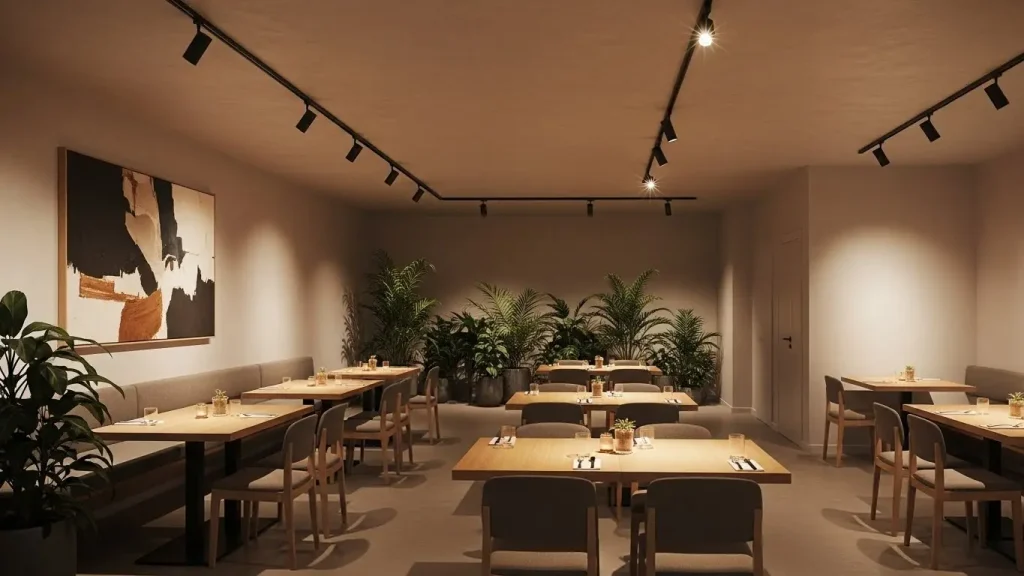
A professional restaurant lighting design uses layered lighting (ambient + accent + task) and treats light as a tool for experience. Adjustable track lights are one of the best solutions because they combine lighting flexibility, precision aiming, and commercial reliability—perfect for restaurants where layouts, menus, and focal points evolve.
If you want to shortlist commercial-ready products quickly:
- Core accent layer: Iluminação de trilho LED
- Flexible optics for changing scenes: Zoomable LED Tracklights
- Ambient base support where needed: Spots de LED embutidos
- Full range overview: Catálogo de Produtos
Why Lighting Is Critical in Restaurant Design
Why is lighting important in restaurant design?Lighting shapes dining atmosphere, visual comfort, and how food and interiors are perceived, directly influencing customer satisfaction.
Restaurant lighting is not “illumination.” It is a customer experience system. It influences:
- Appetite and food appeal (food needs color truth and gentle highlights)
- Mood and intimacy (brightness ratio and CCT shape emotional tone)
- Dwell time (comfort keeps people longer; glare pushes people away faster)
- Perceived quality (premium spaces look premium because contrast and detail are controlled)
- Staff performance (service zones and POS need functional task lighting)
A restaurant is also a “dynamic environment.” Tables shift. Decor changes. Menu boards move. Special events happen. This is why rigid lighting layouts—especially “one fixed downlight grid everywhere”—often fail.
Key takeaway:Great restaurant lighting isn’t about maximum brightness. It’s about visual hierarchy—what you want guests to notice first, second, and third.
What Are Adjustable Track Lights?
What are adjustable track lights?Adjustable track lights are lighting fixtures mounted on tracks, allowing light heads to be repositioned and aimed precisely where needed.
At a practical level, Iluminação de trilho LED is a system of:
- a track rail system that distributes power
- multiple adjustable track heads that can be aimed and repositioned
For restaurants, that means you can:
- change where light lands without moving wiring
- create more intimate table zones without a full ceiling redesign
- upgrade from “flat ambient” to accent lighting and focal storytelling
Compared with fixed recessed fixtures, track systems offer a business advantage: they reduce the cost and risk of future changes.
Why Adjustable Track Lights Work Well in Restaurants
Restaurants aren’t static. That’s the point. Lighting flexibility becomes a competitive advantage because it lets you refresh the experience without reconstructing the ceiling.
Flexible Layout for Changing Dining Spaces
Restaurants frequently adjust:
- table layout to increase capacity or improve circulation
- seating style (booths, bar seating, private zones)
- seasonal decor or thematic displays
With track lighting, you can:
- add or remove heads as the plan evolves
- re-aim beams after layout changes
- shift emphasis to new menu items, wine walls, or feature art
Operational impact: fewer rework costs, faster refresh cycles, and less downtime.
Accent Lighting for Tables, Bars, and Food Displays
Restaurants typically need “attention anchors”:
- table surfaces (comfort + intimacy)
- bar counters (sparkle + highlight bottles and textures)
- feature walls (brand photos, signage, artwork)
- dessert or bakery display (freshness perception)
Track lighting is built for spotlighting products—in restaurants, “products” include dishes, cocktails, and signature interior elements.
Clean Ceiling and Modern Aesthetic
Many modern restaurants want fewer ceiling objects. Too many pendants can create clutter and cleaning issues. Track systems can deliver:
- a clean ceiling line
- modern architectural look
- adjustable focal light without heavy decoration
If your design includes pendant statements, track lighting can still serve as the invisible backbone, while pendants become the “hero fixtures.” (See Luminária pendente de LED for feature-area layering.)
Key Design Tips for Restaurant Lighting with Track Lights
This section translates “cozy / intimate / premium” into decisions that designers and buyers can execute.
Choose the Right Beam Angle
What beam angle is best for restaurant track lighting?Medium to narrow beam angles are ideal for creating intimate dining zones and focused accent lighting.
In restaurants, beam angle controls intimacy. Too wide, and the room becomes flat. Too narrow, and you create hotspots and glare.
Chart 1 — Beam Angle Selection for Restaurant Zones
| Zone | Ângulo de feixe recomendado | Why It Works | Common Mistake |
|---|---|---|---|
| Dining tables | 15°–24° (or 24°–36° if tables are larger) | creates intimate pools; strong table focus | using 60° makes room flat |
| Bar counter | 15°–24° + layered fill | highlights bottles, textures; adds sparkle | narrow-only creates harsh reflections |
| Aisles / circulation | 36°–60° | comfortable navigation, safer flow | narrow beams cause patchy floor hotspots |
| Feature walls / art | 24°–36° | balanced wall brightness and detail | wide beam wastes light onto ceiling |
| Menu board | 24°–36° | readable without glare | overly narrow makes text uneven |
Dica profissional: Most successful restaurants use 2–3 beam angles in one space. A single-angle approach is usually a compromise.
If you need a simpler procurement path, consider flexibility-first optics like Zoomable LED Tracklights so a single model can cover multiple beam needs.
Use Warm Color Temperature for Dining Comfort
CCT is your “emotional slider.” Most restaurants succeed with:
- 2700K–3000K: warm, relaxing, intimate
- 3000K–3500K: modern warmth, slightly cleaner look (often for casual-dining chains)
Avoid pushing too cool in dining areas unless the concept is specifically “clinical-modern” (rare for comfort dining).
Chart 2 — Color Temperature by Atmosphere & Concept
| CCT (Kelvin) | Atmosfera | Best Fit Restaurant Types |
|---|---|---|
| 2700K | intimate, cozy, premium warmth | fine dining, wine bar, boutique bistro |
| 3000K | warm but balanced | mainstream dining, café, grill |
| 3500K | clean warm-neutral | modern casual chain, open-kitchen concepts |
| 4000K+ | crisp, high-clarity | back-of-house, prep zones, some fast casual |
A practical approach is to keep public dining warm, while using slightly higher CCT for task zones where clarity matters.
High CRI for Food Presentation and Trust
Food is extremely sensitive to color rendering. If the food looks dull or “off,” the dining experience suffers instantly.
For restaurants, a strong professional baseline is:
- CRI (color rendering index) ≥ 90
- Premium or showcase areas: Ra97
High CRI is not just for visuals; it supports trust. Guests want the dish to look like what they ordered. If lighting distorts color, the brain reads it as “less fresh” or “less premium.”
Spec-first note (commercial grade):
- Almeje CRI > 90 / Ra97, SDCM < 3 (color consistency across the room), and efficiency 100–130 lm/W depending on design targets and dimming strategy.
Control Glare for Visual Comfort
Controle de brilho is one of the biggest hidden factors in dining comfort. Guests don’t complain. They simply avoid seats that feel harsh.
Glare in restaurants often comes from:
- track heads aimed too shallow (direct into eyes)
- narrow beams hitting glossy tables, plates, or glassware
- high brightness in a dark room (excess contrast without control)
Practical glare-control moves:
- use deep anti-glare optics or honeycomb options
- aim beams 30–45° to the target plane rather than straight down
- balance accent with enough ambient so contrasts feel premium, not aggressive
Engineering choices that support comfort long-term:
- Chip COB for smooth beam
- Lente de PMMA para distribuição controlada
- Dissipador de calor em alumínio fundido to keep output stable over time
- In mixed hospitality scenes, a comfort mindset similar to UGR management is often used to avoid harsh luminance conditions (especially in visually sensitive seating zones).
Recommended Lighting Layouts for Different Restaurant Areas
Great restaurant lighting is designed by zones. Below is a practical layout strategy that owners, designers, and contractors can share.
Dining Area (Main Seating)
Goal: intimacy + comfort + photo-worthy atmosphere
- Ambient base: modest level, soft distribution
- Accent: table focus, feature displays, wall details
- Keep brightness gradients smooth—avoid “dark cave + harsh spots”
Recommended fixture logic:
- Track heads (15°–36°) to define table zones
- Optional recessed support where ceiling is very high (see Spots de LED embutidos)
Bar & Counter
Goal: sparkle + highlight textures + social energy
- Use accent beams to bring out bottles, metal finishes, and countertop materials
- Avoid glare into seated guests’ eyes at the bar
A strong bar strategy includes:
- narrow-to-medium accents (15°–36°)
- controlled glare optics
- optional linear highlights for shelves or back bar (see Iluminação linear LED)
Entrance & Waiting Area
Goal: strong first impression + welcoming
- brighter than dining zone (but still warm)
- highlight brand signage, menu boards, feature art
- guide movement into the space
Track lighting is excellent here because brand displays change frequently.
Feature Walls / Artwork / Signature Elements
Goal: brand memory
- medium beams (24°–36°) for walls
- controlled distribution to avoid “hot spot circle” on the wall
- CRI ≥ 90 so materials look expensive
For real reference structures and solution support, it helps to review implementation examples: Casos de Projeto.
Common Restaurant Lighting Design Mistakes to Avoid
What are common restaurant lighting design mistakes?
Common mistakes include excessive brightness, cold color temperature, lack of accent lighting, and inflexible lighting layouts.
Mistake 1: Over-bright dining room (kills intimacy)
Restaurants often over-light to “look clean.” The result is cafeteria vibes.
Consertar: reduce ambient, increase controlled accents, use warm CCT.
Mistake 2: Cold CCT in dining zones
Cooler light can feel clinical and reduce appetite perception.
Consertar: 2700K–3000K for dining comfort in most concepts.
Mistake 3: Only uniform lighting (no hierarchy)
Without accent lighting, the room looks flat, and signature elements disappear.
Consertar: add track lighting accents for tables, walls, and features.
Mistake 4: Ignoring glare control
Glare is the silent reason some seats never get chosen.
Consertar: optics + aiming + balance. Use glare-control accessories when needed.
Mistake 5: “Fixed forever” lighting layout
Restaurants evolve. Fixed lighting punishes change.Consertar: usar adjustable track lights so the lighting can follow the business.
How Adjustable Track Lights Improve Long-Term Restaurant Operations
This is where restaurant owners and chains make decisions: performance over time.
1) Layout changes without rewiring
When the table plan changes, you don’t want to:
- cut the ceiling
- move downlights
- re-run wiring
Track heads can be repositioned and re-aimed quickly, protecting the investment.
2) Lower total cost of ownership (TCO)
Restaurants run many hours per day, and maintenance interruptions affect service. Commercial-grade track lighting with stable drivers reduces:
- failure rate
- replacement labor
- downtime and guest disruption
3) Easy scene upgrades
Restaurants often want:
- brighter lunch scene
- warmer dimmed dinner scene
- special event scenes
Track systems integrate well with dimming strategies. For projects using centralized control, DALI-style systems are common in commercial environments (reference: Aliança DALI).
Chart 3 — Restaurant Lighting: “Purchase Price” vs “Operating Reality”
| Área de decisão | Cheap / Short-term Choice | Commercial Grade Choice | Business Result |
|---|---|---|---|
| Driver reliability | higher failure risk | stable driver, consistent output | fewer call-backs |
| Color stability | mixed CCT/SDCM across replacements | SDCM < 3 consistency | consistent brand look |
| Conforto | glare and hotspots | glare-control optics | longer dwell time |
| Eficiência | unknown / low | target 100–130 lm/W | lower energy cost |
| Planejamento para a vida toda | unclear | L70/B50 50.000 horas | predictable maintenance |
If you need help matching spec + layout to a restaurant concept, use Soluções de Iluminação or go straight to Contato e Orçamento.
Spec-First Selection Guide
If you’re writing a project spec (designer, contractor, buyer), these are the requirements that most reduce risk.
Recommended baseline for commercial restaurant track lighting
- CRI > 90 (premium zones: Ra97)
- SDCM < 3 (color consistency across heads and batches)
- Glare control optics (deep structure / honeycomb options)
- Eficiência: 100–130 lm/W (balance with dimming and comfort)
- Lifetime: L70/B50 50,000 hours
- Thermal design: dissipador de calor de alumínio fundido
- Optics: Lente de PMMA (or equivalent controlled optics)
- Light source: Chip COB option for smooth beam
- Installation friendly: quick connect, standardized adapters, stable track rail system compatibility
- Dimming: choose based on project (TRIAC/0–10V/DALI depending on region and control plan)
Procurement shortcut:Start from Iluminação de trilho LED and add flexibility with Zoomable LED Tracklights for mixed beam needs.
Comparison Table: Track Lighting vs Downlights in Restaurant Projects
Restaurants often ask: “Do I really need track lights, or are downlights enough?”
Chart 4 — Best Practice Combination
| Item | Iluminação de trilho | Luminárias de embutir LED | Best Practice |
|---|---|---|---|
| Strength | precision accent, flexibility, hierarchy | clean ambient base, uniformity | combine for layered lighting |
| Weakness | can look patchy if used alone | flat if used alone | use downlights as base + track as accent |
| Layout changes | easy (re-aim / reposition) | hard (fixed cutouts) | track protects future refresh |
| Mood control | excellent with aimed accents | stable foundation | both support scenes |
| Typical zones | tables, walls, bar, features | circulation, background base | layered zoning |
To build a balanced system:
- Ambient base options: Spots de LED embutidos
- Accent/focus options: Iluminação de trilho LED
FAQ About Restaurant Lighting Design
1) What lighting is best for restaurants?
The best restaurant lighting uses layered lighting: ambient lighting for comfort, accent lighting to create intimacy and focus, and task lighting where needed. Many restaurants succeed with a combination of Iluminação de trilho LED (flexible accents) plus a controlled ambient base.
2) Are track lights suitable for restaurants?
Yes. Adjustable track lights are highly suitable for restaurants because they provide lighting flexibility, precise aiming for tables and feature zones, and allow changes without rewiring.
3) What color temperature is best for restaurant lighting?
Most dining areas perform best at 2700K–3000K for warm comfort and appetite-friendly atmosphere. Some modern concepts use 3000K–3500K for a cleaner look while maintaining warmth.
4) How bright should restaurant lighting be?
Brightness should be balanced. Restaurants often feel better with controlled contrast rather than uniform high brightness. Use dimming scenes and avoid harsh glare in dining zones.
5) Does lighting affect dining experience?
Yes. Lighting directly impacts conforto visual, mood, how food colors are perceived, and how long guests stay. Poor glare control and wrong CCT can reduce comfort and shorten dwell time.
6) What CRI should restaurant lighting use?
A professional baseline is CRI ≥ 90, especially for food presentation. Premium projects often target Ra97 for the most natural food and material appearance.
7) Do beam angles matter in restaurant track lighting?
Absolutely. Beam angle determines intimacy and focus. Most restaurants use a combination of narrow and medium beams for tables and features, plus wider beams for circulation.
Sejam bem-vindos para discutirmos uma possível cooperação comercial.
The strongest restaurant lighting design is not “warm bulbs everywhere.” It is a system that delivers:
- a premium dining atmosphere
- high conforto visual through glare control
- strong food presentation via CRI > 90 / Ra97
- future-proof lighting flexibility when layouts and themes change
- stable operations with commercial reliability and long lifespan LED planning
If your goal is to sell the experience—not compete on price—build your plan around:
- layered lighting (ambient + accent)
- adjustable track lights for tables, walls, bar, and features
- spec-first quality: SDCM < 3, L70/B50 50.000 horas, 100–130 lm/W, glare-control optics
- robust construction: dissipador de calor de alumínio fundido, Lente de PMMA, Chip COB opções
Next steps
- Shortlist track options: Iluminação de trilho LED
- Reduce risk with flexible beams: Zoomable LED Tracklights
- Add a clean ambient foundation: Spots de LED embutidos
- Add architectural lines if needed: Iluminação linear LED
- Browse everything fast: Catálogo de Produtos
- Request concept + spec support: Contato e Orçamento
- See real implementations: Casos de Projeto
- Know your supplier: Sobre nós