 XHLUX
XHLUX

Índice
- 1. What Defines High-Quality Office Lighting?
- 2. The Core Technical Parameters Behind Recommended Office Lighting
- 2.1 Illuminance (Lux): Horizontal vs Vertical
- 2.2 UGR (Unified Glare Rating) — The Most Important Comfort Metric
- 2.3 CRI & TM-30 (Color Accuracy Beyond CRI)
- 2.4 CCT (Color Temperature) and Psychological Impact
- 2.5 Lighting Distribution (Batwing, Lambertian, Asymmetric)
- 2.6 SHR (Spacing Height Ratio) — The Real Reason Offices Look Uneven
- 3. Recommended Office Lighting by Functional Area
- 3.1 Open Office (Workstations)
- 🔹 3.1.1 Recommended Standards (EN12464-1 + IES)
- 🔹 3.1.2 Optical Distribution Strategy
- 🔹 3.1.3 Recommended Fixtures
- 🔹 3.1.4 Design Consultant Insight
- 🔹 3.1.5 Engineering Note
- 3.2 Meeting Rooms
- 🔹 3.2.1 Recommended Standards
- 🔹 3.2.2 Optical Strategy
- 🔹 3.2.3 Recommended Fixtures
- 🔹 3.2.4 Design Consultant Insight
- 🔹 3.2.5 Engineering Note
- 3.3 Design Studio / Creative Teams
- 🔹 3.3.1 Recommended Standards
- 🔹 3.3.2 Optical Strategy
- 🔹 3.3.3 Recommended Fixtures
- 🔹 3.3.4 Design Consultant Insight
- 🔹 3.3.5 Engineering Note
- 3.4 Corridors, Pantry, and Common Areas
- 🔹 3.4.1 Recommended Standards
- 🔹 3.4.2 Optical Strategy
- 🔹 3.4.3 Recommended Fixtures
- 3.5 Executive Office & Premium Areas
- 🔹 3.5.1 Recommended Standards
- 🔹 3.5.2 Optical Strategy
- 🔹 3.5.3 Recommended Fixtures
- 4. Advanced Optical Engineering Strategies for High-Performance Office Lighting
- 4.1 Light Distribution Types (Batwing, Lambertian, Asymmetric, Darklight)
- 🔹 4.1.1 Batwing Distribution (Ideal for Offices)
- 🔹 4.1.2 Lambertian Distribution (General Diffuse Light)
- 🔹 4.1.3 Asymmetric Distribution (For Wall Washing)
- 🔹 4.1.4 Darklight Optics (Deep Anti-Glare Systems)
- 4.2 Direct vs. Direct/Indirect Optics
- 4.3 Optics and UGR: The Real Mechanics Behind Glare Control
- 5. Real Engineering Calculations for Office Lighting
- 6. Complete Lighting Design Example — 100 m² Office
- A. Linear Parallel Layout (Most Common)
- B. Central Spine Layout (Design-Driven)
- C. Grid Layout (Balanced)
- 7. Common Office Lighting Mistakes
- 8. Selecting the Right Office Lighting Fixtures
- 9. Smart Lighting Controls for Modern Offices
- 10. Energy Efficiency Model for Office Lighting
- 11. OEM/ODM Considerations for Office Lighting Projects
- 11.1 Optical Module Selection
- 11.2 Driver & Dimming Protocols
- 11.3 Mechanical Design & Customization
- 11.4 Sample Lead Time & Engineering Support
- 11.5 Quality Certifications
- 12.1 What is the recommended lux level for office lighting?
- 12.2 Is LED the best lighting solution for offices?
- 12.3 What color temperature is best for productivity?
- 12.4 How do I reduce glare (UGR) in an office?
- 12.5 How many linear lights do I need for 100 m²?
- 12.6 What CRI is recommended for office lighting?
- 12.7 Does office lighting affect productivity?
- 12.8 What smart lighting controls are recommended?
- 12.9 What is the ideal color temperature for meeting rooms?
- 12.10 What is the recommended UGR for offices?
- 13. Conclusion
Lighting is the most underestimated component of workplace performance.A modern office is no longer illuminated merely for visibility—it is engineered for productivity, comfort, cognitive performance, brand identity, employee well-being, and even circadian alignment.
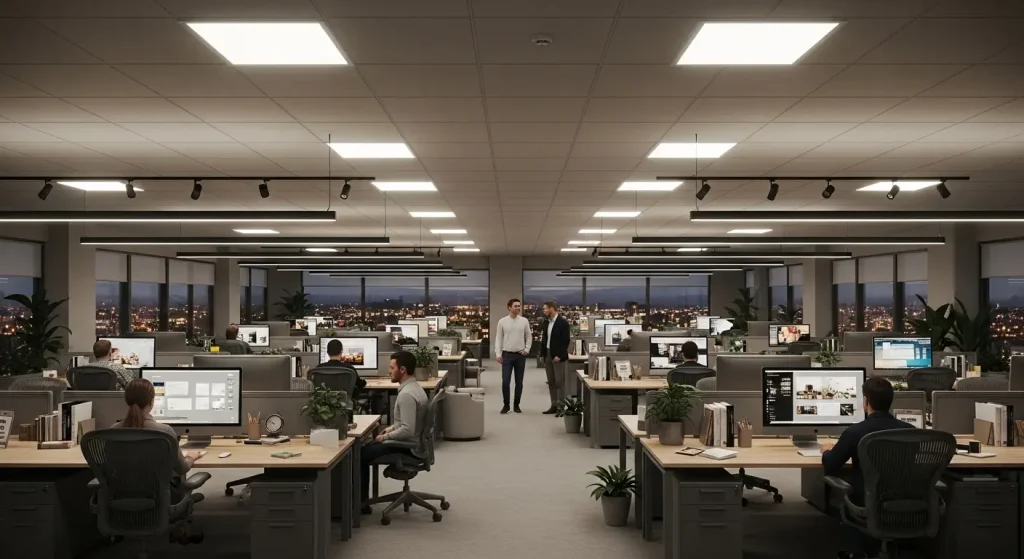
The right lighting can:
- Increase productivity by 10–23%
- Improve task accuracy by 18–30%
- Reduce headaches by up to 24%
- Reduce visual fatigue complaints by 45–60%
- Enhance collaboration and communication quality
- Strengthen the company’s brand through architectural lighting
1. What Defines High-Quality Office Lighting?
(Integrated Engineering, Standards, and Design Approach) A professional office lighting design is not random—it is a system consisting of:
- Human visual needs
- Ergonomic task performance
- Psychological comfort
- Integração arquitetônica
- Energy and sustainability standards
- Lighting distribution engineering
- Corporate identity
Below is a combined perspective from comercial, design, e engineering viewpoints.
1.1 Productivity as the Core Outcome
Office lighting must support task clarity, reduced visual strain, e cognitive focus.
Scientific findings:
- Harvard School of Public Health:
Poor lighting → fatigue ↑, cognitive accuracy ↓ - LightingEurope 2023 Report:
High-quality office lighting reduces visual discomfort by 45% - WELL v2 Standard:
Vertical illumination affects alertness more than horizontal illumination
This is why modern office lighting emphasizes:
- Brightness uniformity
- Low glare
- Balanced vertical illumination (for faces & communication)
- Absence of shadows
- Stable color accuracy
1.2 The Three Fundamental Goals of Recommended Office Lighting
Produtividade
- Appropriate horizontal illuminance
- Iluminação vertical adequada
- Glare reduction (UGR < 19)
- Uniformity ratio (Uo ≥ 0.4–0.6)
Visual Comfort
- Avoid direct glare from luminaires
- Avoid screen reflections
- Provide smooth lighting gradients
- Balanced brightness ratio:
Walls : Ceiling : Desktop ≈ 0.5 : 0.7 : 1.0
Eficiência energética
- 130–160 lm/W fixture efficiency
- Intelligent dimming systems
- Occupancy and daylight harvesting sensors
- Lower overall W/sqm (Target: 8–11 W/m² high-efficiency office space)
1.3 Official Standards (EN12464-1 + IES) — The Non-Negotiable Foundation
Most online articles skip the standards.
This whitepaper does not.
Below is the combined requirement from:
- EN12464-1:2021 (Europe)
- IES Lighting Handbook 10th Edition (USA)
- WELL Building Standard v2 (Global)
| Area | Lux | UGR | CCT | CRI | Uniformity | Vertical Lux (WELL) |
|---|---|---|---|---|---|---|
| Open Office Workstations | 300–500 | <19 | 3500–4000K | ≥80 | ≥0.4 | ≥150 lux |
| Meeting Room | 500 | <19 | 4000K | ≥90 | ≥0.6 | ≥175–200 lux |
| Design Studio | 500–750 | <16 | 4000K | ≥90–95 | ≥0.6 | ≥200 lux |
| Executive Office | 300–500 | <19 | 3000–3500K | ≥90 | ≥0.5 | ≥150 lux |
| Reception | 200–300 | <22 | 3000–3500K | ≥80 | ≥0.4 | ≥100 lux |
| Circulation | 100–200 | <22 | 3500–4000K | ≥80 | ≥0.3 | N / D |
📘 Want full Lux/UGR/CRI/CCT matrix?
📘 Baixar catálogo
2. The Core Technical Parameters Behind Recommended Office Lighting
2.1 Illuminance (Lux): Horizontal vs Vertical
(Engineering + WELL Standard)
Horizontal illuminance (task plane):
- Required for writing, typing, reading
- Standard: 300–500 lux
Vertical illuminance (face brightness):
- Critical for meeting rooms & video calls
- Standard: ≥150–200 lux
- Direct impact on communication quality
Most offices only meet horizontal lux → wrong.
A professional design meets both.
2.2 UGR (Unified Glare Rating) — The Most Important Comfort Metric
UGR is calculated using:
- Luminance of luminaires
- Solid angle of view
- Background luminance
- Observer position
Typical UGR requirements:
- UGR < 19 — standard office
- UGR < 16 — premium, design, or long-screen-use
- UGR < 13 — extremely low-glare deep darklight optics
High-end optics (darklight / deep louver) reduce eye strain by up to 70%.
2.3 CRI & TM-30 (Color Accuracy Beyond CRI)
CRI measures color accuracy, but TM-30 evaluates:
- Rf(Fidelity Index)
- Rg(Gamut index)
For offices:
- CRI ≥ 80 is minimum
- CRI ≥ 90 improves video meeting quality
- TM-30 recommended Rf ≥ 85, Rg ≈ 98–102
2.4 CCT (Color Temperature) and Psychological Impact
4000K is globally recognized for:
- Alertness
- Clarity
- White-paper contrast
- conforto visual
3000–3500K is recommended for:
- Executive rooms
- Hospitality-style offices
- Relaxed environments
5000K should be used carefully—it increases alertness but also stress.
2.5 Lighting Distribution (Batwing, Lambertian, Asymmetric)
High-end office lighting fixtures typically use:
- Batwing distribution — best uniformity for open offices
- Lambertian — soft, general distribution
- Asymmetric wall washer — increasing vertical illumination
- Direct/Indirect — balancing ceiling brightness & task comfort
Choosing the correct optical distribution directly affects:
- Uniformity
- Glare
- Contrast
- Shadow direction
2.6 SHR (Spacing Height Ratio) — The Real Reason Offices Look Uneven
SHR formula:
SHR = Spacing / Mounting Height
Ideal SHR:
- 1.0–1.2 for UGR linear lights
- 1.2–1.5 for standard linear lights
- 0.8–1.0 for deep anti-glare optics
This determines how many fixtures an office needs—not wattage, not lumens alone.
3. Recommended Office Lighting by Functional Area
(Design Thinking + Engineering Logic + Procurement Relevance) Different office zones have dramatically different visual tasks and lighting needs. Most content treats “office lighting” as one category—but professional lighting design requires precise, zone-specific strategies.
3.1 Open Office (Workstations)
The most important lighting zone for productivity and visual comfort
Primary visual tasks include:
- Reading text
- Monitor work
- Collaboration with colleagues
- Long hours of near-field visual focus
Open offices require balanced brightness, low glare, and excellent uniformity.
🔹 3.1.1 Recommended Standards (EN12464-1 + IES)
| Parâmetro | Valor recomendado | Reason |
|---|---|---|
| Horizontal Illuminance | 300–500 lux | Ensures readability and task clarity |
| Vertical Illuminance | ≥150 lux | Supports facial visibility and WELL Standard |
| UGR | <19 | Protects against monitor-based eye strain |
| CCT | 3500–4000K | Neutral white for focus and comfort |
| CRI | ≥80 | Ensures color accuracy for documents/screens |
| Uniformity | ≥0.4–0.6 | Reduces contrast fatigue |
🔹 3.1.2 Optical Distribution Strategy
Best practices for open office illumination:
- Usar batwing distribution linear luminaires to achieve uniformity.
- Avoid direct LED pixel visibility (reduces sparkle glare).
- Prefer direct/indirect suspended linear lights.
- Ideal up/down ratio: 40–60% uplight to soften ceiling shadow.
- Maintain balanced vertical brightness for face-to-face collaboration.
🔹 3.1.3 Recommended Fixtures
- Suspended UGR<19 linear LED lights
- Direct/Indirect suspended linear fixtures
- Edge-lit LED panels
- Anti-glare darklight linear luminaires
- Micro-prismatic linear systems
🔹 3.1.4 Design Consultant Insight
“Open offices feel comfortable when the ceiling glows softly, walls appear subtly illuminated, and the desk plane is evenly lit without looking flat.”
🔹 3.1.5 Engineering Note
- Ceiling height > 3.0 m → Increase lumens by 20–35%
- Ceiling reflectance < 60% → Reduce CU accordingly
- Task plane higher than 0.75 m → Recalculate illuminance targets
3.2 Meeting Rooms
Where communication quality is more important than raw brightness
Meeting rooms require lighting that supports:
- Facial visibility
- Video conferencing performance
- Whiteboard and display clarity
- Flexible lighting scenes
This zone focuses more on vertical illuminance than horizontal illuminance.
🔹 3.2.1 Recommended Standards
| Parâmetro | Value |
|---|---|
| Horizontal Illuminance | 500 lux |
| Vertical Illuminance | ≥175–200 lux |
| CCT | 4000K |
| CRI | ≥90 |
| UGR | <19 |
| Uniformity | ≥0.6 |
🔹 3.2.2 Optical Strategy
- Usar dual optical systems (direct + indirect).
- Add soft, forward-facing light for facial illumination.
- Avoid narrow-beam spotlights directly facing people.
- Use asymmetric wall washers for presentation surfaces.
🔹 3.2.3 Recommended Fixtures
- Direct/Indirect suspended linear fixtures
- Edge-lit panel lights
- UGR<19 recessed downlights
- Wall-wash linear systems for vertical illuminance
🔹 3.2.4 Design Consultant Insight
“For meeting rooms, vertical illuminance is more critical than horizontal illuminance. People read faces, not desktops.”
🔹 3.2.5 Engineering Note
Avoid beam angles narrower than 60°.
Narrow beams create harsh shadows on faces and reduce video quality.
3.3 Design Studio / Creative Teams
The highest visual performance requirement in the office
Visual tasks include:
- Color-critical evaluation
- Materials comparison
- Precision drawing
- Extended periods of deep focus
This is the most demanding lighting zone in the workplace.
🔹 3.3.1 Recommended Standards
| Parâmetro | Value |
|---|---|
| Horizontal Illuminance | 500–750 lux |
| Vertical Illuminance | 200 lux |
| CRI | ≥90–95 |
| CCT | 4000K |
| UGR | <16 |
| Uniformity | ≥0.6 |
🔹 3.3.2 Optical Strategy
- Usar deep anti-glare reflectors to eliminate LED hotspots.
- Ensure high R9 values for accurate saturated reds.
- Prefer luminaires tested with TM-30 (Rf ≥ 85, Rg ≈ 100).
- Provide enough lumens to overcome reduced efficacy in high-CRI modules.
🔹 3.3.3 Recommended Fixtures
- Deep anti-glare darklight linear lights
- High-output suspended linear lighting
- Adjustable high-CRI track lights
- Combined task + ambient lighting schemes
🔹 3.3.4 Design Consultant Insight
“Creative teams require lighting that reveals color relationships—not simply bright light.”
🔹 3.3.5 Engineering Note
High CRI (≥95) reduces lm/W efficiency.
Increase total lumen target by 10–15% to compensate.
3.4 Corridors, Pantry, and Common Areas
Low illuminance, high safety, and clear navigation
🔹 3.4.1 Recommended Standards
- 100–200 lux
- CRI ≥ 80
- CCT 3500–4000K
- Uniformity ≥ 0.3
🔹 3.4.2 Optical Strategy
- Use continuous linear luminaires for spatial navigation.
- Consider occupancy sensors & daylight harvesting.
- Avoid overlighting (wasteful + visually flat).
🔹 3.4.3 Recommended Fixtures
- Small linear fixtures
- Round or square downlights
- Asymmetric wall-wash lighting for guidance
3.5 Executive Office & Premium Areas
Lighting as brand + identity + atmosphere
These areas prioritize:
- A premium feel
- Comfortable contrast
- Warm tones
- Brand visuals
🔹 3.5.1 Recommended Standards
- 300–350 lux
- 3000–3500K
- CRI ≥ 90
- UGR < 19
- Accent contrast ratio ≈ 3:1
🔹 3.5.2 Optical Strategy
- Layered lighting: ambient + task + accent
- Accent lighting for shelves, artwork, wood textures
- Avoid overly bright ceilings to protect atmosphere
🔹 3.5.3 Recommended Fixtures
- Magnetic track lighting systems
- Architectural downlights (UGR<19)
- Lavadores de parede
- Premium suspended linear lights
4. Advanced Optical Engineering Strategies for High-Performance Office Lighting
Professional office lighting is not only about choosing the right lumens or color temperature.It is fundamentally about optical control—how the luminaire distributes light across height, width, and human visual fields.
Below are the core optical concepts used by experienced lighting designers and engineers.
4.1 Light Distribution Types (Batwing, Lambertian, Asymmetric, Darklight)
Understanding light distribution profiles is essential for achieving uniformity, visual comfort, and energy efficiency.
🔹 4.1.1 Batwing Distribution (Ideal for Offices)
The “batwing” distribution creates a wide lateral spread with a central dip, allowing:
- Excelente uniformidade
- Wider spacing between luminaires
- Smooth light gradients
- Lower peak luminance → reduced glare
Why designers love it:
It produces the most consistent lighting for open-plan offices.
Why engineers love it:
It increases spacing height ratio (SHR) efficiency, reducing fixture count.
🔹 4.1.2 Lambertian Distribution (General Diffuse Light)
A Lambertian emitter produces equal intensity in all directions.
Pros:
- Soft, pleasant illumination
- Excellent for general ambient lighting
Cons:
- Uniformity is lower vs. batwing
- Limited spacing efficiency
🔹 4.1.3 Asymmetric Distribution (For Wall Washing)
Designed to push light strongly in one direction.
Utilizado para:
- Whiteboards
- Presentation walls
- Accent walls
- Vertical illumination enhancement (WELL Standard)
🔹 4.1.4 Darklight Optics (Deep Anti-Glare Systems)
Darklight optics hide the LED source from nearly all viewing angles.
Benefícios:
- Extremely low glare (UGR < 13–16 possible)
- Alto conforto visual
- Premium appearance
Utilizado para:
- Design studios
- Executive offices
- Monitor-heavy environments
4.2 Direct vs. Direct/Indirect Optics
(Design strategy that significantly affects comfort)
Direct Lighting Only
- Bright task illumination
- Higher contrast
- Risk of multi-shadow if poorly designed
Direct/Indirect (UP/DOWN) Lighting
- Softens ceiling brightness
- Reduces shadow formation
- Distributes light more naturally
- Supports WELL vertical illuminance requirements
Optimal ratio for offices:
40% up / 60% down
4.3 Optics and UGR: The Real Mechanics Behind Glare Control
UGR is not a “feature”—it is the result of:
- Luminaire luminance
- Beam distribution
- Visible LED components
- Observer angle
- Room reflectance
- Task plane brightness
A luminaire’s UGR performance depends heavily on:
1. Optical shielding depth
2. Reflector/lens type
3. Batwing vs. Lambertian curve
4. Luminance of the LED source (cd/m²)
High-end office luminaires use:
- Micro-prismatic lenses
- Deep darklight reflectors
- Low-luminance diffusers
- Edge-lit light guides
This is what separates cheap panel lights from true professional-grade office lights.
5. Real Engineering Calculations for Office Lighting
(Illuminance → Lumens → Fixture Counts + CU/SHR considerations)This section brings everything down to real numbers and real calculations used by lighting designers.
5.1 The Core Equation: Lux to Lumens
Required Lumens = Area × Target Lux ÷ CU
Where:
- Area = square meters
- Target Lux = recommended standard (e.g., 400 lux)
CU (Coefficient of Utilization) = depends on:
- Ceiling height
- Room reflectance
- Luminaire optics
Typical CU for office luminaires:
- Suspended linear: 0.70–0.85
- Panel light (edge-lit): 0.60–0.75
- Darklight optics: 0.55–0.70
- High ceilings (>3.2 m): reduce CU by 10–25%
5.2 SHR — Spacing Height Ratio
(The true reason some offices look patchy or uneven)
Formula:
SHR = Spacing Between Luminaires ÷ Mounting Height Above Task Plane
Recommended SHR:
- 1.0–1.2 → UGR linear lights
- 1.2–1.5 → general linear lights
- 0.8–1.0 → darklight systems
Example:
If mounting height = 2.2 m and SHR = 1.2:
Spacing = 2.2 × 1.2 = 2.64 m
If spacing > 3 m → visible banding appears.
5.3 Uniformity Ratio (Uo)
Uniformity = Minimum Lux / Average Lux
Target for offices: ≥0.4
Target for design studios: ≥0.6
Uniformity determines comfort over time.
Low uniformity = eye fatigue and reduced cognitive performance.
6. Complete Lighting Design Example — 100 m² Office
(Three real layout strategies: A, B, C) We now apply everything above to a real project example.
6.1 Design Requirements
- Area: 100 m²
- Ceiling height: 2.9 m
- Ceiling reflectance: 75%
- Wall reflectance: 55%
- Workplane height: 0.75 m
- Target horizontal lux: 400 lux
- CU: 0.75 (for suspended batwing luminaires)
6.2 Step 1 — Total Lumen Requirement
100 × 400 ÷ 0.75 = 53,333 lumens
Round up: 55,000–60,000 lumens recommended.
6.3 Step 2 — Choosing Fixture Output
We assume a fixture output of:
- 4000 lm per suspended linear light
Then:
55,000 ÷ 4,000 ≈ 14 fixtures
So the office requires 13–15 fixtures.
6.4 Step 3 — Layout Strategies (A/B/C)
Below are three lighting design strategies commonly used in real office projects.
A. Linear Parallel Layout (Most Common)
- 4 rows × 3–4 fixtures per row
- SHR ≈ 1.2
- High uniformity
- Best for large workstations area
Pros:
- Excelente uniformidade
- Minimal glare
- Predictable calculation
Cons:
- Less architectural interest
B. Central Spine Layout (Design-Driven)
- One or two long continuous linear luminaires
- Combined with accent or task lighting
Ideal para:
- Creative offices
- Design studios
- Tech startup open spaces
Pros:
- Strong architectural identity
- Fewer luminaires
Cons:
- Requires additional task lighting at desks
C. Grid Layout (Balanced)
- Even distribution of shorter linear fixtures
- Combines aesthetic + uniformity
Pros:
- Works in most office shapes
- Soft visual rhythm
Cons:
- Requires careful SHR calculation
6.5 SHR & Uniformity Consideration
For a 2.9 m ceiling:
Mounting height above workplane:
2.9 m – 0.75 m = 2.15 m
Using SHR 1.2 → spacing:
2.15 × 1.2 ≈ 2.58 m
If spacing > 3 m → visible “stripes” or dark gaps occur.
7. Common Office Lighting Mistakes
(Not generic advice — real technical reasons) These mistakes appear in 80% of offices worldwide.
7.1 Mistake: Choosing lamps by wattage, not lumens
Reason: Wattage doesn’t indicate brightness.
Different fixtures:
- 30W can be 2400 lm or 3900 lm depending on efficacy.
Fix: Always specify lumens, efficacy, and optical type.
7.2 Mistake: Ignoring UGR requirements
Panels with visible LED points → glittering glare.
This causes digital eye strain after 30–60 minutes.
Fix: Use UGR<19 optics.
7.3 Mistake: Only looking at horizontal lux
Vertical lux is equally important for:
- Comunicação
- Video conferencing
- Eye comfort
Fix: Design for vertical illumination ≥150 lux.
7.4 Mistake: Incorrect spacing
If SHR > 1.5 → striping effect.
If SHR < 0.8 → overlit areas + energy waste.
7.5 Mistake: Overreliance on ceiling light alone
Lack of:
- Iluminação de tarefa
- Iluminação de destaque
- Iluminação vertical
→ Flat, low-performance lighting.
8. Selecting the Right Office Lighting Fixtures
Technical performance + design considerations + procurement logic. Choosing the correct fixtures is not simply about brightness or price. It involves the intersection of:
- Optical engineering
- Human-centric design
- Application-based illuminance requirements
- Eficiência energética
- Smart control capabilities
- Installation method & flexibility
- Aesthetic integration with the architectural environment
Below is a professional-grade matrix for selecting office luminaires.
8.1 Fixture Selection Matrix for Office Environments
| Tipo de luminária | Ideal para | Optical Performance | Advantages | Limitations |
|---|---|---|---|---|
| Suspended Linear LED | Open offices, meeting rooms | Batwing / Direct-Indirect | Low glare, uniformity, modern design | Requires suspension points |
| Direct/Indirect Linear Light | High-comfort environments | Up/Down split (40–60%) | Soft ceilings, reduced shadows | Slightly higher cost |
| UGR<19 Linear System | Workstations, monitor-heavy zones | Micro-prism / Darklight | Superior visual comfort | Lower raw lumen output |
| LED Panel Light (Edge-lit) | Budget-conscious offices | Lambertian | Affordable, uniform | UGR control varies |
| Darklight Linear | Premium, studios, executive | Deep anti-glare optics | UGR<16–13 possible | Narrower distribution |
| Magnetic Track System | Executive office, creative | Modular, adjustable | High aesthetics, flexible | Higher cost |
| Track Spot + Linear Combo | Mixed-use offices | Asymmetric + Batwing | Vertical + horizontal illuminance | Needs careful aiming |
| Wall Washer (Asymmetric) | Presentation walls | Iluminação vertical | Enhances WELL-compliant lighting | Not for general lighting |
This table gives buyers and designers immediate clarity on how different fixtures behave and perform.
8.2 Which Fixture Type Should You Use in Each Zone?
Open Office:
→ Suspended linear, UGR<19 linear, direct/indirect suspended
Meeting Rooms:
→ Direct/indirect linear + wall washers
→ Optional: edge-lit panels with UGR control
Corridors:
→ Slim linear lights, downlights, wall washers
Design Teams:
→ Darklight linear systems + high CRI task lighting
Executive Areas:
→ Magnetic track systems + accent lighting
8.3 Design Consultant Insight
“Successful office lighting is not defined by the fixtures you choose, but by how well they distribute light in three dimensions — horizontally, vertically, and psychologically throughout the space.”
9. Smart Lighting Controls for Modern Offices
DALI, Casambi, 0–10V, Zigbee. Smart controls significantly enhance comfort, adaptability, and energy savings.
9.1 DALI / DALI-2
The global standard for commercial office lighting.
Benefícios:
- Individual fixture addressing
- Scene control
- Escurecimento suave
- Integrates with BMS systems
- Emergency test compatibility
Ideal para:
- Medium to large offices
- Corporate headquarters
- Multi-zone control requirements
9.2 Casambi (BLE Wireless Control)
Benefícios:
- No wiring changes
- App + wireless switch control
- Scenes + schedules
- Ideal for renovation projects
Ideal para:
- Escritórios modernos
- Meeting rooms
- Co-working spaces
9.3 0–10V Analog Dimming
Pros:
- Custo-benefício
Cons: - No individual addressing
- Requires separate control wiring
Ideal para:
- Simple office spaces
- Basic retrofit projects
9.4 Zigbee / Matter / IoT-Driven Controls
Used in smart building ecosystems.
Pros:
- Sensor integration
- Wireless mesh
- Energy monitoring
Cons:
- Requires system integration expertise
9.5 Recommended Control Strategy by Zone
| Zone | Best Control Method | Por que |
|---|---|---|
| Open Offices | DALI / Casambi | Multi-scene, occupancy, daylight harvesting |
| Meeting Rooms | Casambi / DALI | Scene presets (Presentation / Video) |
| Executive Offices | Casambi | Aesthetic, wireless control |
| Corridors | 0–10V / Sensors | Cost-effective + efficient |
| Design Studios | DALI-2 | Precision dimming and individual control |
10. Energy Efficiency Model for Office Lighting
W/sqm targets, ROI, payback modeling for B2B buyers. Energy efficiency is critical for OPEX costs and sustainability compliance.
10.1 Power Density Targets (W/m²)
For high-efficiency office lighting:
- Excellent: 6–8 W/m²
- Standard: 8–11 W/m²
- Poor: >12 W/m²
With high-efficacy luminaires (130–160 lm/W), achieving 8 W/m² is realistic for modern offices.
10.2 Energy Savings Through Smart Controls
Daylight harvesting → Up to 25–35% savings
Occupancy sensors → 15–25% savings
Automatic scheduling → 10–20% savings
Total combined effect:
~35–55% energy reduction possible.
10.3 ROI & Payback Calculation (Real Example)
Assume a 500 m² office retrofitting project:
- Old system: 13 W/m² → 6,500 W total
- New system: 8 W/m² → 4,000 W total
- Reduction: 2,500 W
- Operating hours: 12 hours/day
- Annual energy savings:
2.5 kW × 12 × 365 ≈ 10,950 kWh
If electricity cost = $0.15/kWh →
Annual savings ≈ $1,642
If upgrade cost = $8,000 →
Payback:
8,000 ÷ 1,642 ≈ 4.8 years
With smart controls →
Payback often drops to 2.8–3.5 years.
11. OEM/ODM Considerations for Office Lighting Projects
Critical for lighting brands, distributors, and commercial integrators
11.1 Optical Module Selection
Choose optical systems that match your brand identity:
- Micro-prismatic (UGR<19)
- Darklight (UGR<16)
- Batwing distribution for open offices
- Asymmetric optics for presentation walls
Ask suppliers for:
- IES/LDT files
- UGR tables
- TM-30 test reports
- LM-79/LM-80 data
11.2 Driver & Dimming Protocols
Ensure your supplier supports:
- DALI-2
- Casambi-ready modules
- 0–10V
- Emergency driver systems
- Flicker-free (<3% IEEE 1789 standard)
11.3 Mechanical Design & Customization
ODM clients often require:
- Custom lengths
- Custom linear profiles
- RAL color finishes
- Branded packaging
- Custom optics (20°/30°/60° batwing etc.)
11.4 Sample Lead Time & Engineering Support
A professional supplier must provide:
- 3D STEP files
- Photometric files (IES/LDT)
- Pre-installation diagrams
- Dialux/Relux simulation support
- 3–4 week sample turnaround
11.5 Quality Certifications
Always check for:
- CE / ENEC (EU)
- CB / RoHS
- ISO9001
- LM80 / TM21
- Safety driver certificates
12.1 What is the recommended lux level for office lighting?
For modern office environments:
| Area | Recommended Lux |
|---|---|
| Escritório aberto | 300–500 lux |
| Meeting Rooms | 500 lux |
| Design Studio | 500–750 lux |
| Corridors | 100–200 lux |
| Executive Office | 300–500 lux |
These values follow EN12464-1 and IES guidelines.
12.2 Is LED the best lighting solution for offices?
Yes.
LED provides:
- High efficiency (130–160 lm/W)
- Low glare (UGR<19 possible)
- Smart control compatibility
- Long lifetime (50,000–100,000 hrs)
- Flicker-free performance (IEEE 1789 compliant)
LED is the global standard for professional office spaces.
12.3 What color temperature is best for productivity?
4000K is the optimal CCT.
It provides:
- Neutral white
- High visual clarity
- Low psychological fatigue
- Consistency for international teams
Use 3000–3500K for executive rooms and reception areas.
12.4 How do I reduce glare (UGR) in an office?
To achieve UGR<19 or lower:
- Choose fixtures with deep reflectors or micro-prismatic lenses
- Avoid direct LED visibility
- Use batwing optics
- Control spacing (SHR 1.0–1.2 recommended)
- Increase uplight percentage (direct/indirect fixtures)
12.5 How many linear lights do I need for 100 m²?
Example calculation:
- Target lux: 400
- CU: 0.75
- Total lumens required: 53,333 lm
- If each suspended linear light delivers 4,000 lm →
13–15 fixtures needed
12.6 What CRI is recommended for office lighting?
- General offices: CRI ≥ 80
- Meeting rooms: CRI ≥ 90
- Design studios: CRI 90–95, with TM-30 preferred
12.7 Does office lighting affect productivity?
Yes.
Studies show lighting can improve productivity by 10–23% and reduce errors by 18–30%, especially when vertical illuminance and UGR are optimized.
12.8 What smart lighting controls are recommended?
- DALI-2 for corporate buildings
- Casambi for wireless control
- 0–10V for simple dimming
- Zigbee/Matter for smart building integration
12.9 What is the ideal color temperature for meeting rooms?
4000K com CRI ≥ 90.
This ensures:
- Accurate skin tones
- High-quality video conferencing
- Professional atmosphere
12.10 What is the recommended UGR for offices?
- Standard offices: UGR < 19
- High-performance zones: UGR < 16
- Executive & premium zones: UGR < 16–13
13. Conclusion
Office lighting is no longer a simple utility—it is a strategic asset.
It drives:
- How people work
- How they feel
- How teams communicate
- How organizations perform
Companies that invest in high-quality lighting benefit from:
- Higher employee satisfaction
- Lower fatigue
- Better communication
- Stronger corporate identity
- Lower operational costs
- Higher productivity and creativity
💬 Converse pelo WhatsApp 📝 Solicite um orçamento 🏗️ View Project Cases 📘 Baixar catálogo