 XHLUX
XHLUX

Índice
- What Defines Contemporary Office Lighting Fixtures?
- Trends in Contemporary Office Lighting Fixtures
- Functional Layers of Office Lighting
- Key Performance Parameters for Contemporary Office Fixtures
- Environmental & Architectural Factors to Consider
- Major Contemporary Office Fixture Types
- How to Build a Layered Contemporary Lighting Layout
- Lighting Calculation Example: A 300m² Modern Office
- Common Mistakes in Selecting Office Lighting & How to Avoid Them
- Mistake 1: Choosing Fixtures Based Only on Wattage Instead of Light Output
- Mistake 2: Ignoring Glare Control (UGR)
- Mistake 3: Using One-Type-Fits-All Lighting
- Mistake 4: Underestimating the Role of Color Temperature (CCT)
- Mistake 5: Ignoring Future Maintenance & Upgrade Needs
- Mistake 6: Overlooking Smart Controls
- Mistake 7: Not Matching Lighting to Architectural Style
- How XHLUX Can Help Clients Avoid These Mistakes
- Professional Workflow for Selecting Contemporary Office Lighting Fixtures
- Step 1 — Define the Purpose of Each Office Area
- Step 2 — Determine Technical Specifications
- Step 3 — Select Fixture Forms According to Architecture
- Step 4 — Build a Layered Lighting Plan
- Step 5 — Integrate Smart Lighting Controls
- Step 6 — Validate Using Photometric Simulations
- Step 7 — Select a Manufacturer with Proven B2B Capability
- FAQ About Contemporary Office Lighting Fixtures
- Q1: What makes lighting “contemporary” in office environments?
- Q2: What is the ideal CCT for modern offices?
- Q3: Are linear suspension fixtures better than panels?
- Q4: How important is UGR in contemporary office lighting?
- Q5: Which fixtures work best for flexible hybrid offices?
- Q6: Do modern office fixtures need to support smart lighting?
- Q7: Can XHLUX support OEM/ODM for contemporary office projects?
- Summary
- Take immediate Action
Office lighting has evolved far beyond merely illuminating workstations. In modern workplaces—shaped by flexible layouts, hybrid models, collaborative hubs, and digital workflows—contemporary office lighting fixtures have become critical tools that influence productivity, visual comfort, brand identity, and overall employee well-being.
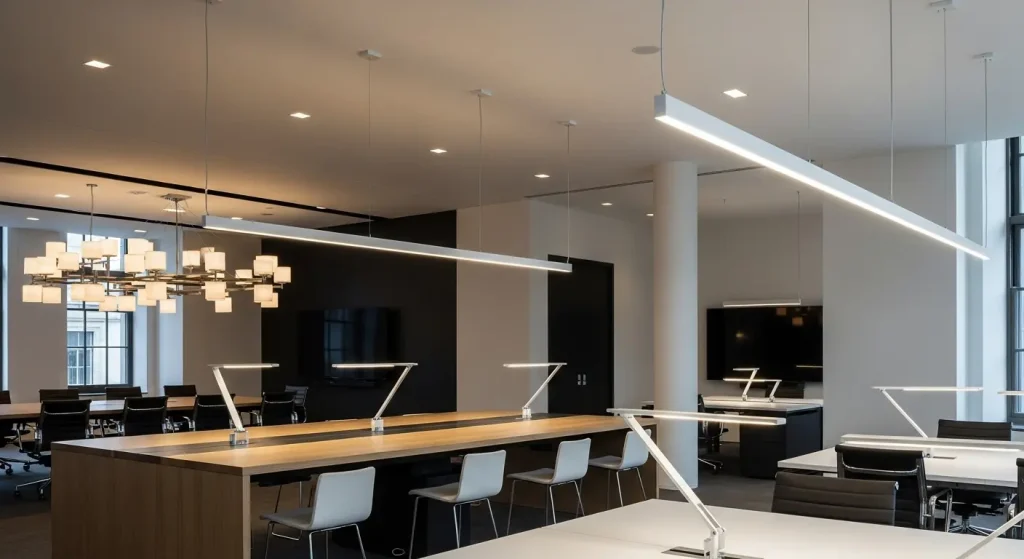
Today’s office is both a functional space and a strategic asset. Lighting must therefore support:
- Healthy and comfortable work environments
- Enhanced focus and visual clarity
- A modern, premium corporate image
- Energy savings aligned with ESG goals
- An adaptable layout that supports hybrid work
- Compliance with WELL Building Standard and EN12464-1
This comprehensive guide explains what defines contemporary office lighting fixtures, the design trends shaping global workplaces, and how corporate buyers, lighting designers, and project contractors can choose the right fixtures for modern office environments.
👉 Need expert advice for your project?
Solicite um orçamento and our engineering team will provide tailored recommendations.
What Defines Contemporary Office Lighting Fixtures?
Contemporary workplace lighting emphasizes clean architecture, user comfort, modularity, and high-performance optics. Below are the elements that distinguish modern fixtures from traditional fluorescent troffers or basic LED panel lights.
1. Minimalist Architectural Aesthetics
Contemporary office luminaires favor simplicity, architectural blending, and visual cleanliness. Typical features include:
- Slim linear aluminum profiles
- Suspended geometries
- Trimless recessed downlights
- Matte black, matte white, or brushed metal finishes
- Deep anti-glare baffles to hide the light source
- Invisible transitions between lighting and ceiling structures
This modern aesthetic aligns with Scandinavian offices, premium co-working spaces, and high-end corporate headquarters.
2. Human-Centric Light Quality
With employees spending 6–9 hours daily on screens, visual comfort is paramount.
Contemporary office lighting prioritizes:
- Low-glare optical systems (UGR < 19)
- High color fidelity (CRI 90–95)
- Balanced CCT between 3000K–4000K
- Flicker-free drivers (≤ 3% flicker)
- Even illumination across task areas
Human-centric lighting directly contributes to productivity, reduced headaches, and improved focus.
👉 Explore modern workplace lighting strategies in our Soluções de Iluminação section.
3. Flexibility for Hybrid Workspaces
Today’s offices are constantly reconfigured to support:
- Team collaboration
- Private focus work
- Hybrid video meetings
- Creative brainstorming
- Multi-use social zones
Thus, lighting must be modular and flexible. Popular options include:
- Magnetic track lighting systems
- Suspended linear fixtures
- Adjustable downlights
- Modular light bars
- Re-positionable spot modules
These allow designers to adjust illumination as the space evolves.
4. Sustainability and Longevity
Corporations increasingly focus on environmental impact and lifecycle cost.
Modern office lighting therefore prioritizes:
- High efficiency (100–150 lm/W)
- Long lifespan (50,000h L80/B10)
- Motion and daylight sensors
- Smart dimming to optimize energy use
- Materials that support green building certifications
Selecting sustainable fixtures not only reduces energy bills but strengthens corporate ESG performance.
5. Smart Lighting System Integration
Contemporary lighting must communicate seamlessly with smart control platforms, including:
- DALI-2 centralized lighting control
- Casambi wireless mesh
- Escurecimento de 0 a 10 V
- Building Management Systems (BMS)
- Meeting room automation systems
This allows offices to create automated lighting scenes such as:
- Morning Boost
- Collaboration Mode
- Video Conference Mode
- Evening Relax Mode
- Cleaning / Maintenance Mode
👉 Want to see how smart controls elevate office productivity?
Visite o nosso Soluções de Iluminação for real examples.
Trends in Contemporary Office Lighting Fixtures
The following trends reflect what lighting designers and procurement teams in Europe, the Middle East, and North America are demanding for modern workplaces.
1. Linear Suspension Fixtures
Suspended linear lights are the flagship of contemporary office design, offering:
- Direct, indirect, or mixed distributions
- Elegant and minimal profiles
- Uniform illumination for long desks and open workstations
- Seamless integration above meeting tables
They create strong visual identity while providing excellent task lighting.
2. Trimless and Recessed Downlights
Recessed fixtures remain essential for modern offices due to:
- Anti-glare optical design
- Architectural purity
- Clean ceiling appearance
- Wide range of beam angles
These fixtures are typically used in reception zones, corridors, meeting rooms, and informal collaboration spaces.
3. Modern Track Lighting Systems
Track systems—especially magnetic track lighting—have become a dominant trend in high-design corporate interiors.
Benefits include:
- High flexibility for evolving office layouts
- Ability to mix spotlights, linear bars, and pendants
- Clean minimalist aesthetic
- Easy re-positioning without rewiring
👉 View examples of track-based office projects in our Galeria de Projetos.
4. Tunable White “Human-Centric” Lighting
Tunable white fixtures support circadian rhythm and improve mood and productivity:
- Morning (4000K) → alertness
- Afternoon (3500K) → focus
- Evening (3000K) → relaxation
These systems are increasingly required in WELL-certified offices.
5. Modern Surface Finishes and Materials
Common finishes for contemporary fixtures include:
- Gunmetal grey
- Matte black
- Metallic champagne
- Brushed aluminum
- Acrylic with micro-prism lenses
These finishes align with premium interior design trends.
Functional Layers of Office Lighting
Modern office lighting is most effective when it blends multiple layers of illumination. Contemporary fixtures are chosen not only for their style but for their functional roles.
Selecting the right contemporary office lighting fixtures goes far beyond aesthetics. For professional buyers, corporate clients, and commercial lighting manufacturers, the real value lies in technical optimization, employee comfort, energy efficiency, future scalability, and architectural integration.
This section breaks down the key parameters and structured workflow needed to make the correct decision for any commercial office environment.
1. Ambient Lighting (General Illumination)
This ensures broad, uniform lighting for open office floors.
Common fixture types:
- Linear suspension fixtures
- Recessed downlights
- Grid-mounted or track-based linear bars
Target illuminance:
300–500 lux depending on activity and local standards (EN12464-1, WELL)
Ambient lighting forms the foundation of visual comfort and must avoid glare, hotspots, or uneven illumination.
2. Task Lighting (Focused Work Areas)
Utilizado para:
- Individual workstations
- Drafting tables
- Balcões de recepção
- Meeting tables
Fixtures typically include:
- Adjustable linear pendants
- Desk-mounted task lights
- Directional track modules
Task lighting improves visual clarity during high-precision work and reduces eye strain.
3. Accent Lighting (Feature Highlighting)
Contemporary offices increasingly include architectural features and visual branding elements such as:
- Logo walls
- Art installations
- Vertical greenery
- Product displays
Accent lighting is achieved using:
- Adjustable spot track lights
- Lavadores de parede
- Narrow beam downlights
It adds depth and visual hierarchy—important for corporate branding and interior experience.
👉 Want professional guidance on combining ambient, task, and accent layers?
Consult our engineering team through Contact Our Engineer Team.
Key Performance Parameters for Contemporary Office Fixtures
Below is the technical framework procurement managers and lighting designers should use when evaluating modern office lighting products.
1. Light Quality: CRI, CCT, and Gamut
High-quality office fixtures must meet:
- CRI ≥ 90
- R9 > 50 for natural skin tones
- SDCM ≤ 3 for color consistency
- CCT options from 3000K–4000K for various office moods
Most contemporary offices prefer:
- 4000K → crisp and professional
- 3500K → balanced and calm
- 3000K → for lounge and hospitality-style office areas
2. Anti-Glare Requirements (UGR)
In open-plan offices, glare control directly affects:
- Concentration
- Eye comfort
- Long-term productivity
- Screen visibility
Contemporary fixtures are designed to maintain:
- UGR < 19 (standard office requirement)
- Deep-set reflectors
- Micro-prismatic diffusers
- Multi-layer baffles
This is essential for compliance with EN12464-1.
👉 Want anti-glare optimized fixtures for your project?
Explore our portfolio under Baixe o catálogo de produtos.
3. Beam Angles and Light Distributions
Modern fixtures require precision optical design. Manufacturers typically offer:
- Narrow beams (20°–30°) for accent or small zones
- Medium beams (40°–60°) for general work areas
- Wide beams (70°–90°) for large open spaces
Suspended linear fixtures often provide:
- Direct lighting
- Indirect lighting
- Direct/Indirect combined distribution
This flexibility supports human-centric design.
4. Efficiency & Sustainability
Even aesthetic fixtures must deliver:
- High lumen efficacy: 100–150 lm/W
- Reduced energy consumption
- Long lifetime (50,000h L80/B10)
- Compatibility with motion/daylight sensors
- Low carbon footprint
These parameters support ESG reporting and LEED/WELL certifications.
5. Fixture Form Factor and Installation Methods
Contemporary fixtures must integrate with diverse ceiling types:
| Ceiling Type | Recommended Fixture Types |
|---|---|
| Open ceiling | Suspended linear, track systems |
| T-grid ceiling | LED panels, linear bars |
| Plaster ceiling | Recessed downlights, trimless linear |
| Wood/feature ceilings | Magnetic tracks, pendant cylinders |
Choosing the right form factor ensures aesthetic alignment with architectural design.
6. Smart Lighting Control Compatibility
Corporate clients increasingly demand:
- DALI-2 centralized control
- Casambi wireless mesh systems
- Escurecimento de 0 a 10 V
- Occupancy sensors
- Aproveitamento da luz do dia
Smart lighting dramatically improves energy savings while enabling flexible scene-setting.
👉 Learn more in our Soluções de Iluminação guide on smart office lighting.
Environmental & Architectural Factors to Consider
Lighting should always support the architecture—not override it. Below are essential environmental factors:
1. Ceiling Height
- <2.8m → recessed downlights + compact linear bars
- 2.8–3.5m → suspended linear fixtures
- 3.5m → track lights or high-output cylinders
2. Surface Reflectance
White or bright interiors reduce required lumen output.
Dark interiors require higher intensity and broader beam angles.
3. Natural Light Contribution
Windows, skylights, and glass partitions significantly affect the lighting plan.
Smart sensors can reduce energy cost by 20–40% through daylight harvesting.
4. Office Type & Layout
Exemplos:
| Office Type | Lighting Recommendation |
|---|---|
| Co-working | magnetic tracks + tunable white |
| Corporate HQ | linear pendants + downlights |
| Startup studio | suspended geometric fixtures |
| Hybrid workplace | flexible grid lighting with track systems |
👉 Need a project-specific lighting layout?
Usar Solicite um orçamento for a free office lighting simulation.
Major Contemporary Office Fixture Types
To build a fully optimized office lighting environment, you need the right mix of fixture types. Contemporary offices rarely rely on a single lighting form. Instead, designers create a layered lighting system that uses different fixtures for different purposes.
Below is a complete breakdown of the fixture types used in modern offices, along with application guidance tailored to lighting designers, architects, procurement managers, and international lighting manufacturers.
1. Linear Suspension Lights (Direct / Indirect)
The signature fixture of modern workplaces.
Key Features
- Architectural minimalist appearance
- Slim aluminum profiles
- Excelente uniformidade
- Options for direct-only or direct/indirect distribution
- Perfect for visually defining zones
When to Use
- Open workstations
- Shared tables
- Meeting rooms
- Collaboration hubs
- Executive desks
Why They Matter
Indirect light softens the atmosphere and reduces shadows. Direct light provides task illumination. The combination creates a balanced, visually comfortable environment.
👉 Want to explore linear suspension options?
Visit Baixe o catálogo de produtos.
2. Recessed or Trim-less Downlights
Recessed fixtures offer seamless ceiling integration and professional visual comfort.
Key Features
- Deep anti-glare optical design
- UGR < 19
- Narrow to wide beam options
- Multi-reflector choices (black, silver, champagne)
- Compatible with plasterboard and grid ceilings
When to Use
- Corporate reception
- Corridors
- Focus rooms
- Lounge zones
- Breakout spaces
Why They Matter
Downlights bring precision and sophistication to office environments, especially when layered with suspended fixtures.
3. LED Panels & Edge-lit Luminaires
Although more traditional, high-end contemporary panels still play an important role.
Key Features
- High uniformity
- Low cost per lumen
- Easy to install
- Available in micro-prismatic anti-glare versions
When to Use
- Budget-driven office renovations
- Large uniform work areas
- T-grid dropped ceilings
Why They Matter
Modern panel lights (especially UGR<19) remain one of the most efficient ways to light large areas at low energy cost.
4. Track Lighting & Magnetic Track Systems
Track lighting has moved from retail to office design due to its flexibility and modern aesthetics.
Key Features
- Adjustable and repositionable modules
- Mix of spots, linear bars, pendants
- Magnetic systems allow tool-free installation
- Black and white finishes match modern interiors
When to Use
- Creative studios
- Co-working spaces
- Hybrid zones
- Multi-functional corporate areas
- Design-led office interiors
Why They Matter
Perfect for workplaces that evolve frequently. Contractors save time, and companies avoid expensive rewiring when layouts change.
👉 See office track applications in the Galeria de Projetos.
5. Pendant Cylinders & Acoustic Lighting
Suspended cylindrical lights and acoustic luminaires are gaining popularity, especially in open offices.
Key Features
- Strong visual identity
- Highly focused task lighting
- Can integrate acoustic materials
- Available in many color finishes
When to Use
- Creative agencies
- Design studios
- High-end corporate headquarters
- Lounge areas
- Acoustic-sensitive spaces
Why They Matter
They combine lighting and acoustic performance—two major needs in modern open-plan offices.
6. Wall Washers & Vertical Illumination Fixtures
Contemporary offices put more emphasis on lighting walls and vertical surfaces.
Key Features
- Smooth vertical brightness
- Enhance architectural lines
- Improve depth and spatial perception
When to Use
- Logo walls
- Brand signage
- Art walls
- Corporate hallways
Why They Matter
Vertical illumination increases perceived brightness without increasing energy consumption—an important advantage for sustainability.
How to Build a Layered Contemporary Lighting Layout
Now that we’ve reviewed the main fixture types, here’s a professional workflow for creating a multi-layer office lighting system.
1. Start with General Illumination (Ambient Layer)
Select linear suspensions or LED panels to achieve:
- 300–500 lux
- Uniformity ≥ 0.6
- UGR < 19
This is the foundation of visual comfort.
2. Add Task Lighting to Boost Focus Areas
Usar:
- Linear pendants directly above desks
- Adjustable cylinders for meeting tables
- Portable task lights where needed
Task lighting helps reduce eye strain and supports productivity.
3. Introduce Accent Lighting to Create Visual Depth
Use track modules or narrow-beam downlights to highlight:
- Architectural features
- Logo walls
- Display shelves
- Textured materials
This layer brings sophistication and brand identity.
4. Integrate Smart Controls
Modern lighting must adapt to office rhythms through:
- Occupancy sensors
- Aproveitamento da luz do dia
- Predefinições de cena
- Tunable white profiles
Typical lighting scenes include:
| Scene Name | Propósito |
|---|---|
| Focus Mode | High clarity, 4000K direct/indirect |
| Collaboration Mode | Softer lighting, 3500K |
| Video Conference Mode | Balanced vertical and facial lighting |
| Creativity Mode | Indirect emphasis, warmer tone |
| Cleaning Mode | High brightness for visibility |
👉 For full technical control integration, see Soluções de Iluminação.
Lighting Calculation Example: A 300m² Modern Office
Below is a simple but helpful case study for B2B buyers.
Office Type:
Open-plan + meeting rooms
Target Illuminance:
350–400 lux
Ceiling Height:
3.0 meters
Recommended Fixture Mix:
| Tipo de luminária | Quantidade | Propósito |
|---|---|---|
| Linear Suspended Direct/Indirect | 22 pcs | Iluminação geral |
| Trimless Downlights | 36 pcs | Circulation pathways |
| Track Spots | 18 pcs | Accent wall lighting |
| Tunable White Fixtures | 10 pcs | Meeting rooms |
| Sensors | 6 units | Otimização de energia |
Expected Energy Savings:
~32–45% with DALI + daylight harvesting
👉 Want a lighting calculation for your office project?
Submit your floorplan via Solicite um orçamento.
Common Mistakes in Selecting Office Lighting & How to Avoid Them
Even in large-scale commercial projects, office lighting mistakes happen frequently—often because decisions are rushed, oversimplified, or based purely on budget rather than long-term performance.
Below are the most common pitfalls lighting manufacturers, distributors, procurement teams, and design consultants must avoid when specifying contemporary office lighting fixtures.
Mistake 1: Choosing Fixtures Based Only on Wattage Instead of Light Output
Many buyers still compare fixtures by wattage rather than lumen output.
However, two 30W fixtures may produce:
- 2400 lm (80 lm/W) — outdated LED
- 3900 lm (130 lm/W) — modern high-efficiency LED
This results in:
- Higher operating cost
- More fixtures needed to reach target illuminance
- More heat load
- Lower sustainability performance
Correct practice:
Always compare lm/W, not watts.
Almeje 100–150 lm/W for today’s modern office fixtures.
👉 For high-efficiency products, check the Catálogo de Produtos.
Mistake 2: Ignoring Glare Control (UGR)
Even high-lumen fixtures can cause discomfort if glare is uncontrolled.
Glare leads to:
- Eye strain
- Fatigue
- Reduced productivity
- Reflections on screens
Contemporary offices—especially open-plan areas—must follow:
- UGR < 19 for workstation zones
- Deep anti-glare baffles
- Micro-prismatic diffusers
- Black reflector options
Neglecting UGR is one of the biggest lighting failures in corporate interiors.
Mistake 3: Using One-Type-Fits-All Lighting
Traditional offices often relied on uniform grid lighting.
However, modern workplaces require layered illumination:
- Iluminação ambiente
- Iluminação de tarefa
- Iluminação de destaque
- Iluminação vertical
Using only panel lights or only downlights results in:
- Flat, uninspired spaces
- Poor visual hierarchy
- Increased visual fatigue
- Reduced brand impact
Correct practice:
Combine multiple fixture types to create depth, comfort, and visual identity.
👉 See real multi-layer office projects in the Galeria de Projetos.
Mistake 4: Underestimating the Role of Color Temperature (CCT)
Choosing the wrong CCT can lead to:
- Spaces that feel too cold or too warm
- Poor focus in work areas
- Inconsistency across different office zones
Recommended CCT for modern offices:
| Area | CCT recomendado |
|---|---|
| Workstations | 3500K–4000K |
| Meeting Rooms | 3500K |
| Lounge / Café Area | 3000K–3500K |
| Reception | 3000K–3500K |
| Brainstorm Zones | 4000K |
Tunable white adds flexibility and is highly recommended for contemporary interiors.
Mistake 5: Ignoring Future Maintenance & Upgrade Needs
Lighting is a long-term investment.
Common maintenance-related mistakes include:
- Choosing sealed fixtures that require full replacement
- Using fixtures with non-standard drivers
- Selecting designs that are hard to access in high ceilings
- Not planning for future smart control upgrades
Correct practice:
Choose modular, front-maintenance-friendly fixtures that support:
- Replaceable LED modules
- Standardized drivers
- DALI / Casambi upgrade paths
Mistake 6: Overlooking Smart Controls
A contemporary office without smart controls is incomplete.
Smart lighting provides:
- Automated energy reduction
- Personalized lighting scenes
- More comfortable meeting environments
- Better compliance with ESG requirements
- Long-term cost savings
Core technologies include:
- DALI-2 centralized control
- Casambi wireless mesh
- Occupancy sensors
- Aproveitamento da luz do dia
👉 Learn how smart systems improve office performance under Soluções de Iluminação.
Mistake 7: Not Matching Lighting to Architectural Style
Lighting is part of interior design.
Choosing fixtures that don’t match the architecture leads to:
- Visual conflict
- Lack of cohesion
- Poor brand perception
Exemplos:
- Industrial-style offices → black track & metal finishes
- Corporate HQ → trimmed or trimless recessed downlights
- Creative agencies → suspended geometries + accent track
- Minimalist tech offices → slim linear profiles
Contemporary lighting must enhance architecture, not fight it.
How XHLUX Can Help Clients Avoid These Mistakes
As a professional LED lighting manufacturer serving buyers across Europe, the Middle East, and beyond, offering the right support can differentiate you from competitors.
1. Provide complete photometric files (IES / LDT)
This helps designers run simulations and avoid miscalculations.
2. Offer expert layout proposals
Your engineering team can create stronger proposals and win large projects.
3. Support customized CCT, optics, and form factors
ODM services make your products fit specific space requirements.
4. Provide long-term warranties and rapid technical support
This increases trust in international buyers.
5. Demonstrate installation flexibility
Show how your systems work with different ceilings and layouts.
👉 For ODM/engineering support, connect with us via Contact Our Engineer Team.
Professional Workflow for Selecting Contemporary Office Lighting Fixtures
Below is a simplified, actionable process designed for distributors, lighting consultants, and engineering contractors working on corporate interior projects.
Step 1 — Define the Purpose of Each Office Area
Each zone has different requirements:
| Tipo de espaço | Primary Lighting Need |
|---|---|
| Workstations | Low-glare + task efficiency |
| Meeting Rooms | Balanced facial lighting |
| Reception | Brand identity illumination |
| Lounge Area | Warm, relaxing ambience |
| Collaboration Zones | Flexible, dimmable lighting |
| Corridors | Uniformity + safety |
Start with functional goals—not fixture types.
Step 2 — Determine Technical Specifications
For each zone, specify:
- Target illuminance (lux)
- CCT & CRI
- Ângulo do feixe
- Light distribution
- UGR requirement
- Smart control compatibility
These technical foundations ensure the lighting aligns with international standards (EN12464-1, WELL, ASHRAE).
Step 3 — Select Fixture Forms According to Architecture
Use architectural style as your guide:
- Linear suspension → open offices
- Recessed downlights → premium corporate HQ
- Magnetic tracks → creative studios / flexible offices
- Wall washers → logo walls, presentation spaces
- Panels → budget-driven fitouts
The fixture type should reinforce the design language of the space.
Step 4 — Build a Layered Lighting Plan
Combine:
- Iluminação ambiente
- Iluminação de tarefa
- Iluminação de destaque
- Iluminação vertical
Layering ensures depth, visual variety, and functional harmony.
👉 Want a free lighting layout simulation?
Submit your floorplan via Solicite um orçamento.
Step 5 — Integrate Smart Lighting Controls
Smart controls are the backbone of modern office environments.
- DALI-2 for centralized control
- Casambi for wireless retrofits
- Sensors for energy optimization
- Scene presets for meeting rooms & hybrid work
Integrated control reduces energy by 20–45% and improves occupant comfort.
Step 6 — Validate Using Photometric Simulations
Before final procurement:
- Run Dialux or Relux simulations
- Confirm uniformity & UGR
- Adjust beam angles & fixture spacing
- Verify emergency lighting coverage
Accurate simulation prevents costly rework.
👉 Our engineering team can assist — use Contact Our Engineer Team.
Step 7 — Select a Manufacturer with Proven B2B Capability
A successful modern office lighting upgrade requires a manufacturer offering:
✔ High-performance optical engineering
CRI90–95, UGR<19, tunable white options.
✔ Multiple fixture platforms
Track, linear, recessed, panels, cylinders.
✔ ODM/OEM customization
Beam angle, CCT, reflectors, drivers, housing.
✔ Global certifications
CE / ENEC / CB / ISO9001.
✔ Fast lead times + reliable supply chain
Essential for international B2B partners.
✔ Strong technical support
IES files, simulations, and installation guidance.
👉 Learn more About XHLUX via Sobre a XHLUX.
FAQ About Contemporary Office Lighting Fixtures
Q1: What makes lighting “contemporary” in office environments?
Contemporary office lighting emphasizes minimalistic design, low-glare optics, flexible layouts, smart control integration, and high energy efficiency.
Q2: What is the ideal CCT for modern offices?
Most offices choose 3500K–4000K for task-oriented clarity and visual comfort. Lounge or hospitality-style zones may use warmer 3000K.
Q3: Are linear suspension fixtures better than panels?
Not necessarily. Linear suspension offers premium aesthetics and direct/indirect balance, while panels are cost-effective for large uniform areas. Many offices use both.
Q4: How important is UGR in contemporary office lighting?
Extremely important. UGR<19 is required for workstation zones. Poor glare control reduces comfort and productivity.
Q5: Which fixtures work best for flexible hybrid offices?
Magnetic track systems and modular linear systems are ideal due to reconfigurability and tool-free adjustments.
Q6: Do modern office fixtures need to support smart lighting?
Yes. Smart controls (DALI, Casambi, sensors) are now standard in high-spec office designs and significantly reduce energy costs.
Q7: Can XHLUX support OEM/ODM for contemporary office projects?
Yes. We provide optical customization, structure redesign, driver options, private labeling, and full engineering support.
👉 For OEM/ODM inquiries, contact us via Contact Our Engineer Team.
Summary
Contemporary office lighting is more than a design choice—it is a strategic investment that shapes:
- Employee well-being
- Produtividade
- Space aesthetics
- Corporate branding
- Operational efficiency
- ESG performance
By combining high-performance optical engineering, architectural integration, and smart control systems, your office lighting can significantly elevate the entire workplace experience.
Whether you’re a lighting manufacturer, distributor, interior contractor, or global procurement manager, selecting the right fixtures and the right partner makes all the difference.
XHLUX oferece:
- CRI90–95 optical platforms
- UGR<19 anti-glare systems
- Linear / track / recessed / panel fixtures
- Smart control compatibility
- EU-standard certifications
- Professional Commercial Engineering Lighting support
Take immediate Action
For immediate assistance or project collaboration, choose one of the following:
📞 Converse pelo WhatsApp
For urgent communication, sampling requests, or quick technical questions.
📧 Email Us
For quotations, specifications, OEM/ODM discussions.
🌐 Solicite um orçamento
For lighting simulations, office layout proposals, or customized fixture packages.
You can also explore: