 XHLUX
XHLUX

Índice
- Why Some Products Get Noticed Instantly—And Others Look “Flat”
- What Is Accent Lighting in Retail?
- Why Accent Lighting Is Essential for Product Presentation
- How Accent Lighting Enhances Product Presentation
- Best Lighting Fixtures for Retail Accent Lighting
- Accent Lighting Techniques for Different Retail Displays
- Accent Lighting vs Ambient Lighting: Finding the Right Balance
- Common Mistakes in Retail Accent Lighting
- How to Design Effective Retail Accent Lighting
- Why Retail Accent Lighting Often Fails After Installation
- Comparison Table: Best Accent Fixture Choice by Retail Category
- FAQ About retail accent lighting
- Conclusão
- Consultas comerciais são bem-vindas.
Why Some Products Get Noticed Instantly—And Others Look “Flat”
Many retail stores invest in great products, clean displays, and strong branding—yet customers still walk past without stopping. Owners often blame the merchandise, pricing, or foot traffic. But in many cases, the real problem is simpler:
the product isn’t being visually “selected” by light.
Many retail stores have good products and attractive displays, yet struggle to make merchandise stand out to customers.
Without proper retail accent lighting, products look flat, colors feel dull, and displays lack hierarchy. Customers don’t know where to look. High-margin items become invisible. Seasonal campaigns fail to “pop,” and the store can feel less premium—even if the interior design is expensive.
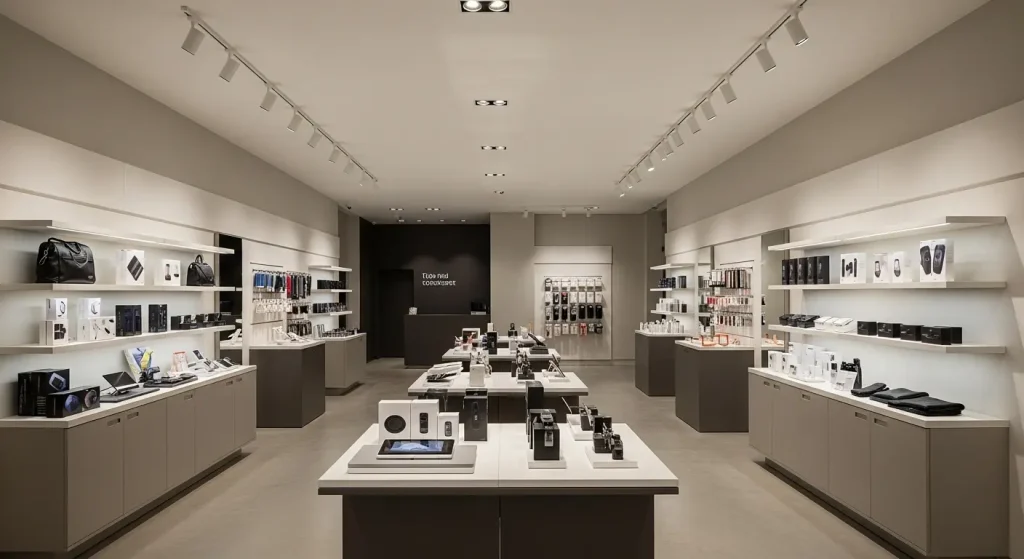
Accent lighting is one of the most powerful tools in retail lighting design because it turns lighting into a merchandising system: it directs attention, creates depth, reveals color and texture, and builds a clear visual path through the store.
This guide gives you a practical, professional method for building accent lighting that works across different retail display types—without guessing, and without costly rework.
If your project requires adjustable accent layers plus consistent ambient foundations, it’s often helpful to evaluate lighting as a complete system:
- Adjustable highlights: Iluminação de trilho LED
- Beam flexibility for changing displays: zoomable track lights
- Ambient comfort base: LED spot downlights
- Architectural ambient fill: LED linear lighting
What Is Accent Lighting in Retail?
Iluminação de destaque is focused, directional lighting designed to highlight specific products, displays, or zones. It creates visual contrast so the eye naturally moves toward what matters.
Accent lighting is not “just brighter lighting.” It is selective lighting.
Accent Lighting vs Ambient Lighting
- Iluminação ambiente answers: “Can customers see and move comfortably?”
- Iluminação de destaque answers: “What should customers notice first?”
If you have only ambient lighting, everything looks equally important—which means nothing looks important.
What is accent lighting in retail?
Accent lighting is focused lighting used to highlight specific products, displays, or areas, creating visual contrast and attracting customer attention.
Why Accent Lighting Is Essential for Product Presentation
Accent lighting is the visual merchandising “multiplier.” It doesn’t just illuminate; it increases perceived value e reduces decision friction.
1) It attracts attention (visibility becomes intentional)
Retail is full of visual noise: signage, packaging, mannequins, shelves, reflections. Accent lighting creates a focal point so products don’t compete equally.
2) It creates depth and hierarchy (the “3D effect”)
Good accent lighting adds shadow and modeling in the right way—so products look dimensional instead of flat. This is why the same display can look premium in one store and ordinary in another.
3) It increases perceived quality (especially for premium categories)
For fashion, leather goods, jewelry, cosmetics, and design products, lighting is part of the brand. Poor accent lighting can make expensive items look cheap.
Why is accent lighting important in retail?
It improves product visibility, creates hierarchy, and makes displays more engaging—so merchandise stands out and feels more valuable.
How Accent Lighting Enhances Product Presentation
This section is the core “repeatable formula.” If you can apply these three outcomes, your accent lighting will work in almost any retail category.
Creating Visual Focus on Key Products
Accent lighting should prioritize what the business wants to sell:
- new arrivals
- promotional displays
- high-margin items
- seasonal campaigns
- hero products and brand statements
This is where iluminação de trilho becomes the retail standard: you can adjust aim and focus as merchandising changes. That flexibility is why Trilhos de luz LED are the default accent tool in modern stores.
Improving Depth and Three-Dimensional Appearance (30°–45° rule)
One of the most reliable professional rules:
aim accent lighting at roughly a 30°–45° angle to the product surface.
Why?
- too vertical (straight down) = flat + shadowing by the shopper’s body
- too horizontal = glare + reflections + discomfort
- 30°–45° = modeling and depth without harsh glare
This is also where optical quality matters. In retail projects, you often want a clean beam with controlled edges. For beam definition basics, see: Beam angle definition.
Enhancing Color and Material Details
Accent lighting is the “truth test” for products. If CRI is low, colors look dull and materials lose richness—especially textiles, wood, leather, food packaging, and cosmetics.
Professional targets commonly used in retail:
- CRI ≥90 (baseline for quality presentation)
- Ra97 for premium fashion/cosmetics/jewelry zones
- SDCM <3 for consistent color appearance across multiple accent heads
How does accent lighting improve product presentation?
It highlights key products, adds depth, and reveals true color and texture—making merchandise more appealing and easier to evaluate.
Best Lighting Fixtures for Retail Accent Lighting
Track Lighting: The Primary Retail Accent Tool
Track lights are preferred because they are:
- adjustable (aiming and repositioning)
- scalable (add or reduce heads)
- compatible with changing display layouts
- available with multiple beam angles and glare-control options
For stores that frequently change merchandising, track lighting reduces rework. Explore typical retail categories in Iluminação de trilho LED and, when beam flexibility matters without changing fixtures, consider zoomable track lights.
LED Spotlights (Focused Accent)
Spot modules (or focused spotlights) are ideal for:
- mannequins
- feature walls
- hero products
- jewelry and premium items
A clean beam and glare control are essential, because shoppers often look toward the fixtures while browsing.
The “Comfort Foundation”: Downlights and Linear Lighting Matter Too
A common failure is installing strong accents without a stable ambient base. Retail needs a comfortable overall brightness layer so the store is navigable and not visually stressful.
That’s why many professional retail schemes combine:
- ambient layer: LED spot downlights ou LED linear lighting
- accent layer: Iluminação de trilho LED
Commercial-grade spec reminders (for repeatability and comfort):
- efficiency target: 100–130 lm/W (application/optics dependent)
- lifetime: L70/B50 50.000 horas
- thermal stability: dissipador de calor de alumínio fundido
- optics: Lente de PMMA options for controlled distribution
- LED engine options such as Chip COB for clean beam behavior
- comfort logic: glare control and, for office-like zones, targets such as UGR<19 are often referenced as a low-glare benchmark
For a neutral reference on glare terminology: UGR (Índice Unificado de Ofuscamento).
Accent Lighting Techniques for Different Retail Displays
This section is where “accent lighting is important” becomes practical.
Accent Lighting for Mannequins
Goal: make the mannequin look dimensional and premium, without creating harsh face shadows.
Practical method:
- beam angle: 15°–24° (narrow to medium-narrow)
- aim: 30°–45° toward torso/face zone
- use 2 lights if needed (cross-lighting) to avoid deep shadows
- avoid aiming from directly above the head (creates “eye socket” shadows)
Common mannequin failure:
One downlight directly above → flat body + shadowed face → looks cheaper.
Accent Lighting for Shelves & Wall Displays
Goal: highlight product faces and labels clearly, without glare into customer eyes.
Practical method:
- beam angle: 24°–36° (medium beam)
- distance from wall: 30–60 cm (depends on ceiling height and beam)
- aim so the beam hits product faces, not the floor
- keep glare control in mind (avoid exposed bright source in sightline)
Accent Lighting for Feature Tables
Goal: make the center display feel like a “stage,” without hotspotting the center and leaving edges dark.
Practical method:
- usar multiple fixtures crossing the table (not just one)
- avoid one single tight beam (creates “spotlight circle”)
- combine a medium beam with a softer fill beam if needed
- aim to balance center and perimeter
A simple test:Stand at typical shopper positions around the table. If you see harsh glare, the aim or optics are wrong.
Accent Lighting vs Ambient Lighting: Finding the Right Balance
Retail lighting is not a binary choice. It’s a layered system.
The professional concept: Contrast ratio (not total brightness)
Great retail lighting is built on contrast:
- ambient lighting provides comfortable visibility
- accent lighting creates hierarchy and focus
If accent lighting is too weak, the store looks flat.
If accent lighting is too strong, the store feels stressful and glaring.
What is the difference between accent and ambient lighting in retail?
Ambient lighting provides overall visibility, while accent lighting creates focus and highlights products.
Chart 1: Retail Lighting Layer Model (Simple and Useful)
| Layer | What It Does | Typical Fixture Types |
|---|---|---|
| Ambient layer | overall visibility, comfort, navigation | downlights / iluminação linear |
| Accent layer | product focus, hierarchy, merchandising | iluminação de trilho / zoomable track |
| Decorative layer (optional) | brand identity, atmosphere | pendant lights |
Common Mistakes in Retail Accent Lighting
This is where most stores lose performance even with “good fixtures.”
Mistake 1: Beam angle too wide (no focus)
If the beam is too wide, you don’t create hierarchy. Everything is lit the same.
Mistake 2: Lighting the floor, not the product
Many track heads are aimed poorly. The floor becomes bright, while shelves remain dull.
Mistake 3: Glare into customer eyes
If customers see the bright LED source in their line of sight, they feel discomfort and stop browsing. Glare control is a pass/fail factor.
Mistake 4: Ignoring display height changes
Retail displays are not static. If the store changes shelf heights or mannequin placement, aiming must adjust. That’s why adjustable track systems are valuable.
What are common mistakes in retail accent lighting?
Poor beam angle selection, incorrect aiming, lighting the wrong surfaces, and excessive glare.
How to Design Effective Retail Accent Lighting
This is a practical “do this, avoid that” framework you can hand to a store owner, contractor, or buyer.
Step 1: Start from merchandising, not the ceiling
- identify what must be seen first (hero products)
- map key display zones (mannequins, shelves, feature tables, wall zones)
Step 2: Assign beam angle by display type
- mannequins/hero products: 15°–24°
- shelves/walls: 24°–36°
- general highlights or broader coverage: 36°+ (use carefully)
Step 3: Use the 30°–45° aiming principle
This reduces flatness and improves depth.
Step 4: Lock in color quality
- CRI ≥90 (upgrade to Ra97 for premium categories)
- SDCM <3 for consistency across the store
- choose color temperature to match brand tone (many stores use neutral white for clarity and slightly warmer for premium accents)
Step 5: Build a stable ambient base
Use downlights or linear lighting so shoppers feel comfortable—then let accents do the selling.
Step 6: Plan for change
Retail changes. Choose systems that can adapt:
- adjustable track heads
- zoomable beams where needed
- consistent product family supply for future expansion
If you want a one-stop reference for a complete retail system (track + downlight + linear + pendant), start with the catálogo de produtos.
Why Retail Accent Lighting Often Fails After Installation
In many stores, the first installation looks acceptable during commissioning—but performance declines once real merchandising begins. Common reasons:
- displays change, but aiming stays the same
- new product packaging reflects differently (glare increases)
- seasonal themes shift, but beams are not updated
- mismatched color between batches becomes visible over time
This is why professional retail lighting is designed as an adjustable system, not a fixed “set and forget” layout. Suppliers who provide selection guidance—beam angles, glare-control options, and layout logic—help buyers avoid the most expensive mistake: finishing the ceiling before the lighting strategy is validated.
If you want support building a retail accent strategy (fixture selection + beam angles + layout logic), a structured approach like Soluções de Iluminação plus reference outcomes from project cases can shorten decision time.
Comparison Table: Best Accent Fixture Choice by Retail Category
| Retail Category | Accent Priority | Best Accent Strategy | Por que |
|---|---|---|---|
| Fashion & apparel | texture + premium feel | track accents + warm-neutral focus | clothing needs depth and color quality |
| Shoes & bags | material detail | medium-narrow beams + glare control | leather and shape need modeling |
| Jewelry | sparkle + precision | tight beams + high CRI/Ra97 | highlights and reflections drive value |
| Electronics | clarity + clean look | neutral base + controlled accents | reduce glare on screens/packaging |
| Cosmetics | skin tone + color accuracy | high CRI/Ra97 + balanced CCT | color rendering is critical |
FAQ About retail accent lighting
Conclusão
Retail accent lighting is not about making the store brighter. It’s about making the store understandable:
- what should customers see first
- what feels premium
- what looks dimensional
- what invites people to pause and engage
If you build accent lighting using:
- correct beam angles
- 30°–45° aiming
- high CRI and tight SDCM
- controle de brilho
- a stable ambient base
you create a repeatable merchandising system—one that works across seasons and display changes.
Consultas comerciais são bem-vindas.
If you’re planning a new store or trying to fix “flat displays,” a simple next step is to map your store into three groups:
- hero zones (mannequins, feature walls, promotions)
- selling zones (shelves, tables, product bays)
- circulation zones (walkways, entrances, cash desk)
Then match beam angles and fixture types to each zone.
To explore practical accent + ambient building blocks:
- adjustable accents: Iluminação de trilho LED
- flexible focus: zoomable track lights
- ambient comfort base: LED spot downlights
- architectural fill: LED linear lighting
- full selection reference: catálogo de produtos
- real application references: project cases
- project support / quotation: Contact/Quote