 XHLUX
XHLUX
Many hotels and restaurants want the same three words: warm, elegant, premium.
Two common results get in the way. The room becomes bright and flat, with no atmosphere. Or it becomes so dark that menus, faces, tables and walkways stop working.
Dobry hotel and restaurant lighting design is not simply less light. It is a decision about where light should lead the eye, where the room should stay quiet, and how those layers work together.
Ten hospitality lighting guide follows one route:
mood → layers → focus → fixtures → control → commercial practicality
Use it as a map. Then open a deeper guide only when you need one decision in detail.
W skrócie: Warm, elegant hospitality lighting comes from hierarchy and visual comfort—not from a single dimmer setting. Use the ambient, task, accent and decorative layers the space actually needs; protect guest sightlines; keep one ceiling language; then route into the room-by-room, wall-lamp, supplier or downlight guides as needed.
Spis treści
- Decide the mood guests should feel
- Shape the room with lighting layers
- Decide what should be brightest
- Hotels and restaurants need different lighting jobs
- Warmth is more than a lower colour temperature
- Control glare before chasing atmosphere
- Decorative lights set identity—not every lighting job
- Design the ceiling as one visual system
- Plan scenes for different times of day
- Match fixtures to lighting tasks
- Check commercial conditions before the design is set
- Plan maintenance and later replacement early
- Hotel and restaurant lighting design decision map
- Common hospitality lighting mistakes
- Streszczenie
🧭 1. Decide the Mood Guests Should Feel
Do not start with a catalogue of downlights, pendants and wall lamps.
Start with the feeling the room should create. That is how luxury hotel lighting design and restaurant work stay aligned with the interior—not with a random fixture shortlist.
| Mood you want | Lighting direction |
|---|---|
| Warm and intimate | Lower ambient level + stronger table / wall accents |
| Elegant and quiet | Controlled contrast + less visual clutter |
| Bright and premium | Clear visibility without an evenly glowing room |
| Dramatic | Stronger accents + quieter background |
| Relaxed | Soft transitions + coordinated warm visual character |
Convert “warm / elegant / premium” into design targets first. Fixture names come later.
🎯 Should you pick fixtures before the room mood?
No. Set mood and visual priorities first; fixture choice becomes clearer afterward.
🧱 2. Shape the Room with Lighting Layers
A flat, evenly bright room often looks ordinary—even when the fittings are expensive.
Think in four possible lighting layers, then use the ones the space actually needs:
- Ambient: base light and orientation through the room.
- Task: reception, reading, dining table, service counters.
- Accent: walls, artwork, architectural detail, display.
- Decorative: pendants and wall lamps that carry visual identity.
Restaurant ambient lighting alone is not enough for a fine dining room. Without task and accent layers, the space stays flat.
Many rooms fail the premium test because every fitting is doing the same job.
🎯 Why can a bright hospitality room still look flat?
When every surface is equally bright, the eye finds no hierarchy and no clear focus.
🔦 3. Decide What Should Be Brightest
Hierarchy starts with focus, not with more wattage.
Hotel priorities
Arrival and guidance often need emphasis on reception, artwork, feature walls, lounge seating and path nodes. Hotel lobby lighting fixtures should support those targets—not turn the entire soffit into the brightest object in view.
Restaurant priorities
A fine dining lighting scheme usually prioritises tables, food, faces, art and the bar or feature zone.
What should not become brightest by accident
- Rows of bright ceiling discs
- Exposed high-brightness sources
- Back-of-house spill into guest view
- Cluttered ceiling services competing with the design
Downlight aperture, trim and source depth belong in that conversation; treat them as part of ceiling composition, not as decoration afterthoughts.
🎯 Should the fixture itself be the brightest thing in the room?
Usually no—unless the decorative piece is intentionally designed as the feature.
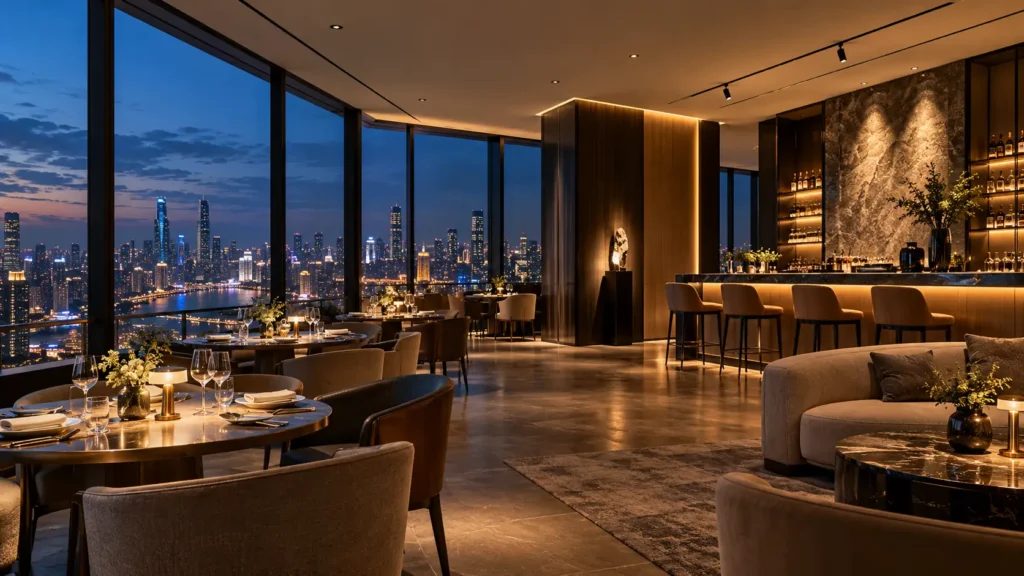
🏨 4. Hotels and Restaurants Need Different Lighting Jobs
Do not copy one lighting logic across every hospitality room.
| Przestrzeń | Główny cel | Lighting focus | Common problem |
|---|---|---|---|
| Hol hotelowy | Arrival + guidance | Architecture, reception, lounge | Evenly glowing ceiling |
| Pokój gościnny | Comfort + multiple activities | Bedside, reading, wardrobe, soft ambient | One ceiling light doing every job |
| Korytarz | Guidance + quiet rhythm | Path, doors, walls | Endless repeating bright dots |
| Dining room | Food + faces + atmosphere | Tables, vertical surfaces, accents | Too dark or too much glare |
| Bar | Focus + intimacy | Counter, bottles, feature surfaces | Overall over-brightness |
| Private dining | Flexible atmosphere | Table, walls, dimming scenes | Only one fixed scene |
This matrix is about jobs, not a full fixture schedule. For hotel zone-by-zone fixture shortlists, use the room-by-room hotel guide. For restaurant wall-lamp placement, use the restaurant wall-lamp guide.
🎯 Can hotels and restaurants share one lighting method?
No. Visual jobs differ by zone—but the overall design language should still stay consistent.
🌡️ 5. Warmth Is More Than a Lower Colour Temperature
A warmer CCT does not automatically create a warm room.
Warm feeling also depends on:
- material reflectance
- wall brightness
- contrast between light and quiet zones
- whether the source is directly visible
- dimming state
- interior colours and finishes
- colour rendering on food, faces and finishes
Even with a warm CCT, harsh sources and a flat field still feel uncomfortable.
🎯 Does a lower colour temperature always make a room feel warmer?
No. Glare, materials, light placement and brightness hierarchy matter just as much.
👁️ 6. Control Glare Before Chasing Atmosphere
Atmosphere fails when guests look up into bright sources.
Sprawdzać:
- source setback and shielding
- reflector / optic behaviour
- guest viewing angles
- pendant height in dining sightlines
- wall-lamp eye-level relationships
A handsome fitting can still glare badly from a seating position.
For deeper glare and beam-angle decisions, use the anti-glare and track beam-angle guides linked in the decision map below.
🎯 Can a good-looking fixture still create serious glare?
Yes. Appearance does not prove that guests will avoid looking into a bright source from real seating angles.
✨ 7. Decorative Lights Set Identity—Not Every Lighting Job
Pendants, wall lamps and decorative heads carry identity.
They rarely cover every job alone:
- base ambient
- reading
- table task
- wall accent
- circulation light
Decorative light answers “what the room looks like.” Architectural light answers “how the room works.” Premium hospitality usually needs both.
🎯 Can decorative lights replace architectural lighting?
Usually no. Decorative pieces build identity; other fixtures carry the practical lighting tasks.
🎼 8. Design the Ceiling as One Visual System
Treat the soffit as composition, not as a parts list:
- trimless or visible trim
- round or square
- recessed or surface-mounted
- fixed or adjustable
- track, downlight or linear
- finish consistency
- one fixture family language
Many premium commercial rooms succeed because the ceiling speaks one language—not because one head is expensive.
For downlight visual moves in more detail, use the designer-downlights guide linked in the decision map below.
🎯 Why does mixing too many ceiling styles look messy?
Different shapes, colours and structures compete instead of reading as one system.
🕰️ 9. Plan Scenes for Different Times of Day
Hospitality lighting is not one fixed brightness.
| Time / use | Lighting emphasis |
|---|---|
| Breakfast | Higher overall visibility |
| Daytime lobby | Balance daylight and electric light |
| Dinner | Lower ambient; stronger table and accent focus |
| Late night | Lower overall level; keep circulation readable |
| Cleaning / service | Higher operational visibility |
Use zoning, scenes, dimming and separate control groups. Keep the discussion at design level—do not turn this hub into a controls protocol essay.
🎯 Why is one fixed brightness weak for hotels and restaurants?
Daylight, guest activity and atmosphere needs change through the day.
🛠️ 10. Match Fixtures to Lighting Tasks
After the jobs are clear, map tasks to common forms:
| Lighting task | Common fixture type |
|---|---|
| Quiet base light | Recessed downlight |
| Aimable accent | Adjustable downlight / spotlight |
| Wall lighting | Wall washer |
| Identity and decoration | Pendant / wall lamp |
| Continuous architectural lines | Oświetlenie liniowe |
| Flexible accent positions | Oświetlenie szynowe |
This is task-to-form matching. It does nie mean a lobby may only use one product family.
🎯 Should fixture selection start from product appearance?
No. Decide the lighting task first, then pick the form that can do that job cleanly.
✅ 11. Check Commercial Conditions Before the Design Is Set
Before the visual scheme is set, scan the practical set:
- light output suitability for the task
- beam behaviour
- colour rendering needs
- kontrola olśnienia
- dimming compatibility
- install conditions
- thermal path
- documentation package
- access for maintenance
- later replacement consistency
This is a design-risk checklist—not a parameter encyclopaedia. Hospitality LED lighting standards and project specs belong in that design-set conversation so optics and install do not break the look later.
🎯 When should these commercial checks begin?
Before the visual design is set—because optics, install and maintenance can change what is buildable.
🔧 12. Plan Maintenance and Later Replacement Early
Design for what happens after opening day:
- driver access
- replaceable modules where required
- ceiling access conditions
- consistency across large repeat counts
- spare parts
- matching beam, colour and appearance after later swaps
Hotels feel this first: corridors and guest rooms repeat the same head many times.
🎯 Why does maintenance belong in the first lighting design?
Because a later mismatch in beam, colour or appearance can undo the original room effect.
Hotel and Restaurant Lighting Design Decision Map
Use this hub to enter the right deeper guide:
| If you need to solve… | Go deeper |
|---|---|
| Hotel zone fixture shortlists | Luxury Hotel Lighting: A Room-by-Room Fixture Guide |
| Restaurant wall-lamp placement | Wall Lamp Placement in Restaurants: A Practical Guide 2026 |
| Hotel lighting supplier checks | What to Check Before Choosing a Hotel Lighting Supplier |
| Designer downlight visual moves | Designer Downlights: 10 Modern Design Ideas for Commercial Spaces |
| Kontrola olśnienia | Does an Anti-Glare Spotlight Really Reduce Glare? |
| Beam angle for track accents | Jaki kąt wiązki światła jest najlepszy dla komercyjnego oświetlenia szynowego? |
| Zoning ideas (retail method transferable) | Pomysły na strefowanie oświetlenia w nowoczesnych układach sklepów detalicznych |
Common Hospitality Lighting Mistakes
- Making the whole room the same brightness.
- Treating warmer CCT as the entire atmosphere plan.
- Relying on decorative lights alone.
- Ignoring real guest viewing angles.
- Choosing fittings one by one with no ceiling system.
- Leaving dimming, maintenance and replacement until the end.
🎯 What is the most common hospitality lighting mistake?
Treating lighting as a pile of fixtures instead of one coordinated visual system for the room.
Streszczenie
- Set mood before fixture shopping.
- Build premium feel with layers and hierarchy.
- Give hotel and restaurant zones different visual jobs.
- Control glare and source visibility early.
- Coordinate fixtures, control, install and maintenance as one system.
Często zadawane pytania
Wniosek
Warm, elegant hotel and restaurant lighting is not simply a darker room.
Decide what guests should notice first. Then organise brightness, fixtures and control around those priorities so the space feels considered from arrival to late night.
Bring Your Hospitality Lighting Concepts to Life with OEM/ODM Support
When a hotel or restaurant project needs a matched commercial family, development can cover:
- downlights for quiet ceilings
- track lights for flexible accents
- linear lighting for architectural lines
- OEM / ODM development for a consistent series
- lighting control options suited to scene changes
E-mail: [email protected]
Strona internetowa: www.xhlux.com
Browse Oświetlenia LED, Oświetlenie szynowe LED I LED linear lights when comparing forms for the same project language.