XHLUX
XHLUX

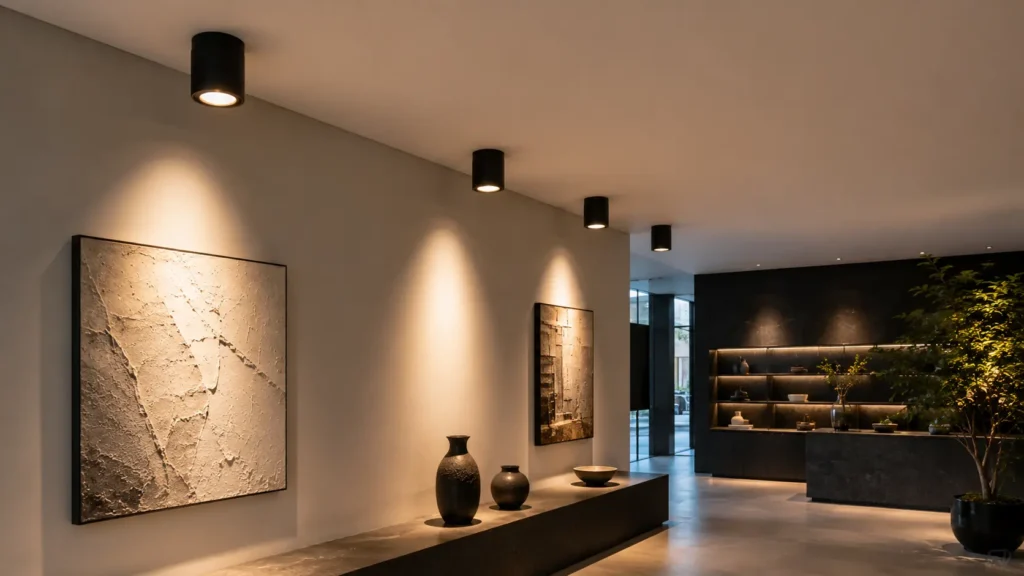
Surface cob lights are luminaires that put a Chip-on-Board (COB) LED package in a body fixed to the ceiling soffit — no recess cut-out — to throw a focused beam.
They are a surface mount COB fixture choice when you need accent punch and the ceiling cannot (or should not) take a recessed housing.
This guide is a how-to for when that package fits — and when it does not.
For mount family routing (recessed vs surface vs adjustable), start here:
→ LED Downlight Installation Methods: Recessed vs Surface Mount vs Adjustable
For ambient-vs-spot terminology, use the companion spoke:
→ Downlight vs Spotlight: What’s the Real Difference?
Key Takeaways
– Surface-mounted COB = soffit-fixed housing + single COB source for controlled COB LED beam concentration.
– Use when you need COB spotlight applications (display, art, feature) and void, fire, or heritage rules block recess.
– Freeze beam class and glare first; then check COB light heat dissipation through the aluminum body and ambient limits.
– Do not specify surface COB as a substitute for a wide ambient downlight grid.
Before you begin
Have these on hand:
- Ceiling type and whether a recess void is allowed
- Target layer: accent / task vs ambient fill
- Approx. fixture-to-target distance and desired spot size
- Product sheet with beam angle, Tc / ambient rating, and driver location
- Glare views (mirrors, seating sightlines, polished floors)
Difficulty: intermediate (specifier / designer).
Time: one planning pass before RCP freeze — not a DIY wiring tutorial.
Step 1: Define what surface-mounted COB lights are
A surface mount COB fixture has two decisions already locked:
- Mount — body on the soffit (surface), not in a cut-out
- Source package — COB (many LED dies under one phosphor / optic interface), not a multi-SMD diffuse array
COB LED beam concentration comes from treating the die cluster as one optical centre.
With the right reflector or TIR lens, the beam reads cleaner for accent than a sparse SMD layout of the same wattage class.
Surface COB is still a downlight/spot family member.
It is not a third ceiling type beside recessed and surface — it is a surface path with a COB optic.
If the ceiling can recess and you want a flush plane, compare recessed COB / gimbal options on the hub and directional spoke instead of defaulting to a cylinder on the soffit.
🎯 What makes a fixture “surface-mounted COB”?
A soffit-fixed housing plus a COB package that acts as one optical centre for a focused beam — mount and source package, together.
Step 2: Decide when surface mount beats recessed
Pick surface COB for the ceiling constraint, not because the render looks “more modern.”
| Condition | Prefer surface mount COB | Prefer recessed (or other path) |
|---|---|---|
| Concrete / solid soffit, no void | Yes — fix to the plane | Only if you add a false ceiling |
| Heritage / no cut-outs allowed | Ja | Nee |
| Fire / acoustic membrane must stay intact | Often yes | Only with rated recessed assemblies |
| Flush architectural ceiling is mandatory | Nee | Ja |
| Deep void + fire hood already designed | Optioneel | Usually cleaner visually |
| You need ambient wash across the room | Rarely — wrong tool | Wider ambient downlight family |
Ceiling-type detail sits here:
→ How to Choose Downlights for Different Ceiling Types
Surface solves access and void.
It does not automatically solve glare or beam class.
🎯 When should surface beat recessed for COB?
When void, cut-out, fire, or heritage rules block recess — not when you only want a taller cylinder for styling.
Step 3: Match COB spotlight applications
COB spotlight applications are accent and focused task — not whole-room fill.
Typical commercial fits:
- Retail feature / mannequin / end-cap punch
- Gallery and reception art accents
- Jewellery and small-object sparkle (with glare control)
- Bar / counter task pools where a tight ellipse is wanted
- Lobby feature objects where contrast matters more than even ambient
Pair with a separate ambient layer when the room still needs general light.
Beam-class habits (confirm on the sheet; accent ladder, not ambient labels):
| Need | Starting beam class (accent scale) |
|---|---|
| Small object / long throw | Narrow (~15–24°) |
| Mid display / table | Medium (~25–38°) |
| Soft feature pool | Wider accent (~40–60°) |
These bands grade inside accent use.
They are not the ambient-vs-spot family split (~60–120° vs ~15–45°) on the downlight-vs-spotlight spoke.
Aiming: fixed surface COB for nadir accents; adjustable / gimbal surface heads when the target sits off-centre.
→ Directional Downlights for Accent and Task Lighting
→ What’s the Difference Between Adjustable and Fixed Downlights?
🎯 Which jobs fit surface COB best?
Accent and focused task — retail features, art, jewellery, counters — with ambient handled by a separate layer.
Step 4: Check COB light heat dissipation before you freeze wattage
COB puts heat in a small footprint.
COB light heat dissipation is mostly the aluminum body path from the COB pad to air — not a sticker claim of “cool running.”
Specifier checks:
- Housing material and contact area (die-cast / extruded aluminum is the usual path)
- Driver in head vs remote — remote can ease head temperature but needs a legal cavity
- Rated ambient (Ta) vs the real ceiling plenum / canopy temperature
- Clearance around the cylinder — do not bury the body in insulation or a tight niche
- Tc / performance points on the sheet if published
Poor thermal contact (warped mount plate, missing TIM on module builds, over-torque stress) raises junction temperature and shortens life — factory assembly should already manage TIM and torque; your job is ambient and clearances.
If the sheet ambient is 25 °C and your soffit runs hotter, derate or pick a lower wattage / better-sinked body.
🎯 What heat check matters most on site?
Rated ambient and free airflow around the aluminum body — wattage without a thermal path is not a free upgrade.
Step 5: Run the when-to-use criteria table
Use this pass once before SKU freeze:
| Rekening | Use surface-mounted COB | Do not use / change path |
|---|---|---|
| Laag | Accent or focused task | Primary ambient for the whole room |
| Ceiling | Surface allowed; recess blocked or unwanted | Flush recess required and void available |
| Optic | Controlled beam + single-source look | Soft diffuse wash from multi-SMD ambient |
| Glare | Shielding / UGR path acceptable to views | Bare COB visible in mirrors or seating |
| Heat | Ta and clearances clear the sheet | Insulated pocket or hot canopy above rating |
| Aiming | Fixed nadir OK, or adjustable head selected | Target moves often and track / another system fits better |
| Partner lighting | Ambient grid or linear already planned | Hoping one surface COB row will light everything |
Track-mounted COB is a different distribution and wiring story — keep that package on its own brief; do not treat this soffit cylinder guide as a track substitute.
🎯 What is the freeze order for surface COB?
Layer and ceiling first, then beam and glare, then heat and wattage — never wattage first.
Step 6: Verify before you order
- [ ] Mount = surface for a documented ceiling / void reason
- [ ] Job = accent / task, not ambient substitute
- [ ] Beam class matches throw and spot size (sheet / IES)
- [ ] Fixed vs adjustable aiming decided
- [ ] Glare to primary views checked
- [ ] COB light heat dissipation path: Ta, clearances, driver location
- [ ] Finish and diameter accepted on the soffit visually
- [ ] Ambient partner luminaires listed on the same issue set
Deep dives:
| Need | Spoke / hub |
|---|---|
| Recessed vs surface vs adjustable map | Installation methods hub |
| Ambient vs spot wording | Downlight vs Spotlight |
| Aimable vs fixed type | Adjustable vs fixed |
| Accent aiming / beam classes | Directional downlights |
| Ceiling constraints | Ceiling types |
🎯 What should you verify first on a surface COB package?
Confirm accent job + surface mount reason, then beam/glare and rated ambient — before finish colour.
Soft brand (fit only)
XHLUX supplies commercial LED families that include surface-mounted and recessed bodies with COB and directional optics.
Match mount and beam layer first.
Then shortlist a product that clears ambient rating, glare, and soffit constraints.
Veelgestelde vragen
Notes on evidence
Commercial surface-mount COB downlight sheets commonly cite die-cast or extruded aluminum housings as the primary thermal path and list selectable narrow-to-medium beams for accent (manufacturer examples in the 15° / 24° / 36° / 60° family).
Accent beam-class bands in Step 3 follow the same ladder used on the directional spoke (~15–24° / ~25–38° / ~40–60°).
Always override planning bands with the product photometric file and rated ambient on the sheet.