 XHLUX
XHLUX
Table of contents
- 1. What Exactly Is 4000K Light?
- 2. Who Chooses 4000K? Applications and Use Cases
- 3. Benefits of 4000K Lighting: What It Solves
- 4. Color Temperature Comparison Table View
- 5. Psychological & Biological Effects: What Research Shows
- 6. Technical Specifications to Pay Attention to When Purchasing
- 7. Real-World Examples: Where 4000K Shines
- 8. Mistakes to Avoid & When Not to Use 4000K
- 9. Expert Views & Industry Insight
- 10. Related content recommendations
- 11. Summary & Final Recommendation
- 12. FAQ About What is 4000K Light
Thinking about upgrading your lighting but not sure if 4000K is the right choice? You’re not alone. With so many options on the market—warm white, daylight, neutral tones—it can be overwhelming to decide which color temperature best fits your space.
Among them, 4000K light has become a popular favorite for offices, kitchens, retail, and healthcare settings. Why? Because it strikes the perfect balance between cozy warmth and bright clarity.
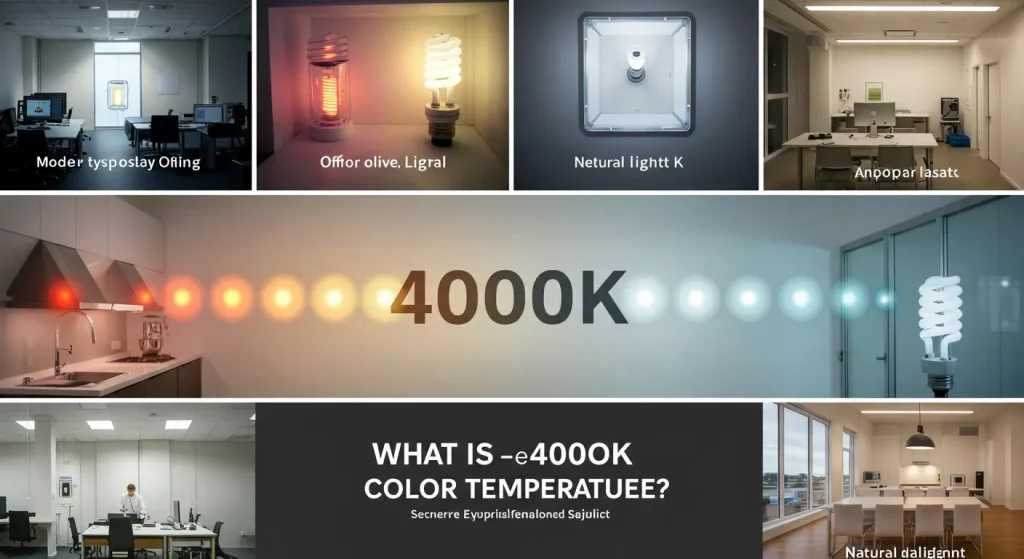
In this guide, we’ll break down exactly what is 4000K light, how it looks, where it works best, and why experts recommend it—so you can make a confident, informed decision for your home or business.
1. What Exactly Is 4000K Light?
Color temperature, expressed in Kelvin (K), describes the hue appearance of a light source relative to a theoretical black‑body radiator. A 4000 K light sits in the neutral white range: brighter and crisper than warm whites, softer and less blue than daylight tones.
- On the Kelvin scale: 2700–3000 K is warm white (yellowish); 4000 K is neutral white; 5000–6500 K is cool or daylight white.
- Reddit lighting experts call 4000 K “neutral white”—“It is not warm, it is not cool. Indoors it is as natural as you can get to a pure white”.
It reflects the hue of mid‑morning or afternoon sunlight, making it feel both clean and comfortable.
In practical terms, a 4000 K LED or fixture emits a crisp white light with a slight yellow undertone—more welcoming than sterile daylight but brighter than a cozy amber glow.
2. Who Chooses 4000K? Applications and Use Cases
Neutral white (4000 K) shines in many environments where color clarity, efficiency, and comfort need balance.
Key applications include:
- Commercial and retail spaces: Stores, showrooms, supermarkets benefit from natural color rendition and clear product visibility.
- Offices and study environments: Encourages alertness without harsh glare or fatigue.
- Kitchens and bathrooms: Ideal for tasks requiring accurate color recognition and crisp lighting.
- Medical and care settings: Nursing homes and assisted living facilities require well‑lit, visually clear environments for safety and comfort.
It’s particularly popular in commercial installations because it strikes a balance between productivity and ambience.
3. Benefits of 4000K Lighting: What It Solves
Efficiency and Visual Comfort
- Provides sufficient brightness while avoiding coldness of daylight bulbs.
- Reduces eye strain and fatigue during tasks involving fine detail.
Boosted Alertness and Cognitive Performance
- Studies show that cooler color temperatures (including 4000 K) support alertness and performance better than warmer light.
- In work environments, staff under ~4000–5000 K lighting perform tasks with better accuracy and speed relative to warmer conditions.
Emotional Well-Being & Stress Reduction
- A 2025 study found that both 4000 K and 6000 K lighting reduced physiological stress indicators (like heart rate), making 4000 K calming yet energising.
True-to-Life Color Rendering
- Most quality LEDs at this temperature range offer CRI (Color Rendering Index) scores above 80 and often approaching 90 or more, meaning colors appear natural and vibrant.
Widely Pleasing Lighting Appearance
- According to the Kruithof curve, neutral whites at moderate illuminance levels (like 4000 K at 300–500 lx) fall into the human‑preferred “comfortable” area.
4. Color Temperature Comparison Table View
| Color Temperature | Appearance | Mood & Setting | Best For | Drawbacks |
|---|---|---|---|---|
| 2700–3000 K Warm White | Soft yellowish | Cozy, relaxing | Living rooms, hospitality, bedrooms | Too dim for task performance |
| 4000 K Neutral White | Clean white with subtle warmth | Balanced, alert, comfortable | Offices, kitchens, retail, healthcare | Slightly cooler feel for leisure-only |
| 5000–6500 K Daylight White | Bright bluish white | High focus, energetic | Labs, clinical spaces, warehouses | Can feel harsh or sterile |
This comparison helps users quickly determine whether 4000 K aligns with their space needs.
5. Psychological & Biological Effects: What Research Shows
Cognitive Performance & Alertness
- Task performance studies confirm that 4000 K enhances concentration and reaction time over warmer lighting; it’s closer in effect to 5000 K choices in workplaces.
- LED lighting with neutral or cool white helps reduce mental fatigue during long tasks.
Stress Reduction & Comfort
- Emerging research (2025) highlights that 4000 K light reduces heart rate responses compared to extremes, balancing calm and alertness.
Natural Preference Patterns
- According to VR-based emotional studies, user mood and preferred lighting remain tied to neutral/4000 K especially in diverse participants across various task conditions.
6. Technical Specifications to Pay Attention to When Purchasing
When evaluating a 4000 K fixture, pay attention to:
✅ CRI (Color Rendering Index): Aim for CRI ≥ 80, ideally 90+. Higher values reveal colors accurately.
✅ Luminous Efficacy: Look for high lumens per watt—LEDs in this range typically deliver 80–120 lm/W.
✅ Beam Angle: Direct light or ambient spread matters depending on tasks.
✅ Dimmability: Choose flicker‑free dimmable LEDs especially in dynamic settings.
✅ Smart Features: DALI, Zigbee, or wireless controls enable tuning of intensity and scheduling.
✅ Certifications: UL, DLC, EnergyStar—important for reliability and rebates.
✅ Warranty and lifespan: Many LEDs offer warranties of 5–7 years or more.
7. Real-World Examples: Where 4000K Shines
Office Environments
Companies choose 4000 K in layout zones where employees engage in screen work, planning, and meetings. The neutral white tone enhances clarity without the harshness of blue‑heavy lighting.
Retail & Supermarkets
Neutral lighting makes products, packaging, fresh produce and signage more appealing and true-to-life under store lights.
Kitchens & Food Prep Areas
Accurate food colors and clearer task zones enhance both practicality and aesthetics. 4000 K lighting combines warmth with precision.
Healthcare & Senior Care
Light sources between 3500–4500 K support visibility, safety, and circadian support—particularly for aged individuals with reduced retinal sensitivity.
8. Mistakes to Avoid & When Not to Use 4000K
- Avoid in purely relaxing spaces: Bedrooms and lounges often benefit from warmer (~2700 K) lighting for evening use.
- Not ideal for evening ambiences in restaurants or hospitality unless combined with dimming or color-tunable fixtures.
- Mismatch of mixed color temperatures causes visual discomfort—keep lighting consistent across zones.
9. Expert Views & Industry Insight
- Industry reports and leading lighting providers consistently point to 4000 K as the optimal midpoint between warmth and functionality in commercial installations.
- Designers appreciate its “clean‑white without glare” quality for hospitality and retail where balanced ambiance matters.
- Lighting associations emphasize human‑centric lighting trends: 4000 K frequently appears in recommended tunable schemes (2700–5000 K ranges) that adapt by time of day or task.
10. Related content recommendations
You may also want to search for the following related content:
- 4000K light color temperature
- benefits of 4000K lighting for offices
- neutral white 4000K vs warm white
- best color temperature 4000K for kitchen and workspace
- 4000K lighting health and productivity
11. Summary & Final Recommendation
What is 4000K light?
It is a neutral white light—balanced between warm and cool tones—that offers crisp illumination, visual clarity, and a calming yet alert atmosphere.
Why choose 4000K?
It brings together productivity, comfort, and natural appearance. With high CRI, low stress impact, and strong cognitive benefits, it’s ideal for commercial, task-oriented, and multi-use environments.
When to use it:
Offices, retail, kitchens, healthcare settings, and anywhere lighting must be functional yet pleasant.
Always pair it with:
Quality fixture specs—high CRI, dimmability, smart controls—and consistent lighting strategy rather than mixing across color temperatures.