 XHLUX
XHLUX
In the competitive landscape of brick-and-mortar retail, every detail matters. From the layout of your store to the texture of the flooring, each element contributes to the customer experience. Yet, one of the most powerful tools in a retailer’s arsenal is often overlooked or undervalued: the lighting. Specifically, the humble retail downlight.
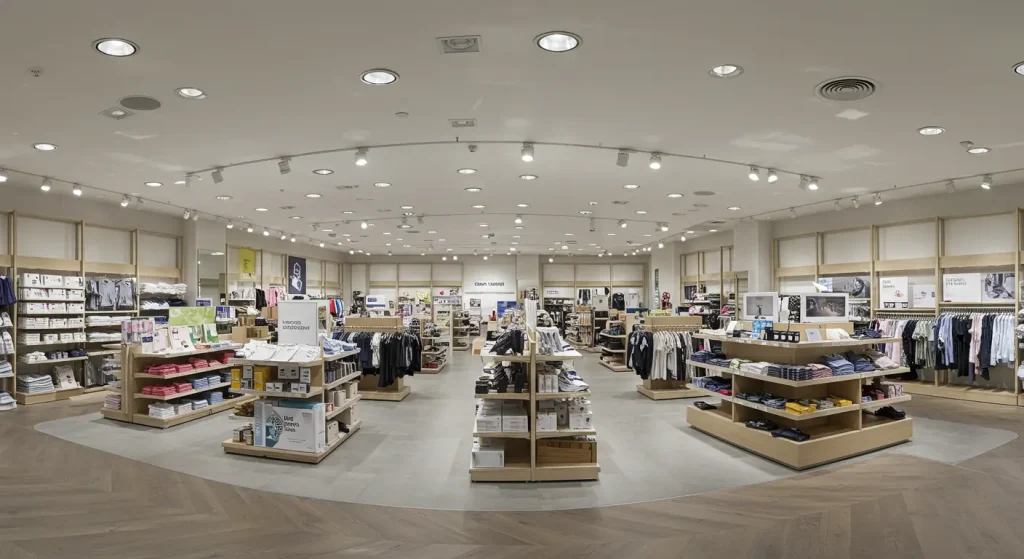
Think of it as your silent salesperson. The right lighting doesn’t just illuminate your space; it directs attention, creates mood, makes products irresistible, and can measurably increase sales. Get it wrong, and your store can feel flat and uninviting, your merchandise lackluster, and your customers uninspired.
If you’re a store owner, a retail designer, or a brand manager, you understand this intuitively. You’re searching for more than just a fixture; you’re looking for a competitive edge. This is your definitive 2025 guide to understanding and leveraging the power of the retail downlight. We’ll move past generic specifications to explore how light influences shopper psychology, what technical specs really drive sales, and how to build a lighting strategy that transforms your space and your bottom line.
The Business Case: Why Your Downlights are a Critical ROI Investment
Before we talk about technology, let’s talk about money. Investing in high-quality retail lighting is not an expense; it’s an investment with a clear and proven return. The right lighting strategy directly influences key retail metrics.
According to a widely-cited study in the Journal of Marketing, specific lighting applications can influence a customer’s path through a store and their emotional response. Furthermore, market reports from firms like McKinsey & Company have consistently highlighted the importance of in-store experience as a key differentiator for physical retail in the digital age.
Here’s how the right downlights deliver ROI:
- Increased Perceived Value: High-quality light with excellent color rendering makes products look more vibrant, luxurious, and appealing, justifying premium price points.
- Enhanced Customer Experience & Dwell Time: A comfortable, visually appealing environment encourages customers to stay longer, explore more, and ultimately, purchase more. Poor lighting, especially glare, causes discomfort and hastens a customer’s exit.
- Improved Sales and Conversion Rates: Strategic accent lighting can increase the visibility and sales of high-margin products by over 30%. It guides the customer’s eye, creating a curated journey through your merchandise.
- Strengthened Brand Identity: Lighting creates atmosphere. Is your brand bright, airy, and energetic? Or is it intimate, exclusive, and moody? Your lighting strategy is a physical manifestation of your brand’s personality.
With the stakes this high, choosing the right fixture becomes a critical business decision.
The Anatomy of a High-Performance Retail Downlight (2025 Edition)
A standard commercial downlight is not a retail downlight. The demands of a retail environment require a fixture engineered for visual impact, comfort, and flexibility. Here are the core specifications you must demand.
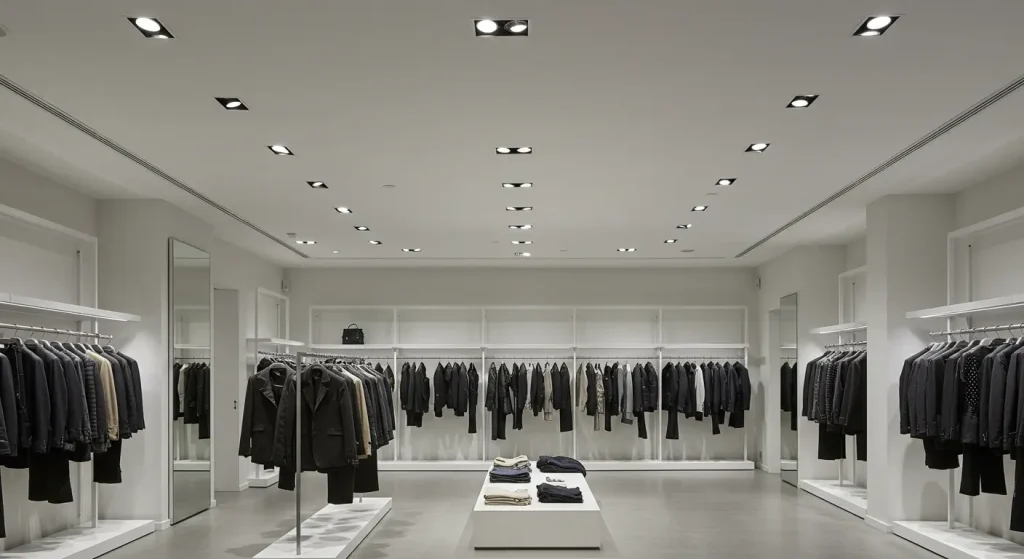
1. Superior Color Quality: Beyond Just “Bright”
This is where many retailers go wrong. They focus on brightness (lumens) while ignoring color quality. In retail, color is everything.
- Color Rendering Index (CRI): This measures how accurately a light source reveals the true colors of an object. For a general office, a CRI of 80+ is fine. For retail, a CRI of 90+ is the mandatory minimum. For fashion, cosmetics, or high-end goods where color accuracy is paramount, you should not accept anything less than CRI 95+. A low CRI can make a vibrant red dress look dull and brownish or distort the shade of a foundation, leading to customer dissatisfaction and returns.
- TM-30-20: As a more advanced metric, TM-30 gives a deeper understanding of color performance. Pay attention to the Color Fidelity Index ($R_f$), which should be above 90, and the Gamut Index ($R_g$), which should be close to 100. This ensures colors are rendered accurately without being artificially oversaturated. Ask your lighting supplier for the full TM-30 report.
- Color Temperature (CCT): This is the perceived warmth or coolness of the light, measured in Kelvin (K). There is no single “best” CCT; it must align with your brand and products.
| Color Temperature (CCT) | Feeling / Mood | Best For |
|---|---|---|
| 2700K – 3000K (Warm White) | Intimate, cozy, luxurious, traditional | High-end boutiques, jewelry stores (for yellow gold), fine dining, lingerie stores. |
| 3500K (Neutral White) | Clean, friendly, professional, inviting | The most versatile choice. Excellent for fashion, department stores, car showrooms. |
| 4000K (Cool White) | Modern, crisp, energetic, alert | Electronics stores, sporting goods, pharmacies, grocery produce sections. |
| 5000K+ (Daylight) | Can feel sterile or clinical | Generally avoided for interior retail, but sometimes used for diamond evaluation. |
2. Visual Comfort: The Fight Against Glare
Have you ever walked into a store and felt an immediate sense of visual discomfort without knowing why? The culprit is likely glare. Glare is the enemy of good retail lighting. It distracts from the merchandise and makes a space feel cheap.
- Unified Glare Rating (UGR): This is a metric for quantifying glare. The lower the number, the better. In a retail setting, you should be looking for fixtures with a UGR < 19. This is achieved through intelligent optical design.
- Deep-Regression & Baffles: Look for downlights where the LED source is set deep within the fixture (deep-regressed). This shields the light source from the direct line of sight. A black baffle on the interior of the trim can further absorb stray light and dramatically reduce glare. A cheap, flush-mounted downlight is a recipe for a high-glare environment.
3. Flexibility and Control: The Key to Dynamic Displays
Retail is not static. Your displays change with seasons, promotions, and new product lines. Your lighting needs to adapt just as quickly.
- Adjustability: A fixed downlight is of limited use. A retail-grade downlight must be adjustable. Look for gimbal or semi-gimbal designs that offer at least a 30-degree tilt and 360-degree rotation. This allows you to aim the light precisely onto vertical displays, mannequins, or hero products.
- Interchangeable Optics & Beam Angles: The ability to change the beam angle is a game-changer. A single downlight housing should be able to accommodate different reflectors or lenses to produce various beam spreads:
- Narrow Spot (10°-15°): For dramatic accent lighting on small items like jewelry or a watch.
- Spot (20°-30°): The workhorse for accenting mannequins, handbags, and specific items on a shelf.
- Flood (35°-50°): For washing walls with light, illuminating larger displays, or contributing to ambient light.
- Wall Wash Optics: Asymmetrical lenses designed to illuminate a vertical surface smoothly and evenly from top to bottom.
Building a Winning Lighting Strategy: The Three Layers of Light
Professional retail lighting design isn’t about blanketing a space with a uniform grid of downlights. It’s a strategic, layered approach.
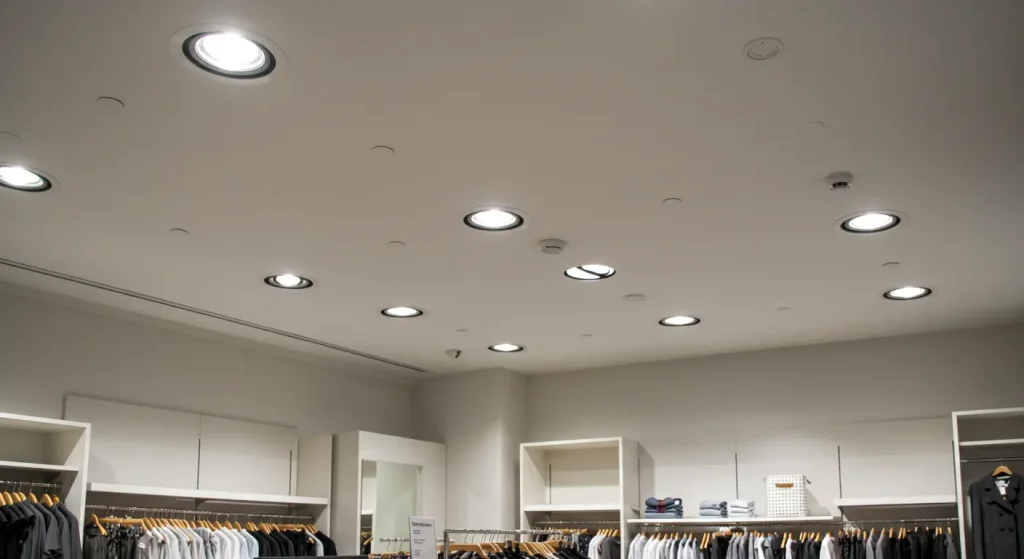
Layer 1: Ambient Lighting
This is the foundational layer, the general illumination that allows customers to navigate the space safely and comfortably.
- Goal: Create the overall mood.
- Fixtures: Typically wide-beam (40°+) fixed or adjustable downlights, spaced evenly to provide a uniform base level of light (e.g., 30-50 foot-candles). The goal is consistency, not drama.
Layer 2: Accent Lighting
This is where the magic happens. Accent lighting is used to create contrast, draw attention, and highlight key merchandise. This is your primary sales tool.
- Goal: Create focal points and guide the customer’s journey.
- Fixtures: Narrow-to-medium beam (10°-30°) adjustable downlights with high CRI. The key principle is contrast. Your accent lighting should be at least 3 to 5 times brighter than your ambient lighting to be effective. If your ambient light is 50 foot-candles, your accent points should be 150-250 foot-candles.
Layer 3: Task Lighting
This is functional light placed in areas where specific tasks are performed.
- Goal: Provide clear, functional illumination.
- Fixtures: Downlights placed directly over point-of-sale counters, in fitting rooms, or above mirrors in beauty sections. The priority here is high-quality, glare-free light that allows for clear visibility. For fitting rooms, using vertical lighting or multiple downlights is crucial to eliminate unflattering shadows.
Expert Insight: “We tell our clients to stop thinking about lighting the floor and start thinking about lighting the merchandise. We build a base of ambient light just for safety and comfort, then we invest the majority of the fixtures and budget into highly flexible, high-contrast accent lights. The product is the hero, and our job is to put a spotlight on it.” – A leading retail design consultant
Trends and Technologies for 2025: Smart Retail Lighting
The evolution of LED technology continues to unlock new possibilities for retailers.
- Advanced Wireless Controls (Bluetooth Mesh): Systems like Casambi allow for individual control of every single downlight from a tablet or smartphone. This means you can re-aim and re-zone your lighting for a new store layout without ever touching a wire. You can create lighting “scenes” for different times of day or for special promotions with the tap of a button.
- Tunable White & Human-Centric Lighting: This technology allows you to adjust the CCT of your lighting. Imagine a system that automatically shifts from a crisp, energizing 4000K during peak afternoon hours to a warmer, more relaxed 3000K in the evening. Or a fitting room where a customer can select the lighting that mimics an “office environment” or a “candlelit dinner” to see how an outfit looks in different settings.
- Data Integration (IoT): Smart lighting systems can be integrated with sensors to gather data on customer traffic patterns. By analyzing which areas of the store are most brightly lit and comparing that to footfall data, retailers can gain valuable insights into customer behavior and optimize store layouts accordingly.
Choosing a retail downlight is far more than a technical decision about watts and lumens. It’s a strategic choice about how you want your customers to feel, how you want them to perceive your products, and how you want them to experience your brand. By investing in high-quality, flexible, and comfortable lighting, you are empowering your silent salesperson to work its magic, turning browsers into buyers and creating a loyal customer base that will return again and again.