XHLUX
XHLUX

A project team specifies “recessed downlights” for a new commercial fit-out, only to find during installation that the cut-out dimensions do not match the ceiling grid, the beam angle washes out the retail display instead of highlighting it, and the driver protocol is incompatible with the building’s DALI control system. The specification was not wrong — it was not specific enough.
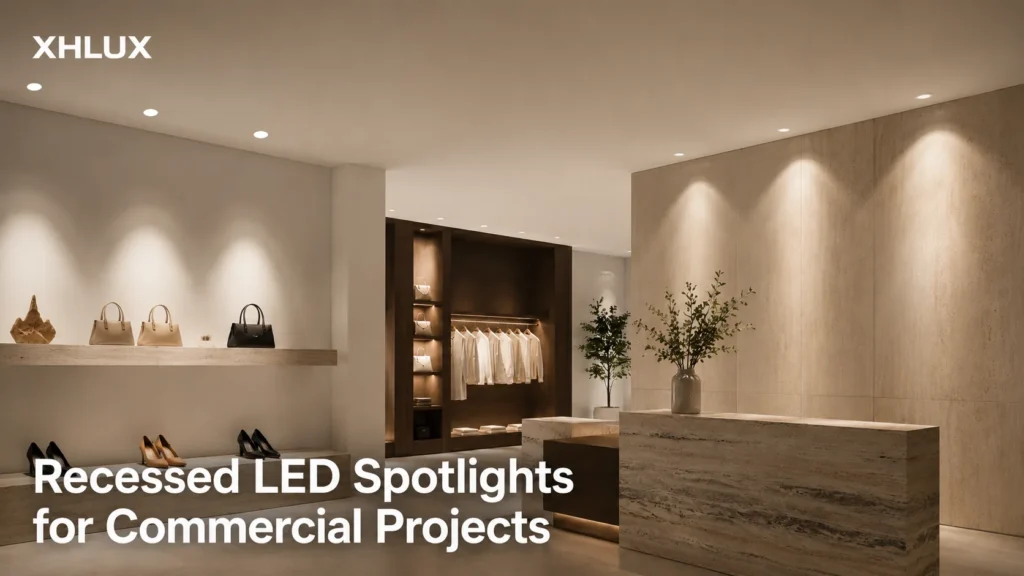
Recessed LED spotlights are one of the most widely used lighting product categories in commercial projects, but the difference between a correctly specified installation and a costly reorder often comes down to a handful of technical decisions made before the order is placed. This article covers the key specification points — cut-out dimensions, beam angle selection, CCT and CRI requirements, driver and dimming compatibility, and material and finish options — that determine whether a recessed LED spotlight performs as intended in a commercial environment.
For a broader overview of commercial downlight types, selection criteria, and OEM/ODM procurement considerations, see the Commercial LED Downlights Guide.
Recessed LED Spotlights vs. Standard Downlights — Key Specification Differences
What “Recessed” Means for Commercial Ceiling Installation
A recessed luminaire is installed into a ceiling cut-out so that the fixture body sits above the ceiling plane with only the trim flange and lens visible from below. This is the standard installation method for commercial ceiling grids, plasterboard ceilings, and many architectural ceiling systems. Unlike surface-mounted or suspended fixtures, recessed spotlights require sufficient clearance above the ceiling for the housing, driver, and thermal management — and the cut-out dimension must be confirmed before any ceiling work begins.
Spot Light vs. Flood Light Beam Distribution in Commercial Spaces
The functional distinction between a recessed spotlight and a general-purpose recessed downlight is primarily optical. Recessed LED spotlights use narrower beam angles — typically 15° to 38° — to direct light onto a specific area, product display, or architectural feature. Standard downlights use wider distributions (38° to 60° or wider) for general ambient illumination across a larger floor area.
In specification terms, the choice between spotlight and downlight optics determines the number of fixtures required, their spacing, and the visual effect achieved. A retail project using 24° spotlights on merchandise displays needs fewer lumens per fixture to achieve the required accent illuminance than the same space lit with 60° wide-flood downlights — but the spotlights must be positioned with greater precision relative to the target surface.
When to Choose a Recessed Spotlight Over a General-Purpose Downlight
A recessed spotlight is the right specification choice when the lighting design calls for any of the following:
– Directional accent on merchandise, artwork, or architectural details – Controlled beam spread to avoid light spill into adjacent areas – Higher perceived brightness on a specific surface without increasing overall ambient levels – Visual hierarchy — drawing the eye to featured products or key areas within a larger commercial space
General-purpose downlights remain the correct choice for uniform ambient illumination across open-plan offices, corridors, and back-of-house areas where the priority is consistent light levels rather than directional emphasis.
Cut-Out Dimensions and Ceiling Compatibility
Common Commercial Cut-Out Sizes and What They Fit
The cut-out dimension is the diameter of the hole required in the ceiling to accommodate the recessed fixture. It is one of the first parameters to confirm, because it determines whether a given product can be installed in the existing or planned ceiling.
For commercial recessed LED spotlights in the XHLUX product range, common cut-out diameters span approximately D90–D105mm for standard 10W–25W models. The exact cut-out varies by model and wattage — higher-wattage fixtures with larger heat sinks typically require larger cut-outs and deeper housings.
| Wattage | Typical Cut-Out Range | Typical Housing Depth |
|---|---|---|
| 10W | D90–95mm | H67–80mm |
| 15W | D90–95mm | H67–80mm |
| 20W | D100–105mm | H115mm |
| 25W | D100–105mm | H115mm |
Note: These are representative ranges based on XHLUX X20S and X20P series specifications. Exact dimensions vary by model. Always confirm from the product specification sheet before ceiling work.
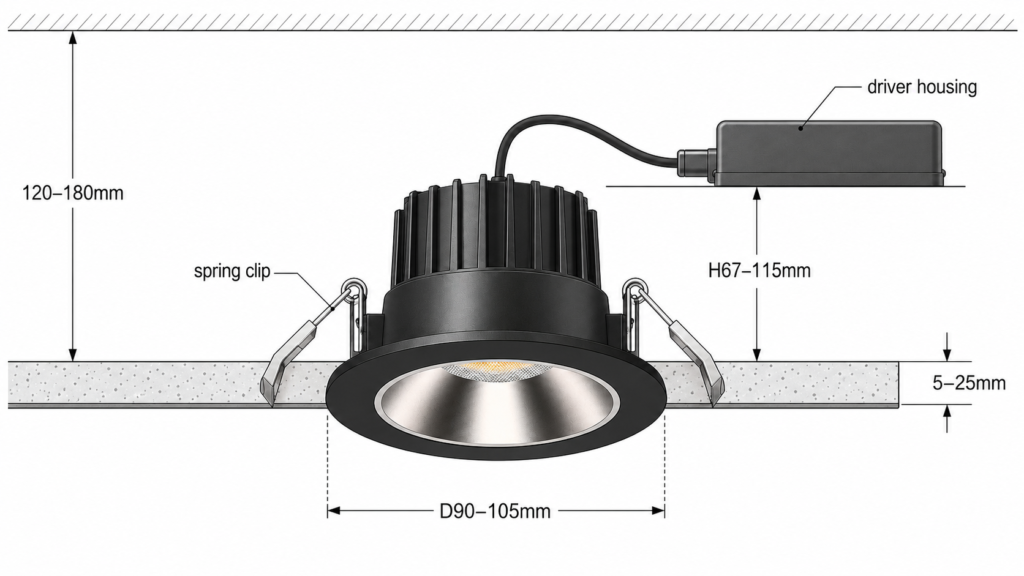
Ceiling Type Considerations
Plasterboard ceilings: The most common commercial ceiling type. Cut-out dimensions must be confirmed before the plasterboard is installed or drilled. Spring-clip mounting is standard for most recessed spotlights in this ceiling type. Ensure the ceiling thickness is within the fixture’s clamping range.
Suspended ceiling grids: T-bar grid systems require careful coordination between the luminaire cut-out and the ceiling tile dimensions. Standard 600×600mm or 1200×600mm ceiling tiles typically accommodate a single recessed spotlight per tile, though the exact position within the tile must be planned. The fixture weight must also be within the tile’s load rating — if the fixture plus driver exceeds the tile rating, independent support wires to the structural slab above are required.
Concrete ceilings: Recessed installation into concrete slabs requires pre-formed apertures or core-drilling after construction. This ceiling type demands the highest level of pre-installation specification accuracy, because adjusting a cut-out after concrete is poured is expensive. Confirm the exact cut-out dimension and housing depth before the slab is poured or drilled.
Ceiling Depth Requirements and Clearance
The space above the ceiling must accommodate the full housing height plus the driver housing (if external), plus sufficient clearance for heat dissipation and maintenance access. For standard commercial recessed spotlights in the 10W–25W range, total clearance requirements typically range from 120mm to 180mm above the ceiling plane depending on the model, wattage, and driver configuration.
Where ceiling void depth is limited — such as in retrofit projects with shallow ceiling cavities — confirm the housing height and driver dimensions against the available clearance before specifying a model. Slim and mini downlight variants exist for space-constrained installations.
Beam Angle Selection for Commercial Applications
The beam angle determines how narrowly or broadly light is distributed from the fixture. For recessed LED spotlights, four beam angle options are commonly available across the product range: 15°, 24°, 38°, and 60°.
Narrow Beam (15°–24°) for Accent and Display Lighting
Narrow beam angles produce a concentrated, high-intensity pool of light suitable for:
– Retail display accent lighting — highlighting individual product shelves or mannequins – Gallery and museum exhibit lighting — directing attention to specific artworks or artifacts – Hotel reception desk and feature wall highlighting – Restaurant table or bar counter accent
At typical commercial ceiling heights of 2.7m–3.5m, a 15° beam produces an illuminated circle of approximately 0.7m–0.9m diameter at floor level. A 24° beam produces approximately 1.1m–1.5m diameter. The narrower the beam, the fewer fixtures are needed per display unit — but the more critical the aiming precision becomes.
Medium Beam (38°) for General Commercial Illumination
The 38° beam angle is the most versatile option for commercial spaces. It provides a balanced distribution suitable for:
– Open-plan office lighting — adequate spacing with good uniformity – Retail general sales floor illumination – Hospitality corridors and guest room lighting – Conference and meeting room general lighting
At 2.7m–3.0m ceiling height, a 38° beam produces an illuminated area of approximately 2.0m–2.5m diameter at working plane height. This allows practical fixture spacing of 2.0m–3.0m on-center for most commercial applications.
Wide Beam (60°) for Broad Coverage
Wide beam angles maximize the illuminated area per fixture, making them suitable for:
– Low-ceiling commercial spaces (below 2.5m) – Wide-open retail floors where uniform ambient light is the priority – Back-of-house, storage, and utility areas – Spaces where fixture count must be minimized
The trade-off is lower perceived brightness per square meter. In spaces with higher ceilings (above 3.5m), a 60° beam may produce insufficient illuminance at the working plane unless higher-wattage fixtures are specified.
Matching Beam Angle to Ceiling Height and Task
| Ceiling Height | Recommended Beam Angle | Typical Application |
|---|---|---|
| Below 2.5m | 60° | Low-ceiling retail, corridors |
| 2.5m–3.5m | 38° | General office, hospitality, retail |
| 3.5m–5.0m | 24° | Higher-ceiling retail, hotel lobbies |
| Above 5.0m | 15°–24° | Atrium, gallery, high-bay accent |
These are starting-point recommendations. The final beam angle selection should account for the specific illuminance target, surface reflectance, and the visual effect required by the lighting design.
CCT, CRI, and Optical Performance
CCT Selection by Commercial Space Type
Correlated Color Temperature (CCT) determines whether the light appears warm (yellowish), neutral, or cool (bluish). XHLUX recessed LED spotlights are available across a wide CCT range — from 2700K to 6500K — with the appropriate choice depending on the commercial application.
| CCT | Appearance | Typical Commercial Application |
|---|---|---|
| 2700K–3000K | Warm white | Hotels, restaurants, high-end retail, residential lobbies |
| 3500K–4000K | Neutral white | Offices, general retail, healthcare, education |
| 5000K–6500K | Cool white / daylight | Industrial, inspection, high-detail task areas, some gallery applications |
For most commercial mixed-use projects, 4000K is the most commonly specified CCT — it provides a clean, professional appearance without the clinical feel of cooler temperatures or the residential feel of warmer ones. However, hospitality and high-end retail projects frequently specify 2700K–3000K to create a warmer, more inviting atmosphere.
CRI Requirements — When 80+ Is Enough and When 90+ Is Necessary
Color Rendering Index (CRI) measures how accurately a light source reveals colors compared to a reference source. XHLUX recessed spotlights are available in CRI 80+, 90+, 95+, and 98+ configurations.
CRI 80+ is the minimum acceptable level for most commercial general lighting. It is adequate for:
– Back-of-house and storage areas – Corridors and circulation spaces – General office lighting where color-critical tasks are not performed – Utility and plant rooms
CRI 90+ should be specified for:
– Retail sales floors — accurate color rendering affects perceived product quality and purchase decisions – Hospitality guest-facing areas — warm, accurate color supports the premium experience – Gallery, museum, and exhibition lighting — color fidelity is non-negotiable – High-end office reception and meeting areas – Any space where textiles, paint finishes, food, or branded materials are displayed
CRI 95+ and 98+ are available for the most demanding applications — luxury retail flagship stores, museum conservation-grade lighting, and high-end hospitality projects where the lighting specification is part of the brand standard.
The CRI selection affects cost and luminous efficacy — higher CRI configurations typically produce slightly fewer lumens per watt. The trade-off should be evaluated against the application requirements.
SDCM < 3 and Color Consistency
SDCM (Standard Deviation of Color Matching) quantifies the color consistency between individual LED fixtures. An SDCM value below 3 means that the human eye cannot distinguish color differences between adjacent fixtures — a critical requirement for commercial installations where multiple recessed spotlights are installed in the same visible area.
XHLUX recessed LED spotlight models are rated SDCM < 3, which supports uniform appearance across multi-fixture commercial installations. For projects where color consistency across a large fixture count is critical — such as retail chains with standardized store designs — confirm the SDCM specification with the product documentation for the specific model and CCT being ordered.
Reflector and Lens Options
The optical assembly in a recessed LED spotlight typically consists of a reflector and a lens. Reflector design — faceted, smooth, or multi-facet — affects beam distribution smoothness and glare control. PC (polycarbonate) lenses are standard for most commercial models, providing good light transmission with impact resistance.
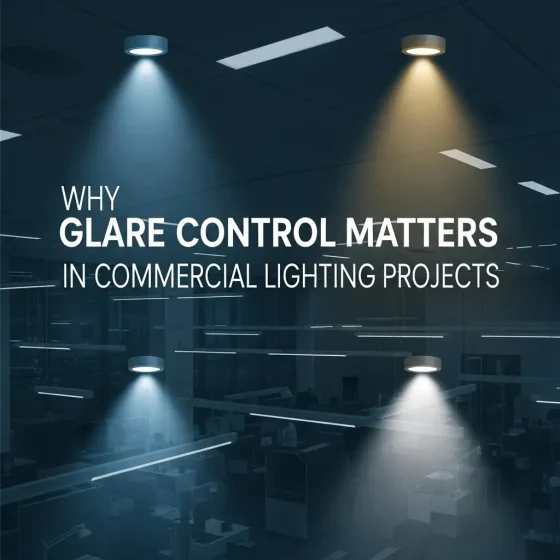
For projects with specific glare control requirements, anti-glare models with deep-recessed reflectors or honeycomb louver accessories are available. These reduce visible brightness at oblique viewing angles — important for office environments where occupant comfort is a specification requirement. Confirm anti-glare options per model.
Driver Selection and Dimming Protocol Compatibility
External Driver vs. Integrated Driver
Commercial recessed LED spotlights typically use external (remote) drivers rather than integrated onboard drivers. This design offers several advantages for commercial projects:
– Thermal separation: The driver’s heat output is separated from the LED module, improving LED lifespan and lumen maintenance. – Maintenance access: External drivers can be accessed through the ceiling cut-out or a separate access point without removing the entire fixture. – Protocol flexibility: External drivers can be specified independently, allowing the same fixture model to pair with different driver protocols depending on the project’s control system.
The driver should be matched to the fixture’s electrical requirements (constant current, typically 250mA–600mA depending on wattage) and the project’s mains voltage (AC200-240V for most markets; AC100-240V available for specific regions).
Dimming Protocol Options
XHLUX recessed LED spotlights support multiple dimming protocols depending on the driver selected:
| Protocol | Best For | Note |
|---|---|---|
| DALI / DALI-2 | Large commercial projects with building management system integration | Individually addressable, bidirectional communication, IEC 62386 standard |
| 0/1-10V | Mid-size commercial projects, straightforward dimming | Analog control, widely compatible, limited to group-level control |
| TRIAC | Retrofit projects using existing phase-cut dimmers | Simple retrofit, no control wiring needed, forward or reverse phase |
| ZigBee / BLE | Wireless building automation and smart building projects | No control wiring; requires network infrastructure and commissioning |
| DMX | Entertainment, theatre, and architectural dynamic lighting | Fast response, individual fixture control, requires DMX infrastructure |
DALI is the recommended standard for new commercial construction where a building management system or centralized lighting control system is specified. TRIAC dimming is suitable for retrofit projects where existing mains dimmer switches are already in place and rewiring for control cables is impractical.
The dimming protocol must be confirmed at the specification stage — it is determined by the driver, not the LED module, and switching protocols after installation typically requires driver replacement.
Driver Brand Options and Regional Voltage
XHLUX recessed spotlights can be configured with drivers from multiple manufacturers — including Tridonic, Philips, Osram, HEP, TCI, BOKE, and Lifud — depending on the project’s certification requirements, regional voltage standards, and brand preferences.
For projects in markets requiring specific driver certifications (CE, ENEC, SAA, RCM), confirm the compatible certified driver option at the specification stage. The driver selection affects the final product code, lead time, and per-unit cost.
Material, Finish, and Installation Factors
Die-Cast Aluminum Housing — Thermal Management and Durability
XHLUX commercial recessed LED spotlights use ADC12 die-cast aluminum for the main housing. This material choice serves two functions: structural durability and thermal management. Aluminum’s high thermal conductivity draws heat away from the LED module and dissipates it into the surrounding ceiling void, maintaining the LED junction temperature within the rated operating range and preserving lumen output over the product’s service life.
For commercial projects, the aluminum housing also provides better impact resistance and longer mechanical life than plastic-housed alternatives — relevant for installations where ceiling access panels are opened regularly for building maintenance.
Matt White vs. Matt Black Finish — Architectural Integration
Two standard finish options are available: matt white and matt black.
Matt white is the default choice for most commercial ceilings — it blends with standard white ceiling tiles and plasterboard, keeping the visual emphasis on the light effect rather than the fixture itself.
Matt black is specified when the ceiling is dark-colored, when the lighting design calls for the fixtures to disappear visually when not illuminated, or for gallery and museum applications where fixture visibility must be minimized.
Custom finish colors may be available for larger projects — confirm with the product team if the project requires a specific RAL color match.
Installation Depth, Spring Clips, and Ceiling Thickness
Standard recessed spotlights use spring-loaded mounting clips that clamp the fixture against the ceiling material from above. The clamping mechanism accommodates a range of ceiling thicknesses — typically 5mm–25mm for plasterboard installations. For ceilings outside this range, confirm compatibility before specifying.
The spring-clip installation method allows the fixture to be installed from below after the ceiling is complete and the cut-out is made. This is the standard installation workflow for most commercial projects and does not require above-ceiling access during fixture installation — though above-ceiling access is still needed for driver placement and electrical connection.
IP Rating Considerations for Standard Commercial Interiors
Standard XHLUX recessed LED spotlights are rated IP20 — suitable for dry interior locations. This covers the majority of commercial applications: offices, retail stores, hotel guest rooms and corridors, restaurants (dining areas), conference centers, and educational facilities.
For commercial locations with moisture exposure — hotel bathrooms, spa facilities, commercial kitchens, food preparation areas, outdoor covered walkways — IP65-rated waterproof downlight models should be specified instead. IP65 fixtures provide protection against water jets and are the minimum standard for wet and damp commercial locations. Do not specify IP20 recessed spotlights for any location where water spray, condensation, or high humidity is expected.
OEM/ODM Configuration and Procurement Checklist
Configurable Options
XHLUX recessed LED spotlights are manufactured on an OEM/ODM basis, meaning that multiple parameters can be configured to project requirements. Configurable options include:
– LED chip brand: Citizen, Bridgelux, CREE, Philips, Luminus – Driver brand: Tridonic, Philips, Osram, HEP, TCI, BOKE, Lifud – CCT: 2700K, 3000K, 3500K, 4000K, 5000K, 6500K – CRI: 80+, 90+, 95+, 98+ – Angolo del fascio: 15°, 24°, 38°, 60° – Fine: Matt white, matt black – Dimming protocol: DALI, TRIAC, 0/1-10V, ZigBee, BLE, DMX – Color output mode: Single color, tunable white (TW), dim-to-warm (DTW), RGB, RGBW, RGBCW
The final product code is determined by the combination of these options. Not every combination is available in every model — confirm the available configurations for the specific product series and wattage being ordered.
Documentation to Request Before Confirming a Specification
Before finalizing an order for commercial recessed LED spotlights, request and review:
– Product specification sheet (datasheet) for the exact model and configuration – IES/LDT photometric files for lighting design software (DIALux, Relux) – Dimming compatibility test report for the selected driver and control system – Certification documentation relevant to the project’s target market (CE, ENEC, CB, SAA, RoHS, EMC, ErP as applicable) – Sample unit for visual evaluation (recommended for projects over 50 units or where color consistency is critical)
Minimum Order Quantities and Lead Time
As an OEM/ODM manufacturer, XHLUX minimum order quantities and lead times vary by product configuration, order volume, and the level of customization required. Standard-configuration products from regular production lines typically have shorter lead times than fully customized configurations with specific LED chip, driver, or finish combinations.
Confirm the current MOQ and lead time with the product team at the specification stage, particularly for projects with fixed construction schedules.
Certification Documentation — What to Confirm Per Target Market
Certification requirements vary by target market, product model, driver configuration, and installation environment. Buyers should confirm which specific certification documents apply to the project location and product code being ordered. Depending on the target market, projects may reference CE, ENEC, CB, SAA, RCM, RoHS, EMC, ErP, IEC/EN standards, or other local documentation.
Do not assume a certification applies to all models and configurations. Request the certification documentation for the exact product code and driver combination being ordered.
How Recessed LED Spotlights Fit into the Broader Commercial Downlight Range
Relationship to Adjustable / Gimbal Spotlights
Recessed LED spotlights with fixed beam direction are the standard choice for general accent and directional lighting from a ceiling plane. Where the lighting design requires adjustable beam direction — such as retail displays that change seasonally, gallery walls with rotating exhibitions, or architectural features that require precise aiming — adjustable (gimbal) LED downlights with tilt and rotation capability are the preferred specification. See the article on adjustable LED downlights for commercial projects for specification guidance on tilt-adjustable models.
Relationship to Trimless Architectural Downlights
Standard recessed spotlights use a visible trim flange that sits on the ceiling surface. For architectural projects requiring a flush, trimless appearance — where the ceiling material continues uninterrupted up to the light aperture — trimless (plaster-in) downlights are the correct specification. Trimless models require more complex installation (plastering up to the fixture edge) and are typically specified for high-end hotels, museums, and luxury commercial spaces where the architectural finish takes priority over installation simplicity.
Relationship to Waterproof IP65 Downlights
For commercial wet and damp locations, standard IP20 recessed spotlights are not suitable. IP65-rated waterproof downlights provide sealed protection against water ingress and should be specified for bathrooms, spa facilities, commercial kitchens, food preparation areas, and outdoor covered locations. IP65 models use sealed housings and gaskets that are not present on standard IP20 recessed spotlights.
When a Recessed Spotlight Is the Right Choice
A fixed-beam recessed LED spotlight is the right specification choice when all of the following apply:
– The lighting design requires directional or accent light distribution – The ceiling construction allows a standard cut-out installation – The ceiling void provides sufficient depth for the housing and driver – The target surface or area is in a fixed position (no need for post-installation beam adjustment) – The environment is a dry interior location (IP20 sufficient)
If any of these conditions are not met, evaluate adjustable, trimless, slim, or waterproof alternatives depending on which condition is not satisfied.
FAQ
Conclusion
Recessed LED spotlights are a core product category in commercial lighting specification. The fixtures themselves are relatively straightforward — but the specification decisions that determine whether they work for a given project are not. Cut-out dimension, beam angle, CCT, CRI, driver protocol, and finish all interact with the ceiling type, control system, and commercial application.
The most common specification errors — wrong cut-out size, incompatible dimming protocol, CRI too low for a customer-facing space — are all preventable by confirming each parameter against the product specification sheet before ordering. For B2B buyers and project teams, the pre-order confirmation checklist is the single most valuable tool for ensuring the specified recessed LED spotlights perform as intended after installation.
For broader commercial downlight selection guidance — including adjustable, trimless, slim, and waterproof options — visit the Commercial LED Downlights Guide. For current recessed LED spotlight product availability, configuration options, and specification support, visit the XHLUX LED Downlight product category.