 XHLUX
XHLUX

Table of contents
- 1. Understanding the Two Lighting Systems
- 2. Technical Comparison: Track vs Recessed Fixtures
- 3. Application Advantages and Limitations
- 4. Optical and Smart Control Differences
- 5. Project Applications and Selection Guide
- 6. Cost and Long-Term Value Analysis
- 7. How to Choose the Right Lighting Supplier
- 8. FAQ About LED Museum Lighting
- 9. Conclusion
Lighting defines how art is perceived — not just how it is seen.In modern museums and galleries, every luminaire affects how colors are interpreted, how depth is felt, and how audiences emotionally connect with each piece.Choosing between track lighting E recessed lighting can therefore shape not only the visitor experience but also the integrity of the artwork itself.
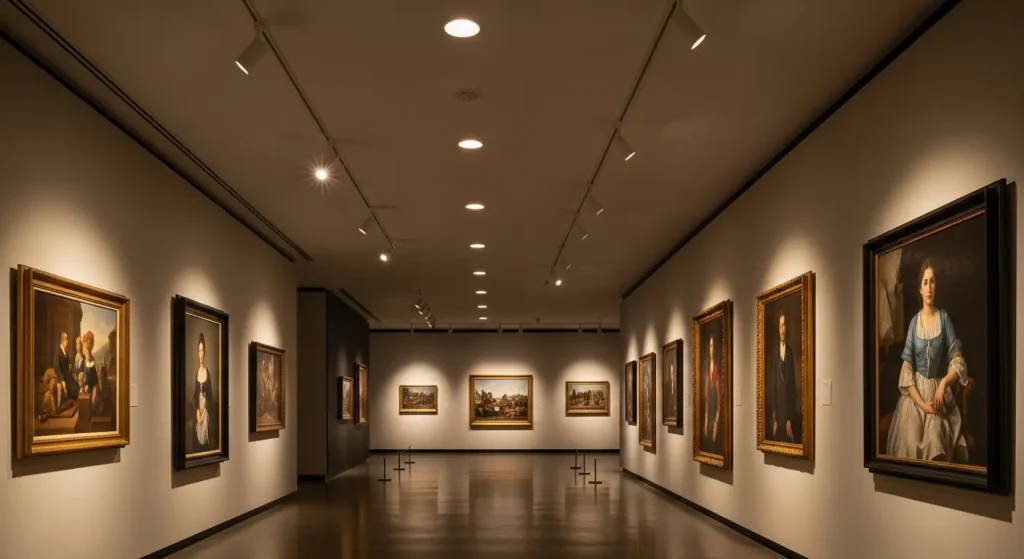
So which is better for your project — the flexible adjustability of track systems, or the architectural purity of recessed fixtures?This article compares both options in depth, helping curators, specifiers, and lighting designers make data-driven decisions for their next museum or gallery installation.
💡 Download Comparison Sheet
Want a side-by-side summary of both systems?
👉 Download the Museum Lighting Comparison Guide ›
1. Understanding the Two Lighting Systems
1.1 What Is Track Lighting?
Track lighting is a modular system that connects multiple light heads to a single power track.
Each luminaire can be repositioned, rotated, or replaced with different optics — making it ideal for temporary exhibitions, rotating displays, or multi-use spaces.
Key characteristics:
- Flexible positioning and rotation (up to 355° / 90° tilt)
- Compatible with multiple light types (spot, flood, accent)
- Quick-change modular design for curators and technicians
- Common configurations: surface-mounted, pendant, or recessed track systems
This adaptability makes track lighting the preferred solution for galleries where exhibits change frequently, or for designers seeking dynamic beam compositions.
1.2 What Is Recessed Lighting?
Recessed lighting fixtures are embedded directly into the ceiling or architectural surface.
They provide a clean, minimalistic appearance, creating the illusion of light emerging naturally from the space.
Their integration with the ceiling structure minimizes visual distraction, offering a museum-grade aesthetic suitable for permanent exhibitions, luxury showrooms, and heritage institutions.
Key features:
- Hidden luminaire body, seamless visual integration
- Optimized glare control (UGR < 19)
- Suitable for high-end or minimalist design environments
- Available in fixed or adjustable gimbal configurations
🏛️ Summary:
- Track lighting = functional flexibility
- Recessed lighting = architectural harmony
💡 Expert Consultation
Unsure which fits your project better?
👉 Talk to Our Lighting Engineers ›
2. Technical Comparison: Track vs Recessed Fixtures
When choosing between track and recessed systems, several technical factors come into play — from installation depth to glare control and beam uniformity.
The table below summarizes their respective performance across key parameters.
| Feature | Track Lighting | Recessed Lighting |
|---|---|---|
| Installation | Mounted or suspended on visible rail | Concealed within ceiling cavity |
| Visual Appearance | Visible housing, industrial aesthetic | Seamless and minimalist |
| Beam Adjustability | High (10°–60°, quick-swap lenses) | Moderate (fixed or limited tilt) |
| Color Rendering (CRI) | ≥ 95 | ≥ 95 |
| Glare Control (UGR) | 19–22 | < 19 |
| Maintenance Access | Easy, front-service | Moderate, front maintenance required |
| Initial Cost | Low–Medium | Medium–High |
| Best For | Temporary exhibitions, flexible zones | Permanent installations, heritage halls |
From this comparison, the track lighting system clearly excels in adjustability and maintenance, whereas recessed lighting wins in aesthetic integration and visual comfort.
The right choice ultimately depends on your project’s spatial layout, curatorial style, and long-term objectives.
📊 Download Full Comparison Report
Get the complete data breakdown for your project planning.
👉 Download PDF ›
3. Application Advantages and Limitations
Lighting in a museum must be both artful and technical — enhancing artworks while protecting them from light damage.
Each system offers unique strengths depending on the exhibition environment.
3.1 Track Lighting: Designed for Flexibility
Track systems shine where change is constant.
They allow quick adjustment for new exhibitions, wall configurations, and different object sizes.
Advantages:
- Repositioning without reinstallation
- Swappable optics (15°, 24°, 36°, 60°) for different exhibit types
- Compatible with accessories like honeycomb filters, barn doors, or lenses
- Ideal for open ceilings, industrial design, and evolving galleries
Limitations:
- Visible tracks may conflict with minimalist interiors
- Slightly higher risk of glare due to exposed optics
- Requires periodic repositioning and recalibration
🧠 Pro Tip:
In modern European galleries, recessed track systems combine both benefits — offering the flexibility of tracks with the visual purity of recessed housings.
3.2 Recessed Lighting: The Choice for Permanence
Recessed luminaires integrate seamlessly with architecture, creating a timeless lighting effect.
They are preferred for heritage buildings, high-end galleries, and luxury exhibition halls.
Advantages:
- Visually hidden, providing distraction-free illumination
- Lower glare and better visual comfort (UGR < 19)
- Stable performance ideal for constant display layouts
- Supports smart dimming systems and fixed zones
Limitations:
- Requires adequate ceiling depth (≥ 80 mm)
- More complex installation and upfront cost
- Less adaptable to frequent layout changes
💡 Explore Project References
See how European museums combine recessed and track systems to achieve both flexibility and elegance.
👉 View Project Cases ›
4. Optical and Smart Control Differences
Light quality and control precision define the success of a museum installation.
While both track and recessed LED systems can achieve exceptional results, their optical architecture E control integration differ significantly.
4.1 Optical Performance
Both lighting systems can achieve museum-grade specifications — high CRI, precise beam control, and soft light transitions — yet their optical delivery differs.
Key insights:
- Track lighting uses interchangeable optics and external accessories to adjust beam spread dynamically (10°–60°).
- Recessed fixtures offer tighter beam uniformity and smoother edges — ideal for paintings, sculptures, and permanent exhibits.
- Both can be equipped with CRI ≥ 95, R9 ≥ 90 LED for true color reproduction.
| Parameter | Track Lighting | Recessed Lighting |
|---|---|---|
| CRI (Color Rendering Index) | ≥ 95 | ≥ 95 |
| Beam Uniformity | 0.75–0.85 | 0.85–0.9 |
| Beam Edge Quality | Sharp or adjustable | Soft, diffused edge |
| Glare Index (UGR) | 19–22 | < 19 |
| Optical Accessories | Honeycomb, barn doors, diffusers | Anti-glare baffle, recessed cone |
🎯 Conclusion:
Choose track systems when optical flexibility is needed across various art forms.
Choose recessed fixtures when consistency, comfort, and architectural invisibility are paramount.
💡 Download Optical Reference Sheet
Explore beam-angle and CRI data comparisons between both systems.
👉 Download Lighting Optics Guide ›
4.2 Smart Control Integration
In modern galleries, static lighting no longer suffices.
Smart lighting technologies now enable curators to craft precise lighting moods for each exhibit — adjusting intensity, color temperature, and timing seamlessly.
Control System Compatibility:
- DALI-2: Ideal for permanent museum installations with zone-based control.
- Casambi Bluetooth Mesh: Perfect for temporary exhibitions and retrofits — wire-free and app-based.
- 0–10V and DMX512: Common in mixed-use and new-media art spaces.
| Control Protocol | Track Lighting | Recessed Lighting | Best Use Case |
|---|---|---|---|
| DALI-2 | ✔️ | ✔️ | Permanent exhibits |
| Casambi | ✔️ | ✔️ | Wireless control, mobile management |
| 0–10V | ✔️ | ✔️ | Energy optimization |
| DMX512 | ✔️ | ❌ | Interactive or digital art zones |
Smart systems can also integrate daylight harvesting, occupancy sensors, E scene recall — ensuring both sustainability and art protection.
💬 Talk to Our Engineers
Want to integrate DALI or Casambi control into your museum project?
👉 Consult Our Engineering Team ›
4.3 Maintenance and Longevity
Both systems leverage advanced thermal design and LED driver technology to achieve long lifespans.
However, maintenance accessibility differs:
- Track fixtures: Quick service; replaceable light heads.
- Recessed fixtures: Longer lifespan but require front-access design.
- Both achieve ≥ 50,000 hours (L80/B10) lifetime performance.
🧩 Pro Insight:
Track systems suit dynamic exhibition schedules, while recessed fixtures favor stability and minimal intervention in heritage environments.
5. Project Applications and Selection Guide
No single solution fits all museums — the best system depends on the space type, exhibit purpose, and desired visitor experience.
Below is a curated guide based on XHLUX’s European case experience.
| Project Type | Recommended System | Design Priorities |
|---|---|---|
| Temporary Exhibition Halls | Track Lighting | Flexibility, adjustable angles, quick reconfiguration |
| Classical Art Museums | Recessed Lighting | Visual comfort, glare suppression, long-term stability |
| Photography & Digital Art Galleries | Combination System | Layered lighting, dynamic contrast |
| Luxury Brand Showrooms | Recessed Lighting | Minimalist aesthetics, high CRI color accuracy |
| New-Media & Interactive Spaces | DMX Track Lighting | Dynamic control, programmable effects |
5.1 Hybrid Approach: The Best of Both Worlds
Many contemporary European museums now adopt hybrid systems, combining recessed luminaires for base lighting with track-mounted accent fixtures for flexibility.
This ensures balance between aesthetic consistency E functional adaptability.
💡 Example Configuration:
- Recessed downlights: 3000 K, CRI 95+, 1200 lm
- Track-mounted accent spots: 3500 K, adjustable 15°–36°, CRI 97
- Casambi control: synchronized scene transitions for exhibits and walkthroughs
🏛️ Explore Case Studies
Discover hybrid lighting setups used in European galleries.
👉 View Project References ›
6. Cost and Long-Term Value Analysis
Lighting projects aren’t only about performance — they’re also long-term investments.
While initial installation costs differ, total ownership cost (TCO) depends on maintenance, flexibility, and energy efficiency.
6.1 Initial Investment
- Track lighting: Lower upfront cost due to simple wiring and modular setup.
- Recessed lighting: Higher initial expense due to concealed installation and architectural integration.
Typical Cost Ratio:
Track:Recessed ≈ 1 : 1.5
6.2 Maintenance and Operational Cost
- Track fixtures require periodic adjustment and replacement of optics.
- Recessed luminaires, once installed, need minimal upkeep.
- Both offer long LED lifespans and energy-efficient drivers.
| Aspect | Track System | Recessed System |
|---|---|---|
| Installation Cost | ★★☆ (Moderate) | ★★★☆ (Higher) |
| Maintenance | ★★★★ (Easy access) | ★★☆ (Front service required) |
| Energy Efficiency | ★★★★ | ★★★★★ |
| Flexibility | ★★★★★ | ★★★ |
| Lifetime Value | High | Very High |
6.3 ROI Perspective
Over 5–10 years, recessed systems yield better aesthetic and operational stability, while track systems offer better short-term adaptability.
Museums that frequently rotate exhibitions often choose track-based systems for their low reconfiguration cost.
ROI Insight Example:
A mid-sized European museum with 200 fixtures achieved 22% reduction in reinstallation cost after switching to modular track systems for its temporary hall, while its permanent gallery maintained recessed lighting for visual consistency.
💰 Get ROI Calculator
Estimate your total ownership cost and payback period.
👉 Request ROI Assessment ›
7. How to Choose the Right Lighting Supplier
Choosing between track and recessed systems is only half the decision — the other half lies in selecting a reliable manufacturing partner.
The right supplier ensures every detail — from optics to controls — aligns with both artistic and technical goals.
7.1 Verify Certifications and Compliance
Before approving any fixture, always confirm the following:
| Certification | Purpose | Why It Matters |
|---|---|---|
| CE / ENEC | Safety and quality for EU market | Legal compliance and reliability |
| CB / RoHS | Electrical & environmental standards | Ensures sustainability |
| LM80 / TM21 | LED lifetime and lumen maintenance | Predicts long-term performance |
| CIE 157:2004 | Optical radiation control | Protects artwork from UV/IR damage |
| ISO 9001 | Quality management | Guarantees process consistency |
📘 Tip:
Suppliers with ENEC-certified production lines are better equipped for European museum-grade projects and tend to maintain more consistent photometric standards.
7.2 Technical and Optical Engineering Support
Professional buyers should prioritize manufacturers that offer engineering collaboration — not just catalog products.
Ask whether the supplier provides:
- IES / LDT photometric files for Dialux or Relux simulations
- BIM / STEP 3D models for architectural coordination
- Custom beam-angle and optical designs
- On-site or online commissioning support
A technically proactive partner can save weeks of design revision time and ensure perfect lighting uniformity during installation.
7.3 ODM / OEM Customization Capabilities
For lighting brands and integrators, private-label manufacturing is a strategic edge.
XHLUX supports full ODM/OEM customization, including:
- Reflector and trim design (black, silver, white, champagne)
- CRI, CCT, and driver configuration customization
- Branding and packaging services for EU distributors
- Short production lead times (3–4 weeks for standard models, 6–8 weeks for custom series)
- EU warehouse for regional logistics and small-batch quick-ship programs
💬 Partner With XHLUX
Searching for a CE & ENEC-certified ODM manufacturer for your next gallery project?
👉 Contact the XHLUX Engineering Team › | Chat on WhatsApp ›
7.4 After-Sales & Service Commitment
A reliable supplier stands behind their light:
- 5-year warranty on all museum fixtures
- 48-hour technical response time
- Spare-parts availability for 5+ years
- Continuous technical updates and photometric database sharing
Professional after-sales support ensures project longevity and protects your investment in both hardware and brand reputation.
8. FAQ About LED Museum Lighting
Q1: Which lighting type is more energy-efficient?
Both systems use high-efficiency drivers and LED (>120 lm/W).
Track fixtures may offer a slight advantage in scenes requiring frequent dimming, while recessed luminaires are optimized for constant illumination.
Q2: Does track lighting disrupt the minimalist aesthetics of a museum?
Not necessarily.
Modern recessed-track systems allow the rail to be integrated within ceiling slots — achieving “invisible flexibility” where functionality meets design minimalism.
Q3: Are recessed luminaires difficult to install?
They require adequate ceiling cavity (typically ≥ 80 mm).
For retrofits or tight spaces, XHLUX provides ultra-slim recessed models as thin as 35 mm depth.
Q4: Can both systems integrate with smart control protocols?
Yes.
All XHLUX fixtures are compatible with DALI-2, Casambi, 0–10 V, and DMX512, supporting scene recall, motion sensing, and daylight harvesting.
Q5: Can XHLUX offer OEM/ODM branding?
Absolutely.
We design and manufacture private-label products for several European brands — from custom optics to packaging — under full IP protection and ISO 9001 quality assurance.
📄 Download Technical Pack
Access ENEC certificates, IES data, and BIM models for your next tender.
👉 Download Product Catalog ›
9. Conclusion
Choosing between track E recessed lighting isn’t about which is superior — it’s about what fits your curatorial intent, spatial design, and operational strategy.
- Choose Track Lighting → if you value flexibility, fast reconfiguration, and dynamic exhibits.
- Choose Recessed Lighting → if you prioritize architectural purity, glare control, and long-term stability.
- Or combine both → to balance functionality and visual elegance.
Ultimately, the most successful museum lighting designs blend engineering precision with emotional storytelling — crafting light that both reveals and protects art.
With more than 15 years of manufacturing experience, XHLUX delivers CRI 95+ full-spectrum LED systems, UGR < 19 anti-glare optics, E smart-control-ready platforms for galleries and museums across Europe, the Middle East, and Asia.
Every beam of light is engineered to make art timeless.
✨ Why Professionals Choose XHLUX
- 15 + years in museum & commercial lighting manufacturing
- Certified under CE / ENEC / CB / RoHS / ISO 9001
- Expertise in CRI 95+ LED optics, DALI & Casambi integration
- Proven ODM/OEM partner for European lighting brands
- 5-year warranty and EU-based warehouse for fast delivery
📞 Take Immediate Action
Not sure which system best fits your next project?
Let our engineers provide a detailed comparison and simulation.
👉 Richiedi un preventivo | Chat on WhatsApp | View Projects | Download Catalog