 XHLUX
XHLUX

Table of contents
- 1. Why Choose LED Lighting for Artwork Display?
- 2. Optical Fundamentals in Art Lighting
- 3. Proper Installation Angles and Fixture Positioning
- 4. Preventing Light Damage and Reflection Issues
- 5. Smart Dimming and Lighting Scene Control
- 6. Choosing the Right Art Lighting Fixtures
- 7. FAQ About LED Lighting For Artwork
- 8. Conclusion
Light defines how art is seen — and often, how it is remembered.Whether you are curating an oil painting collection, sculptural installations, or contemporary photography, the right lighting determines how colors, textures, and emotions are perceived.
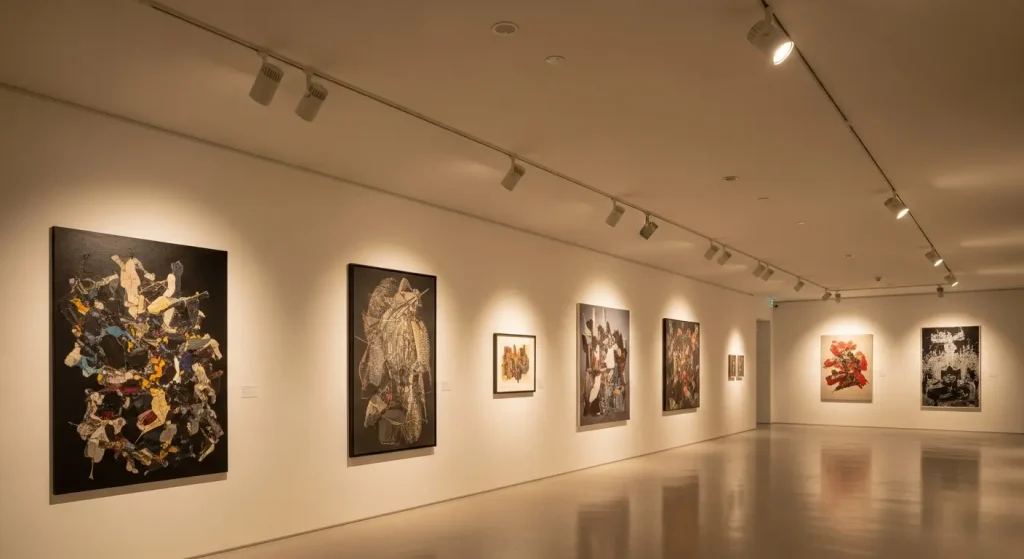
In professional art environments, lighting is not a background element — it is an active design language.
This article explores how to properly use LED lighting for artwork display, covering everything from color rendering and beam control A anti-glare optics and smart lighting systems, so curators and designers can achieve both aesthetic excellence and long-term conservation.
💡 Download LED Art Lighting Catalog
Explore CRI 95+ LED luminaires designed for galleries and museums.
👉 Download Product Catalog ›
1. Why Choose LED Lighting for Artwork Display?
1.1 Comparing LED vs. Traditional Light Sources
LEDs have become the standard for museum and gallery lighting due to their precise spectral control, high energy efficiency, and minimal heat output.
| Parameter | LED Lighting | Halogen / Fluorescent |
|---|---|---|
| Spectral Control | Tunable, consistent, high CRI | Color shifts (too warm / cool) |
| Energy Efficiency | Low power (up to 60% energy savings) | High wattage, heat generation |
| UV/IR Radiation | None | Present — may damage artwork |
| Lifetime | ≥ 50,000 hours | ≈ 2,000 hours average |
| Smart Control Compatibility | DALI / Casambi / DMX | Manual or basic dimming |
Unlike halogen or fluorescent lamps, high-CRI LED systems provide accurate color reproduction while eliminating harmful UV and IR emissions — crucial for pigment preservation and temperature-sensitive materials.
1.2 Lighting Requirements for Art Display
Art presentation demands a delicate balance between visual impact and material safety.
A professional LED system must deliver:
- True color fidelity – CRI ≥ 95, R9 ≥ 90
- Lux limitation – 50 – 200 lux to prevent fading
- Soft, uniform light – no glare, no flicker
- Focused precision – adjustable beam control
- UV/IR protection – to ensure artwork longevity
🎯 Goal: Reveal every brushstroke, texture, and hue exactly as the artist intended — without compromising conservation.
💡 Request Optical Test Data
Need detailed CRI / R9 / UGR reports for your museum project?
👉 Contact XHLUX Engineering Team ›
2. Optical Fundamentals in Art Lighting
Lighting artwork is about sculpting light — with precise color, direction, and softness.Below are the optical design factors that matter most in a museum or gallery context.
2.1 Color Rendering Index (CRI) and Spectral Consistency
High-CRI LEDs (95 +) reproduce pigments and surface tones faithfully.They ensure reds (R9), yellows (R10), and skin tones (R13) appear vivid and natural — essential for oil paintings and mixed-media exhibits.
| Metric | Recommended Standard | Professional Grade (XHLUX) |
|---|---|---|
| CRI (Ra) | ≥ 95 | 96 – 97 |
| R9 Value | ≥ 90 | > 92 |
| SDCM (Color Consistency) | ≤ 3 | ≤ 2 |
| Flicker Index | < 1 % | 0.5 % (flicker-free) |
Consistent color across fixtures (SDCM ≤ 3) ensures the same white point throughout the gallery, preventing color shifts that could distort artwork appearance.
2.2 Choosing the Right Color Temperature (CCT)
Color temperature influences perception, emotion, and spatial depth.
| Artwork Type | Recommended CCT | Lighting Effect |
|---|---|---|
| Classical Oil Paintings | 2700 K – 3000 K | Warm, soft tone; enriches texture |
| Modern Art / Photography | 3500 K – 4000 K | Neutral white for color accuracy |
| Sculptures / Installations | 4000 K – 5000 K | Enhances shape and shadow contrast |
Pro tip: Neutral white (≈ 3500 K) works well for multi-genre exhibitions; warm white is preferred for organic materials and vintage collections.
2.3 Beam Angle and Illuminance Distribution
LED optics define how light interacts with the artwork surface.
Selecting proper beam angles ensures balanced coverage without hotspots.
- Recommended beam angles: 15°, 24°, 36° (depends on artwork size)
- Ideal illuminance: 50 – 200 lux (based on material sensitivity)
- Uniformity: > 0.8 for smooth gradation
Example setup:
| Artwork Size | Beam Angle | Mounting Distance | Target Lux |
|---|---|---|---|
| Small (≤ 0.5 m) | 15° – 24° | 1 – 1.2 m | 80 – 120 lux |
| Medium (1 – 1.5 m) | 24° – 36° | 1.2 – 1.5 m | 100 – 150 lux |
| Large (> 1.5 m) | 36° – 60° | 1.5 – 2 m | 150 – 200 lux |
Uniform soft-edge beams create dimensionality without sharp transitions — vital for a calm, immersive viewing experience.
📊 Get the Optical Parameter Table
Download recommended beam, CCT, and CRI settings for different art categories.
👉 Download Lighting Guide ›
3. Proper Installation Angles and Fixture Positioning
Lighting placement determines not only how an artwork is illuminated, but also how comfortable the viewing experience is.
Incorrect angles can create glare, reflection, or even uneven illumination — distracting from the piece itself.
3.1 Recommended Lighting Angles
The optimal beam angle is typically 30°–45° from the artwork surface.
At 30°, light strikes the artwork at a controlled path that minimizes frame reflections and viewer glare while enhancing dimensional depth.
Best practices:
- Use 30° for framed paintings to prevent glass reflections.
- Increase to 35–45° for sculptures or textured surfaces to emphasize shadows.
- Apply dual-beam symmetry for large artworks to achieve balanced light coverage.
| Artwork Type | Suggested Angle | Effect |
|---|---|---|
| Framed Paintings | 30° | Reduces reflection, preserves clarity |
| Textured Canvas / Relief | 35–40° | Enhances texture depth |
| Sculptures / Installations | 40–45° | Highlights shape and contours |
💡 Lighting Simulation Support
Want to confirm the perfect beam setup for your gallery layout?
👉 Request a Free Lighting Simulation ›
3.2 Selecting the Right Mounting System
Different exhibition types demand different fixture architectures.
| Space Type | Recommended Fixture | Mounting Style | Advantages |
|---|---|---|---|
| Temporary Exhibition | Faretto a LED su binario | Adjustable on rail | Fast repositioning for new layouts |
| Permanent Gallery | Recessed Downlight | Concealed ceiling mount | Clean aesthetics, low glare |
| High-Ceiling Atrium | Pendant Spotlight | Suspended or surface | Highlights vertical height |
Modular systems — such as recessed track lighting — combine both flexibility and elegance, ideal for hybrid museum environments.
3.3 Distance and Coverage
Proper lamp-to-artwork distance ensures even illuminance without overexposure.
A general rule of thumb: mount the light at 1.2–1.5× the height of the artwork.
Example:
If a painting is 1 m high, the luminaire should be placed roughly 1.2–1.5 m from its surface.
This ratio guarantees full coverage of the artwork with soft edge transitions and prevents hot spots or dark patches.
🏛️ Download Mounting Reference Chart
Get XHLUX recommended installation angles and beam coverage chart for different exhibit types.
👉 Download Mounting Guide ›
4. Preventing Light Damage and Reflection Issues
While LED lighting minimizes UV and IR radiation, poor design or mismanagement of illuminance can still cause gradual pigment fading or visual discomfort.
Here’s how to protect artwork while maintaining exceptional presentation quality.
4.1 UV and IR Protection
Traditional halogen lamps emit ultraviolet and infrared radiation that can degrade paintings and paper-based works.
Modern museum-grade LED eliminate these wavelengths entirely.
Protection measures:
- Use UV/IR-free LED modules (UV < 75 µW/lm).
- Add anti-UV lenses E low-iron anti-reflection glass covers.
- Select CIE-compliant light engines that meet CIE 157:2004 optical radiation standards.
Result: no pigment fading, no heat buildup, and consistent color fidelity over time.
4.2 Controlling Illuminance and Exposure
Different materials have different light sensitivity.
Maintaining appropriate lux levels is critical for long-term preservation.
| Artwork Material | Recommended Illuminance (Lux) | Notes |
|---|---|---|
| Oil Paintings | ≤ 150 | Maintain texture detail without overheating |
| Watercolor / Sketches | ≤ 100 | Prevent paper oxidation |
| Archival Documents | ≤ 50 | Extremely light-sensitive |
| Sculptures / Metal Art | ≤ 200 | Stable under higher lux |
To maintain consistency, employ lux sensors or daylight-harvesting dimming to automatically regulate output throughout the day.
4.3 Glare Control and Visual Comfort
For viewers, glare is the enemy of immersion.
Professional art lighting fixtures employ multiple anti-glare technologies:
- Deep recessed optics (UGR < 19) hide the LED source.
- Honeycomb louvers or black baffles diffuse excessive brightness.
- Soft beam-edge reflectors ensure light appears natural, not harsh.
These designs ensure a smooth, “invisible” light that allows the artwork to shine while the source disappears.
🔧 Consult Optical Design Expert
Need help achieving museum-grade UGR performance?
👉 Contact Our Optical Engineers ›
5. Smart Dimming and Lighting Scene Control
Lighting design for art is not static — it changes with exhibitions, daylight, and mood.
Modern intelligent lighting systems enable precise control of brightness, color temperature, and timing, ensuring both protection and presentation quality.
5.1 Choosing the Right Control Protocol
| System | Type | Best For | Features |
|---|---|---|---|
| DALI-2 | Wired | Permanent galleries | Centralized control, programmable zones |
| Casambi | Wireless (Bluetooth Mesh) | Temporary or retrofit projects | App-based control, scene presets |
| DMX512 | Digital | Interactive / new-media art | Dynamic color and light movement |
| 0–10 V | Analog | Small installations | Basic dimming, cost-effective |
All XHLUX LED systems are compatible with these protocols, allowing clients to choose based on project scale and infrastructure.
5.2 Programming Scene Modes
Different exhibition phases demand distinct lighting moods.
By pre-setting scene profiles, curators can adapt instantly between modes.
| Scene Mode | Illuminance (Lux) | Use Case |
|---|---|---|
| Exhibition Mode | 100–200 | Standard gallery display |
| Cleaning / Setup | 300 | Maintenance or reinstallation |
| Night / Standby | 10–20 | Energy saving, security patrol |
| Special Event | 200+ | Enhanced brightness for openings |
Through DALI or Casambi control, these transitions can occur automatically or via mobile app, offering full creative flexibility.
5.3 Benefits of Intelligent Lighting
- Protect artworks: precise lux limitation and dimming schedules.
- Enhance visitor experience: dynamic lighting scenes adapt to flow and focus.
- Save energy: daylight harvesting and occupancy sensing reduce consumption.
- Centralized management: integrate with Building Management Systems (BMS).
📘 Explore Smart Control Solutions
Experience how Casambi and DALI-2 integration transforms exhibition spaces.
👉 View Project Demo ›
6. Choosing the Right Art Lighting Fixtures
Selecting the right LED fixture is the final — and most crucial — step in designing an art lighting system.
A well-engineered luminaire combines optical precision, aesthetic integration, E long-term reliability, ensuring artworks are illuminated accurately and safely.
6.1 Key Fixture Specifications
Professional art lighting fixtures must meet rigorous standards for both performance and durability.
| Specification | Recommended Value / Feature | Purpose |
|---|---|---|
| CRI (Color Rendering Index) | ≥ 95 (R9 ≥ 90) | Accurate color reproduction |
| UGR (Unified Glare Rating) | < 19 | Comfortable viewing experience |
| CCT Options | 2700 K – 4000 K, Tunable White | Flexible scene adaptation |
| SDCM | ≤ 3 | Consistent color uniformity |
| Thermal Performance | Surface rise < 25 °C | Stable output, longer lifespan |
| Lifespan | ≥ 50,000 hours (L80/B10) | Reduced maintenance cycles |
| Optical Options | Interchangeable reflectors (15°–60°) | Adaptable to various exhibits |
6.2 Recommended Fixture Types
| Fixture Type | Best Use Case | Highlights |
|---|---|---|
| LED Track Spotlight | Temporary and rotating exhibitions | Adjustable angle, easy reconfiguration |
| Recessed Downlight | Permanent galleries | Hidden source, high-end visual integration |
| Pendant Spotlight | High ceilings or sculpture halls | Focused downward light, creates drama |
| Wall Washer | Large paintings and murals | Uniform light distribution |
| Framing Projector | Photographs, limited-space exhibits | Sharp-edge light control |
For best results, combine track-mounted adjustable fixtures for flexibility with recessed luminaires for architectural consistency.
6.3 Certifications and Quality Standards
Before specifying or purchasing any LED artwork lighting system, ensure it meets global compliance benchmarks.
Essential Certifications:
- CE / ENEC / CB / RoHS for EU conformity and electrical safety
- LM80 / TM21 for LED chip reliability
- CIE 157:2004 for optical radiation limits (UV/IR safety)
- ISO 9001 for manufacturing quality assurance
Choosing an ENEC-certified manufacturer guarantees that the fixture will meet European museum-grade safety and performance criteria.
💬 Request Data Sheets
Need ENEC and CE-certified photometric reports for your tender?
👉 Download Technical Data ›
6.4 ODM/OEM Customization Capability
For lighting brands or integrators, a trusted manufacturing partner can offer complete private-label and modular customization:
- Custom reflector colors (black, silver, white, champagne)
- Tunable White 2700–4000 K or fixed CCT options
- Logo branding and packaging customization
- Driver protocols: DALI-2, Casambi, DMX, or 0–10 V
- Rapid sampling (3–4 weeks) E EU warehouse logistics
Partnering with an experienced ODM supplier like XHLUX helps lighting brands expand their professional product line without investing in new R&D.
💡 Partner With XHLUX
Build your next gallery lighting collection with our OEM/ODM program.
👉 Contact the Engineering Team ›
7. FAQ About LED Lighting For Artwork
Q1: Will LED lights cause artwork to fade?
No.
High-quality LED modules emit no ultraviolet (UV) or infrared (IR) radiation, eliminating the heat and radiation damage associated with halogen or fluorescent lamps.
Q2: How far should LED fixtures be from the artwork?
Generally, the fixture should be 1.2–1.5 times the height of the artwork away to achieve even light coverage and soft shadows.
Q3: Can one fixture type light different artworks?
Technically yes, but optimal presentation requires varying beam angles and CCTs.
For example, use 2700–3000 K warm light for oil paintings and 3500–4000 K neutral light for photography or sculpture.
Q4: What is the expected lifetime of professional art lighting?
Museum-grade fixtures typically last 50,000+ hours (L80/B10), equating to 5–7 years of continuous use with minimal maintenance.
Q5: Does XHLUX provide customized ODM solutions?
Yes.
XHLUX offers full OEM/ODM support including optical design, structural customization, private labeling, and smart control integration.
📘 Download Project Reference Pack
Get real examples of LED artwork lighting in European museums.
👉 View Project Gallery ›
8. Conclusion
Light doesn’t just reveal art — it redefines it.
Properly implemented LED lighting transforms a gallery from a passive viewing space into an immersive storytelling environment.
By choosing CRI 95+ LEDs, UGR < 19 anti-glare optics, E DALI / Casambi smart control, curators and designers can achieve perfect color reproduction, protect sensitive materials, and elevate the viewer’s emotional connection.
For over 15 years, XHLUX has specialized in museum and art gallery lighting systems, combining optical precision with architectural integration.
From classical exhibitions in Paris to contemporary installations in Milan, XHLUX lighting helps masterpieces shine exactly as their creators intended.
✨ Why Professionals Choose XHLUX
- Over 15 years of experience in museum and gallery LED systems
- Certified under CE / ENEC / CB / RoHS / ISO 9001
- Expertise in CRI 95+ full-spectrum LED optics & anti-glare design
- Compatibility with DALI, Casambi, and DMX protocols
- Proven ODM/OEM solutions for European lighting brands
- 5-year warranty E EU-based warehouse support
📞 Take Immediate Action
Ready to design your gallery’s perfect lighting system?
Our engineers will help you select optics, color temperatures, and controls tailored to your space.
👉 Chat on WhatsApp | Richiedi un preventivo | Download Catalog | View Projects