 XHLUX
XHLUX

Table of contents
- 1. Why Choosing the Right Architectural Lighting Company Matters
- 2. What Is an Architectural Lighting Company?
- 3. How to Choose the Right Architectural Lighting Company
- 4. On-Site Comparison Checklist
- 5. Common Service Types Provided by Architectural Lighting Companies
- 6. Choosing by Project Type — What to Prioritize
- 7. Common Mistakes — What Not to Do
- 8. Case Inspirations
- 9. FAQ About Architectural Lighting Company
- 10. Conclusion
1. Why Choosing the Right Architectural Lighting Company Matters
In modern commercial construction—whether retail, hospitality, workplace, cultural venues, or mixed-use developments—the quality of the lighting environment is just as important as the architectural plan or the construction materials. Light defines how a space feels, functions, and communicates brand identity.
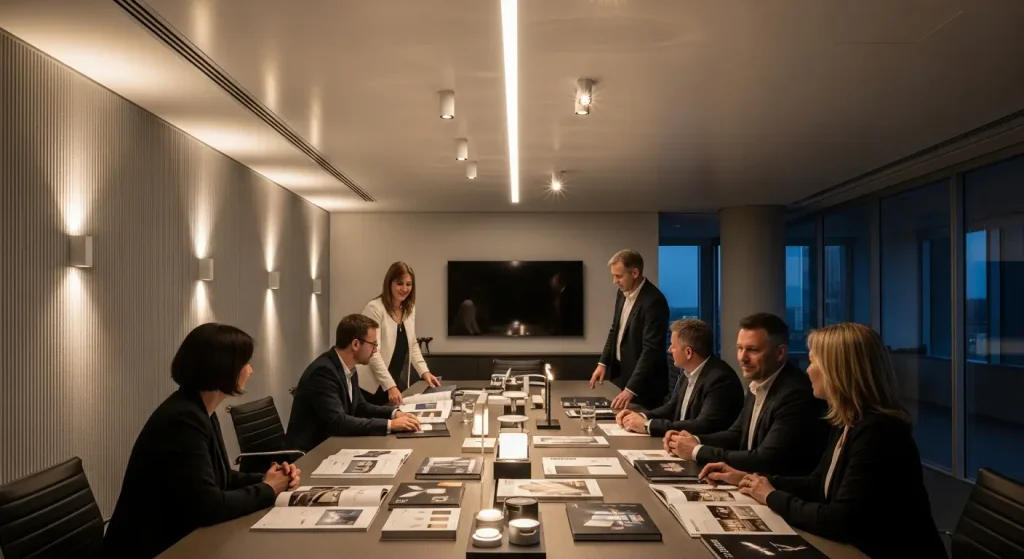
Choosing the right Architectural Lighting Company impacts:
- the quality of illumination,
- the visual comfort of occupants,
- the efficiency & long-term maintenance costs,
- the aesthetic outcome,
- the project schedule,
- and the success of the entire space.
This guide answers these questions with a professional, unbiased, and highly actionable framework, grounded in recognized lighting principles from organizations like IES, DALI Alliance, and industry leaders such as ERCO, Zumtobel, E Signify Lighting Academy.
2. What Is an Architectural Lighting Company?
Unlike a standard lighting vendor that simply sells fixtures, an Architectural Lighting Company provides:
- Lighting design & concept development
- Fixture selection and engineering coordination
- Photometric studies & IES files
- Control system design (DALI / 0–10V / CASAMBI / DMX)
- Installation consultation & field support
- Long-term maintenance planning
How It Differs From a Typical Lighting Supplier:
| Category | Architectural Lighting Company | Standard Lighting Supplier |
|---|---|---|
| Design capabilities | Concept → Planning → Photometrics | Usually none |
| Technical support | Strong (optics, control, integration) | Limited |
| Project involvement | Full project lifecycle | One-time product delivery |
| Fixture quality | Architectural-grade | Commodity-grade |
| Coordination | Works with architects, MEP, GC | Minimal coordination |
In short:
Architectural lighting companies design and deliver the entire lighting experience, not just the fixtures.
3. How to Choose the Right Architectural Lighting Company
This is the most critical section—an objective toolset for evaluating any lighting partner.
3.1 Capabilities & Experience
Ask:
- Do they have built commercial projects (hospitality, retail, office, museum, gallery, residential development)?
- Can they show real site photos, not catalog renders?
- Have they worked on large-scale or multi-phase projects?
- Do they understand building codes, lighting standards, and commercial requirements?
Evidence to request:
- Portfolio
- Case studies
- Client testimonials
- A list of completed projects
Leading companies like Zumtobel E ERCO emphasize the importance of project-based expertise when selecting a lighting partner.
3.2 Lighting Design Expertise
A high-quality architectural lighting company must be able to deliver:
- Lighting concept development
- Fixture layout plans
- Photometric analysis (IES files)
- Glare control & UGR strategy
- Beam selection (10°/24°/36°/60°)
- Vertical illumination logic
- Lighting scenes & daylight integration
According to Signify Lighting Academy, effective lighting design balances function, atmosphere, and human comfort.
Look for companies that:
- Provide layered lighting: ambient + accent + task + decorative
- Understand visual comfort (UGR <19 for offices, hospitality)
- Know how to use contrast, grazing, E wall-washing
3.3 Technical & Product Supply Capabilities
Key evaluation points:
- Can they propose suitable fixture types for each zone (linear lights, downlights, track lights, wall washers, accent lighting)?
- Do they have reliable manufacturing or sourcing partners?
- Can they support customization (housing, optics, size, beam angles, control compatibility)?
- Do fixtures meet compliance and certification standards (UL / ETL / DLC / CE)?
Ask about:
- Product lead times
- Warranty conditions
- Spare parts availability
3.4 Lighting Control & Smart Systems Integration
Modern commercial projects rely heavily on lighting control.
Evaluate whether the company supports:
- DALI 2
- 0–10V dimming
- CASAMBI / Bluetooth control
- Scene-based control
- Integration with BMS systems
- Daylight harvesting
DALI Alliance reference.
3.5 Project Support & Coordination Ability
Strong architectural lighting companies:
- Collaborate with architects, interior designers, electrical engineers, general contractors, and installers
- Provide on-site technical support
- Can handle design changes or unexpected field conditions
- Offer mock-up testing before full installation
This is essential for large hospitality, retail, or office construction.
3.6 After-Sales Service & Lifecycle Support
Evaluate:
- Spare parts availability
- Maintenance strategies
- Replacement plans
- Fixture access design
- On-site training for staff
A long-term perspective prevents costly failures after handover.
4. On-Site Comparison Checklist
A simple, practical checklist for evaluating any architectural lighting company:
✔ Project Experience
“Can you show similar completed projects (photos + technical info)?”
✔ Lighting Design
“Can you provide a full design package including IES, photometrics, layout, and control logic?”
✔ Customization
“Can you support custom housings, optical modules, or sizes?”
✔ Control Systems
“Do you support DALI / 0–10V / CASAMBI / smart scene control?”
✔ Project Coordination
“Will you communicate with our architect / GC / MEP team directly?”
✔ Supply Chain Stability
“What are your lead times? Can you guarantee delivery for large-volume projects?”
✔ Maintenance & Warranty
“What is your service structure for replacements and long-term support?”
This checklist alone can eliminate 70% of unqualified vendors.
5. Common Service Types Provided by Architectural Lighting Companies
5.1 Lighting Design Service
- Concept development
- Fixture layout (CAD/BIM)
- Photometric simulation (IES)
- Lighting atmosphere strategy
5.2 Fixture Specification & Supply
- Product selection
- Technical cutsheets
- Optical modeling
- Line-by-line BOQ control
5.3 Lighting Control Integration
- DALI / 0–10V / Bluetooth
- Energy management strategies
- Scene-setting control
5.4 Documentation & Engineering Support
- CAD files
- BIM content
- Control diagrams
- Submittals & compliance documents
5.5 On-Site Technical Support
- Installation guidance
- Aiming / commissioning
- Scene programming
5.6 Maintenance Planning
- Spare parts
- Replacement strategy
- Lifecycle management
6. Choosing by Project Type — What to Prioritize
Different project types require different strengths from a lighting company.
6.1 Retail / Showroom
Priorities:
- Accent lighting
- High CRI
- Glare control
- Flexible aiming
- Visual merchandising support
Look for companies with retail-focused optics (similar to ERCO specialty retail systems).
6.2 Hospitality (Hotels / Restaurants)
Priorities:
- Multi-layered lighting
- Emotional atmosphere
- Scene control
- Integration with interior design
6.3 Office / Workplace
Priorities:
- UGR <19
- Uniformity
- Circadian & wellness support
- Daylight integration
EN12464-1 standards apply.
6.4 Exhibition / Gallery / Museum
Priorities:
- High CRI (≥90–97)
- Precision beam control
- Adjustable optics
- Conservation-safe lighting levels
ERCO & Zumtobel’s museum guides emphasize strict standards for illuminance and color rendering.
6.5 Public Buildings / Large Complexes
Priorities:
- Energy efficiency
- Long-term maintenance
- Centralized controls
- Large-volume supply reliability
7. Common Mistakes — What Not to Do
Avoid:
❌ Choosing only by fixture price
Lighting cost is <1% of most commercial projects but impacts 100% of the experience.
❌ Ignoring design capability
Even expensive fixtures look bad with poor design.
❌ Over-relying on one brand
Good partners provide a system, not just a catalog.
❌ Assuming all lighting companies are the same
The difference between architectural-grade and commodity lighting is dramatic.
❌ Not evaluating lifecycle cost
Maintenance, spare parts, and failure rates matter more than upfront cost.
8. Case Inspirations
Case 1 — Luxury Flagship Retail Store
Goal: create a high-contrast, product-focused environment
Outcome: layered lighting + beam control + adjustable accent track lights
Case 2 — Hotel Lobby Lighting
Goal: dramatic, memorable welcome
Outcome: cove + accent + decorative + programmable scenes
Case 3 — Modern Workplace
Goal: balanced comfort + productivity
Outcome: UGR <19 linear systems + daylight sensors + controls
9. FAQ About Architectural Lighting Company
Q1: What is an Architectural Lighting Company?
A professional group offering design, fixtures, engineering support, and commissioning for commercial projects.
Q2: Do I need a lighting company for commercial projects?
If the project involves branding, atmosphere, or large-scale spaces—yes.
Q3: Can I choose based only on fixture catalogs?
No. Lighting success depends on design + optical strategy + control integration.
Q4: What if I have a limited budget?
You can phase the project:
Design first → Lighting supply later → Optimize by value engineering.
Q5: What’s the fastest way to verify a lighting company’s capability?
Ask for:
- previous case studies,
- IES files,
- design package samples,
- supply chain proof.
10. Conclusion
Selecting an architectural lighting company isn’t about buying lamps—
it’s about choosing:
- better design,
- better experience,
- better control,
- better efficiency,
- and fewer risks.
A strong partner will:
- reduce project delays,
- ensure lighting quality,
- deliver code-compliant performance,
- control long-term costs,
- enhance the aesthetic and functional value of the space.
The right partner turns lighting from a technical requirement into a strategic asset.