 XHLUX
XHLUX

Table of contents
- 1. Why Architect Design Lighting Is Transforming Modern Commercial Spaces
- 2. Core Concepts & Principles Behind Architect Design Lighting
- 3. Where Architect Design Lighting Excels in Commercial Space Design
- 4. Key Technologies & Lighting Strategies in Architect Design Lighting
- 5. Why Architects Prefer Architect Design Lighting
- 6. Limitations — When Architect Design Lighting Is Not Ideal
- 7. How to Implement Architect Design Lighting in Real Commercial Projects
- 8. FAQ About Architect Design Lighting
- 9. Conclusion
1. Why Architect Design Lighting Is Transforming Modern Commercial Spaces
In today’s commercial environments—ranging from luxury retail and boutique hotels to offices, galleries, restaurants, and public spaces—the role of lighting has evolved dramatically. Lighting is no longer a technical afterthought providing “enough brightness.” Instead, Architect Design Lighting positions light as an architectural material and a shaping force within space.
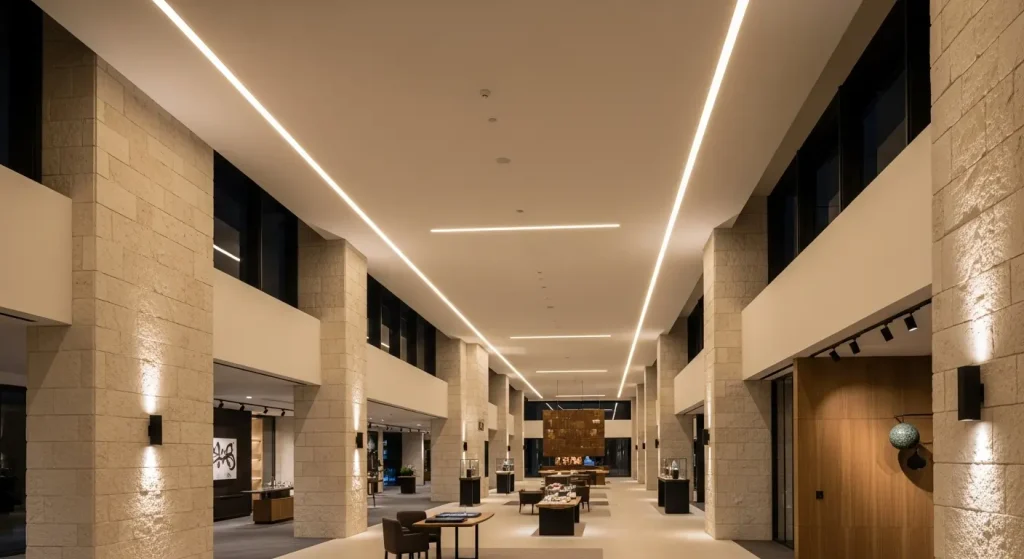
Modern commercial architecture increasingly prioritizes:
- Experience over illumination
- Brand narrative through atmosphere
- Human comfort and wellness
- Architectural expression through precision light
- Material storytelling using shadow, contrast, and texture
lighting institutions like ERCO emphasize that architectural lighting must align with spatial structure, materiality, and human perception—not just deliver lumens.
Reference:
Similarly, Zumtobel highlights lighting as a storytelling tool in retail, hospitality, and cultural spaces, shaping mood and engagement.
This article explores how Architect Design Lighting shapes modern commercial environments—including where it excels, how it differs from traditional lighting, and how to implement it effectively in real-world projects.
2. Core Concepts & Principles Behind Architect Design Lighting
Architect Design Lighting is fundamentally different from generic commercial lighting. Instead of focusing on fixtures, it focuses on how light interacts with architecture, materials, and human behavior.
Here are the core principles:
2.1 Lighting Must Align with Spatial Structure
In architectural lighting, luminaires are visually quiet. The light expresses form—not the fixture.
- Trimless recessed systems
- Minimalist linears
- Concealed coves
- Integrated slot lights
This “lights over fixtures” philosophy aligns with professional design practices taught by Signify Lighting Academy.
2.2 Layered Lighting: Function + Emotion + Direction
Architectural lighting requires layered composition:
- Ambient lighting — baseline illumination
- Accent lighting — emphasize merchandise, artwork, features
- Task lighting — functional performance
- Decorative lighting — identity, atmosphere, brand tone
Each layer supports wayfinding, comfort, and emotional mood.
2.3 Material Expression Through Light
Lighting reveals:
- Stone veining
- Wood grain
- Concrete texture
- Metal finishes
- Fabric detail
Beam selection, grazing, wall washing, and angle control play critical roles.
2.4 Contrast Creates Depth & Drama
Lighting contrast creates:
- Architectural rhythm
- Focal hierarchy
- Depth perception
- Emotional engagement
ERCO notes that contrast—not brightness—is the foundation of perception in architectural environments.
2.5 Emotion-Driven Lighting
In modern commercial spaces, emotion is value.
Lighting supports:
- Brand storytelling
- Hospitality mood
- Retail attraction
- F&B ambience
- Workplace calm
Architectural lighting is emotional design.
3. Where Architect Design Lighting Excels in Commercial Space Design
Architectural lighting is most effective in environments where experience, brand identity, and spatial quality matter.
3.1 Retail Stores & Luxury Boutiques
Retail lighting is strategic. It supports:
- Visual merchandising
- Customer pathways
- Product highlight
- Brand identity
Accent lighting E precision beam control deliver:
- Clean, focused highlights
- Better material rendering (CRI ≥ 90)
- Emotional contrast zones
- Dynamic window lighting
Zumtobel’s retail research confirms lighting directly impacts sales and dwell time.
3.2 Corporate Offices & Co-working Spaces
Modern workplaces demand:
- Visual comfort
- Low glare (UGR compliance)
- Human-centric lighting
- Flexible, layered illumination
Architectural lighting creates:
- Bright, uniform ambient zones
- Linear lighting for spatial rhythm
- Adjustable white light to support circadian well-being
EN12464-1 provides visual comfort guidelines for office lighting.
3.3 Hotels, Restaurants & Hospitality Projects
Lighting is arguably the strongest atmosphere creator in hospitality design.
Architectural lighting supports:
- Soft, ambient warmth
- Dramatic accenting
- Indirect light for intimacy
- Layered moods across morning, evening, and night
Cove lighting, grazing, and wall-wash bring emotional depth far beyond pure brightness.
3.4 Showrooms / Galleries / Exhibition Spaces
These spaces depend heavily on:
- Color accuracy (CRI 90–95+)
- Clean beams
- Tight cutoff
- Adjustable optics
Architectural lighting excels here by ensuring:
- Artwork integrity
- Product clarity
- Material realism
- Non-distracting fixtures
ERCO, a leader in museum lighting research, supports these standards rigorously.
3.5 Public Spaces — Lobbies, Airports, Cultural Venues
These areas require:
- Wayfinding
- Visual order
- Safety
- Spaciousness
- Architectural identity
Architectural lighting uses:
- Linear lines
- Perimeter illumination
- Grazing and wall-wash
- Ceiling-integrated luminaires
to enhance clarity, elegance, and navigability.
4. Key Technologies & Lighting Strategies in Architect Design Lighting
Below are the essential tools and techniques that define high-performing architectural lighting.
4.1 Precision Optics
Control over:
- Beam angles (10° / 24° / 36° / 60°)
- Beam uniformity
- Soft edges or hard edges
- Artifact-free illumination
Referenced by ERCO’s optics education pages.
4.2 Glare Control (UGR Systems)
Architectural lighting requires:
- Deep baffles
- Shielding
- Cutoff angles
- Anti-glare lenses
Low-glare systems reduce fatigue and enhance comfort.
4.3 Layered Lighting Approach
Architectural lighting is never one-dimensional.
A complete scheme includes:
- Ambient – functional baseline
- Accent – focal points
- Task – performance zones
- Decorative – brand personality
4.4 Lighting Integration & Concealment
Lighting becomes part of the architecture via:
- Slot lights
- Trimless recessed lighting
- Hidden linear cove systems
- Integrated wall details
- Indirect reflectance
This results in clean ceilings and architectural purity.
4.5 Material Lighting
Lighting interacts with materials in different ways:
- Grazing enhances stone texture
- Warm light softens wood
- Neutral-white enhances metal finishes
- Wall-wash reveals plaster details
4.6 Smart Controls (DALI, 0–10V, Casambi)
Smart controls enable:
- Scene presets
- Energy optimization
- Daylight harvesting
- Time-of-day mood shifts
DALI reference
4.7 Human-Centric Lighting (HCL)
Supported by global studies from Signify Lighting Academy.
HCL benefits include:
- Improved productivity
- Enhanced mood
- Healthier circadian rhythm
- Better overall comfort
5. Why Architects Prefer Architect Design Lighting
Architectural lighting offers a range of benefits unmatched by generic lighting solutions:
5.1 Creates a Premium Spatial Identity
Lighting shapes:
- Brand perception
- Space hierarchy
- Emotional tone
- Visual sophistication
It dramatically elevates perceived value.
5.2 Enhances Comfort & Usability
Low glare + layered lighting =
Better visual comfort in workplaces, retail, hospitality, and public areas.
5.3 Improves Navigation & Spatial Order
Light guides:
- Customer flow
- Staff pathways
- Focal points
- Entry thresholds
5.4 Supports Architectural Purity
By minimizing fixture presence, architectural lighting lets the environment breathe.
5.5 Delivers a More Refined, High-End Look
Uniform lighting + clean details + precise contrasts =
Spaces feel more elegant, modern, and expensive.
6. Limitations — When Architect Design Lighting Is Not Ideal
Architectural lighting has significant value, but not every project is suitable.
6.1 High Installation Requirements
Trimless recessed systems require:
- High-precision carpentry
- Structural coordination
- Skilled contractors
6.2 Higher Costs
Higher expenses come from:
- Premium luminaires
- Professional designers
- Smart control systems
- Advanced installation methods
6.3 Not Suitable for “Fast Build” Commercial Rollouts
Examples:
- Fast-fashion retail
- Budget chain restaurants
- Pop-up stores
These projects cannot justify extended construction or lighting integration.
6.4 Incompatible with DIY Lighting
Architectural lighting must be designed and executed by professionals—no exceptions.
6.5 Not Suited for Industrial Brightness Requirements
Architectural lighting focuses on:
- Precision
- Aesthetics
- Comfort
Not on:
- Massive lumen output
- Utility lighting
- Warehousing
IES industrial standards support differentiated approaches.
7. How to Implement Architect Design Lighting in Real Commercial Projects
Successful implementation requires a structured process.
Step 1 — Spatial Analysis
Understand:
- User flow
- Functional areas
- Focal points
- Ceiling conditions
- Daylight patterns
Step 2 — Define Lighting Strategy
Decide:
- Where ambient light is needed
- Where accent or grazing enhances experience
- Where task lighting is essential
- Where decorative lighting supports branding
Step 3 — Select Optics & Luminaires
Choose:
- Beam angles
- Temperatura di colore
- CRI level
- Anti-glare features
- Recessed or surface mounting
Step 4 — Material Interaction
Match light to materials:
- Grazing for stone
- Warm tones for wood
- Neutral tones for metal
- Clean wall-wash for plaster
Step 5 — Plan Control Systems
Determine:
- DALI
- Casambi
- 0–10V
- Scene settings
- Time scheduling
- Daylight integration
Step 6 — Mock-Up Testing
Architects must:
- Verify beam performance
- Adjust lighting ratios
- Confirm material rendering
- Refine positioning
This is a critical professional step emphasized by ERCO and Zumtobel.
Step 7 — Installation Quality Control
Ensure:
- Precise cutouts
- Flush details
- Correct aiming
- Scene calibration
8. FAQ About Architect Design Lighting
Q1. How is Architectural Lighting different from conventional commercial lighting?
Architectural lighting focuses on light design, not fixtures.
Conventional lighting focuses on achieving a brightness level.
Q2. Is this approach suitable for chain retail?
Suitable for high-end retail—not for budget fast-rollout chains.
Q3. What color temperatures work best?
Depends on brand identity and material palette:
2700K–3500K for most commercial applications.
Q4. Does Architect Design Lighting require high-end luminaires?
Not mandatory—but poor optics or inconsistent color will ruin the effect.
Q5. Can track lighting achieve architectural lighting?
Yes—especially in retail, galleries, and flexible commercial spaces.
9. Conclusion
Architect Design Lighting is not merely a visual component — it is a spatial experience system.
It excels by:
- Enhancing brand identity
- Elevating material expression
- Creating emotional atmospheres
- Improving user comfort
- Organizing space through light
It is most effective in:
- Retail
- Offices
- Ospitalità
- Galleries
- Public spaces
- High-end commercial environments
In modern commercial architecture, lighting is no longer about brightness.
It is about experience, narrative, and architectural beauty.
When executed well, Architect Design Lighting transforms spaces into immersive, memorable environments that directly influence behavior, comfort, and brand perception.