XHLUX
XHLUX
A pendant can look appropriate in a restaurant, hotel or office and still be incomplete as a project specification. The search phrase pendant lights commercial points to a commercial-use decision, not proof that a decorative product is ready for the required duty.
Use this page after the visual direction is chosen but before a family image, generic wattage or finish is released for quotation.
For current aesthetic directions, use the separate trends article:
→ Tendances modernes en matière d'éclairage suspendu commercial : ce que vous devez savoir
If the proposed product is a long linear pendant, start with the terminology guide:
→ Qu’est-ce qu’un luminaire suspendu linéaire commercial ? Guide du débutant
TL;DR : Specify the exact pendant, not a commercial-looking silhouette. Fix the target, photometry, glare control, suspension, canopy, driver, control, environmental limits, maintenance method and project evidence before approving the purchase order.
1. Define the job before selecting the form
“Commercial pendant” covers very different duties. A decorative fitting over a hotel lounge table, a linear row over office desks and a dome above a service counter do not share one optical or operational brief.
Start with the target:
- Horizontal task, display or dining surface
- Faces, merchandise, walls or signs requiring vertical light
- Circulation that must remain clear below and around the fitting
- Seated and standing observers who can see the aperture
- Screens, glass, polished stone and mirrors that may reflect it
- Operating hours, cleaning cycles and scene changes
Then decide what role the pendant plays. It may be the main task source, an architectural focal point, one layer within ambient lighting or a combination of those roles. Do not ask one pendant to provide general illumination, accent, task light and decoration unless the photometry demonstrates that it can.
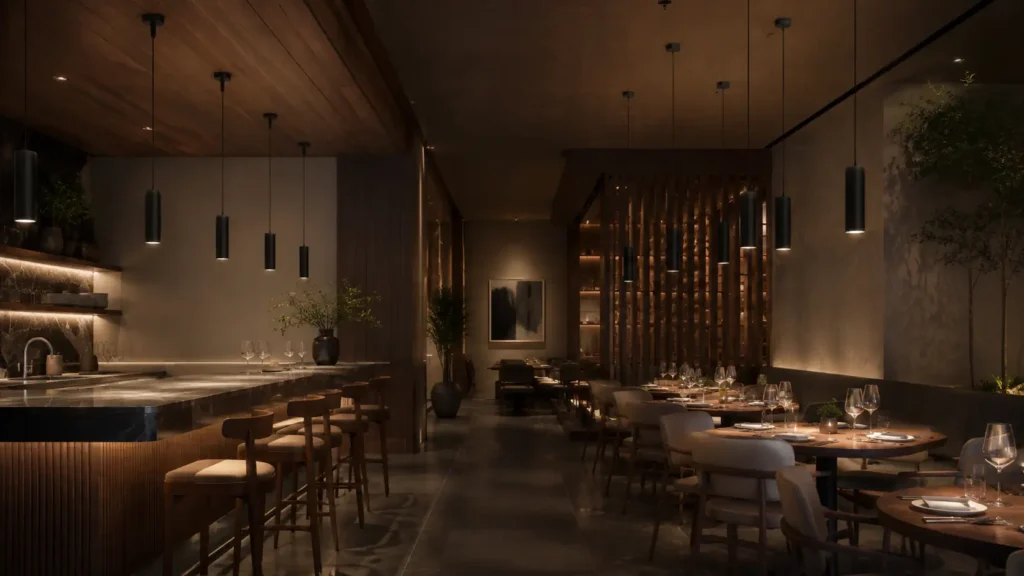
Pour pendant lighting for restaurants, separate table presentation from circulation, face lighting and after-hours ambience. A bright spot on the tabletop is not a complete dining-lighting solution.
🎯 Can appearance define the commercial duty?
No. Record the targets, users, operating pattern and visual role before selecting the pendant form.
2. Approve the exact photometric distribution
Wattage and lumen output do not show where the light goes. A deep reflector, diffuse globe, louvre, narrow aperture and direct-indirect linear optic can produce very different results from similar input power.
Request the IES or LDT file for the exact output, optic, length and diffuser. Test:
- Maintained illuminance on the required target planes
- Uniformity within and between pendant distributions
- Vertical illumination on faces, displays and surrounding surfaces
- Spill beyond counters, tables or reception zones
- Ceiling contribution from any indirect component
- Source visibility and reflected glare from normal views
Do not model one member of a family and apply the result to all sizes. Changing the diameter, housing depth, LED board, reflector, diffuser or suspension height can change the distribution.
ISO/CIE 8995-1:2025 treats indoor workplace lighting as a combination of light quantity and quality. That is a useful specification principle outside offices too: a calculated average value cannot substitute for distribution, glare and visual context.
🎯 Is lumen output enough to approve a pendant?
No. Verify where the exact optic sends the light and how adjoining distributions interact.
3. Check glare from every normal sightline
Pendant apertures sit below the ceiling and are often visible across a room. Lowering the source may improve task delivery while increasing direct view into the optic.
Draw sightlines from seated guests, standing staff, reception users, stairs, mezzanines and adjacent circulation. Check the underside, lamp or LED image, reflector, diffuser, louvre and end openings. Also inspect reflections in screens, glass, polished tabletops and mirrors.
CIE 117-1995 explains that discomfort glare depends on observer position and viewing direction. CIE 232:2019 addresses non-uniform LED sources for which average-luminance methods can underestimate discomfort.
For clusters and repeated rows, assess the group. One moderate source may become a field of bright apertures when multiplied through a restaurant or lobby. At low dimming levels, inconsistent drivers or LED boards can make the group appear uneven even if every fitting looks acceptable at full output.
The right shielding is application-specific. A translucent shade may reduce point-source contrast but create a large luminous area. A deep baffle may hide the source at high angles but narrow the useful distribution.
🎯 Does a diffuser automatically solve glare?
No. It changes luminance and distribution, so assess its apparent size, brightness and normal viewing angles.
4. Verify suspension, canopy and structure as one system
The pendant body is only part of the mechanical assembly. The specification should identify the canopy, suspension method, adjustment range, electrical cord, strain relief, couplers, anchors and permitted mounting orientation.
IEC 60598-1:2024 provides general luminaire safety requirements, but it does not approve a project’s ceiling substrate or choose its structural attachment. Obtain the exact installation instructions and coordinate the load path with the responsible project parties.
Check these interfaces:
- Structural attachment and maximum supported mass
- Cable, rod or chain quantity and spacing
- Canopy dimensions and compatibility with the junction or feed point
- Levelling adjustment and tolerance for multiple pendants
- Electrical cable routing without structural loading
- Sloped-ceiling or wall orientation where proposed
- Secondary restraint or seismic provisions where required locally
Products sold as industrial pendant fixtures may use a durable visual language without being approved for vibration, dust, heat, impact or demanding service conditions. Industrial styling is not an environmental rating.
The diagram separates the visible selection from the interfaces that must be documented.
🎯 Can a commercial ceiling grid carry the pendant?
Only when that exact grid, support and attachment are approved for the complete installed load.
5. Match controls, emergency functions and circuits
Fix the control method before ordering. A family may offer phase-cut, 0-10 V, DALI or other drivers, but availability does not prove compatibility with the project’s controller, sensors or emergency strategy.
The schedule should identify:
- Driver manufacturer and exact model
- Input and output limits
- Dimming protocol and minimum dim level
- Control zone and address where applicable
- Occupancy and daylight-sensor interaction
- Emergency supply, test arrangement and indicator location where required
- Access to remote drivers, batteries or control modules
Test a representative unit with the nominated control. Check starting, low-end dimming, flicker, shimmer, audible noise and consistency between multiple pendants. Decorative shades can conceal different internal drivers, so two matching bodies may not behave identically unless the electrical build is fixed.
Claims for energy-efficient pendant lighting need more than low input watts. Review delivered light, control strategy, operating hours, driver losses and maintained performance. A low-power fitting that misses the target or requires extra luminaires is not automatically the more efficient project solution.
🎯 Does a dimmable driver guarantee smooth dimming?
No. Verify the exact driver, controller, load range, wiring and minimum level together.
6. Match the product to environment and cleaning
Commercial interiors expose pendants to conditions that a product photograph cannot show. Restaurant grease, cleaning chemicals, dust, high ambient temperatures, air movement and frequent handling can change the suitable construction and finish.
Pour commercial hanging lights, confirm:
- Permitted ambient-temperature range
- Indoor dry, damp or other environmental classification as applicable
- Shade, diffuser and finish resistance to the intended cleaning method
- Openings that can collect dust, grease or insects
- Corrosion risk around kitchens, entrances and humid areas
- Cable, gasket and connector suitability for the declared environment
- Access without placing staff or furniture at avoidable risk
Do not transfer an IP claim from one component to the complete pendant. The installed assembly includes the canopy, feed, body, optic and joints. Local electrical and fire requirements still apply to the actual position.
Restaurant and hospitality projects should also approve a physical finish sample under the intended lighting. Dark paint, plated metal, glass and acoustic material can look different between batches and after repeated cleaning.
🎯 Does an industrial appearance prove harsh-duty suitability?
No. Environmental limits, construction, ratings and cleaning compatibility need documented evidence.
7. Plan maintenance before approving the purchase order
Pendant location affects every future service visit. A fitting over a bar, dining table, reception desk or stair may require furniture removal, access equipment or shutdown before a technician can reach it.
Ask what can be replaced:
- Lamp, LED module or complete light engine
- Driver, emergency module and control component
- Diffuser, reflector, louvre or decorative shade
- Suspension cable, cord grip, canopy and connector
- Finish-sensitive parts that must match adjacent pendants
Record the access method and replacement sequence. A replaceable driver provides little practical benefit if opening the canopy damages the ceiling or requires the full cluster to be dismantled.
For batch orders, approve tolerances for dimensions, suspension lengths, CCT, colour consistency and finish. Keep a spare-parts schedule that reflects the likely service life of drivers, optics and decorative components rather than relying on a generic LED package lifetime claim.
Before release, the purchase order should identify the exact body, optic, output, CCT, driver, control, suspension, canopy, finish, environmental limits and service arrangement. A family name alone leaves too many project decisions unresolved.
🎯 What should the purchase order freeze?
Freeze the exact optical, electrical, mechanical, finish, environmental and service configuration.
FAQ
Que faire ensuite ?
- Use the trends article linked in the introduction only for visual direction, not technical approval.
- Use the linear-pendant beginner guide linked there when the proposed product is a long linear system.
- Prepare one schedule that fixes the body, optic, output, driver, control, suspension, canopy and finish.
- Calculate the exact photometry and review a representative installed sample from normal sightlines.
- Ask XHLUX to review the complete project configuration, evidence and service requirements before an OEM or project-based pendant order is released.
Notes et sources
- ISO/CIE 8995-1:2025, Lumière et éclairage, Éclairage des lieux de travail, Partie 1 : Intérieur.
- CIE 117-1995, Éblouissement inconfortable dans l'éclairage intérieur.
- CIE 232:2019, Inconfort causé par l'éblouissement des luminaires à luminance non uniforme.
- CEI 60598-1:2024, Luminaires, Partie 1 : Exigences générales et essais.
- CEI 62722-1:2022, Performances des luminaires, Partie 1 : Exigences générales.
- CEI 62722-2-1:2023, Performances des luminaires, Partie 2-1 : Exigences particulières, luminaires à DEL.