XHLUX
XHLUX
Un led linear luminaire is a complete lighting product built as a long line—not a bare LED strip with a hopeful diffuser photo.
It must include the housing, optical system, electrical gear, mechanical joins and a defined mounting method that can be installed and maintained as one approved build.
For the deeper product-boundary essay—why a long light is still incomplete without those layers—use the guide de définition des luminaires linéaires. This page stays on definition plus install checks.
For basic commercial linear vocabulary, start here:
→ Qu’est-ce qu’un luminaire suspendu linéaire commercial ? Guide du débutant
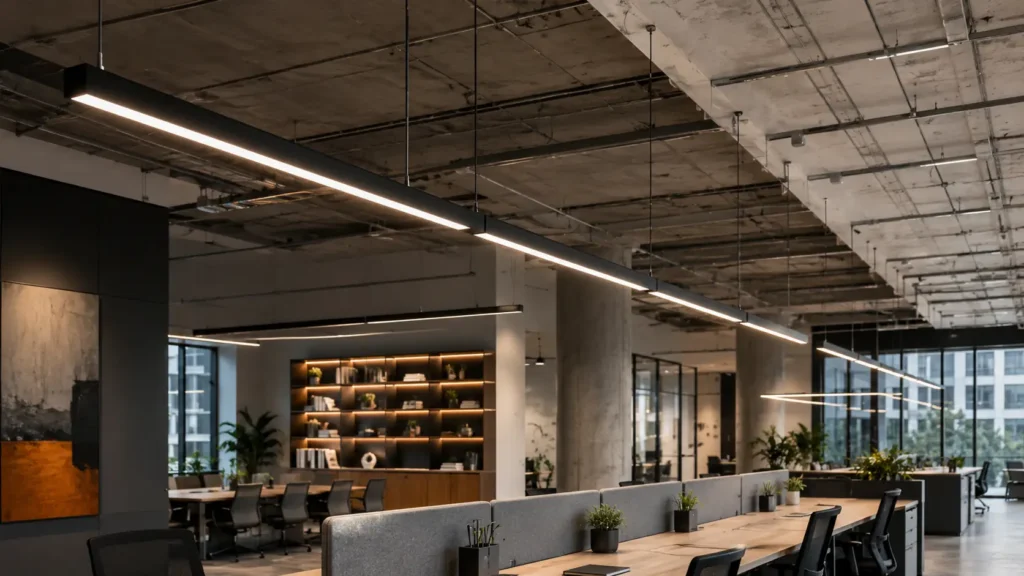
TL;DR : Treat “LED linear luminaire” as a system. Confirm suspension (or other mount), run geometry, joiner type and continuous-row control before anyone cuts or hangs. Do not install from a glowing-bar image alone.
1. What counts as an LED linear luminaire
A complete LED linear luminaire usually names all of the following in the submittal:
| Couche | What must be clear |
|---|---|
| Housing / profile | Length modules, finish, IP/IK if claimed |
| Light engine + optics | Output, CCT, beam or diffuser type, glare notes |
| Driver / gear | Location, dimming protocol, emergency if required |
| Joins and ends | Mechanical and optical continuity at joints |
| Mount kit | Suspended, surface or recessed interface for this SKU |
If any layer is “TBD on site,” you do not yet have an installable luminaire—you have a shopping sketch.
Office glare and task comfort still need occupied-layout thinking. Discomfort-glare practice in CIE 117-1995 and CIE 232:2019 applies once the build is real, not only when the bar looks slim in a render.
🎯 Is a linear LED strip already a luminaire?
No. A strip needs housing, optics, driver, joins and a mount kit before it is a complete linear luminaire.
2. How installation differs from “hang the bar”
Installation here means approving the interfaces that turn modules into a safe, serviceable line.
It is not a substitute for a licensed electrician’s wiring method, and it is not the deep suspend-versus-recess interface essay already published on this site.
Before site work, freeze:
- Mount path (suspended, surface or recessed)
- Module lengths and allowed cuts
- Feed positions and driver access
- Joiner family and end caps
- Control zones inside one visual run
Mount routing across suspended, surface and recessed paths belongs on the linear LED lighting systems overview for this topic family on this site (Page draft until that hub is live). Use that map when it is published; until then, keep the three paths separate on the ceiling section.
🎯 Can you install from length and colour alone?
No. Install needs mount kit, joins, feeds and access notes—not only a catalogue length.
3. Linear luminaire suspension mounting checks
Linear luminaire suspension mounting is more than picking a cable kit from a photo.
Check before hang:
- Rated suspension points and spacing for the housing mass
- Power feed cable path versus decorative suspensions
- Level tolerance over long sightlines
- Free space above for driver or remote gear if used
- Clearance to structure, sprinklers and services
Wrong drop height or centres shows up as sag, misalignment and glare long before lumen complaints. For how low is too low on suspended linear rows, use the live drop-height guide on this site.
🎯 Does any cable kit fit any linear housing?
No. Match suspension hardware to the named housing, mass, feed path and maker’s mounting notes—not a generic cable photo.
4. LED linear lighting runs and continuous rows
LED linear lighting runs are planned lengths with feeds, corners and service breaks—not a single metre count on a quote line.
Document for each run:
- Module schedule and cut rules
- Feed locations and maximum distance to gear
- Corners, T-joints and blank sections at doors
- Alignment datum for long open ceilings
Continuous row linear lighting means the visual line reads continuous. It does not automatically mean one driver or one dimming address.
Approve where the row may break for access, expansion or emergency modules without looking accidental.
🎯 Does a continuous look prove continuous control?
No. One visual row can hide several drivers or zones—schedule both appearance and control.
5. Linear fixture joiner connectors
Linear fixture joiner connectors carry mechanical load, electrical continuity and often optical continuity at the seam.
Before install, confirm:
- Joiner type matched to the housing family (not a generic “linear joiner”)
- Whether the joint is lit, dark or blank by design
- Locking method and torque or clip notes from the maker
- Whether the joiner can be opened later for service
A dark seam in a continuous row is often a joiner or diffuser mismatch—not a missing watt of LED.
🎯 Can you mix joiner brands on one run?
Not as a first plan. Stay inside the approved housing family unless the project engineer signs a tested exception.
6. Install sequence checklist (before power)
Use this order on drawings and at delivery—not as a DIY wiring manual.
- Confirm the product is a complete luminaire (all layers named).
- Freeze mount path and structure fixings.
- Dry-lay modules, joiners and end caps on the floor or bench.
- Mark suspension or surface points from the approved layout.
- Hang or fix housings level; install joiners as the run advances.
- Place drivers and feeds where they remain accessible.
- Fit diffusers only after mechanical alignment is accepted.
- Energise and dim only after inspection and circuit checks by the qualified party.
For recessed profile channels, the live profile pre-install checklist is the deeper cut-before-open guide. This page stays on luminaire-system install checks across mount types.
🎯 When is an LED linear luminaire ready to energise?
After mechanical alignment, correct joiners, accessible gear and qualified circuit checks—not after the diffuser simply clicks in.
What to verify before install: priority chart
The chart below ranks checklist weight—not product scores.
FAQ
Que faire ensuite ?
Name every luminaire layer on the submittal. Freeze suspension or other mount details, run geometry and joiner type. Dry-fit a joined sample before the ceiling closes.
For project LED linear luminaires, XHLUX can review suspension mounting, run schedules, joiner families and continuous-row control notes before production.
Notes et sources
- CIE 117-1995, Discomfort glare in interior lighting — used for occupied-layout glare checks once the linear build is real (plain-text citation; no outbound link).
- CIE 232:2019, Discomfort caused by glare from luminaires with a non-uniform source luminance — used with CIE 117 for indoor linear systems (plain-text citation; no outbound link).
- Project Serper PAA for
led linear luminaire(2026-07-08) — FAQ from primary-keyword pool; secondaries had 0 PAA rows. - Project-specific electrical, structural, fire and accessibility rules remain applicable. Confirm local requirements before installation. Qualified electrical work must follow local code.